
How to be more Effective.

One of the dozen topics I have written on over the past five years is how to be more effective. You can access all the best pieces in section 4 here: https://rishadtobaccowala.com/100
The 3 keys to being effective are 1) leveraging the only asset one has which is time, 2) making sure that every interaction has the ability to be a tattoo moment, and 3) soaring through feedback.
1. Time is the essential asset.
Franz Kafka wrote “The meaning of life is that it stops”.
How we spend our days is, of course, how we spend our lives wrote Anne Dillard.
Tell me, what is it you plan to do with your one wild and precious life? asked Mary Oliver
Life is a journey through time in search of meaning.
A definition of success is the ability to spend time in the way that gives one joy.
To understand what is important before it is too late.
Successful firms and people use time differently than others.
Four behaviors/beliefs that are common to most successful individuals and firms:
The Power of Compound Interest/Compound Improvement: The most powerful concept in gaining wealth or knowledge is continuous growth over a sustained time period.
See early what others see late: Almost every successful person or company recognized a trend when it was a little stream rather than a gushing river and then committed to align with it.
Persistence: They just keep on going through adversity and setback and they remember Queen Elizabeth the First who said “Time dissolves more problems than man solves” or “that persistence isn’t just continuing to try— it is the runway that gives your talent time to take off.”
Focus: The key to effectiveness is to focus. Here are two filters on how to focus:
a) Comparative Advantage: We should spend our time doing things that we can do better than most people. Some focus areas are easy like being a spouse or a parent, since by definition we should be able to do this better than other folks. However, for many of the errands we run and the assignments we take on at work, it is important to ask if we can outsource or delegate or find a colleague who is better than us so we can focus on what we are best at.
b) Positive Outcome: We should try to choose how we spend our time in ways in which we create a positive outcome. Either we 1) earn a financial reward, 2) learn something new, 3) help someone else or the team get better or 4) the experience in itself feels good.
2. What one should bring to an interaction.
There are a lot of books and articles on meeting management and how to get the most out of gatherings.
Most of them are utter and complete BS because they all focus on how you can get the most out of an interaction, while the focus should be how can you give the most in an interaction.
If you go to a meeting with an “extraction” mindset versus a “giving” mindset you are likely face several problems including a) missing meetings where you may have been able to share your knowledge and therefore build goodwill b) become so focused on what you are looking for that you do not discover what you need.
Instead go to the meeting with this:
a) Generosity.
How can one leave the person or the people whom one is meeting with or presenting to with a gift?
Knowledge. Appreciation. Guidance. These are three ways to bring generosity to an experience.
b) Empathy.
How can one truly understand the other persons perspective and point of view because in doing so one will grow even if we might disagree with their perspective or view.
c) Attention.
When we have a great interaction, we feel that the person talking to us is paying attention to us.
They do not appear distracted looking away at some screen or signal they are participating grudgingly in the interaction. They are there in body and spirit.
People watch for tone of voice, facial expressions, and small gestures rather than one’s physical presence if one is paying attention paying attention.
While these are what you bring to a meeting ideally you want people to leave the meeting with these:
a) Clarity.
In a great interaction or meeting people come out with a clearer understanding of a situation, with greater precision of knowledge, and clear-cut next steps than before the meeting or interaction.
b) Belief.
It is one thing to be clear as to what must be done next but as important is to leave an interaction with a greater belief in your or your team’s ability to do what is necessary.A key is to leave someone feeling better about themselves after you meet them rather than worse even if you provide them with less than positive information by showing how you or another individual tackled the same problem, reminding them of the times they recovered when they were knocked back by a challenge or sharing your individual stories of tackling similar situations.
c) Energy.
We are living in a time of great change, accelerating velocity of business and multiple pressures.
This is leaving people often drained, burnt out and wanting to just curl up under a blanket from the noise and tension.
Great interactions leave people rejuvenated, replenished, and refreshed.
While clarity is about the mind, belief about the heart, energy is about the body.
Bringing energy to a meeting can boost others. Energy is contagious
The ideal interaction is a TATTOO interaction in that it so impacts people that they remember it for years. Read Tattoo Moments.
3. Feedback
To grow one needs to continuously improve.
A key ingredient to improvement is feedback.
Feedback however is both difficult to give and receive.
The six steps to giving better feedback.
Best practices suggest that there are six approaches that can help people give and accept feedback:
1. Focus on how the task or the process could have been improved rather than criticize the person: By focusing on how an assignment could be done better the emphasis is in on the product and not the person.
2. Compare the shortfalls to a higher standard that might have been met on another project or another time: By recalling assignments or times where the individual or team did a great job, one reinforces to the person or team that they are capable of having done better. The emphasis is on what was less than ideal on this occasion versus rather than believing the individual or team is incapable of doing a good job.
3. Be sensitive and aware of extenuating circumstances: We all have bad days and many times these are a result of something else distracting us or worrying us in our lives. It may be illness, family issues or other challenges. By empathizing with an individual and wondering if there is a reason quality has slipped indicates both concern and humanity.
4. Provide input as specific as possible as to what could be done better: Pointing out what went wrong or was less than optimal is only one half of feedback. The more important half is showing or teaching or guiding on how one can improve. Identify either steps or training or changes that need to be made.
5. Identify the next opportunity or project for a do-over or try another take: By showing both how one can improve and then identifying an upcoming opportunity to put the feedback to work concentrates the mind and channels emotions to action and the possibility of correcting the shortfall.
6. Provide personal help and perspective: If feedback is provide with examples of how the person providing feedback or other leaders have learned and improved, it signals that mistakes, mess-ups, and other shortfalls are par for the course in career growth. By also asking how you can help reinforces that you are on the persons side and are committed to building them to be better versus tearing them down.
Three ways of ensuring one is getting feedback
While we learn how to give feedback and not be scared of receiving feedback, how can we ensure that we get feedback?
1. Scan for signals: People are constantly providing feedback even if they are not vocalizing it. In some instances, you may gauge it in numerical signals from how well your writing is read, reacted to, or shared or whether you are invited to key meetings. Other times it is to watch facial and body language. You learn a lot by reading a room or a Zoom gallery.
2. Ask for feedback on a regular basis: One can do this with three simple questions framed in ways that ensure people are comfortable helping you since they are positive in tone:
a. What worked well?
b. If/when I do this next time what could be better?
c. Who do you think does what I need to do well and where can I learn more?
3. End of Day or Week Self Review: Most people know in their gut what worked or went well and what did not. Many successful individuals end the day or week with some variation of a quick three step review :
a. The Work: What went well with my work product that I feel proud about and what could have gone better?
b. The Team: What felt good and productive in the way I interacted with people and where could I have been better in some ways in handling my or someone else’s emotions.
c. The Improvement: What little improvement did I manage to make today or this week? A new habit. Learning a new approach. Strengthening a relationship.
We get better not by being better than other people but aiming to being better than we were yesterday. Every day.
To do so it is critical to help our teams and ourselves with feedback.
Spend an hour reading Section 4 here and become more effective tomorrow .
Check out the Rethinking Work Show. Every Wednesday on YouTube, Apple and Spotify. People pioneering the next generation of work while so many companies are are lost and looking in the wrong direction! The future is here and you can get a first look by subscribing at RethinkingWork.io. Its full of insights and free of any cost or ads.

Managing Careers.

Image using Midjourney
This 260th edition of “The Future Does Not Fit in the Containers of the Past” marks its 5th year anniversary ( 5 X 52= 260).
Over these past 5 years the content has spanned a dozen different topics including The Future, Managing Change, Creating Great Cultures and Future Forward Organizations, Leadership, How to Upgrade Our Mental Operating Systems, Strategy, Rethinking Media, Marketing and Creativity, Selling Better, Personal Growth, Wisdom, and Managing Careers.
The Substack has remained completely free and has grown from 100 to nearly 31,000 readers. Starting today, I will revisit each of the 12 topics combining the key points from the past with some new thoughts.
Today we begin with some thoughts on Managing Careers.
1. Plan Careers with a 50 year horizon.
With life expectancies nearing the mid-eighties, social security being pushed back and most people enjoying good health till the mid seventies, it is unlikely that we will be parked on a beach when we near sixty. And even if we do not have to work for financial reasons we will do for reasons of meaning, connection and growth. Thus if we are in our 40’s we have three decades ahead of us so it is never too late to learn new things and start again and if we are in our 20’s or 30’s we should try not to get hysterical or depressed about a lost business or a bad quarter.
Rather, we should not make job or career decisions with three month horizons but at least three year horizons. Ideally one should stay in a company as long as one is finding ways to grow. With time in a firm one builds relationships, reputation and acumen. Avoid switching from something that is working just because more money is offered unless we have financial stress. Remember that often the grass is greener on the other side because it is fertilized with bullshit. Wherever there are people there is drama and nonsense . By taking a longer term perspective our decision making will be better, our skills will mature, and we will take daily and weekly gyrations in perspective.
2. Having a job and having meaningful, purposeful, rewarding work are not the same thing.
We are likely to see a decline in jobs but an increase in the opportunity to find work.
This shift is already underway as full-time employment in a company via holding a job is being supplemented and complimented by part-time well paid opportunities outside holding a job. Every force from unbundling of the office, the rise of AI, the explosion in marketplaces such as Shopify, Etsy, Upwork and more will further drive this change.
Thus a career is a “career of work” and not a “career of jobs”. It is a “working” career not a “jobbing” career. We must prepare for a career that combine a series of jobs and gigs and projects, sometimes serially and often in parallel.
3. The people you work with and for are more important than most other things.
When given a choice between someone who could mentor us, teach us or help us grow versus a higher salary or a better known company we should go for the former. Our skill growth, our work satisfaction and our future potential are highly driven by the people we work with rather than the company we work for.
The ideal is to find a great person or team to work for in a well regarded company or to find your way to these leaders and teams.
To grow we must align with people who can help us grow.
This is particularly true in the first two decades of our careers.
4. Be data and reality driven.
Money never comes accompanied.
Whomever pays us expects we will deliver a quality product or service at a market competitive or even under market price. We are a unit of production that can be replaced by another unit of production that offers more for less.
Nobody is irreplaceable and beyond a point our personal drama is friction and heat and considered a hindrance so pouting and bad mouthing should be kept to a minimum if one wants to stay in an assignment.
Work is not a spa and there is a reason one is being paid.
It is a tough and fast moving marketplace. And change is so difficult because we have to constantly adapt and learn and twist ourselves into new shapes. This is harder the more senior and accomplished we are in a firm.Change sucks but irrelevance is even worse.
Facts matter. Truth has a habit of breaking in. Reality matters.
The market, the company and the future will never adapt to us. We have to adapt to it.
5. Learn to operate with “a company of one” mindset to maximize our optionality.
The best way to control our careers is to have options. There are many ways to increase our optionality.
The most powerful is to have “a company of one” mindset even if we are working for a company of thousands. It’s a way of being and operating and behaving. It is not necessarily about having to set up shop as a company of one.
To operate with “a company of one mindset”we need to combine craft, collaboration, reputation, and make investments in our own growth while keeping our costs under control.
It is key to work really hard at honing a craft, expertise and skill that the market is demanding since that is what people are buying. Second it is critical to be very collaborative since it is teams and network that make work happen. Individual contributors will be isolated without also being collaborators. The third is to build a reputation so people will think of and call us when there are opportunities inside or outside the company. Next, invest in our own growth program. Do not only depend on your future learning on the company for two simple reasons. First, they will invest to teach us what they need but that is not what the market might need. Second most companies are barely investing in training these days. We ourselves should subscribe to the latest and greatest AI engines, communities and much more. It is our career not theirs.
Finally to increase our options we should not price ourselves out of our dreams. Keep costs as low as possible so we do not have to keep working at a job we dislike to pay for things that impress others versus something that gives us purpose, meaning and joy.
The goal is to craft expertise, earn a stellar reputation, practice a growth mindset and build a fortress balance sheet so we have the option to walk away anytime people try to control us or make us feel less.
The option to walk away does not mean we should. In fact the option allows us to stay and deal with the drama and find ways around the problem. When we feel we have optionality outside we can stay in a company for much longer than if we did not.
Optionality is true power that comes from a Company of One Mindset.
6. Invest in the 6c’s to Future Proof.
The world keeps changing and technology is replacing a lot of knowledge, experience and even some skills ( from translation to coding).
Now the ability to learn, to grow relevant skills and expertise and to bring insight and crystalized intelligence (wisdom) to the task at hand is what matters.
Here are six skills we should work at that will stand the test time. They are the 6c’s : Cognition, Creativity, Curiosity, Connection, Convincing, Communication
Cognition: We need to upgrade our mental operating system which means unlearning and learning is key, particularly the more senior and accomplished one is. Today careers die when we stop learning. Clear an hour in every day to learn ( take it from anywhere but sleep and family). If you do not have time to learn be aware that we are becoming irrelevant.
Creativity: Creativity is an expression of self and a way to connect dots in new ways. To do so we need to combine our past and our futures, hone our voice and taste and bring our insights, intuition, instincts, imagination to the knowledge and processing bases of AI
Curiosity: Lets ask two questions as often as we can. Why not? What if?
Connection: The ability to connect and resonate with other humans, other firms, other expertise means we will need to hone our API’s and MCP’s ( Machine Context Protocols) but also our empathy and vulnerability.
Convincing: In a world where everybody has the same knowledge bases since AI will be like electricity , a commodity that we will all use, what we will need is the ability to story tell, inspire, and motivate.
Communication: When a Samsung phone can translate Mandarin in real time and coding will need English ( or our native language) the old advice of learning Chinese and Coding may be less relevant. Learning to write well and present to hold a room are skills that will help us thrive.
7. Practice Resurrection
Even if we are amazingly successful, we may find ourselves kicked to the curb, right sized, passed over for the promotion, layered, denied the prize, removed from the business, or marched out of an office…
The world will seem to end. Our self worth crushed. The story sullied. Our reputation tarred.
But we must practice resurrection
And rise like a Phoenix.
For in the ashes of our setbacks are the seeds of learning that will help us take flight again.
Ask anyone with great achievements and they will tell us how the stops at failure made their journey more successful.
8. Keep things in perspective.
Work is central to human satisfaction and happiness because it provides us not just income but also identity, community, purpose and growth.
We need to work seriously and with passion to excel.
But relationships and health are the other keys to happiness and very few people you work with will be at your funeral.
Notice how people who have lost a position are surprised that they are no longer popular. The reality often is people were not interested in the person but the Company and Client they worked at or budget they controlled.
So we should chill about our supposed fame, popularity and clout.
It will be gone and one day we will need to be by ourselves.
Time rather than money is the only real currency we have.
Many people will run out time long before they run out of money.
For many people work is a key part of a good life.
But there is much more than work to a great life.
Much more on Managing Careers in Section 6 here :https://rishadtobaccowala.com/100 and in Rethinking Work that is unleashing people and helping prepare for the future at Rethiningwork.io


The Future of Work = Less and More.

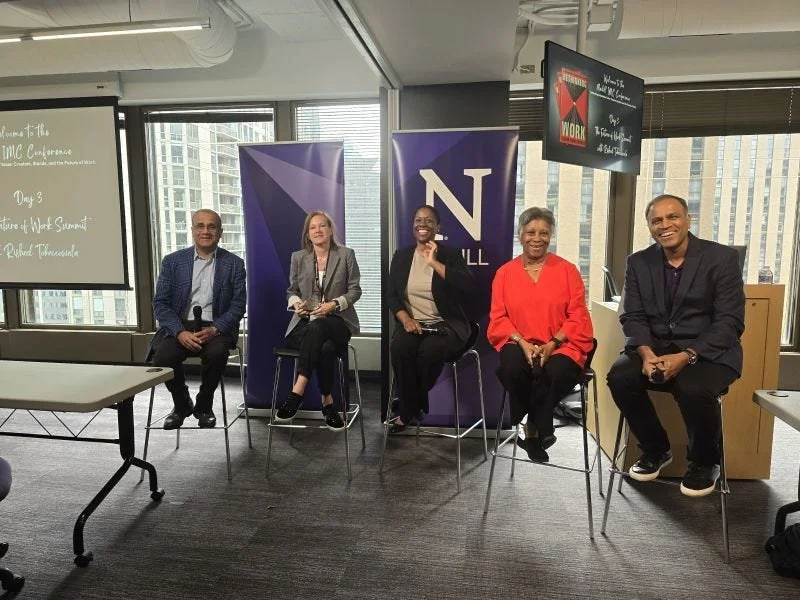
( View from downtown campus of Northwestern University Medill School.)
The Future of Work Summit by Northwestern University’s Medill School in Chicago was held yesterday (Saturday, July 26 ) and brought together dozens of leaders from Industry, Start-Ups, Academia and much more sharing and discussing how to thrive in the new world of work.
It was honest and open discussion. Nobody was there to sell tools, technologies or their company. The conference included CEO’s and students, VIP’s and people in transition, seasoned veterans and just out of school folks.
Here a a few points of discussion which many in the work force might find compelling.
Note this is very small fraction of of the points discussed.
Here is a link to the Agenda to see the range of topics and guests.
Less Employees.
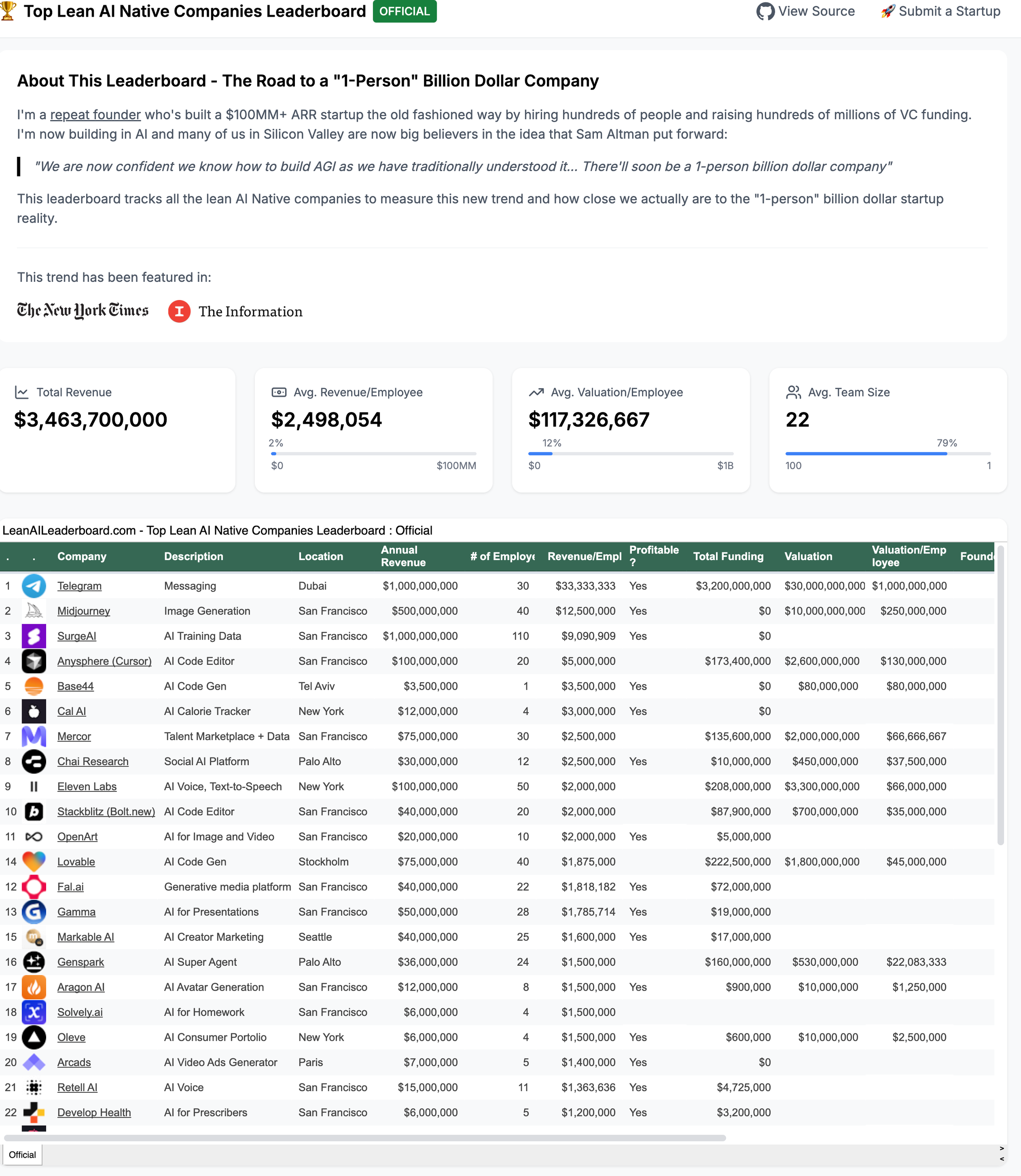
Once upon a time the number of employees had in a firm was a vanity metric
Now it may be a sign of bloat
The new metric is revenue per employee
Here is a chart from Leanleaderboard.com (see above) showing that the revenue per employee which is just under 2.5 million dollars per employee.
The most successful marketing services company today has revenue of about $200,000 per employee.
Less Scale.
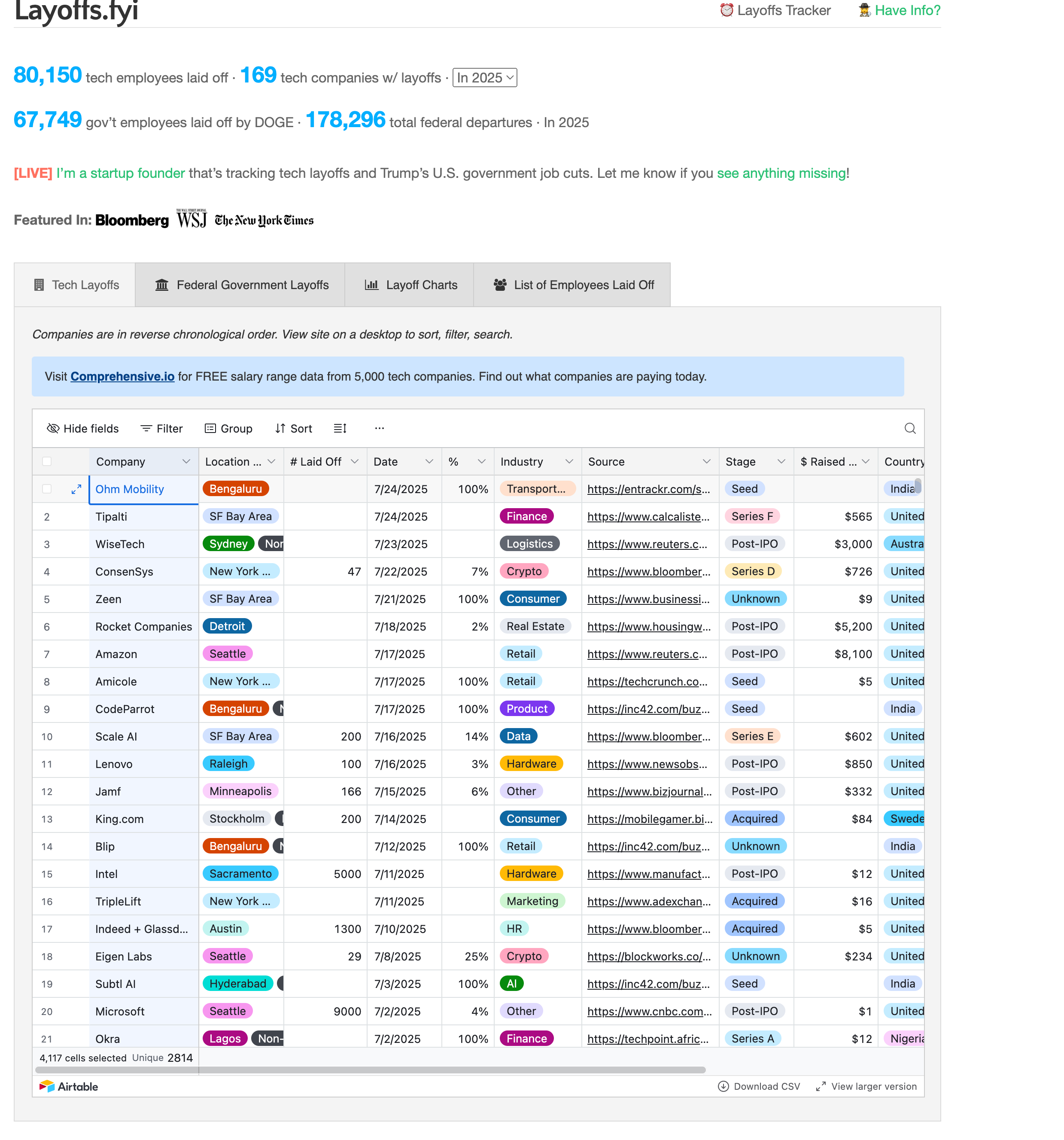
Tech companies are now past peak employment
This year they have laid off 80,150 workers while 178,296 Federal employees have been laid off this year according to Layoff.fyi
Satya Nadella the CEO of Microsoft just sent a memo to the entire company which is a must read. Here it is: https://blogs.microsoft.com/blog/2025/07/24/recommitting-to-our-why-what-and-how/
He address the enigma of a company laying of 9,000 plus employees when every financial metric is moving upwards to the right.
You should read the entire note but here are the key paragraphs:
We must reimagine our mission for a new era. What does empowerment look like in the era of AI? It’s not just about building tools for specific roles or tasks. It’s about building tools that empower everyone to create their own tools. That’s the shift we are driving—from a software factory to an intelligence engine empowering every person and organization to build whatever they need to achieve.
Just imagine if all 8 billion people could summon a researcher, an analyst, or a coding agent at their fingertips, not just to get information but use their expertise to get things done that benefit them. And consider how organizations, empowered with AI, could unlock entirely new levels of agility and innovation by transforming decision-making, streamlining operations, and enabling every team to achieve more together than ever before.
The mission has changed.
These tools being built by Microsoft, ChatGPT, Adobe, Salesforce, SAP and many big companies but also by many new companies will give every David and Danielle the power of Goliath
Technology is the slingshot that allow each talented person to catapult themselves into the future and for companies starting today to start with a clean sheet of paper to combine not just AI and modern technology but but leverage the best talent from all over the world…
Less Space
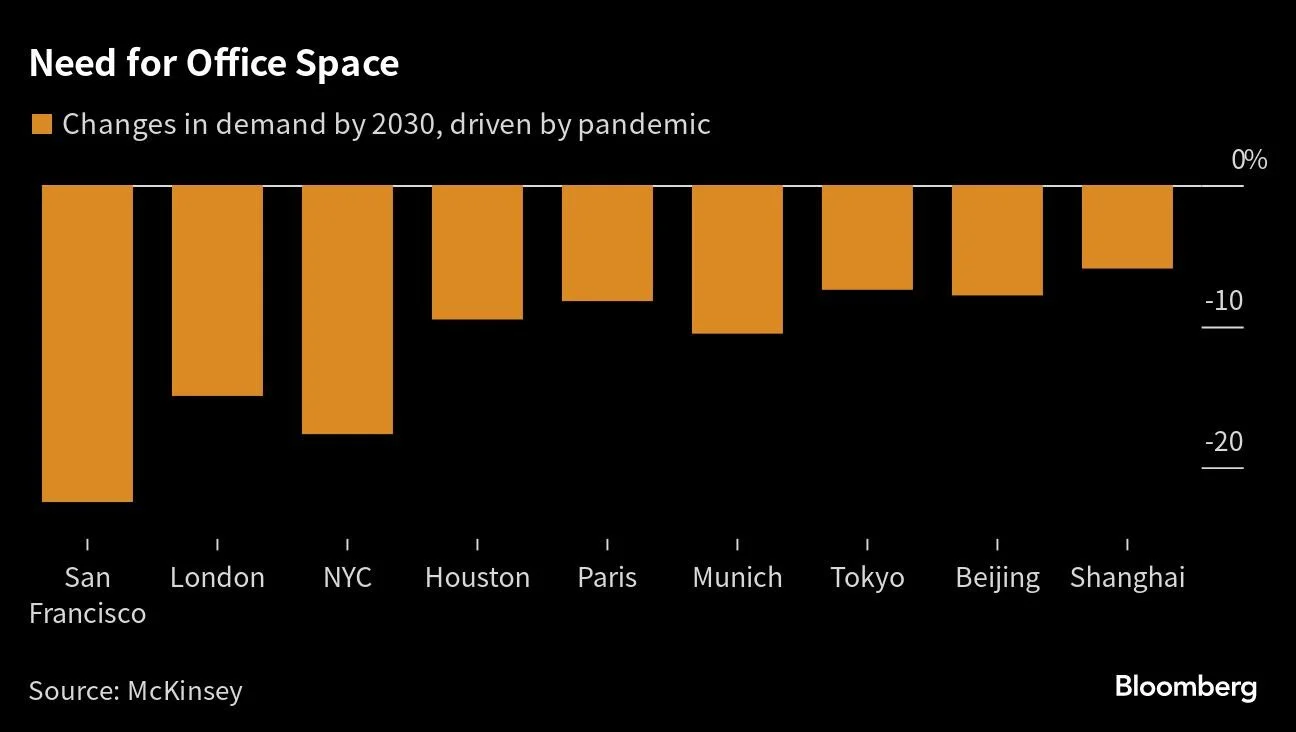
Even companies mandating five days back to the office are significantly reducing their real estate foot print since most of these companies are expecting attrition due to the forced mandate and are making exemptions for 25% of their employees who have contracts or are too valuable to lose.
Every smart CEO knows that limiting their talent to certain geographies and loading up on expensive real estate just when speed, agility and low cost are imperative makes no sense.
Work is distributed and more and more people will work from anywhere and there will be less and less office space.
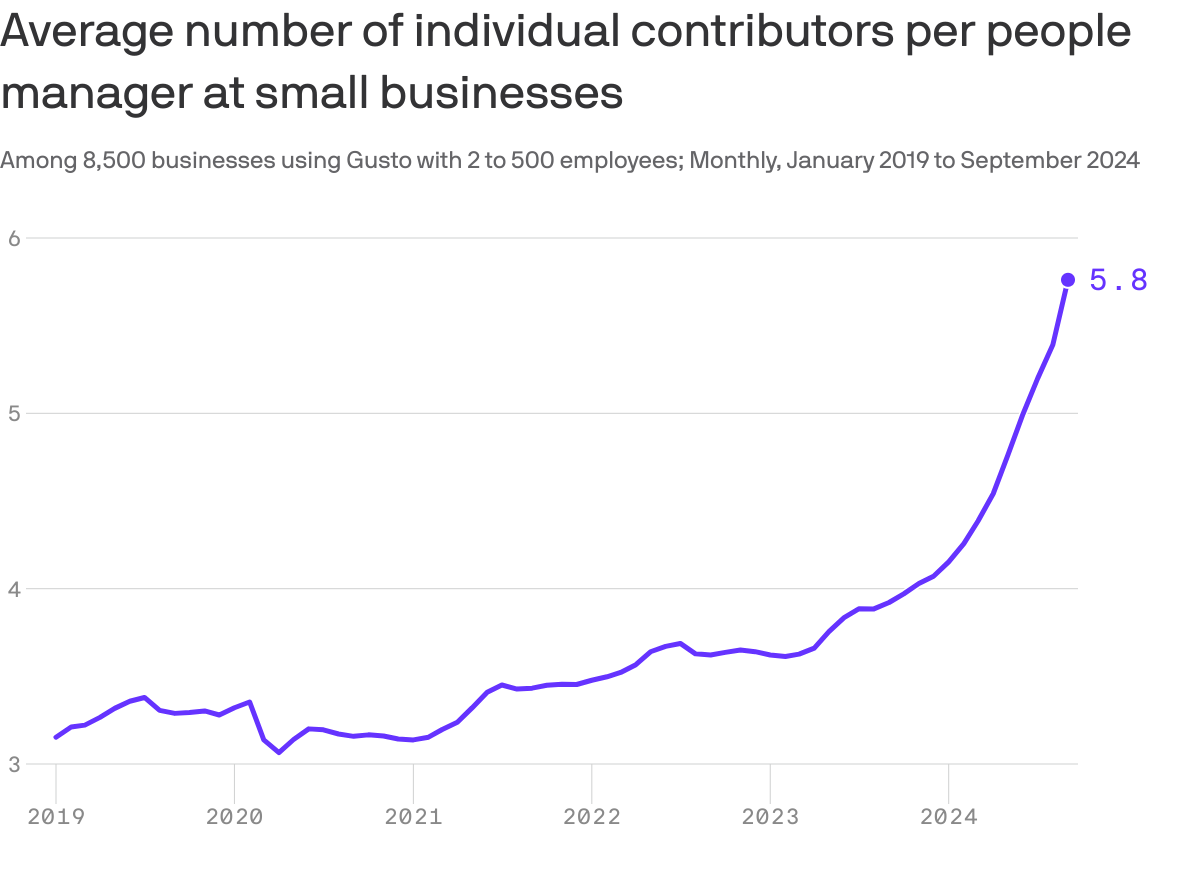
Less Managers
As the world moves from vertical to matrix to networked eco-system and work is increasingly done in asynchronously by distributed workforces the need for old style managers who allocate, delegate, monitor, measure and check-in is in free fall. Companies want people who create, build, sell, mentor, make, inspire.
Small companies were already doing this as the chart above shows and now large companies are.
The Great Flattening is real.
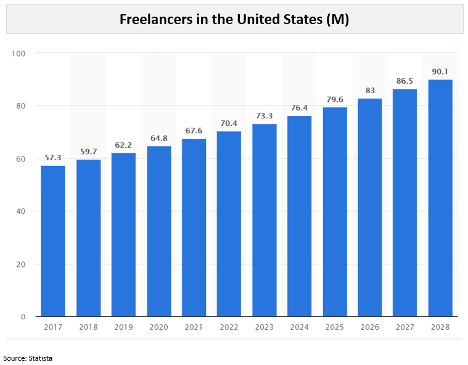
Less Jobs
The biggest fallacy is equating jobs to work.
We are moving to a world where there will be fewer full-time jobs but more and more work to be done
Globally 39% of jobs are part-time or free-lancer.
Rather than job descriptions the key is to understand the skills needed and how to train for the expertise.
To be work focussed versus job besotted.
To many companies are architected around jobs versus work.
More
But for companies and individuals willing to learn and re-invent the future is brighter than ever but it will require the following recognition:
a) More Speed: The speed of change is so fast that doing is critical versus cogitating. Fast failing versus navel gazing. The fear of failure has to be reduced.
b) More Non-AI Differentiation: While AI will be key it will be like electricity. Key to compete but not a differentiating advantage. The firm will have to find more edges than AI.
c) The More AI the more HI will matter: AI will replace a portion of many jobs and do many tasks better. People will have to embrace, adapt and complement but humans and talent will be the edge. It will he AI+HI versus only AI or HI.
d) More Investment for Training: One of the key differences will be training and developing people. Investing in AI tools and doing M and A deals without a significant investment in education and training is doomed. As half life of knowledge declines up skilling of expertise is key. Learning will be the new superpower. But today most companies invest less than $1000 per year per employee.
e) More Opportunities: Power is moving to small and talent. This year six million new companies were launched in America all starting with a blank sheet of paper, easy to purchase AI, access to market places for every type of talent and buyer. For every whale there will be thousands of planktons.
f) More Courageous Leadership: Like never before this is the time for more courage and more willingness to reinvent. Leadership will be key. Companies will need to get unstuck by overcoming fear, urgently ending inertia, crafting an ability to bring the outside ( outies) point of view into the inside leadership (innies).
g) More Versatility: Different types of go to market models as well as different approaches for different types of talent. Companies cannot talk about personalization if they do not create different options for their employees and agile and differing organization structures built around client, talent and market competition.
h) More Trust and Integrity: Trust and Integrity will be key both for Brands and leaders. ( Funny how the companies that speak about trust and integrity are monitoring and scanning key badge entries and need to helicopter parent their staff)
i) More Career Ownership: Every individual must invest and take care of their own career. While HR and L&D are critically important enablers to career growth they work for the company and each person must take control of their own careers.

Human in an AI Age: Grace

This is the third of a series on Human in an AI Age.
The first post Roots and Wings reminded us that humans are a unique combination of memories and dreams, of what we were and what we are becoming. Roots and Wings is about our distinct journeys that define our humanity. The post illustrated how the roots and wings approach can help us connect and resonate in an AI age.
The second post Voices reflected on the combination of creative expression, taste, curation, connection and inspiration that is each persons unique voice which will keep us distinct and adding value in an AI age. Voice is about the idiosyncrasies that make us. The post suggested ways we architect, hone and sculpt our voice.
This third post builds on our state of unique becoming ( roots and wings), and what makes us distinct (voice) to introduce the concept of a way of being that is uniquely human: Grace.

Grace.
Think of the people we admire, respect and aspire to emulate.
Initially it may be the rich, the successful, the uniquely talented, the beautiful, the brilliant and the powerful.
Money has declining returns beyond a certain point of accumulation. Success comes and goes. Talent may shrivel. Beauty withers. Power ebbs. Time laughs and overcomes all.
Looking for contentment and freedom we often find people of grace.
While grace is often linked to the divine and is incorporated into many of the great religions it is not limited to these spheres.
A person of grace tends to combine the elements of dignity, humility and generosity.

Dignity.
Dignity is the right of a person to be valued and respected for their own sake, and to be treated ethically. It is of significance in morality, ethics, law and politics as an extension of the Enlightenment-era concepts of inherent, inalienable rights. The term may also be used to describe personal conduct, as in "behaving with dignity" (Wikipedia)
The Dignified are not just graceful in bearing but treat everyone with dignity.
They understand the importance of of being respectful of what has gone before and tradition even when challenging the status quo.
These individuals do not look down on others and are aware that those in need or on the outside could very well be themselves under different circumstances or on another day.
They treat others as humans with great potential that are working to overcome confusion and complications.
To be human is to recognize the dignity of every human without the badges of power, money and fame. To respect the non-quantitative, to give weight to what does not compute, to bet on what might be versus what there is.
AI might struggle to be dignified.

Humility.
To be humble is to not lose one’s sense of perspective.
To understand that achievement while significant is often due to a combination of many factors including luck, opportunity, inheritance, and the specific time and not just one’s skill and hard work.
To not gloat in victory but to be circumspect and keep a sense of decorum.
To remember the line from the great 17th Century poet John Donne:
“never send to know for whom the bell tolls; it tolls for thee"
We are all part of the same human experience and often the same industry and if too many competitors are going under it cannot behoove well for our own future or future of our industry.
AI may not understand humility given it lives forever and expands its capabilities exponentially.

Generosity.
In the world of business and technology it is important to monetize, gain market share and scale. To optimize for efficiency and effectiveness. To battle and to win.
But often a zero sum game shrinks everybody.
Abundance may also be a part of the approach.
A CEO shared a story about how a poor family of immigrants stopped to help someone who had a flat tire in bad weather. After the tire was changed, the individual offered money to the family. They turned it down saying “Today it was you. Tomorrow it might be us.”
Sooner or later, everybody finds themselves needing help and depending on acts of generosity. It might be some form of aid, guidance, a person to talk to who will listen, a leg-up or sometimes gently delivered difficult to hear advice.
By being there and helping when someone is in need ensures good “Karma.”
If what goes around comes around it may make sense to send good stuff people’s way.
Generosity makes for a better life for not just the recipient but also to the giver.
If strategy is future competitive advantage, generosity is smart for individual or company strategies.
Generosity builds good will which is both an asset and a moat.
It is an asset in that it can be tapped in the future.
It is a moat because when an individual or a company has been generous in times of trouble their employee or customer are less likely to switch to a different firm for a lower price or higher pay.
Generosity is also a key differentiator in that usually when a person or firm needs help there are few people willing to help someone out of power or in trouble. Those individuals and brands who do help stand out and their showing up and helping when others are not burns into the emotional and mental memory of the recipient.
Emotional connections are harder to sever or replace than financial connections.
AI may not feel that.
AI is still under-hyped. It is changing the world and unleashing great wealth, scientific breakthroughs and opportunities as well as great shifts and challenges. It is critical to embrace and learn AI. But it is how we complement and augment AI and integrate it with human purpose and meanign is where the magic will lie.
Recognizing roots and wings, voice and grace is one way we might thrive as Humans in an Age of AI.
And here is an opportunity to provide dignity and be generous from someone who is as graceful as they come:
A note from Jack Klues Retired CEO of Publicis Media and VP of Off the Street Board.

You're invited: Swing For the Kids - A Day of Fun, Impact and Sisterhood
25 years ago, we dreamed up a women-only charity golf outing to primarily benefit the girls programming of the Off The Street Club (OTSC.) For those not familiar, for the last 125 years, the Club is a "safe haven” - allowing kids who live in Chicago’s highly dangerous West Side to be kids.
The event is called Swing For the Kids and has grown into what we believe is the largest and longest running women's charity golf AND pickleball event in the country.
More than just a day of sport, Swing For The Kids is a powerful gathering of professional women from across Chicago's Advertising, Media, Financial, and Corporate worlds. Entry Level to C Suite Officers from companies like Publicis Groupe, Netflix, Google, NBC Universal, Wrigley, and JP Morgan Chase. Over 250 participants coming together to make a real difference in these kids' lives.
As former Kraft CEO and current OTSC Board President, Betsy Holden, says it's "an amazing, inspirational day of sisterhood.”
Whether you are golfing, playing pickleball, or just soaking up the energy, food and prizes, you will leave with more than you came for: new connections, memorable stories, and the satisfaction of supporting kids who really need it and are worth it.
Tell your friends. Ask your employer. We want and need you to join us.
Experience the magic that happens at Swing.
Monday, September 8
Twin Orchard Country Club in Long Grove, Illinois
Call 312-315-2917 or visit otscswing.com to learn more or sign-up
Photography by Rishad Tobaccowala.

Human in an AI Age: Voice

This is the second of a series in how to thrive as a human in an AI Age.
While AI is deeply significant, doubling in capability every seven months, and changing and impacting every industry and human it’s future contours are still uncertain.
However, a case may be made that while AI itself will be essential to compete just like electricity has been necessary to compete, like electricity it will not provide a competitive advantage. Everybody today has access to electricity and so will we to AI.
The difference will come from how companies and individuals use AI not just to become more efficient and effective but also to re-imagine their businesses and much more. This competitive difference will come from Humans combining with AI.
Last week’s post of Roots and Wings explained one way to find leverage human imagination, human inspiration, human inventiveness, human instinct and human intuitiveness.
Today’s piece is on another key edge:
Voice.

What is Voice?
I once wrote a piece on how to future proof ourselves by listing 6C’s.
These were Cognition ( the ability to learn), Curiosity , Creativity, Convincing (ability to persuade) Communication and Collaboration.
Most of these 6c’s are a subset of Voice.
Anthropic’s Claude defines Voice in many ways but this piece will focus on are these:
Communication: Voice represents your ability to express thoughts, feelings, and ideas through speech. It's your personal way of communicating - the tone, pitch, rhythm, and style that makes your spoken communication unique.
Metaphorical/Social: Having a "voice" means having the power or opportunity to express your opinions and influence decisions. When people talk about "giving voice to the voiceless," they mean providing platforms for those who lack power or representation.
Literary/Artistic: In writing and storytelling, voice refers to the distinctive style, tone, and perspective of a narrator or author. It's what makes one writer's work recognizable from another's.
We often hear about the importance of curation, of taste, of story-telling, of creativity and inspiring in what humans will bring to the mix in an AI Age.
All of these are about our voice.
Creativity as an expression of self….voice
Curation is how one uniquely filters and selects from a cornucopia of information….voice
Taste…is a an expression of our individuality…voice
Convincing and persuading is about what one brings to a world where everyone has same knowledge when knowledge is free…voice
Inspiring people to do things that facts alone may not be enough is to utter the unsayable, urge the impossible…voice
Communication is about how you write and present and its built around voice
Each one of us are special and in today’s AI age we need to find, hone, architect and sculpt our voice in addition to embracing, adapting and complementing AI.
Four Ways to bring our Voice to an AI Age.
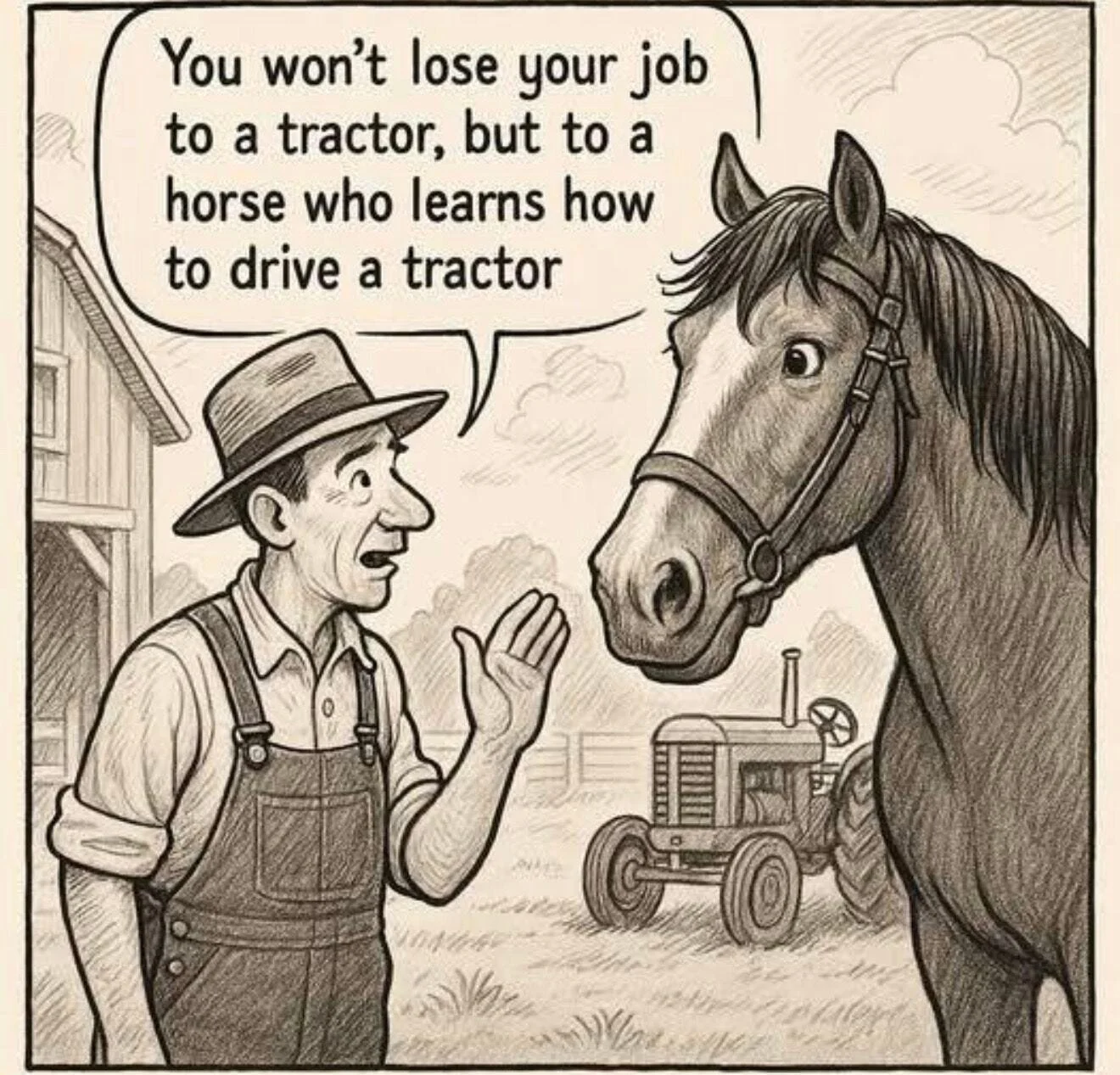
Step 1: Upgrade AI skills.
First to thrive as a human in an AI Age it is critical to upgrade our AI quotient. Below is a piece I wrote about how to do it ( no need for consultants, schools, conferences or anything else…just yourself and 20 to 100 dollars a month depending on what you can afford)
Start with following the recommendations from Upgrading our AI Quotient.
Step 2: Hone the 4P’s: Perspective. Point of View. Provocation. Plan of Action.
Everybody will have access to the same knowledge in a world where knowledge will be free.
No one will care that we have data bases, decks, charts and graphs all dressed up in color with moving videos. Chump change anybody can develop once we upgrade our AI skills ( thus Step 1)
The questions that will bring our voice to the data will be the following:
What is our Perspective about all this information? How does it fit with what has come before, come after, our competitors businesses etc. We need to learn to put everything we do in context.
What is our Point of View on everything. What do we believe. What do we agree with and what do we not agree with.
What Provocation do we bring. Can we challenge the data or look at in a different way that maybe even rejects it all.
What is the Plan of Action we recommend. Yes the AI may suggest plans of action. Are they right? Should they be combined? Can we build on what is recommended.
Every single meeting, every single conversation think of bringing one or more P’s to the data or to the output of AI.
Any meeting that is just about sharing information is worthless without one of the 4P’s.
Perspective. Point of View. Provocation. Plan of Action.
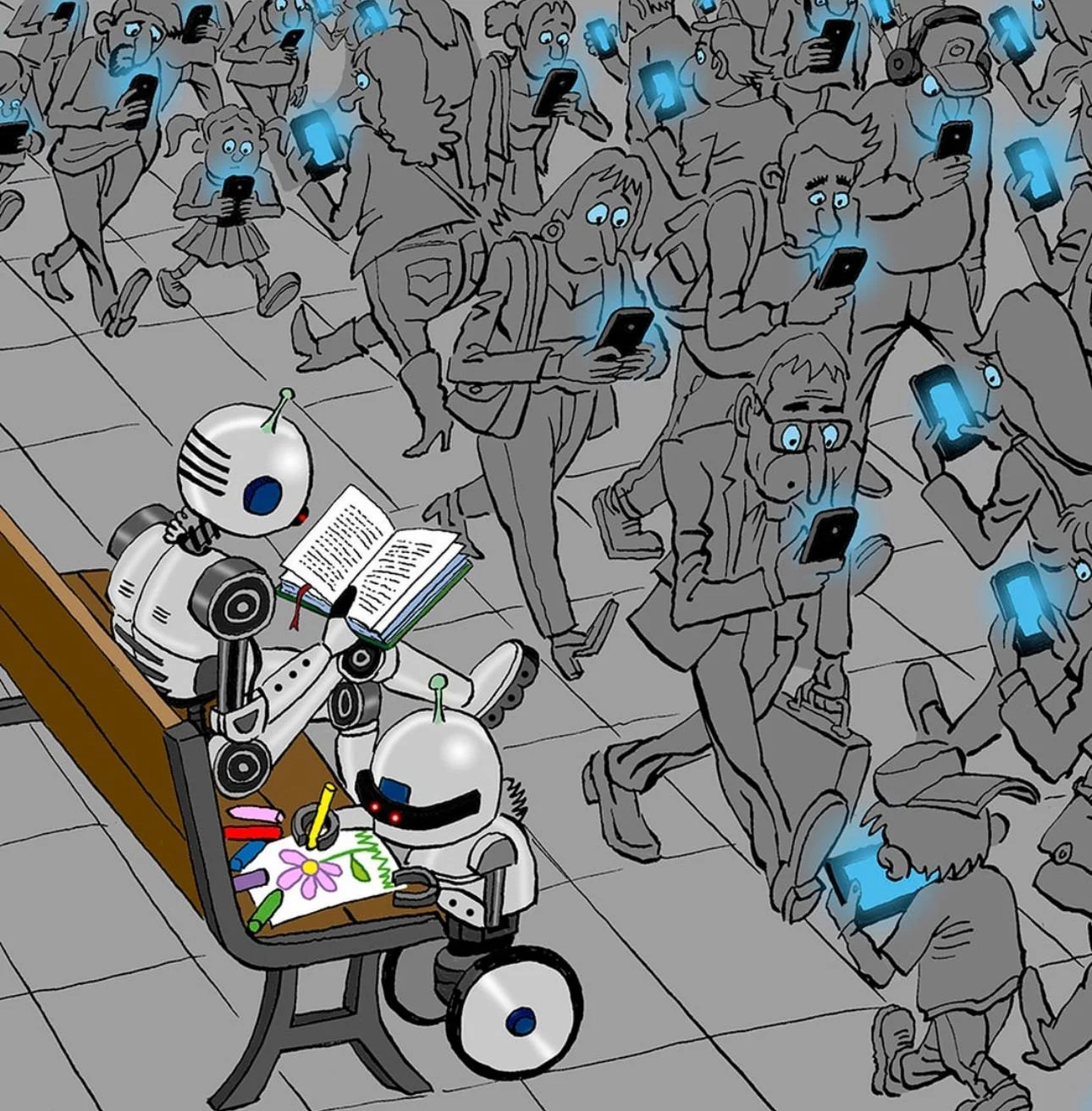
Step 3: Open Many Portals to Many Worlds.
To curate, select with taste, express self, and learn to inspire we need to marinate in the works and learn from people who have great voices whether it be scientists, business people, teachers, musician, authors, painters, film makers and story tellers.
It is important to expose ourselves to a range of inputs and stimuli. From reading to listening to music to traveling to watching movies to visiting museums to helping people to going back to school to concerts to sporting events the more varied and different experiences the more dots we have to connect and work with.
The more stuff we interact with including opposing points of view the better.
The more portals we open the more we have to curate, grow our taste, use in our communication, align and find our voice.
Embrace life.
Step out of the stream and search results
Follow the path less taken.
Open the portals.

Step 4: Aesthetics
Aesthetics is defined by Leonard Koren as “ a cognitive mode in which you are aware and think about the sensory and emotive qualities of phenomena and things”.
A simple way build such one’s aesthetic sense is to observe.
To pay attention. Not just to things but to people.
To do things that move you or move others.
David Foster Wallace wrote
“The really important kind of freedom involves attention, and awareness, and discipline, and effort, and being able truly to care about other people and to sacrifice for them, over and over, in myriad petty little unsexy ways, every day.”
No AI will ever do that.
Or just look and feel since all humans choose with our hearts and then use numbers to justify what we just did…
A Day of Fun, Impact, and Sisterhood!
My long time boss and mentor Jack Klues who was on the Directoire of Publicis Groupe and was the CEO of Publicis Media and many others including myself have been involved in an amazing endeavor called Off The Street Club.
25 years ago, we dreamed up a women -only charity golf outing to primarily benefit the girls programming of the Off The Street Club ( OTSC). For those not familiar, For the last 125 years, the Club acts as a "safe haven"; allowing kids just to be kids who live in Chicago's highly dangerous West Side.
The event is called Swing For the Kids and has grown into what we believe is the largest and longest running women's charity golf AND pickleball event in the country.
More than just a day of sport, Swing For The Kids is a powerful gathering of professional women from across Chicago's Advertising, Media, Financial, and Corporate worlds - Entry Level to C Suite Officers from companies like Publicis Groupe, Netflix, Google, NBC Universal, Heinz/Kraft, and JP Morgan Chase . Over 200 participants coming together to make a real difference in these kids lives.
As former Kraft CEO and current OTSC Board President, Betsy Holden, says it's "an amazing , inspirational day of sisterhood".
Whether you are golfing, playing pickleball, or just soaking up the energy, food, and prizes, you will leave with more than you came for- new connections, memorable stories, and the satisfaction of supporting kids who really need it and our worth it.
Tell your friends. Ask your employer. We want and need you to join us.
Experience the magic that happens at Swing.
- September 8th
- Twin Orchards Country Club in Long Grove, Illinois
- Call 312-315-2917 or visit otscswing.com to learn more or signup.
Photography by Rishad Tobaccowala