
Looking Back: Five Learnings.

This past week I was fortunate to be honored at an event in NY. After acknowledging the other recipients who are in the prime of their careers ( very much like the 350 leaders in the audience) and thanking those who enabled my success, I shared five learnings that that have proved useful to finding success in work and life with the next generation.
1. Repair/Practice Resurrection.
In any career and sometimes in a single year we will believe we have arrived at Good Friday. We feel that all is lost and our future potential has been crucified. But let us never forget to focus on Easter Sunday and raise ourselves up again.
To do so we need to practice repair.
“Everything that has a shape breaks”- Japanese Proverb
But…
“The world breaks everyone and afterward many are strong at the broken places”- Ernest Hemingway
And…
“Repair is the creative destruction of brokenness”—Elizabeth Spelman
Read more about how to repair…
2. Generosity as a strategy.
If strategy is future competitive advantage, generosity is smart for individual or company strategies.
Generosity builds good will which is both an asset and a moat.
It is an asset in that it can be tapped in the future.
It is a moat because when an individual or a company has been generous in times of trouble their employee or customer are less likely to switch to a different firm for a lower price or higher pay.
Generosity is also a key differentiator because often when a person or firm needs help when they are down and out there are few people willing to help. Those individuals and brands who do help during these troubled times stand out. Their showing up in to offer help when others might not, burns into the emotional and mental memory of the recipient and is rarely forgotten.
Emotional connections are harder to sever or replace than financial connections.
Read more on Generosity…
3. Upgrading Our Mental Operating Systems.
My book “Restoring the Soul of Business: Staying Human in the Age of Data” includes a chapter called ‘Upgrade Your Mental Operating System” which ends with these key takeaways:
1. Regardless of how senior or established employees are, they all possess the capacity for growth and relevancy in changing times.
2. Organizations need to set aside time for people’s mental self-improvement. They can encourage employees to escape digital routines and engage in tasks and conversations that stretch their minds.
3. Today there are many amazing new ways of self-learning and improving of which every person can take advantage of.
Here is how to learn to learn…
4. Combine roots and wings.
To succeed as an individual or as a firm one must have roots and wings.
Roots provide stability, a place to stand, a passed along tradition and a sense of history.
But roots alone which are important to ensure one does not get blown away by the winds of change might anchor one too much to the past and to a status quo which may no longer be relevant.
Thus, the importance of wings.
The ability to raise oneself and see above the horizon, to look down with new perspectives and to ensure that the roots which feed us do not wither by failing to adapt to a new world.
Roots nourish via what we were and where we came from and what we did.
Wings encourage us to go where we need to and to blaze new trails which will lay down tomorrows roots and are a highway to what we will accomplish
Read more about Roots and Wings…
5. Think like an immigrant.
World class leaders and companies rarely get defeated.
They decide to defeat themselves by a) not taking emerging competitors with new models seriously, b) paying scant attention to underdogs with fewer resource and different approaches, and/or c) by refusing to align with the forces of the future and take the hard decisions to get there.
We can all learn from immigrants.
a) Immigrants often think like outsiders.
Individuals and companies that thrive over the long run view their business from external perspectives and not just internal perspectives.
b) Immigrants often think like underdogs.
Underdogs use technology, drive, and ingenuity to find ways to leverage what they have or what others have to change the rules of the game.
They do not view the moat surrounding the castle as a something to navigate but a source of material to flood the castle with by changing the rules of the game!
c) Immigrants think with an emphasis on the future
Short or mid term sacrifices and pain is endured to build a future for themselves and families just like great companies think beyond the quarter and the year but in long time periods.
Read more about how to Think like an immigrant…
These five learning will serve everyone, everywhere, decade over decade.
Even if one does not work these will help us all lead thriving and fulfilling lives…

Career Fitness: 3 Critical Exercises.

All Images via MidJourney
In these tectonic times, our career planning may need to build new muscles so we can remain relevant.
Here are three critical exercises to upgrade our mental operating systems:
1. Prepare for a very long marathon and not a sprint.
Most of us will work for five decades from our early twenties to our late sixties or early seventies.
We need to plan and plot for fifty year careers where over the decades we may pursue completely different vocations.
AI, Time and the rapidly declining half-life of knowledge: Just as careers are getting longer the half-life of knowledge is declining faster and faster. Even if we are 30 our skills may lead to a forced retirement at 35 or 40 unless we upgrade and reinvent our skills. Continuous learning will be the only path to constant earning.
We should not price ourselves out of our dreams: Too many people find themselves doing a job they do not truly enjoy or love, much longer than they need to because the job creates the ability to fund a certain lifestyle. One’s lifestyle is rarely the dream that nourishes or fulfills. The way we spend our time is the way we live our lives and work is central not just to income, but also to identity, community, purpose and growth. Funding the lifestyle often prices us out of the careers and vocations that truly resonate with us, but we now cannot afford to pursue.
Aging is a “prejudice against our future selves”. Avoiding thinking about or thinking negatively about aging . Ageism is a form of self-discrimination since we will all age. We are never too old to reinvent ourselves, build fresh skills and pursue new dreams.
Many of us will “fail” retirement. A lot of retirement planning is about making sure one has the financial means to retire and how to remain healthy but that is not enough. Most people who can stop working soon find themselves without purpose or meaning or even identity since work is so central to identity, community, purpose and growth. The question of “Why am I waking up in the morning?” is rarely answered day after day after day with “To play golf” or “To travel”.

2. “Jobs” ≠ “Work” . Get fit for periods where we have work but not a full-time job.
Official payroll jobs are a narrow concept: a single employer, a W‑2, a slot in the BLS counts. Work is everything people do to create value, paid or not, whether it shows up on a company’s head‑count or not. Once you separate the two, the paradox becomes clearer:
We are at peak full-time jobs but not peak work or wealth creation opportunities.
The faster we delink work and jobs in our minds and the way companies are run the better off we will be.
Too many leaders fixate around jobs, classical organization design and place as critical when a new generation of companies focus on work to be done to deliver outcomes with different types of talent ( full time, freelance, fractional, contract and agentic) wherever they are to maximize agility and minimize costs. The age of conducting talent with a baton is cool for a classical age but is useless in a jazz age of improvisation.
Why payroll jobs can flatten or fall…
Automation & AI: Firms can keep revenue rising while head‑counts stay flat. U.S. job openings slid from 8.1 million in March 2024 to 7.2 million in March 2025 even though output kept growing. Bureau of Labor Statistics
Demographics: Retirements outpace new entrants in every rich economy; a smaller workforce limits the absolute number of jobs that can exist.
Risk off‑loading:Companies re‑label employees as contractors or outsource entire functions, removing positions from the payroll tally without killing the underlying tasks.
Capital‑first business models: Software, cloud services and robotics make it cheaper to buy capacity than hire people, so fewer traditional roles are created per dollar of GDP. Capital invests in “tireless” agents vs “tiresome” people.
While work opportunities can keep exploding (but often invisible to job statistics)
Gig & platform labor: At least 70 million Americans will freelance in 2025, on track to pass 86 million by 2027—meaning a majority of workers will earn income outside a W‑2 at least part‑time. Fortunly
The creator / micro‑entrepreneur economy: YouTube, TikTok, Substack and Shopify have spawned a $250 billion creator economy where millions earn revenue shares, sponsorships, or merch sales—none of which count as “employment.” Forbes
Solo & very‑small businesses: Record formation of 5.5 million new business applications in 2023 shows a surge of one‑person LLCs and side‑hustle ventures. These founders are working—sometimes 70 hours a week—but they don’t appear as employees. U.S. Chamber of Commerce
Unpaid but indispensable care work: Family caregivers now provide labor valued at ~$874 billion a year in the U.S.—bigger than the pharmaceutical industry—yet it is entirely off the payroll radar. Axios
Open‑source coding, online tutoring, volunteer crisis mapping, fan‑translation, DAO moderation—all productive, often time‑intensive work outside formal employment.
AI leverage: One skilled person plus copilots or low‑cost bots can do the output of a small team, so head‑counts shrink even as the task volume—and value—expands. Recently McKinsey reduced head count by 5,000 people while adding 12,000 agents.

3. Sculpting a “Company of One” mindset is critical to keep a career fit.
Whether it is finding work post-retirement, working a side-hustle or passion project to make ends meet or build an expertise or create an off-ramp, or filling the gaps between full-time employment at firms which are often trigger-happy in adding and removing talent from their payrolls, the smart professional prepares to be a company of one.
But even if you do not fit any of these categories be aware that companies are creating internal marketplaces where opportunities can be identified and applied for and teams of experts can form and dissolve around projects.
As a result, for an individual to thrive in a company they will need to learn how to operate as a company of one. The combined power of the Avengers is because each of the Avengers is powerful on their own and not just because they learn to work as one.
Think of yourself as a better paid Uber driver with benefits if you work for a company.
If your expertise is needed at that time or in a particular market and location, and your collaboration and ability to work in teams is highly rated you will be in demand.
If not, as companies manage and monitor costs and increasingly find ways to plug into resources all the time everywhere you will find yourself parked permanently.
Or consider the Hollywood model where expertise come together on tv or movie projects and then the people disband and move on. Very few people work at a studio. Most people work in teams where they bring their skill whether it be casting, directing, catering or make up etc. The future of business will be similar as companies begin re-aggregating expertise around projects versus having hordes of generalists or people hanging around for a project. McKinsey and Bain have done this for years.
Nor everyone will be a freelancer going from gig to gig but if we build our career with the mindset of continually honing expertise, working well with other people in teams and being flexible, we will succeed in our company of tens of thousands versus thinking of ourselves as a cog in big machine waiting for someone to care for or build our career.
Think of our main as job as venture capital to fund the side gig or the next job.
We must plan for a very long career where work will involve both full time jobs and many other types of gigs and through it all we need to keep upgrading skills, reputation and collaborative skills by thinking of ourselves as a Company of One and never delegating our future to anyone else.
This allows us to be true to the only mantras worth following:
Keep skills up to tomorrow not just up to date .
Maximize Optionality.
All Images via MidJourney

On Education.

The Power of Education.
Three of the most powerful forces in the world are a) gravity b) compound interest and c) the bond between a mother and a child.
They have always existed driven by the power of science, math and nature.
An even more powerful force than these is education.
Education lifts us up while gravity holds us down.
Education compounds even more than compound interest in that it increases not just returns to money but returns to living.
Education is seen as crucial by mothers and fathers who invest and sacrifice for it.

Education has never been more important.
Today in a world of change it is critical to upgrade our mental and emotional operating systems.
Transformation of lives and companies happen when talent transforms and the only way to do so is through education.
Education can be academic and in institutions and classrooms but a lot of education comes from the school of life, risk taking and experience.
While credentials may be important, education is less about degrees and more about learning new skills. It is about the building of new insights by connecting dots in new ways. The growth that comes from reflecting and building on failure and mistakes. The layers of experience that transform a body of knowledge into craft and expertise.

Education has never been easier.
While certain schools in countries continue to be highly expensive and deeply selective (often for no other reason than to constrain supply to allow graduates to earn high incomes) they are forgetting that education is about abundance versus scarcity. This mindset and way of teaching has now begun a rapid decline.
Today, a new world order and range of learning is increasingly available and will soon completely disrupt the old ways. Low cost resources from online courses, YouTube, AI tools and a series of credential courses from guilds and companies are making learning, training and skill development easier and easier. These skill sets can be monetized in a range of ways that does not require having credentials to get a job. World class tools including compute are available in the cloud on a just in time basis, AI agents to staff teams, and global marketplaces to access talent and inputs and sell services and products are a click away on the mobile device 24 hours a day.
The key is not to think of education as a signal to get us into a place but a way of building life long skills and learning that enables us to find meaningful, purposeful and rewarding work.

Education has never been more challenged.
Most professional education establishments are imparting irrelevant skills, concentrated in the first 25 years of life, using out of date approaches, for a job market that no longer exists.
Education in the traditional way is being deeply disrupted and the people in charge of learning are now going to have to go about unlearning their pedagogy!
The new educators will be a combination of reinvented outfits and self-educators, who enable and access new skills, across fifty year working careers, leveraging the latest methods and technologies , with a recognition that the majority of us will find meaningful purposeful work outside of jobs in a company.
The disparity between what is needed and where the future is going is a wide chasm.

How to self-educate.
Education is also not just about constant life-long learning but also unlearning.
The future does not fit in the mindsets of the past.
Five keys to self-educate when one has highly limited budgets and little to no time:
1. Set an hour a day to learn. This builds cognition which is the ability to think.
2. Build a case once in a while for the opposite of what you believe is true. This enables curiosity which is about asking what if? And why not?
3. Pay attention to what gives you flow and fit. This allows one to be creative which is best described as an expression of oneself.
4. Start with AI tools not search. Converse with other humans and machines. This will build skills of the choreographer allowing us to connect alien (eg. agentic AI ) and human life forms to drive outcomes.
5. Practice story telling in a multitude of forms from oral to visual to verbal. This will help us be communicators who can convince and move people.
Architecting, building, honing skills of cognition, creativity, curiosity, choreography and communication is the key to our future.
And educating ourselves in these is the best way to find purpose, meaning and rewards.
All images via prompts to MidJourney

Rethinking …

The most popular edition of the 268 posts of this Substack so far is Rethinking Presentations on how to put together powerful presentations with only 9 slides!
The third most popular post is A Company of One on a way to ensure one remains relevant in a world of changing work.
This post combines a second approach to rethinking presentations and then illustrates how the format is used to get people to start rethinking work.
Rethinking Presentations 2
Rethinking Presentations 1 showed how to put together a presentation to make a sale or get an order and remains a very impactful way to do so.
Over the past few years as I have worked for myself rather than a company. I spend less time selling and more time advising, explaining the tectonic shifts we are experiencing and trying to inspire new behavior. Here is a very simple approach anyone can use when one is trying to educate, explain or inspire change.
The three key outcomes this new format seeks to deliver are:
a) Accessible explanations that are simple, focused and identify all the key issues. People are overwhelmed.
b) Actionable inspiration that leaves people not just feeling inspired but armed with a way to take action right away.
c) Personalized relevance in that every single person finds relevance to their personal situation. It must resonate to help them solve a problem or take advantage of an opportunity.
This approach also requires only 9 key slides:
Slide 1: Title Slide (Action oriented)
Slide 2: Agenda (A simple, impactful way to telegraph what is to follow)
Slide 3: Shifts (What are the forces driving the changing situation and future)
Slide 4: Implications (What are the implications of these key shifts on the audience)
Slide 5: Realities (The hard truths and key challenges we need to face)
Slide 6: Approaches (What steps should one take right now)
Slide 7: Mindset (How to frame and address the situation moving forward)
Slide 8: Questions (Interaction and Q&A key when trying to explain/inspire)
Slide 9: Resources (Ways people can learn more and upgrade themselves)
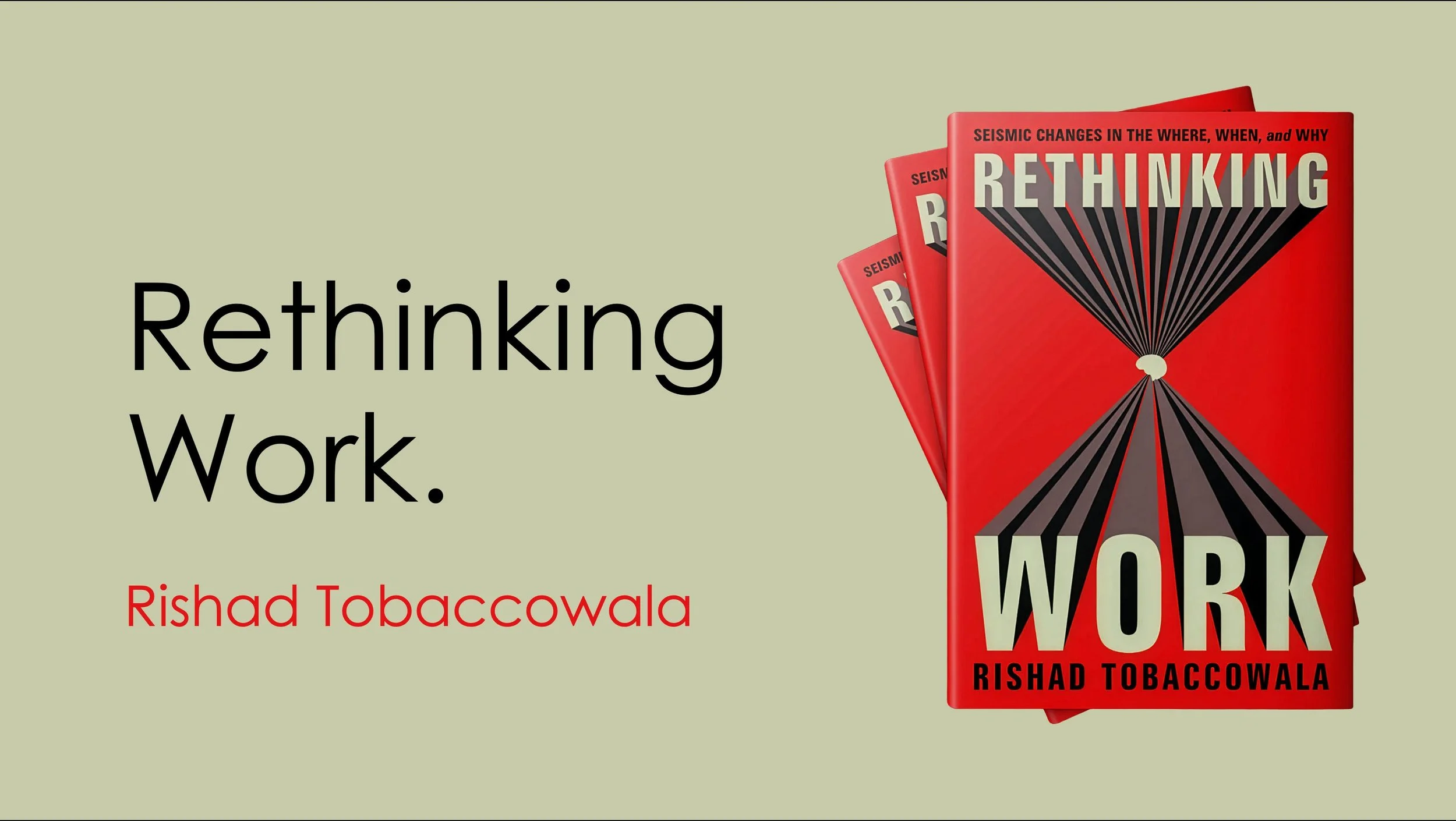
Rethinking Work
The Rethinking Work presentation below uses this 9 slide approach to explain to management why work will change more this decade than the previous 50 years and what leaders and companies need to understand and address right now.
But this same approach can be used by anybody who wants to educate, explain and inspire on any subject or topic. It is totally modular. Just change topic and put in the relevant shifts, implications, realities, exercises and mindsets!
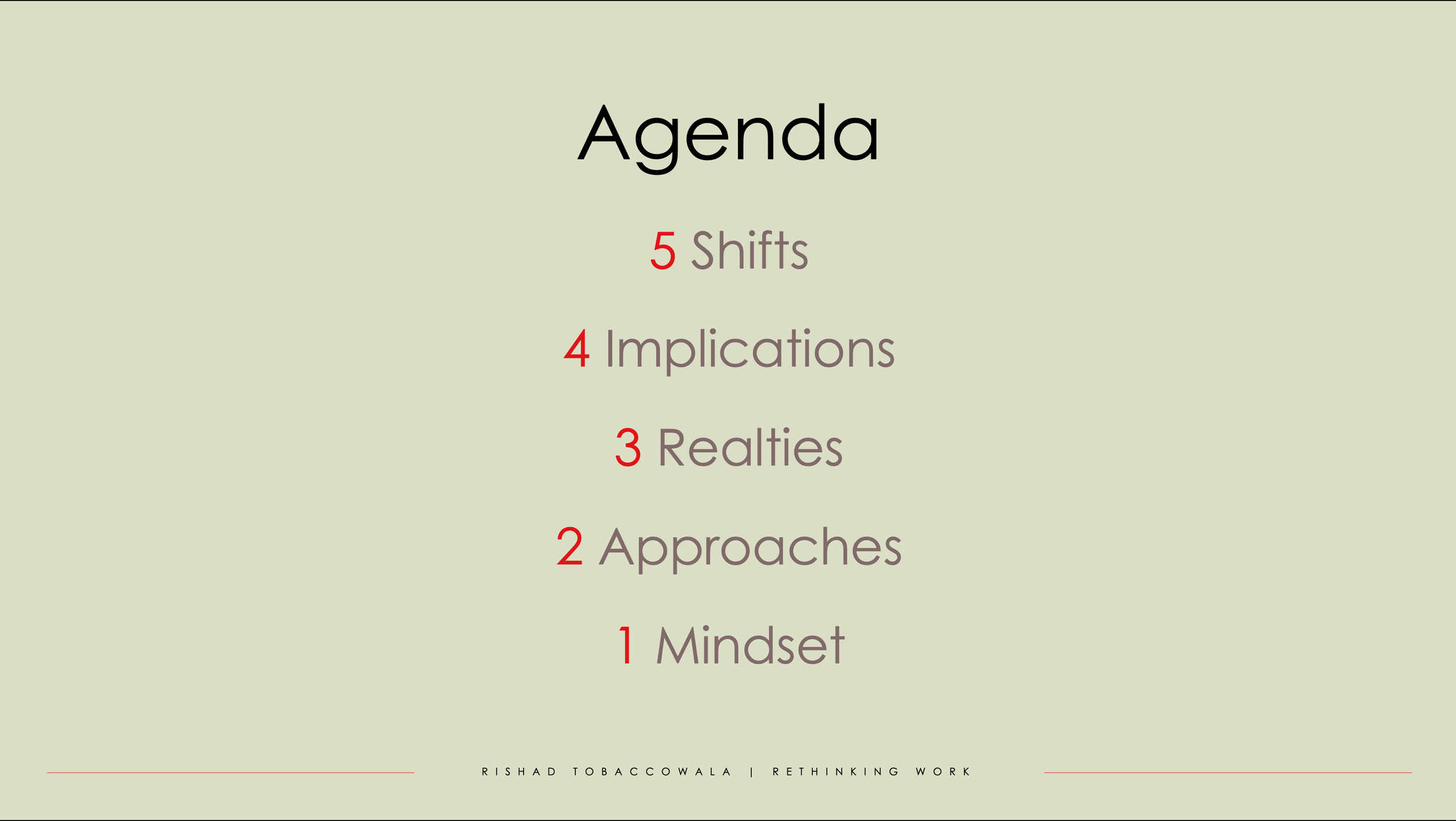

Five interconnected shifts will change work more this decade than the past 50 years.
Demographics of declining & aging population. Different mindsets across generations.
Technology (AI, Blockchain & Media Landscape where everyone is a media company).
Marketplaces that allow individuals and companies to access talent and opportunities.
More people will work part time or free-lance than full-time in the USA starting 2026.
Covid did not just change where we work but why we work and who we work for.
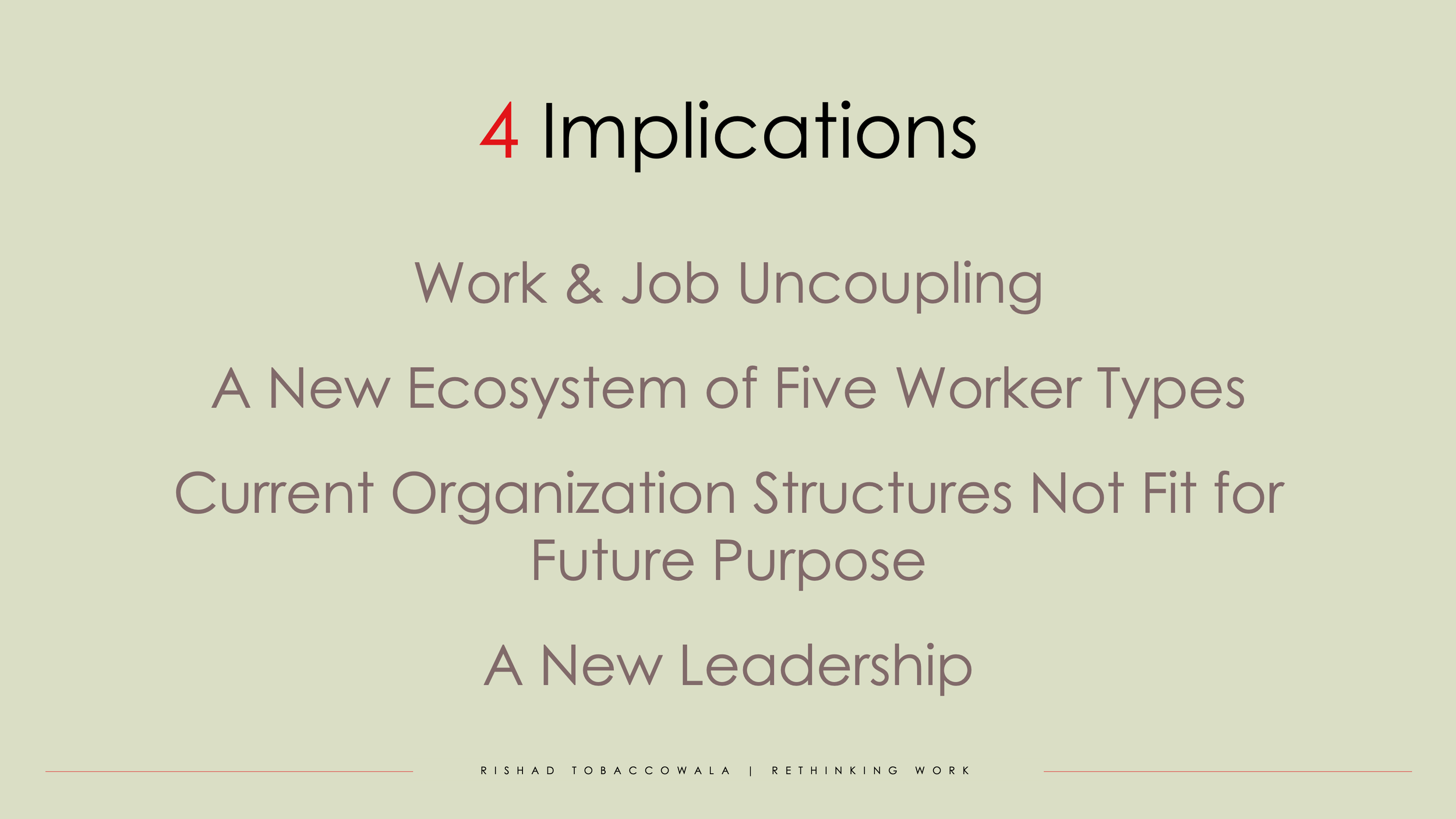
Four implications that organizations and leaders must address.
More and more work will be done without filling jobs. Until 200 years ago there was lots of work and few jobs. We are now going to have more and more work and income/wealth opportunities than ever but fewer jobs. We are past peak jobs.
Full-time, freelance & contract employees will be joined by fractionalized employees and agentic workers.
Current structures of most companies are often built around jobs rather than how to get work done by attracting and retaining the best talent with the greatest agility and affordability.
Debossification is the only way forward where leaders focus on zones of influence vs zones of control. Where leaders spend the majority of their time selling, building, inspiring, servicing and mentoring vs. monitoring, measuring, processing, and checking in, all of which will be done better by AI.
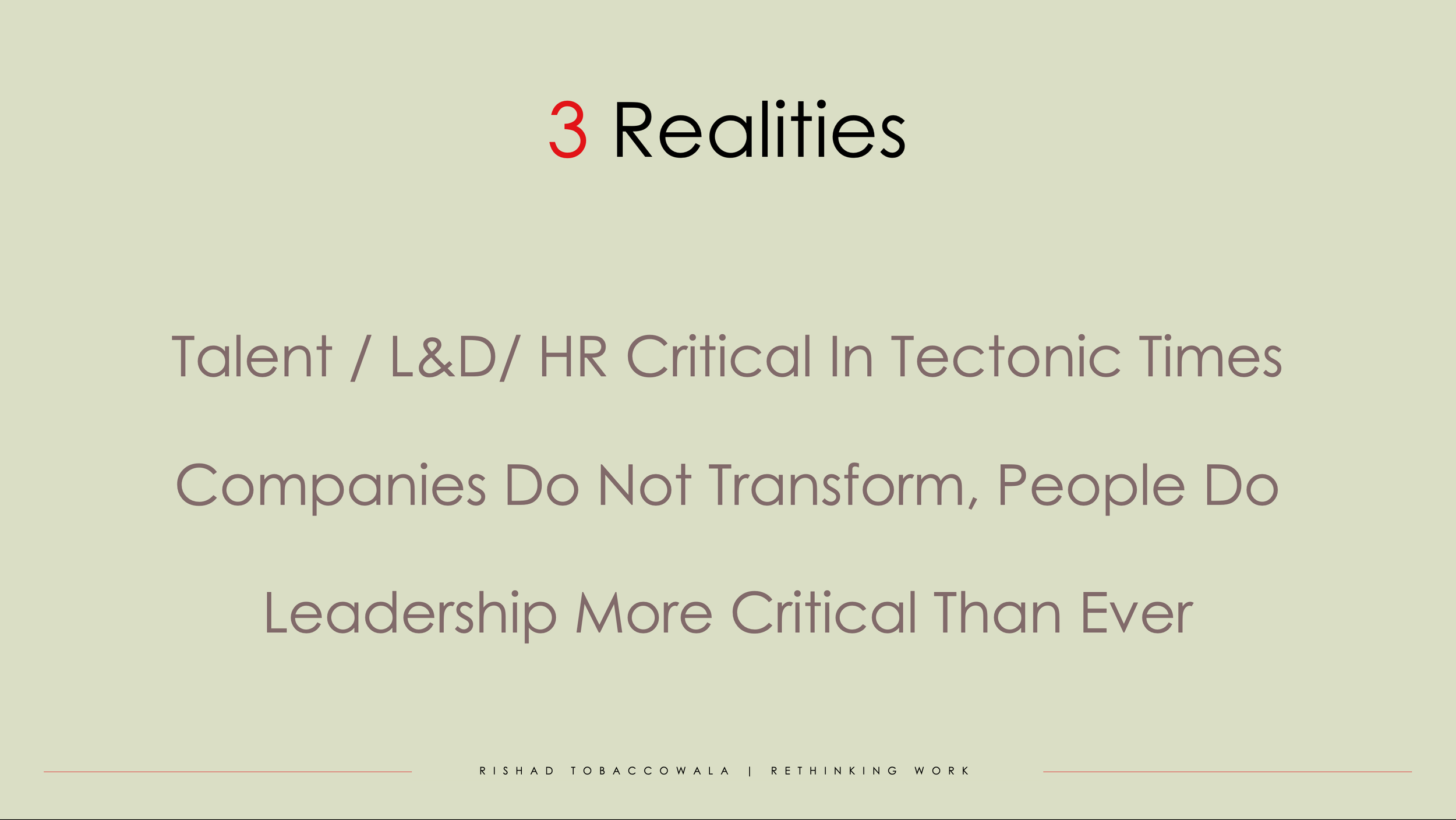
Three realities every company must face.
Companies do not transform people do. Change never happens without a talent plan.
Talent/L&D more critical than ever but must reinvent themselves and be less fearful.
Leadership is the critical element more than technology or strategy or partnerships.
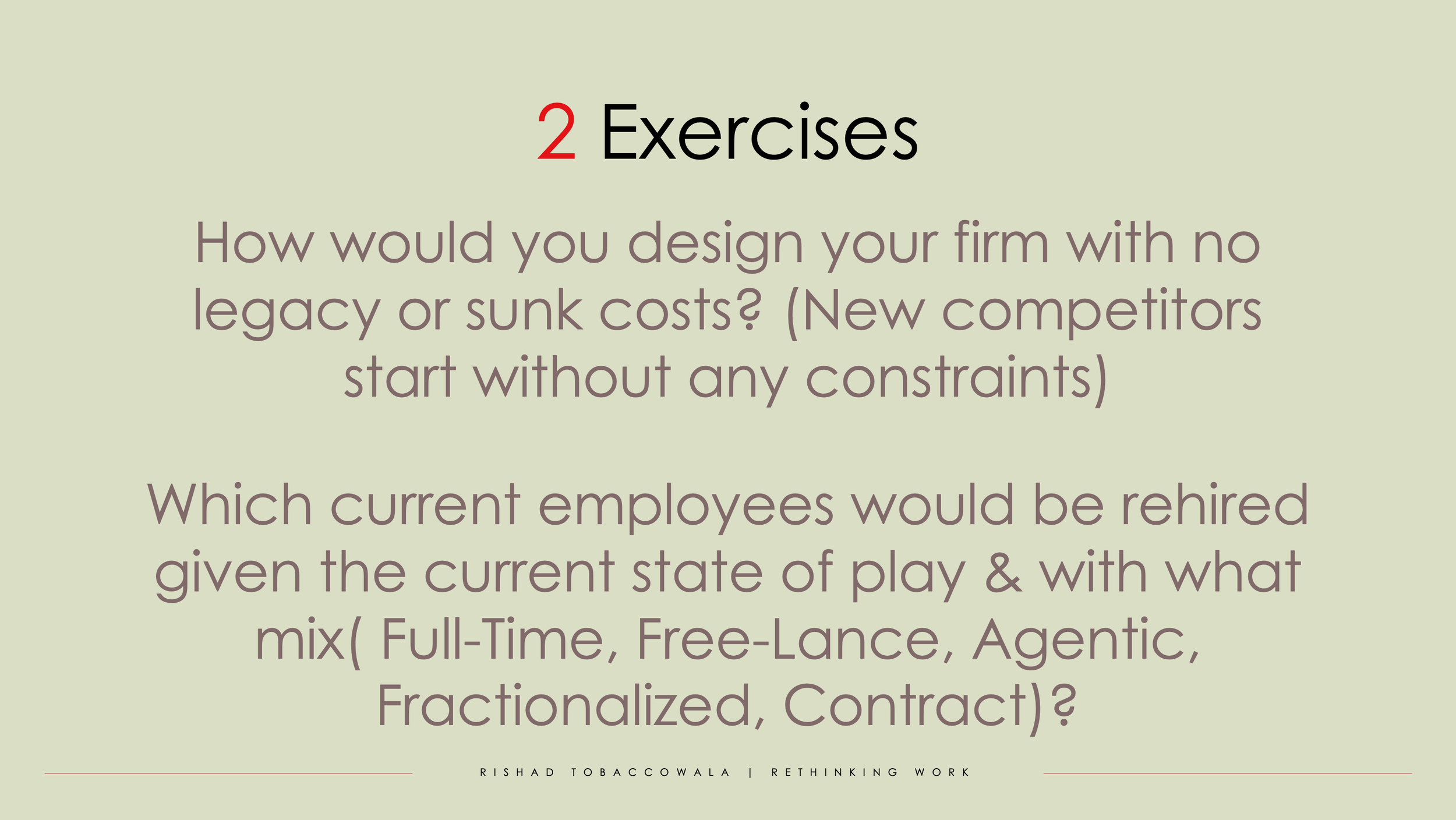
Two Exercises.
Most management is world class but often self oppress and limit themselves by imagining constraints that only exist in their minds. These two exercises suggest starting with a fresh sheet on both the organizational and talent front.
Why is the current organizational structure which was probably out of date pre-Covid, pre-AI, pre-distributed work, still relevant for the tectonic changes coming? Without the right spinal architecture it makes no difference what AI or other organs are added.
The only thing a company has is talent. If the game changes and the playing field changes, talent needs to be rethought via a combination of upgrading skills, new ways of working and accessing of enhanced expertise both inside and outside the firm.
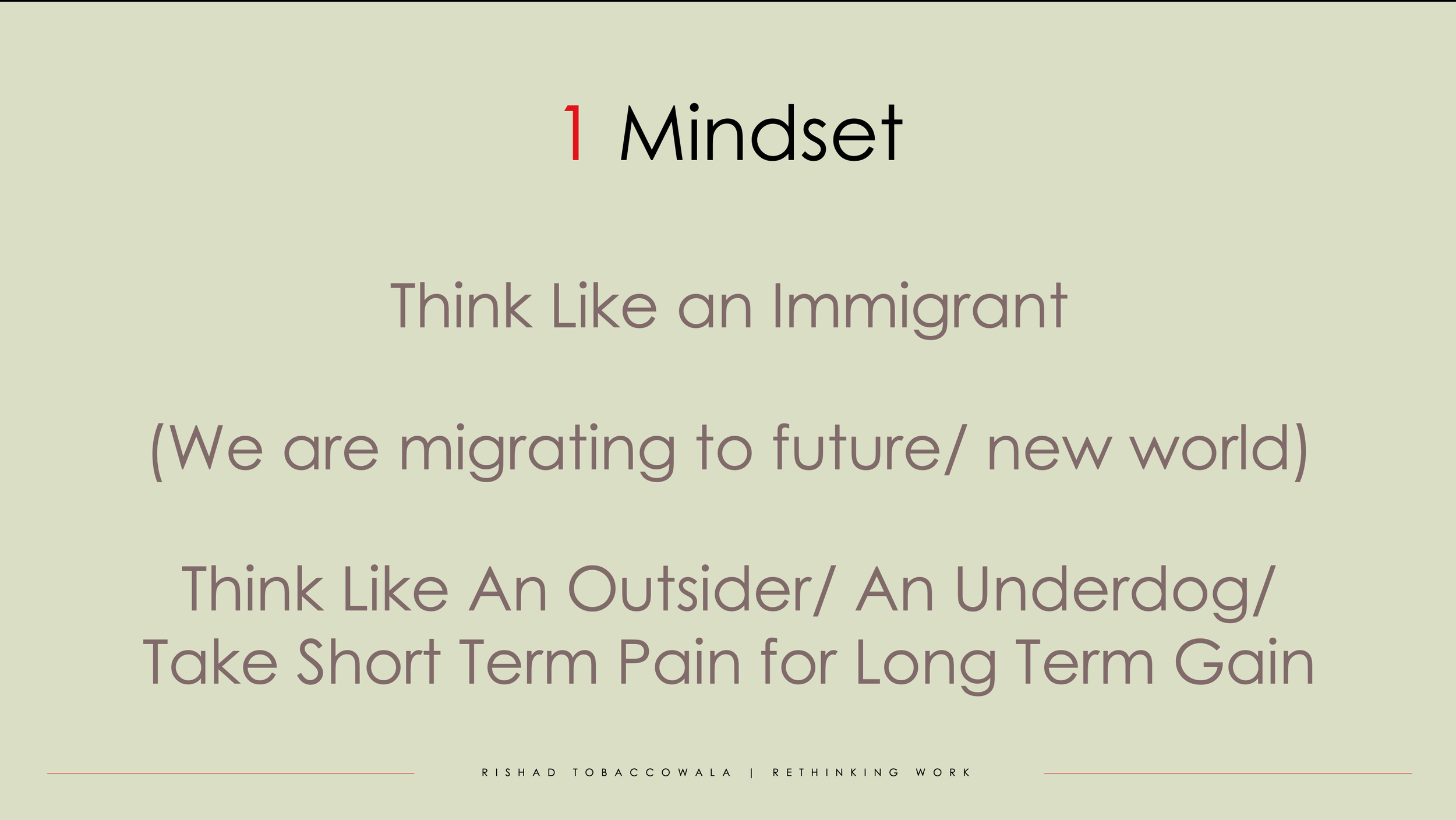
One Mindset.
We are all migrating to a new country, a new world, an unknown zone called the future which will not look like the place we are today.
So why have an immigrant mindset?
We need to think like outsiders since the new risks and opportunities will come from outside our existing competitive set.
We need to think like underdogs since AI is the slingshot that allows David to bring down Goliath. Moats might be used as sources of water to flood our castle!
We need to take the hard painful decisions and make the sacrifices now so we and our company can thrive in the future.

Questions and Resources to Keep Learning.
Education, Learning and Reinventing are constant.
Here are three completely free resources to upgrade one’s mental operating system:
This Substack (The Future Does Not Fit in the Containers of the Past)
A weekly podcast (What Next?) where every week people who are forging the future share their best insights, provocations, perspectives and points of view.
And The Rethinking Work Show a show on YouTube but also on Spotify and Apple where every week a discussion with people reinventing work from CEO’s and architects wrestling with back to the office, technologists introducing agentic employees into the work place, academics with data that put a lie to so much fuzzy thinking about the future of work, pioneers designing new firms which are AI first, different generations speaking about companies and work and much more…
You can download the extended (18 slide version of this presentation which goes deeper into the 5 shifts and the 4 implications) here by clicking on the presentation and you may use it in anyway you want.
Also at Rethinking Work check out the resources section where there is career advice and lots of stuff to help every one become better and more effective. If you or someone you know is rethinking your career these four articles might completely change the way you plan the rest of your working life.

On Leadership and Culture.

Companies and organizations that thrive excel in two areas:
Leadership and Culture.
They are both key and closely intertwined.
A. Leadership.
Leadership can be distilled down to this:
Leaders acknowledge, face and communicate reality.
People follow people and not titles since titles are bestowed while leadership is earned.
The six characteristics of great leaders are capability, integrity, empathy, vulnerability, courage and inspiration.
Reality.
A key to leadership is to solve challenges and address problems. This requires confronting issues versus looking away or hoping some form of magical thinking will make them go away.
People will follow a person if they suspect they are not addressing real issues and challenges however difficult they may be.
Followership.
Without the hearts and minds of the team one is not a leader but a ruler.
Rulers leverage fear, project power and exploit insecurity.
Employees genuflect, fall in line, salute and pander to the hollow and bloated boss, while they silently seethe, plot insurrection or practice defection.
Six Characteristics.
a) Capability: To be a leader one must be capable in one’s field of work or craft and to keep improving and honing one’s skill with a dedication to a growth mindset. Doctors will not listen to doctors who are not great at medicine. A creative will not respect someone whose body of work they do not admire.
b) Integrity: Can one be trusted? Does what one says, what one does and how one behaves aligned and also resonate with the rules of science and economics ?
c) Empathy: Leaders can see from other points of view and they understand that employees are people and work is a very important part but all of their being. They understand and they listen. They care. They do this both for employees and for customers.
d) Vulnerability: Great leaders acknowledge mistakes. They know they do not have all the answers. This means they are open to criticism and correction and they surround themselves with skills sets that offset and balance their areas of weakness.
e) Inspiration: How do leaders face and acknowledge reality and hard truth but still get people to unite, align and take the challenges head on? They do so by recognizing that people choose with their hearts and not their minds. They inspire through a combination of personal example and storytelling.
f) Courage: The courage to make the hard decisions. The courage to take calculated risks. To understand that sticking to principles often comes with a price.
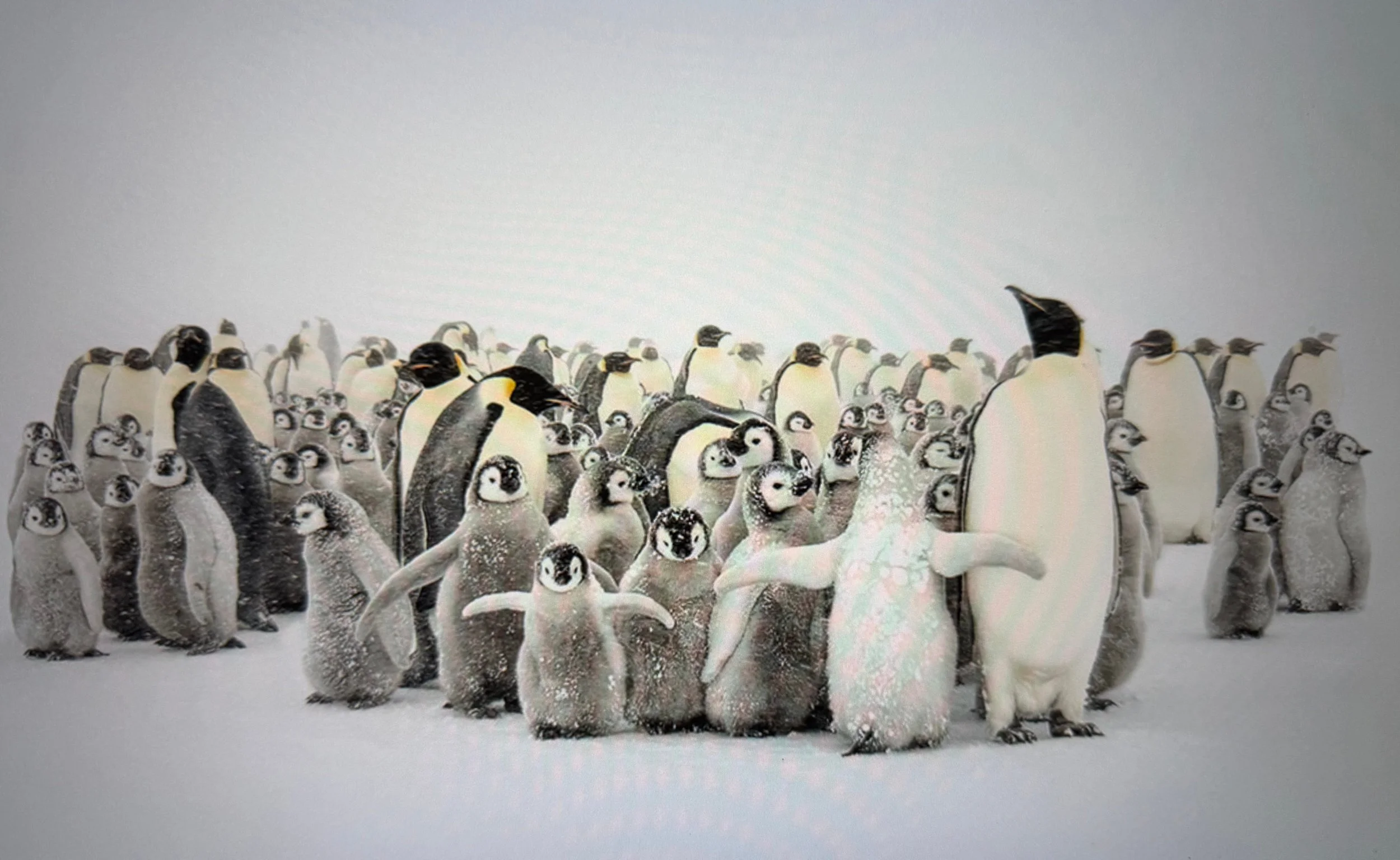
B. Culture
It has been said that “culture eats strategy for breakfast’ and often when companies decay ( Sears) or resurrect (Microsoft) or have distinctly different outcomes in the same industry (Delta vs American) a key determinant is the culture. What it is like, how it is improving or how it is getting worse.
Next Wednesday on The Rethinking Work Show we will hear from Alastair Creamer and Doug Milliken who co-founded Creamer and Milliken which help some of the best companies in the world on cultural change.
Once I read that the culture of an organization is revealed in how people behave when no one is looking or monitoring their behavior.
It is not just heard or seen but felt as my guests so eloquently stated.
Culture is about people. Yes, it requires leaders to set, correct and support the culture but it is how they treat people and how people feel about themselves, their company and their colleagues that is the fabric of culture.
Companies with great cultures tend to have talent who feel most of the following about their jobs and companies:
Excellence: One cannot have a great culture without excellent financial results, products/services and superior talent. People. Product. Profit. At least two of these need to be firing on all cylinders most times. Companies sometimes reduce the emphasis on one to invest in one of the other areas such as reducing profit to invest in new products.
Good Compensation and Aligned Incentives: If people are not paid adequately or fairly it really hard to attract and retain the best people to have a good culture. Companies do not need to have the highest compensation but they need to ensure the gap between them and their competitors is managed. But it is not just individual compensation but ensuring that incentives are aligned with the behavior that is expected. If team work is key there should be a greater focus on rewarding team results versus individual results ( though both are important)
Recognition : Great cultures recognize contributors and key players ( “difference makers”). They ensure people are heard.
Autonomy: People are trusted to deliver with limited monitoring and can access resources to do so. Freedom within a framework versus rule books and overly regimented “play books”.
Purpose: Talent believes in the purpose and values of the company and see the role of their company beyond that of just profit but ensuring their customers thrive and giving back to society or community.
Growth: The company is growing, has a plan for growth or even if static, the individual is growing and teams are growing by being given opportunities to learn and build new skills.
Connectedness: People feel connected to each other and to their leadership. They feel free to speak up and share and even joke. They express themselves without fear.
Solving for and focusing on these seven drivers of culture is one way smart leaders are working to ensure that in a distributed world with different types of employees including AI agents the fabric of culture is not torn.
They and their talent/people leaders will all have different approaches to get there but they all recognize it is key to ensure that each of these seven seeds of culture are watered.
Leadership and Culture and not technology or strategy or size that are they keys.
Photos by Roger Fishman.