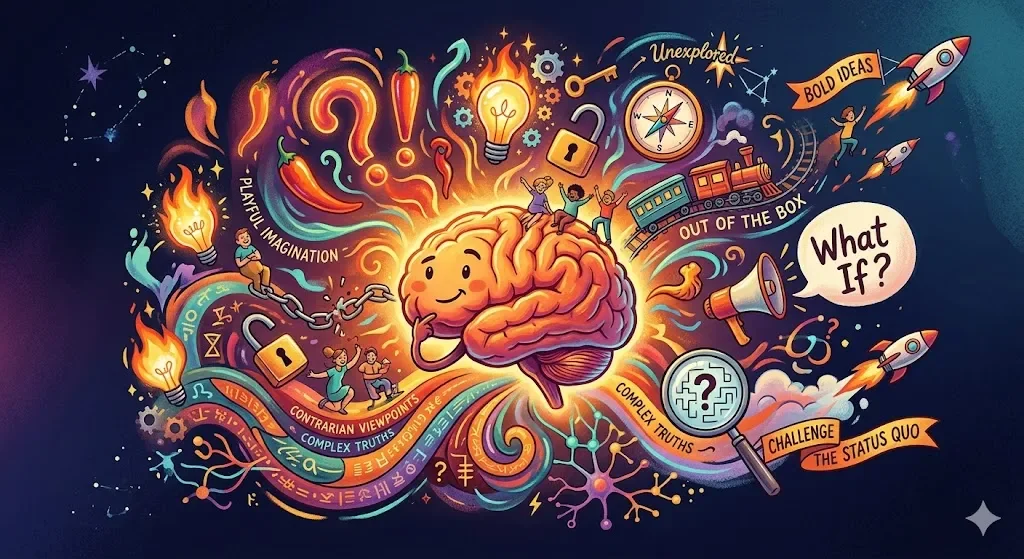
Spicy Thinking.
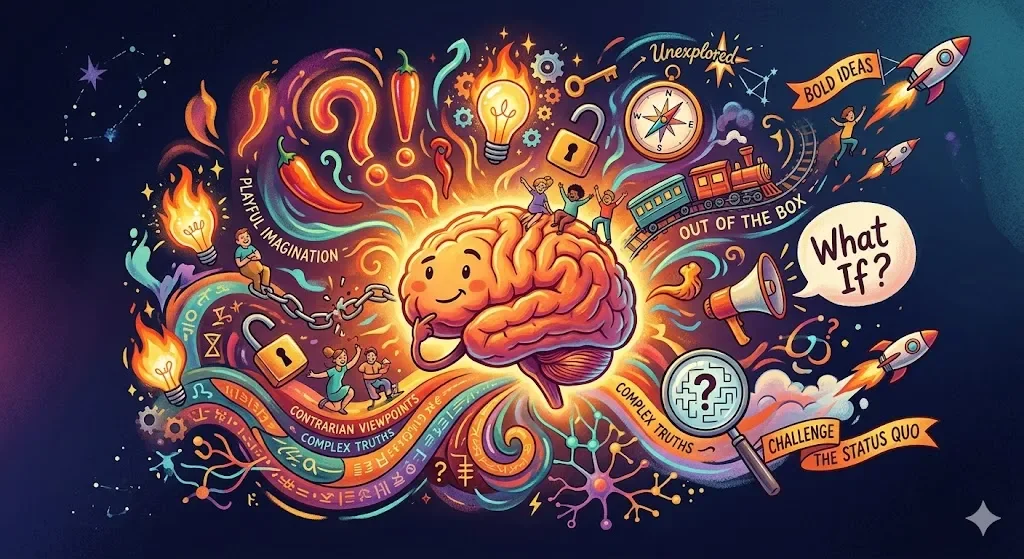
Image by Gemini
Charles’s conversation was as flat as a sidewalk, and everyone’s ideas filed along it in their ordinary clothes, exciting no emotion, no laughter, no reverie”
―Gustave Flaubert, Madame Bovary
Today there is a surfeit of data and reports and white papers and podcasts and…
AI is enabling the creation of content, video, presentations, graphics at exponential scale.
Presentations are getting longer, more beautiful to look at, filled with charts and numbers and screeching statistics.
But watch people in presentations and their eyes glaze over.
Read the posts on LinkedIn and you wonder whether the person writing it is alive or if they have ever had an original thought.
Everywhere a bland soup of buzz-word bingo.
A damp stew of retreaded ideas.
A mumbo jumbo of cocktail puffery and regurgitated goo.
I recall a third grade teacher advising our elder daughter on something she had written:
“Spicy words. Use spicy words. Make it special”
Today we need spicy thinking.
Thoughts and ideas with zest, verve and elan.
Thinking that makes one see, think and feel differently versus a diarrhea of diction or a warmed over plate of common bunk.
In a world filled with increasing amounts of data, computational power and advances in AI, talent will matter even more if we a) focus on what is unique to humans and b) do so in a way that leverages the power of technology.
After the math does its stuff it will be time for us to add the meaning.
Today the two most common words in earnings calls and in lay-off announcements are the words AI and uncertainty.
AI will not be a differentiator and uncertainty is not an acceptable excuse.
AI is like electricity.
No business or leader will be able to survive without it.
But just as no company differentiates itself through its use of electricity, AI alone will rarely differentiate a company or leader.
True leaders do not hide behind numbers and say things like “there is too much uncertainty.”
Life is uncertain.
If things were certain, a machine could do our jobs.
So let us be glad the future cannot be lived forward with only backward-looking databases.
What do we bring to the data and next generation tools when we bring the data and tools to our management, clients or to meetings?
What matters is not the data and technology and the reality that we cannot predict the future but the perspectives, points of view, provocations, and plan of action we bring.
Our unique spices that turn data to insights, observations to ideas, the seen to the imagined.
The 4P’s of Spicy Thinking.
Perspective: How is what we are recommending today or what is happening today look from different vantage points? For instance, the vantage point of a longer time horizon or the vantage point of a different person. This is often what machines or less experienced people do not have.
One way to ensure thinking from different perspectives is to build a case for the exact opposite of what we believe or are recommending. This allows one to stress test one’s thinking and also defend against competitors who might target the weakness in an argument.
Points of View: We often bring well documented cases and facts to buttress our arguments. These are essential. But the documentation and facts will never differentiate us versus others or machines since most people will bring the same facts. It is the point of view which matters. What do we believe this means versus what others say or what the facts state. What do we believe especially when we believe differently. Points of view matter.
Many years ago when I worked for Jim Jenness the Chief Operating Officer of Leo Burnett ( Jim eventually became CEO and Chairman of The Kellogg Company) he would ask me a question after I reviewed a deck that I was going to take to a Client that went something like this:
“Forget this deck. If this was Jim’s Garage and I asked you for some advice what would you tell me. What is the right thing to do? What do you believe?”
Jim wanted my point of view. What was the right thing to do for the Client? He was clear that he wanted what I thought rather than all the data and charts one might hide behind.
Provocations: The best organizations and teams find ways to balance, unify and integrate different and diverse points of view including those that challenge the status quo, speak up to power and question accepted thinking. It is when the internal challenges go missing does a company and leader begin to miss delivering results.
Thinking provocatively is often key.
Here is a provocation if you are in marketing and advertising. Could it be that in the future with the deep interactions (multiple questions that reveal a persons true needs and state of mind at that time not in the past) and increasing length of time that people are spending with conversation engines ( even with the right answer people are spending more time in conversations than when they were searching ) such as Claude or ChatGPT or Gemini mean that first party data will be less important than mindset relevance ?
When everybody believes the competitive edge is going to be first party data what if that is no longer true in world of conversation engines and agentic commerce?
Plans of Action: While perspectives, points of view and provocations help determine what needs to be done, we do eventually have to “make happen”, “to do” and to take ideas and convert them to reality.
Machines will often suggest potential actions and we may calibrate different paths with probabilities of success but sooner or later true leaders and successful individuals suggest a clear-cut plan of action.
A plan of action that may be revised once data suggests otherwise but it is key to commit to action.
To succeed in an age where data is plentiful, pattern matching cheap, and machines are becoming smarter we should all begin lots of valid data and the best of technology including AI.
But to add true value to a company and our careers it will be key to ask ourselves all the time what we offer as a) a perspective, b) a point of view, c) a provocation and/or d) a plan of action on everything we have imbibed versus just reporting facts and process.
If we do, we will forever grow and succeed.
If we do not, we will be undifferentiated and will be automated away…
The Ritual of Writing.
Every year I try to read 52 books.
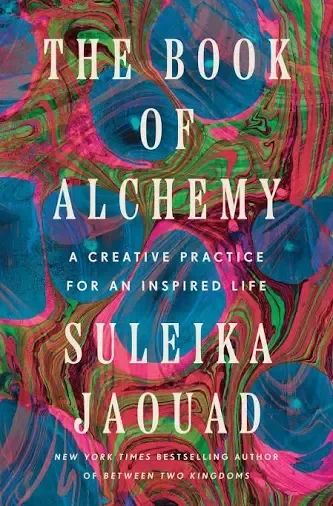
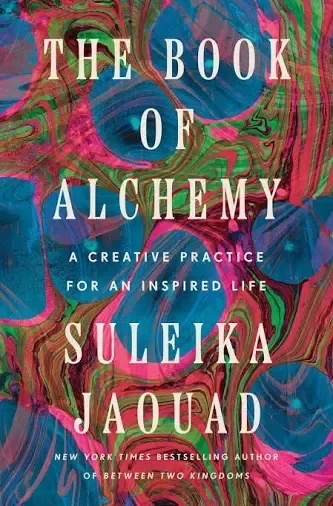
One of the best books I read last year was “ The Book of Alchemy” by Suleika Jaouad.
“The Book of Alchemy” is a unique compilation of essays on essential human concerns such as memory, love, fear, and rebuilding, by the book’s author, interspersed by short pieces on the topic by a range of artists, scientists, business leaders and more. Each short piece ends with a prompt encouraging the reader to think about and ideally write down their answers to the prompt.
Here are three prompts as an example:
What would you write if you were not afraid?
Today everywhere one senses fear. People are frozen doing jobs they dislike, working for people they do not respect, doing things they do not want to, all because of the very human emotion of fear. This prompt gets one thinking on the topic.
“You just have to be one percent more curious than afraid” Suleika Jaouad
“You don’t have to be particularly brave. You just have to be a tiny, tiny bit more interested in something than you are frightened of it” Elizabeth Gilbert.
Goodbyes make room for something new.
And
“And as an artist, it was my biggest epiphany-that the most civilized thing we can do as a human is to change the story. We can always, always, change the story.”
Think of an inherited story that needs your changing-in your own life, in your family, in your hometown, in your country. How was it told to you? How will you tell it differently?”
This is a prompt that reminds us that we all have agency. That we can determine how our stories are written and not let others take the wheel of our life’s journey. That the histories and traditions handed down over the centuries can be interrogated, questioned and changed.
We can change our own stories.
And
“How are you really?”
Next time when we ask someone how they are and they say they are fine, we might consider following up with the question above.
Or write down the answer on how we are feeling internally despite the external brave face and our answer that everything is okay.
The book is ostensibly one that encourages journalling. The ritual of writing every day on a topic or topics of our choice. The prompts help one overcome writers block and provide stimulus for writing.
It helps us create rituals and in the ritual often is the meaning.
“Writing is how I translate my life to myself. And I have given my life a voice by writing it down.” Ann Parsons Story.
But this book is about much more than writing or journaling.
It is about paying attention to life as it passes by. Of taking time to think and feel and consider versus respond. About seeing, noticing and observing.
One of the prompts asks us to remember the ten images that defined the day. If at the end of every day we knew we had to make such a list, would we not pay more attention?
For it is between the stimulus and the response that we are uniquely us.
‘Between stimulus and response, there is a space. In that space is our power to choose our response. In our response lies our growth and freedom” Victor Frankl.
And here is another reason to get the book. You can ask your favorite Alien Intelligence to respond to each prompt. And the response makes you also think.
Here is one prompt in the book that I asked Claude 4.6 to respond to.
Write about a time when you had a pressing question and nature provided the answer?
Claude’s answer below also came with a title “What the River Knew.”
What the River Knew
There was a summer when I couldn’t stop asking the same question: Is it better to hold on, or to let go?
It sounds abstract now, stripped of context. But at the time it had weight and edges. I carried it the way you carry a stone in your pocket — always aware of it, fingers returning to it without thinking.
I had driven to a river without any particular intention. Just the vague instinct that moving water might unstick something in me. I sat on a flat rock at the bank and watched.
The river, I noticed, didn’t deliberate. It didn’t choose to release the leaf that had fallen onto its surface. It simply moved, and the leaf moved with it. But the rock I was sitting on — the river moved around that, reshaping itself, carving new paths, neither surrendering to the obstacle nor pretending it wasn’t there.
I watched this for a long time. Probably longer than anyone should sit watching a river, looking slightly unhinged from the bank’s perspective.
And something clarified: the question I’d been asking was wrong. It wasn’t hold on or let go — as if those were the only two dignified options. The river suggested a third way. You could be changed by what you meet. You could route around it. You could, over enormous time, wear it down entirely. But you didn’t have to resolve it into a single clean act of grasping or releasing.
I drove home still carrying the stone. But it felt different in my pocket — more like a keepsake than a burden. The river hadn’t answered my question. It had quietly replaced it with a better one.
Nature has a way of doing that — not solving our problems so much as reframing them until the original urgency loosens its grip.
A compelling answer from Claude 4.6
But now a little extract from a human, the late John Binkley who after losing his wife Sherrie after 46 years of marriage began writing letters to her after she had succumbed to a 3 year fight with cancer.
One of the pieces in Suleika’s book is an extract from a letter in a piece called “Across the Gulf of Space Time”.
He speaks about how they worked together over three years to fight together against her cancer…
“Damn the skeptics. Crush the fences. Transcend the static, whatever the interferences, to enable us to carry on the teamwork. The oneness. I don’t need to understand it to embrace it. To live by it. To profit from it. There are no rules. No tracks on the snow on this one.
Be patient, Sherrie, with my learning how to do this. Show me once more the tolerance that has marked our 46 years together, from the beginning.
I love you.
Pook.”

Staying Human in the Age of AI.

Image by addyfe (UrbanOrigami) using Midjourney.
A few days ago at I delivered a keynote at a SAP event at their US Headquarters in Newtown PA on Staying Human in the Age of AI. Nearly 2000 people comprised of technologists ( primarily enterprise architects) from the top 1000 global companies and leaders of SAP listened to the talk in person or via streaming.
The talk resonated and was highly rated.
Earlier this week Tim Clark wrote an article summarizing the keynote for ASUG website and newsletter. (ASUG is the only SAP customer user group officially partnered with SAP, connecting members directly to SAP expertise and innovation).
I am republishing the article and the video of the talk with permission from Tim Clark the writer and SAP.
Artificial intelligence is not just another wave of automation. It is not another productivity tool. And it is not merely the next phase of digital transformation.
According to Rishad Tobaccowala, who presented at the recent Next Generation SAP Enterprise Architect Learning Forum at SAP headquarters in Newtown Square, Pennsylvania, it is something far more profound.
“I believe, with everything we already know, AI is still under-hyped,” said Tobaccowala, an author, speaker, teacher and advisor with four decades of experience helping people and organizations reinvent themselves.
That’s a striking claim in a world saturated with AI headlines, market volatility, and bold predictions. Yet Tobaccowala argued that most leaders still fail to grasp the true scale of change underway. To explain why, he first reflected back on 2019.
A Prescient Warning
When Tobaccowala wrote his first book, Restoring the Soul of Business (which was published in January 2020, just before the pandemic), its subtitle centered on “staying human in the age of data.” The original working title, he notes, was The Story and the Spreadsheet. His publisher, HarperCollins, ultimately went in a different direction.
What’s notable is not just the book’s success, but its timing. Released more than two years before the launch of ChatGPT 3.5, the final chapter already addressed AI. As generative AI entered mainstream consciousness, readers began interpreting the subtitle differently—as being not merely about data, but about staying human in the age of AI.
Today, Tobaccowala’s thesis has sharpened: this is not incremental change. What AI is bringing about is structural.
AI Is Not an Extension
Every major technology in history has extended human capability. Fire extended physical power. The printing press extended knowledge distribution. The internet scaled information sharing globally. Social media turned individuals into publishers.
“All technology up to now has extended the human brain,” Tobaccowala explained. “My basic belief is AI creates a new brain. It’s not about extending our brain. It’s a new brain.”
Previous technologies amplified human cognition. AI introduces a parallel form of cognition, he told attendees at the event, that operates independently and at speeds beyond human comprehension. The implications of this are economic and philosophical.
“All previous technologies enhanced and made valuable knowledge,” he said. “I believe AI will make knowledge completely free and not monetizable. And all of us are knowledge workers.”
The Speed Problem
The velocity of AI development compounds its disruption. Digital advertising, Tobaccowala noted, took roughly 30 years to become the majority of global advertising spend. Moore’s Law predicted computing power would double roughly every 18 months.
When his second book was published just a year ago, AI capability was doubling every 11 months. Now, he says that agentic AI capability is doubling every seven weeks.
“This is the first time that you have a technology that is outstripping human and organizational ability to keep up,” he said. “If anybody basically says, ‘I believe this is what’s going to happen,’ take it with a grain of salt.”
From Artificial Intelligence to Alien Intelligence
At one point in his presentation, Tobaccowala deliberately reframed the terminology, referring to AI as “alien intelligence.”
“The top three reasons today that people in the consumer world use AI is not to make a video or a fake picture,” he said. “The top three reasons are therapy, companionship and self-help medical care.”
In other words, people are engaging with AI systems as if they were human. “It’s not human, but it definitely doesn’t feel like or sound like a machine,” he said.
Extending the metaphor further, AI agents are not simply “agents,” said Tobaccowala. They are “replicants.”
“We are living in a world of aliens and replicants,” he said. “And we are humans.”
Computing Machines Vs. Feeling Machines
In building upon this statement, Tobaccowala reflected that AI systems are computational engines operating in binary logic. Human beings are not.
“Computers are digital, silicon-based computing machines,” Tobaccowala said. “We are analog carbon-based feeling machines.”
Ask a machine a question and it returns a direct answer. Ask a human a question and the response may be layered, emotional, or evasive.
“Human beings are not computing machines. We are feeling machines,” he said.
This distinction has profound business implications, as many technologists model the future on machine logic by assuming humans will optimize decisions purely for efficiency.
But real-world behavior tells a different story. If humans optimized purely for utility, Tobaccowala asked, why wear expensive watches when smartphones keep better time? Why own cars in cities where ride sharing is available? Why choose luxury brands if cheaper alternatives function just as well?
“Humans choose on stories,” he said. “We choose on identity. We choose on design. We choose on desire. People choose with their hearts, then use numbers to justify what they just did.”
That tension between rational optimization and emotional decision-making will shape how AI integrates into markets.
The Work Disruption Ahead
Historically, technological revolutions have created more jobs than they destroyed—over time. But Tobaccowala worries about the pace.
“My biggest fear is organizations are moving too slow,” he said. He expects 20-30% of current tasks to be “machined away” in the near term. That work will not be reassigned to humans using AI. It will simply disappear.
“Half the jobs are cut away because the machines can do it better,” he said. “That part of our job is not going to be done by anybody.”
While new roles will emerge, the transition could outpace institutional adaptation.
“No organizational design is setting up for the other world,” he said.
Alien Intelligence Plus Human Intuition
Despite the disruption he anticipates, Tobaccowala remains optimistic.
The future, he argued, belongs not to AI alone but to a combination of AI and what he calls HI: human intuition.
“Human intelligence is overrated,” he said. “It’s long been beaten.”
Instead, Tobaccowala emphasizes four uniquely human strengths: intuition, insight, imagination, and interaction.
“Only messy human beings can connect with messy human beings,” he remarked, offering an example from health care.
AI tools may analyze scans with remarkable accuracy, yet patients still want human doctors to deliver life-altering news.
Embrace, Adapt, Complement
For individuals navigating this shift, Tobaccowala proposed a three-part framework: embrace, adapt, complement.
First, embrace AI. Learn it. Understand it. Accept that it is transformative.
Second, adapt. Some portion of current work will vanish. Clinging to outdated roles is futile. “Between 20-30% of what we currently do is going to be machined away,” he reiterated.
Third, complement. Identify how uniquely human capabilities integrate with machine strengths. Tobaccowala rejects the notion that workers will simply lose jobs to other workers who use AI.
“That’s like telling a horse you’re not going to lose your job to a tractor. You’re going to lose your job to a horse who learns how to use a tractor,” he said. “That’s nonsense.”
Some work will disappear entirely. The opportunity lies in redesigning roles around what machines cannot replicate.
Efficiency Is Not the Strategy
Many enterprises focus narrowly on AI-driven efficiency and effectiveness. Cost savings. Productivity gains. Faster processes. Those improvements are measurable—and necessary. But Tobaccowala argued they are not where true advantage lies. “The real opportunities and threats are not going to come from being more efficient or more effective,” he said.
Instead, leaders must consider existential opportunities and threats.
Tobaccowala pointed to the shipping container as a historical example. Standardized containers revolutionized global trade, not merely by improving shipping efficiency but by reshaping entire cities, industries, and supply chains.
Similarly, in media, some newspapers optimized printing processes while others questioned the premise of print itself. Today, The New York Times has transitioned from 1.8 million print subscribers to roughly 12 million digital subscribers, evolving into a multimedia platform spanning audio and video.
Roots and Wings
Large organizations, Tobaccowala noted, cannot rely solely on yesterday’s strengths.
“There’s going to be some combination of yesterday’s you, which I call ‘roots,’ and tomorrow’s you, which I call ‘wings,’” he said.
AI capability alone is not a differentiator. It is infrastructure, much like electricity. What differentiates companies is how they integrate that infrastructure into new value creation models.
He pointed to emerging AI-first companies generating millions in revenue per employee as signals of a new operating model. The question for established enterprises is not whether they will remain important, but whether they will evolve.
Importance of Optimism
Despite the immediately incoming volatility that AI promises, Tobaccowala’s outlook is not dystopian, he said. “Human beings adapt,” he said. “Human beings are resurrection engines.”
Every technological upheaval has triggered fear. Every era has also generated new forms of wealth, opportunity, and innovation. AI, he believes, will cure diseases, expand access to knowledge, and create economic growth. But it demands self-reinvention.
“It’s never too late to invent tomorrow,” he said.
Staying human in the age of AI is not about resisting alien intelligence. It is about upgrading human capability, leaning into intuition, imagination, and emotional intelligence.
Here is the 35 minute talk as delivered:

“There is no room for small dreams.”

For the past five years I have been the host of a podcast called What Next? speaking to leaders, pioneers, authors, artists, scientists and many others on what is coming next in their fields and what we should prepare for.
We have recorded over 168 episodes, and it is ranked among the top one hundred global podcasts. What Next? was the idea of Chris Harrison a senior leader at the Publicis Groupe who also served as the initial show runner. While the show is produced by the Publicis Groupe, ninety percent of my guests are external. It is free to subscribe to and also free of advertising and available on all global platforms. Each episode is tightly edited by Gilly Smith an expert food writer and podcaster to less than 40 minutes to fit into the time someone may commute or work-out. Currently Camilo Miranda based in Costa-Rica is the show runner and George Turner engineers the podcast from London.
This week for the first time after 168 episodes we are republishing an episode with Maurice Levy who was the CEO and Chairman of the Publicis Supervisory Board for a couple of reasons:
1) 2026 is the 100th anniversary of the Publicis Groupe and many people might be interested in the four or five key turning points that transformed how a small French company became the most valuable, fastest growing and the largest of the marketing communication service companies until the recent Omnicom and IPG merger.
2) Today as the world changes fast and every company and industry is challenged, what learnings can we take away that can be used both by leaders and individuals to thrive?
The majority of the conversation is not about Publicis Groupe but about how to manage change, think like a start-up, the meaning of trust, how to embrace and overcome failure, how to stay forever young, the importance of passion and much more.
These days we all need an injection of optimism and a call to arms and here is a conversation that will leave you inspired with actionable steps regardless of your industry or your level of seniority.
Here is a small sampling of what you will hear:
1. No Silo. No Solo. No Bozo: This is Maurice as a copywriter.
No Silo: Organizations can no longer have silos. While we did not talk about AI at all it is clear that orchestration becomes the key in an AI age where sales, marketing, and CRM merge as does creative, data and tech.
No Solo: Teamwork has always been key and even more in a connected world, fluid, and shape-shifting world.
No Bozo: Nobody regardless of their skill, client relationship or budget control can be allowed to behave like a bozo. Cemeteries are filled with “irreplaceable” people but the world goes on.
Moving to such an organization however takes many years since human habits are ingrained. Arthur Sadoun who took over from Maurice Levy nine years ago has launched many initiatives that has led to today’s success, one of which was a country and client focused versus brand focused model which unleashed the potential energy that had been built and stored in Groupe.
2. Think like a start-up: Regardless of the age or size of a company the only way to remain relevant in changing times is to think like a start-up. Well into his 8th decade Maurice Levy launched a start-up called VivaTech into being. Today it is the largest technology conference and exhibition in all of Europe combining CES and Davos.
3. Forever Young: Youth is a mindset and not just an age. It is never too late to reinvent, to learn and to take chances.
4. Trust cannot be measured: One cannot trust someone 10% or 80%. Trust is binary. You trust someone or you do not. The best way is to begin by trusting everyone until they prove different. Without trust there is no speed or high performing team.
5. Dare to fail: Daring is key. Willing to fail and embracing and learning from failure is critical. Maurice shares his biggest failures and what he learned from them. Failure is an option. If it is not, then very few new companies or re-inventions would ever have been launched. Maurice shares his daring moves after the dot com melt down and financial crisis.
6. Optimism is key: One has to be positive if one is to pioneer or persevere. A key is to look at challenges as obstacles that one has to overcome versus problems that cannot be solved.
7. Think higher. Feel Deeper. It is key to have great passion and to strive for excellence. Benchmark against the best. While one may need to have our feet on the ground our heads should be in the clouds as we reach for the stars.
Life is too short to think small or settle for less than excellence.
There is no room for small dreams.
Much more wisdom and inspiration in just 39 minutes.
You can listen to the conversation on any podcast platform globally but the links to the Apple and Spotify streams are available here:
On Spotify:
On Apple:

Finding Career Fit For An AI Age.

Image by Scentofmoment via Midjourney
Many months ago I was given early access to the beta version of a new service which promised to help an individual better understand themselves and find ways navigate their career in ways that were aligned with and fit their personality.
Trying the beta version I was surprised at not only how easy and fast it was to use but also how accurate and revealing it was.
Today the service called myTrudy is available to everybody for free to try at myTrudy.Com
It will provide a person with their PQ which is personality quotient in less than five minutes.
It became clear to me that myTrudy’s Personality Quotient approach would be important in the AI Age where what we know and what we have done will become less important than who we are and what we can become!
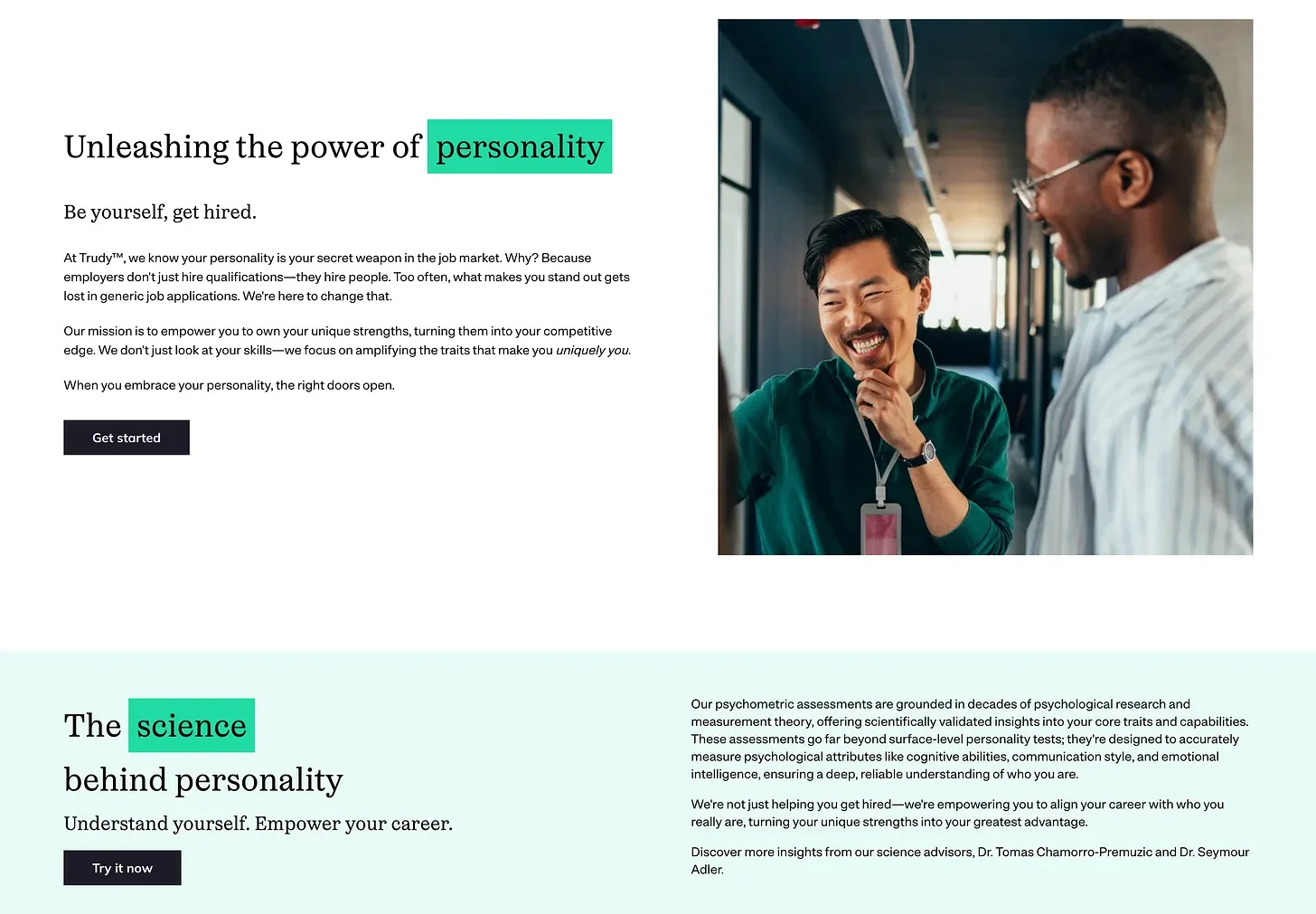
This week on The Rethinking Work Show Avi Steinlauf the CEO and Co-founder of myTrudy and Tomas Chamorro-Premuzic another of the Co-founders share the science, the thinking, and the ways their service can augment an individual in finding fit while also helping companies find the right talent that fits their firm.
Avi most recently was the CEO of Edmunds.com. Tomas is an international authority in people analytics, talent management, leadership development, and the Human-AI interface. He is also Chief Science Officer at Russell Reynolds Associates. The other two founders of MyTrudy are Peter Steinlauf and Dr Seymour Adler. Peter Steinlauf acquired Edmunds Publications in 1980 and launched Edmunds.Com in 1995 which grew to be the pre-eminent automobile site before being sold to CarMax. Dr. Seymour Adler has been awarded the Distinguished Professional Contribution Award from the Society of Industrial and Organizational Psychology in recognition of his career-long and global impact on talent assessment and development practice.
Encourage listening to or watching the entire conversation with Avi and Tomas but here are some key insights and provocations:
1. Who we are is an under-rated determiner of future career success: Our success is t based not just on our IQ or EQ or TQ(Technology Quotient) but also on our own personality or PQ ( Personality Quotient). Today in an AI age, IQ and TQ are often being outpaced by machine intelligence making EQ and PQ more important.
2. The new PQ test identifies five key traits and reveals three keys to career success: The five traits are agreeableness, conscientiousness, how extroverted one is, how open one is and emotional stability. Three keys to future career success are SDL where S is smart and ability to learn, D is drive or ability to work hard and L is likability or ability to get along with others.
3. Reinvention will be the key to career success: As we work with Alien Intelligence (AI) and Replicants (Agents) our ability to reinvent what we work on , how we work and most important how we learn and unlearn will be key. As will our ability to persist, adapt and work alongside and collaborate with messy humans. To reinvent ourselves for the future of work we will need to understand ourselves.
4. Beyond the Resume and LinkedIn: One’s resume and LinkedIn profile while important are backward looking in a world which moves forward and companies focus on hiring for future potential. A LinkedIn profile is the road we have travelled while our personality and PQ serves as a GPS to help us navigate the next turn in our career journey.
5. PQ will be key for for a world of work versus a world of jobs: We may have passed peak full time jobs in many countries but not peak work opportunities. As companies in an AI age focus on getting work done versus filling jobs, and many individuals through choice or circumstances pursue portfolio careers, a key to success will be fit. What work fits us. How can companies fit work to the skill and the personality of the candidate? How can individuals look for opportunities that fit us versus searching for jobs?
6. Persistent Career Blueprint we can all own: While the world changes fast our personalities do not. But how should we architect, sculpt and hone ourselves to remain relevant ? One way is to sprout wings around the roots of our true selves which is our personality. PQ is part of the persistent career blueprint we can all own.
Listen or watch the entire episode. It will be 40 minutes that will make you think differently about your future career, how to manage your team and how to hire for your firm. And you can access MyTrudy and the free Personality Quotient test here: https://mytrudy.com/
YouTube:
Apple Podcast:
Spotify: