Silicon and Soul: Be the Most Human Person in the Room
As I close in on the 300th edition of this thought letter (this is #296) I am introducing two new initiatives:
Guest posts: An occasional guest post by someone who I know well who shared a thought or idea that I wish I had come up with and who is willing to write about it on this platform. Today’s guest post is by a long time friend David Armano who I first came to know when he was a senior executive at Edelman. David is a true pioneer including in digital and social media. Recently, David has been writing and thinking a lot about how to thrive as a human in the Age of AI.
One single thing: Time is the only thing we have. Today we are overwhelmed with content. I never take for granted the 32,000 plus readers of this Substack who take 3 to 5 minutes of their time every week to read my writing. Starting today at the end of every post I will suggest and link to one single thing that I came across the previous week which I believe might leave the reader or viewer changed.
Today I feature a seven minute twenty second video called Retirement Plan which might just change the way you live your life.
And now here is David Armano:
Silicon and Soul: Being the Most Human Person in the Room
“Once upon a time, I was considered one of the smartest people in the room. At least in some rooms, some of the time. This is no longer my goal. But I know I am in good company. One of my mentors, Neil Clemmons, who worked for companies like Apple before we crossed paths professionally, was also considered one of the smartest people in the room. In fact, our former Critical Mass colleagues nicknamed him “Google” because of the wealth of knowledge he wielded at his fingertips.
Today, Neil remains in my orbit—and the orbit of other professional peers, not because he’s exceptionally intelligent (he is) but because he also takes a genuine interest in people’s lives. The same can be said for our host, Rishad, who so graciously is sharing his platform here.
It is with great intention that I start my own thought sharing here by highlighting the influence of mentors, because in this age of AI, where access to vast amounts of knowledge, expertise, and even capability lives on the other end of a simple chat—our remit as both leaders, employees and even grey collar polyworkers needs to shift, from being the smartest person in the room, to the most human person in the room.
The Most Human Person In The Room
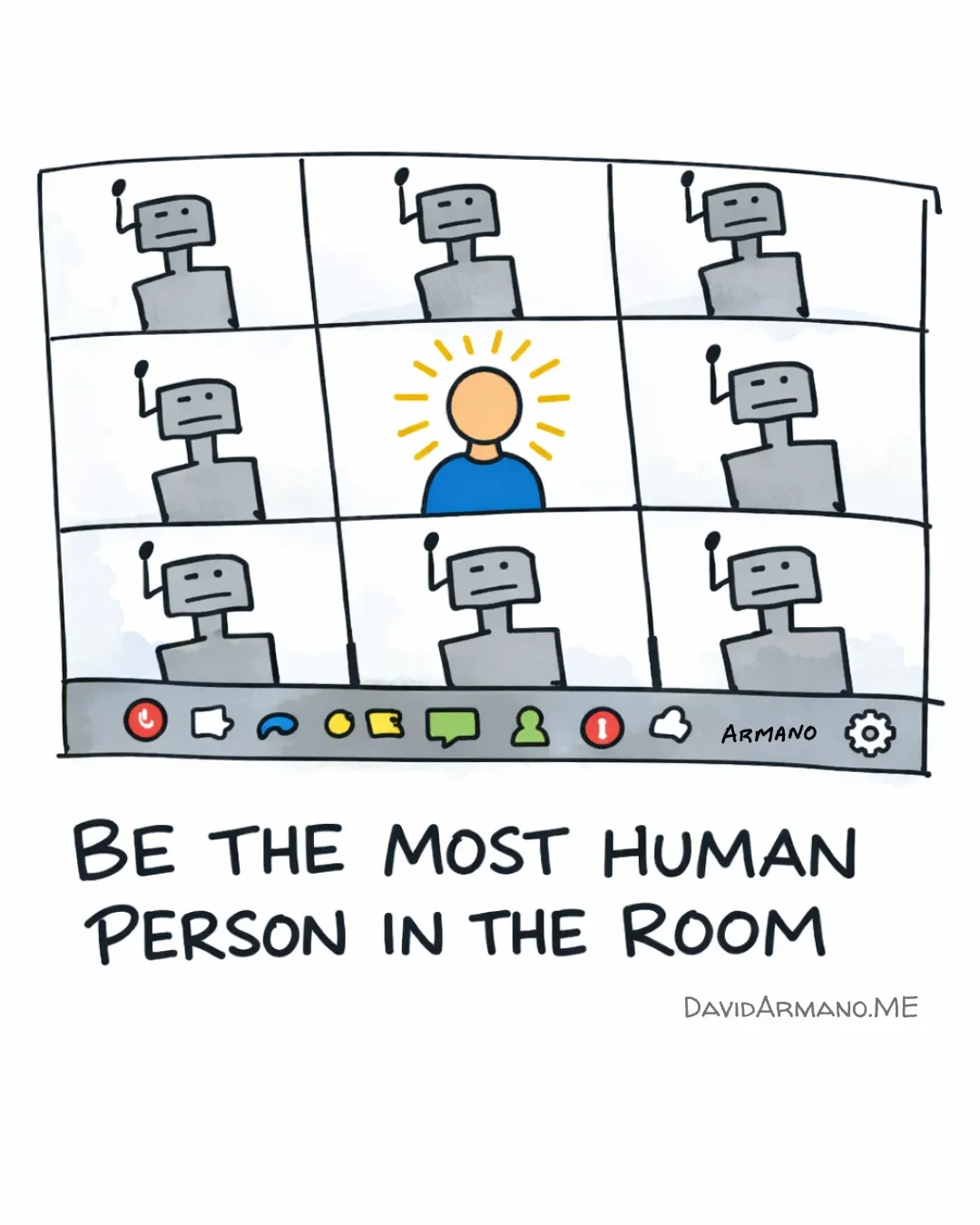
These days, I strive to be the most human person in the room (or Zoom). The reason is obvious—I don’t need to tell you that knowledge and knowledge work are rapidly becoming a commodity. In tech circles, there’s something of an ongoing inside joke—yesterday’s NFT enthusiasts are today’s AI evangelists, AKA “Tech Bros”; tech-optimistic Silicon Valley insiders who are sufficiently read up on the latest AI essays. Tech Bros are now being referred to as “Taste Bros” because of their embrace of the popular philosophy that when AI makes knowledge and knowledge work more of a commodity, what’s left for us humans are things like taste, judgment, discernment, etc.
But the “Taste Bros” are presenting a facsimile of what it is to be human. They treat “taste” as another asset to be optimized—a curated shell of preferences that still feels like a performance. Being the most human person in the room isn’t about having the most refined aesthetic or the right “takes” on the latest LLM; it’s about the things a machine has no interest in: empathy, vulnerability, and genuine generosity.
Knowledge Work vs. Relationship Work
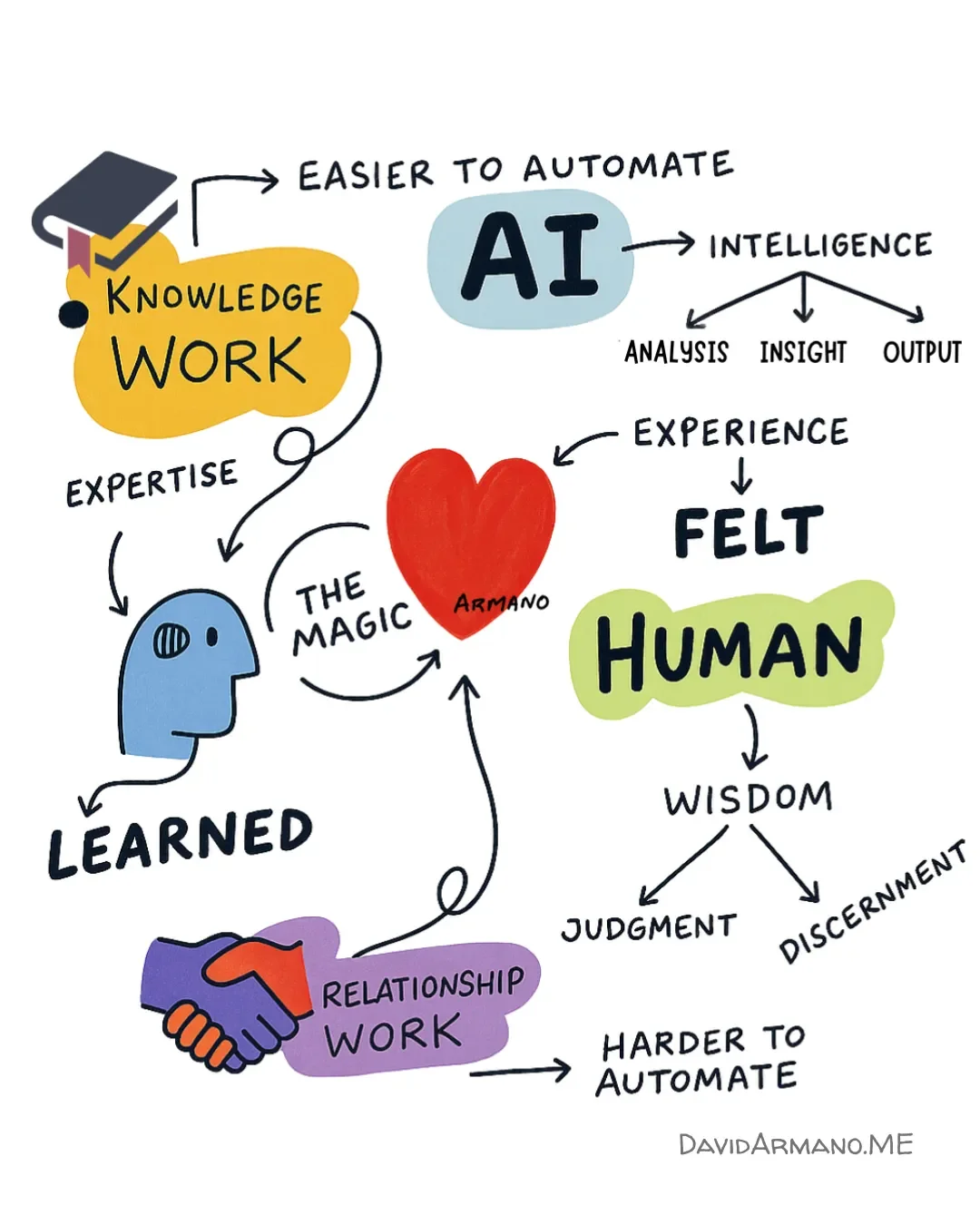
For decades, the “Knowledge Worker” was the hero of the information economy. Success was defined by the ability to acquire, process, and deploy information. However, we are entering a “post-knowledge” era. When an LLM can synthesize a 100-page strategy document in seconds, the act of processing information is no longer a human value-add—it’s a utility.
The new frontier is Relationship Work. This isn’t just “networking”; it is the high-stakes labor of building trust, navigating office politics with empathy, and managing the irrational, beautiful complexities of human emotion. The data suggests that while “hard” knowledge is being automated, the “human” element is becoming a premium.
According to my professional alma mater at Edelman, the folks behind the Edelman Trust Barometer, as people become more skeptical of AI-generated content and “faceless” corporations, the value of a trusted, human relationship increases. We don’t want to be “managed” by an algorithm; we want to be led by a person.
In this age of abundant intelligence, there’s something to be said for social skills becoming a premium. Research by Harvard education economist David Deming shows that since the 1980s, nearly all job growth in the U.S. has occurred in occupations that require high levels of social skills. Jobs that require high analytical skills but low social skills have actually seen a decline in the share of the labor force. We’ve been on this trajectory for a while—the AI Age is simply adding rocket fuel to it.
Magician vs. Expert
True story: Another former colleague once said something to me that stuck. We were having a working session, and something I regularly do is take to the whiteboard to synthesize thoughts, strategies, and plans. After a few hours, my former colleague looked up at the marker-filled whiteboard, then looked over at me, and said: “I love watching you work—it’s like watching a magician”. To be transparent, at the time, I did not see it as a net positive. I was always self-conscious as a highly visible executive, and I would have preferred that my efforts be described as something other than magic.
Today, I feel very different. I am often the first person to step up to the whiteboard in the boardroom, and I practice a form of active listening that captures the signal amid the noise as executives debate ideas. They, too, pause to look at my output on the whiteboard and express wonder. They see it as magical, special, and unexpected.
I see it as human.
I was sharing the above story with Mike Rohde recently, who leads a community of “sketch note” artists in his spare time. He asked me for advice that I could give to practitioners of this craft, and I shared two things:
1. Use today’s AI tools to do remote sketch noting faster, better, and more efficiently.
2. Dial up your presence when you are in a physical room. Be remarkable, be memorable, and be more than what you put up on the whiteboard/panels.
In other words, be the most human person in the room—to the fullest extent possible.
AI can give you the notes, but it can’t feel the music. It can fill a whiteboard with data, but it can’t create the “wonder” that occurs when a human captures a shared truth in real-time. But here is the secret: being the most human person in the room is not a solo performance, and it cannot exist in a silo. It is an act of human orchestration. I was recently reminded of this while having coffee with Sameer Kamat, who has served as a CEO and is currently a senior leader at a venture equity firm. He reinforced with me that human orchestration will remain the most impactful way to get executives in a room to align and coalesce around common goals and ideas.
In short, on a good day, AI informs and enables. Humans persuade, inspire, and lead.
When you lead with vulnerability, insight, orchestration, and radical generosity, it becomes contagious. Your humanity grants others permission to lead with their own humanity. This is how you move a team from a collection of “efficient processors” to a symphony of inspired contributors. The experts are worried about being replaced by the machine. The magicians are too busy connecting people, building relationships, and doing what humans do best.
Choose the magic, choose the orchestration, and be the human who makes the room (or Zoom) more human.”
David Armano
One Single Thing.
What make us human is that unlike machines we are finite and are aware of our temporary nature.
While Silicon and Soul may live for ever we will not.
Franz Kafka wrote “the meaning of life is that it ends”
If there is one single thing I would recommend this week that will leave you seeing the world and your work differently is this seven minute video which was a short film Oscar nominee called “Retirement Day”.
Even if you are three decades away from retirement watch it.
It not about retiring.
It is about living.
It might change you.