From Caterpillar to Butterfly.

Image via Mid Journey.
Every individual, team and firm has the ability to transform.
Six learnings.
1. The future does not fit in the containers of the past.
We are all interested in the future since we will be spending the rest of our lives there.
And the future by definition is unknowable since it is yet to unfold.
From organizational structure to how markets are organized, the existing ways of doing business have been optimized on what has come before. The challenge for most of us is to realize that the future refuses to be contained in the containers of the past whether it be media, money, markets or mindsets.
Future prognosticating is often aligned with crystal ball gazing, scenario planning and blue-sky thinking. We look ahead and above. We watch market leaders and todays visionaries and time after time we are surprised that the future did not come from where we were looking but from those we looked down upon or were outside the “velvet rope” or who never appeared on our radar.
The future came from the slime while we looked for signs from the heavens.
The biggest threats and opportunities come from outside one’s categories.
2. Change sucks. But irrelevance is even worse
Adapting to the future requires change.
Change is neither good or bad but difficult.
Change sucks.
It requires one to step into the unknown.
To twist and turn into a new transformed self, team or firm. To leave the safety of the known path. Lift anchor and sail into a foggy horizon with no guarantee of safe harbor.
Difficult as it is…
Irrelevance is worse.
Individuals, teams and companies that wish to transform must endure change.
3. Companies do not transform. People do.
Michael Tyson said, “Everyone has a plan till they get punched in the face”.
Boards and leadership of firms come quickly to the realization that everything is easy until people get in the way.
Technology moves fast but people move slow.
Technology is clean but people are messy.
Telling people that change is good, threatening them with job loss if they do not change or creating communication materials and slogans to goad them into a cult like devotion to the new dear leader or the way forward rarely works in the short run and will likely fail after the threat of flagellation fades.
Too many companies are focussing on efficiency, effectiveness and enterprise technology versus talent and existential opportunities and threats to re-imagine their businesses.
If we want our organization or our teams to grow and change we will need to deliver answers to four questions to our teams:
Why are the recommended changes good for them?
How can they help us re-imagine the company to grow ?
What are the monetary or other incentives to change?
When and where will training be provided to help them learn the new skills needed?
Change does not happen because of M&A, press-releases, re-organizations, or announcing this or that AI partnership.
An organization changes and grows when the people in the organization change and grow.
4. The turd on the table.
To transform people need to face reality.
We need to call out the turd on the table.
It is something that is brown and moist, and people know it is a piece of poisonous waste, but they pretend it is a brownie. They are aware of the stink but perfume over the aroma. Here are some flavors of turd:
Toxic cultures. Organizations are highly defensive about their cultures, even when they become cult-like and inflexible or fear-driven. Telling a leader that the culture has become poisoned requires courage.
Major industry shifts. A leader may refuse to address big changes in customer behavior, or the competitive landscape, or mammoth technology changes requiring tough decisions (such as Kodak and digital emergence). It’s easier to rationalize or deny shifts than articulate the business-altering trend and the need for rethinking everything. Today like never before every industry needs to be re-imagined.
People problems. The boss or some person with influence is acting like a jerk, or is playing favorites, or is blind to internal or external developments. In many ways, this is the biggest turd on the table, in that it requires confronting a powerful individual about his or her issues.
5. Upgrade ones mental operating system.
In our pockets we all carry a device that has upgraded its mind 17 (Android OS) or 18 times (Apple iOS) in the past 18 years.
These same mobile devices contain applications from Open AI, or Google, or Anthropic, or xAI or some other frontier models which are improving themselves constantly and doubling their capability every few months.
How many times have we upgraded our own mental operating systems in the past 18 years?
If the future does not fit in the containers of the past then it also does not fit in the mindsets of the past.
Successful people and successful companies rarely get defeated by others.
Rather, they sometimes defeat themselves because they fail to change their frameworks, worldviews, mindsets and approaches as the world changes around them.
Their strategies go stale.
A definition of strategy is “future competitive advantage”.
Thus any company or leader working to a strategy that is more than five years old should revisit the assumptions they made years ago about the future. In a world of AI, Generational Ruptures, New Globalization and Technology that has empowered consumers and customers with “God-Like Power”, many firms may may be operating on an irrelevant picture of the future.
The future does not bend to us. We have to bend to the future.
We have to upgrade ourselves to remain relevant and not just be up to date but up to tomorrow.
6. Think like an immigrant.
We are all immigrating to an unknown country called “ The Future”.
We can all learn from immigrants to thrive in this undiscovered country
a) Immigrants often think like outsiders.
Individuals and companies that thrive over the long run view their business from external perspectives and not just internal perspectives.
They understand the viewpoints of future competitors, changing consumer and customer needs and they realize the biggest threats and opportunities come from outside their categories ( eg. Tesla and Uber came from outside the traditional Auto Industry, Google and Meta changed the content industry more than any newspaper, magazine or television conglomerate).
But many leaders and businesses benchmark against existing competitors, go to the same conferences, and stay in the lane of well trodden paths of thinking.
Maybe its time to think like an outsider.
b) Immigrants often think like underdogs.
Underdogs use technology, drive, and ingenuity to find ways to leverage what they have or what others have to change the rules of the game.
They do not view the moat surrounding the castle as a something to navigate but a source of material to flood the castle with by changing the rules of the game!
Today AI is the slingshot that allows David to bring down Goliath.
Even Meta was surprised that what they thought was a moat which was their social graph was used against them. TikTok practiced asymmetric warfare by eschewing the social graph and replacing it with an interest graph. Its algorithm and learning loops allowed individuals to be exposed to a spectrum of great content without having to bring any friends or create any content!
c) Immigrants think with an emphasis on the future.
Short or mid term sacrifices and pain is endured to build a future for themselves and families just like great companies think beyond the quarter and the year but in long time periods.
These firms and leaders focus on compound improvement, constant iteration and experimentation and an enduring long term vision whether it be Amazon or Microsoft or Netflix or recently Delta who by taking the long view became the most valuable and biggest airline.
One Single Thing.
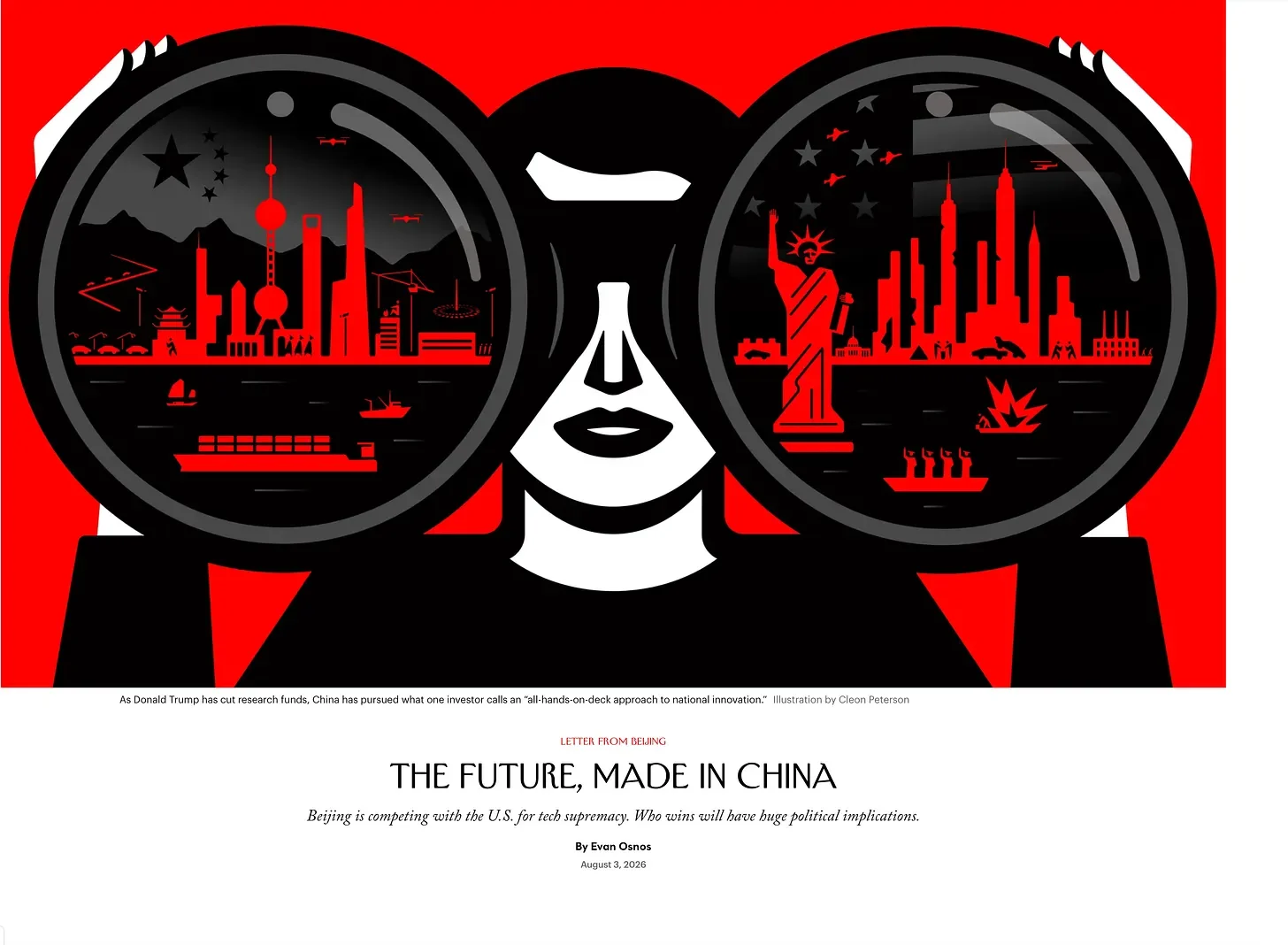
A 12 page article that is a must read if you wish to understand China and how it went from being a caterpillar to a butterfly.
https://www.newyorker.com/magazine/2026/08/10/the-future-made-in-china