Jobs are a phase work is going through.
This past week I had the opportunity to keynote at Transform the big ADP ( a global multi-billion dollar of Human Capital Management Solutions) in Las Vegas and then the ANA ( Association of National Advertisers) Media Conference in Nashville.
While the subject and content of both talks were almost completely different given the audiences of senior HR and Talent leadership at one event and Media and Marketing Leadership at the other, I did repeat one statement between the two talks which resonated with both audiences.
“Jobs are a silly phase that work is going through”
The Human Resource function has historically focused on jobs so clearly they were interested. Given the opportunities for full time jobs in marketing and media are shrinking and many media conferences are career networking opportunities, jobs were also top of mind with this audience.
I do not mean that jobs are silly. In fact jobs are very important and provide people with not just income, but also identity, community, purpose and growth. It is just that we are seeing the acceleration of a trend I first wrote about in my book Rethinking Work…
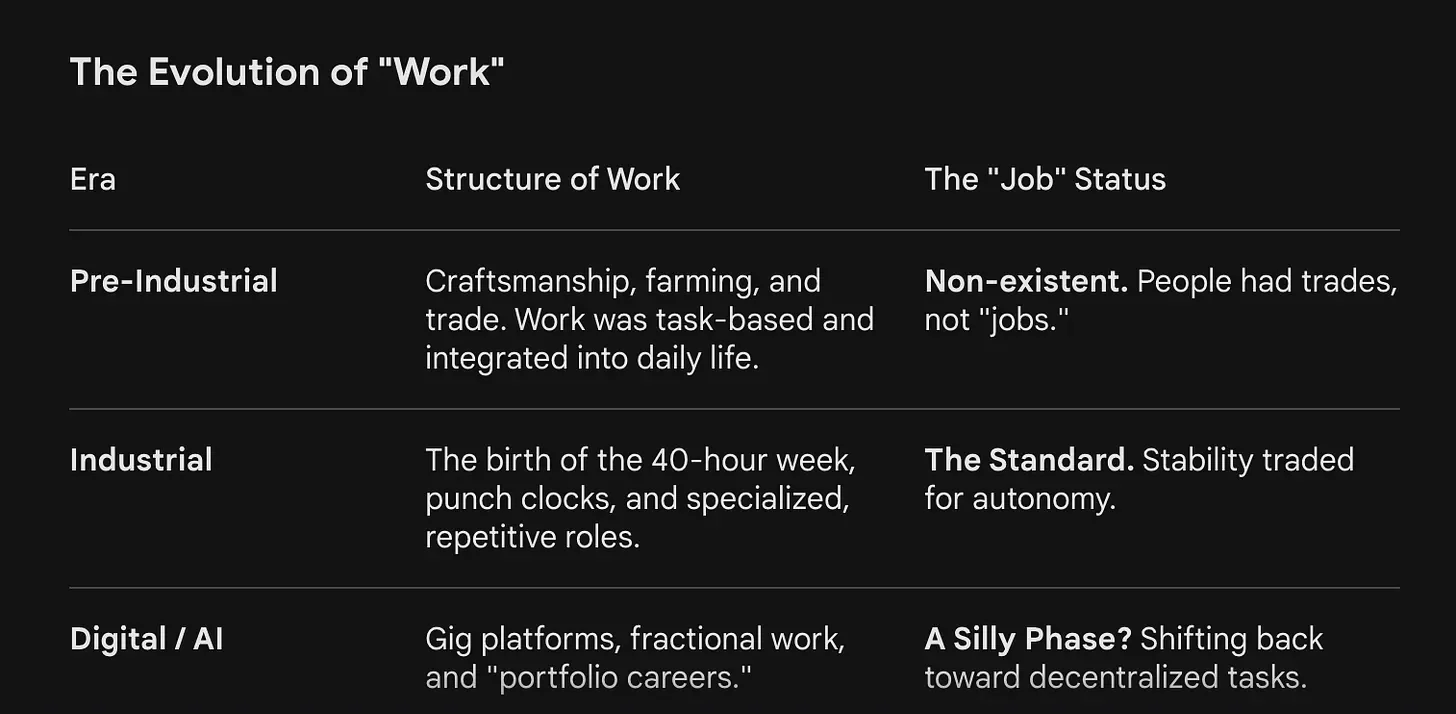
Work and Jobs are uncoupling…
As the chart above shows until the Industrial revolution people had work without jobs and even today 70 million people in the US are free-lancing while 60 percent of people globally work and have an income without holding a job.
In many parts of the world, 2025 will have marked the peak of full-time human jobs.
Individuals have discovered that work can be done and incomes can be earned without holding a full time job. Companies continue to expand use of contractor or part-time workforces, or even avoid hiring a human worker and adopt use of agentic employees (AI-powered workers).
During the recent earnings call at Meta which continues to eliminate thousands of employees every quarter despite stellar results…
“We’re starting to see projects that used to require big teams now be accomplished by a single, very talented person,” Zuckerberg said.
Meta CFO Susan Li said since the start of 2025, “output per engineer has risen 30%, driven largely by adopting AI coding agents, and “power users” have increased output 80% year over year.
Meta did increase employment by 6 percent over the past before the most recent round of cutsbut that pales in comparison to a nearly 24 percent rise in revenue. Most companies from Amazon to EY to Walmart have telegraphed keeping the same number of employees or reducing them despite increased revenue.
The implications of this shift are significant both for society but also for companies which have tended to be organized around filling and managing jobs versus getting work done. As work can get done with fewer full time humans we will see today’s full time jobs being replaced by a mix of a smaller number of full time jobs and an explosion of freelance and fractionalized jobs plus agentic workers.
Just like how people compile playlists to customize music for mood and occasion rather than buying full compact discs or vinyl records, companies are going to compile and access skills and expertise to get work done. Hiring human workers for specific skills to use on term-fixed projects, instead of full-time employment.
This model is widely prevalent in fields such as entertainment where talent gets together around a project whether it be a play, a movie or a tv show and then move on to the next opportunity.
We will all feel the societal impact of the loss of so many full time jobs. In the US, the linkage between full-time employment and health care access will become a key election issue by 2028, if not earlier.
Fewer full time jobs does not necessarily mean less work or opportunity.
The biggest fallacy is equating jobs to work.
We are moving to a world where there will be fewer full-time jobs but more and more work to be done.
Rather than job descriptions the key is to understand the skills needed and how to train for the expertise.
To be work focussed versus job besotted.
Too many companies are architected around jobs versus work.
Many professional platforms like LinkedIn will soon reimagine themselves around helping people find and grow skills for work versus finding and announcing jobs.
AI First and Talent Everywhere Models are eating the competition.
Once upon a time the number of employees had in a firm was a vanity metric.
Now it may be a sign of bloat.
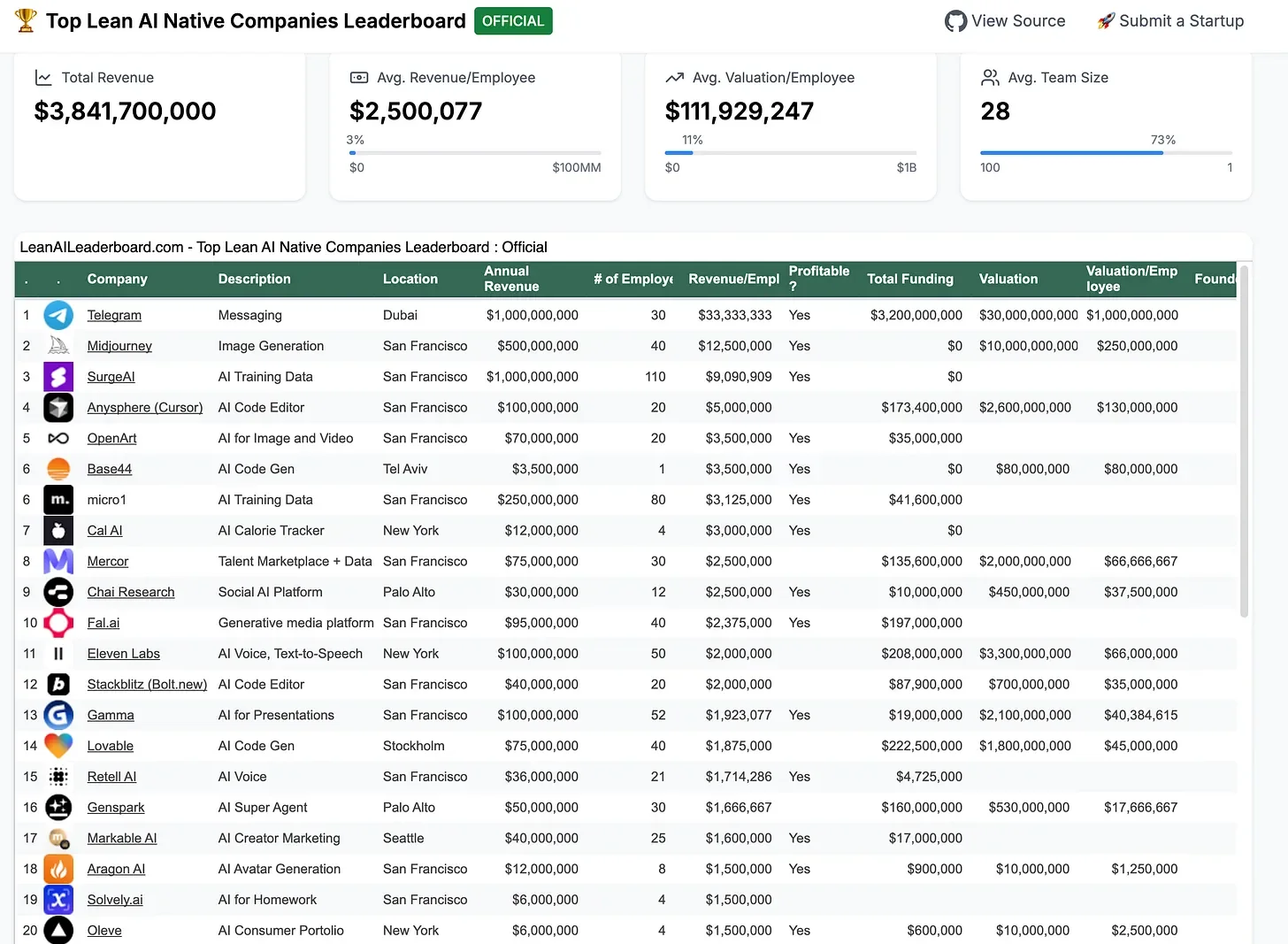
The new metric is revenue per employee.
Above is a chart from Leanleaderboard.com (see above) showing that the revenue per employee for AI focused firms which is just under 2.5 million dollars per employee
For context in the US the average revenue per employee for marketing services companies are around $125,000 or 5 percent of these companies.
A world of far fewer managers and full time employees
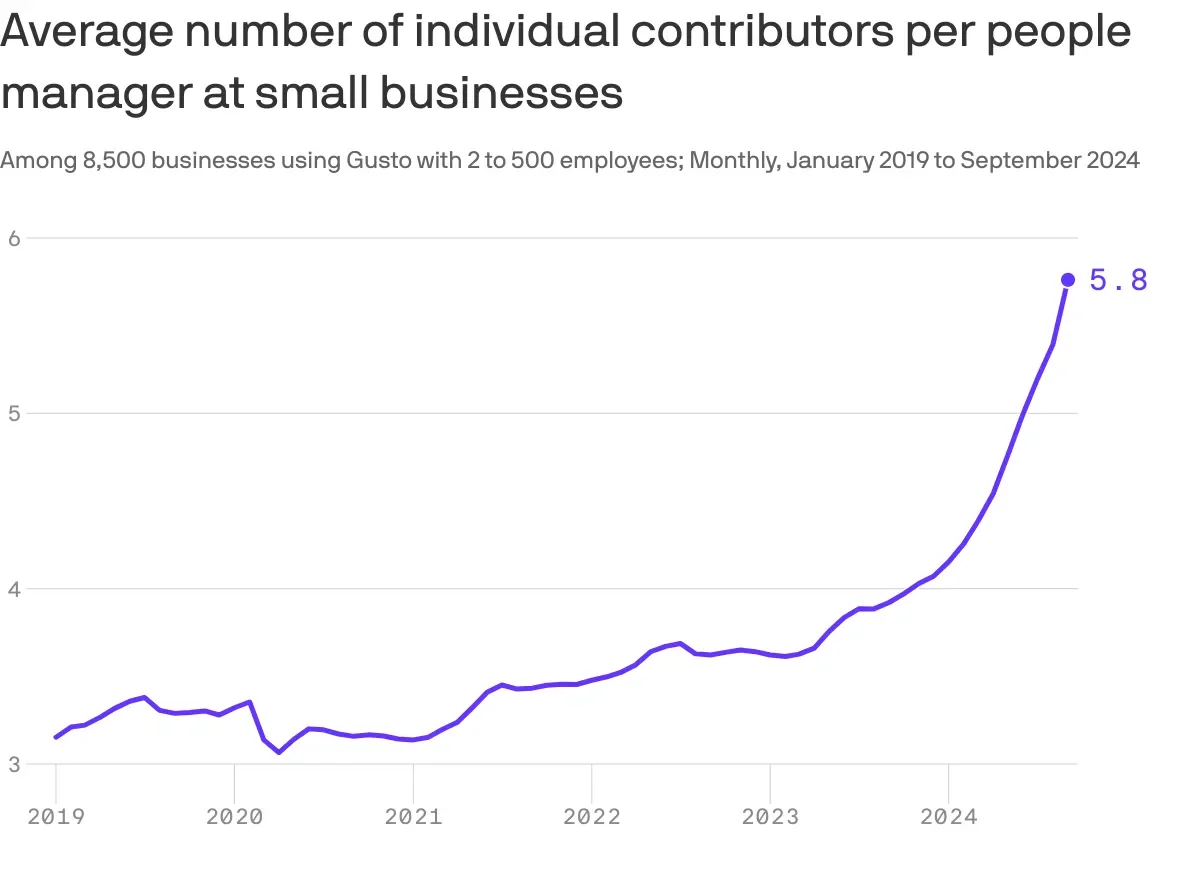
As the world moves from vertical to matrix to a networked eco-system where work is increasingly done asynchronously by distributed workforces, the need for old style managers who allocate, delegate, monitor, measure and check-in is in free fall. Companies want people who create, build, sell, mentor, make, inspire.
Small companies were already doing this as the chart above shows and now large companies are.
The Great Flattening is real.
At the start of this decade most companies’ employees were a mix of full-time employees, contract employees and free-lance employees. Well before the end of this decade the majority of most companies’ employees will be agentic employees and fractionalized employees (individuals with the equity and health benefits of full-time employees, but work for, and are compensated for, 50 to 80 percent of a full-time employee as AI requires less of them and aging populations causes people to work fewer hours).
McKinsey the consulting company today has 40,000 humans and 25,000 AI agents.
Fusing agentic and human work forces is going to be a significant challenge creating challenges when managing and aligning a combination of five types of employees (full time, free-lance, contract, fractionalized and agentic).
Leaders and companies will have to re-imagine themselves when they have fewer full time employees than free-lance, agentic and fractionalized who will have far fewer managers.
The real challenge to AI is less the technology but the re-organization and re-skilling needed around human talent.
How to Prepare
Jobs will still be the main way most people work but increasingly they may not be full time and will require much more effort to retain.
For companies there are three actions that are necessary:
a) Human Resources and Talent Upgrade: HR and Talent need to work very closely with the board level because the re-design of the firm around work versus jobs will be critical to strategy, capital allocation and financial competitiveness. At the same stage HR and Talent need to re-imagine how and what they do for this AI first, Talent Everywhere, Work vs Job focused world.
b) Enabling Fractionalized Employees: Too many companies are failing to realize that there is a way between retaining employees and lay-offs which are creating fractionalized employees. These give people the security and guarantee of monthly income, full time health care and potential equity and bonus upside but pay them 20 or 40 percent less than a full time job for 3 to 4 days of work. This enables companies to retain the range of talent they might require, not have to deal with the corrosive morale and reputational impact of lay-offs and even attract and retain talent who would like to have more time to care for loved ones or do a non-competitive side gig while the company significantly reduces costs.
c) Leadership Retraining: We have entered an age of debossification where managers are being replaced by doers and leaders, overseers by orchestrators, overseers by builders. Often the challenge in the company is less technology and hardware but more leadership and human software.
For Talent there are three actions to prepare for work vs jobs.
a) Embrace Learning and Unlearning : We need to embrace the new tools and learn new skills but also learn to let go of some of our old mindsets as the architecture of world of employment re-organizes around work to be done versus jobs to be filled.
b) Be one’s own HR department: While Talent and HR teams are important they will be focused on reinventing their own careers and dealing with the demands of management to cut costs or reimagine the new world. This is time for every individual to be clear eyed about their career and grab the wheel with both hands and adopt a mindset to maximize career optionality with and without the help of HR.
c) A Company of One: The best way to retain our job and to stay for decades in a big company is to think like a company of one. A company of one is not about being focused on oneself but on constantly honing skills and keeping them up to tomorrow so people will call us for our expertise, on being deeply collaborative in a world where teamwork will grow important and finally building a reputation and network long before one needs it. Too many people confuse their power and fame with the budgets they control or the brand name of their company only to realize that it is the personal skills, reputation and network that really matter and are truly portable.
To learn how to maximize your optionality read A Company of One Series and Career Architecting . In less than an hour you will gain agency over your future.
They will help you soar in a world where work replaces jobs.