Musings.

Appreciation.
Among the teachings of the Stoics is the ephemeral nature of life and the passing of time.
The followers of Wabi-Sabi in the Orient recognize the impermanence, imperfection, and incompleteness of all things.
The Poet Kate Ryan writes of the “joy of finding lost things”
And Carly Simon in “Anticipation” sings that she will stay right here because these are the good old days.
From all these individuals one learns three mental exercises to appreciate what we have:
Imagine a thing you own or a person or place you appreciate has been lost.
Imagine that you were doing something for the last time.
Imagine that the life you lead is the life that millions aspire to as you aspire to some other life.

Joy.
Experience, time, and observation reveals there are ways to architect joy.
Joy encompasses grace, flow, and connection.
The joyous exhibit graciousness, they tend to be in a state of flow and connected to both reality, other people, and some things higher and deeper.
The graceful combine a generosity of spirit, a sense of respect for others and a humility regardless of their level of excellence and skill.
When in a state of flow an individual is inside and outside time and this can come from being immersed in making things, building things, or creating things and from learning and seeking wisdom. Being able to connect the dots and see and understand things in new ways often gives one joy.
Joy often emanates from connection . This comes from having strong relationships to other people and to a higher cause or purpose. The ability to invest and grow connections tends to be associated with joy. In addition to human/family connections many gain joy by connecting to a higher cause or purpose.
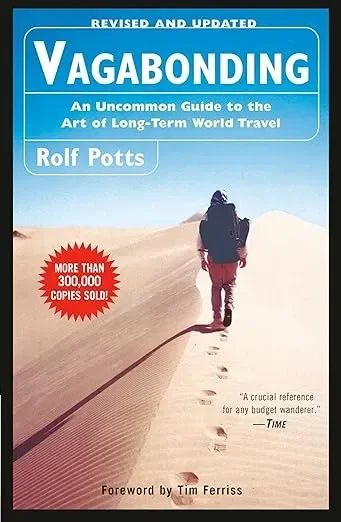
Vagabonding.
Vagabonding is an outlook on life.
Vagabonding is about using the prosperity and possibility of the information age to increase your personal options instead of your personal possessions.
Vagabonding is about taking an extended time-out from our normal life-six weeks, four months, two years-to travel the world on your own terms.
Vagabonding is not a lifestyle, nor is it a trend. It’s an uncommon way of looking at life-a value adjustment from which action naturally follows. And as much as anything, vagabonding is about time-our only real commodity-and how we choose to use it.
Vagabonding has never been regulated by the fickle public definition of lifestyle. Rather, it has been a private choice within a society that is constantly urging to do otherwise.
Have a library of over one hundred travel books including all the classics and among the best is a simple book published over twenty years ago that is book about travel but also a book about living called Vagabonding by Rolf Potts which reminds us that we and nobody else must determine how we live.

Enough.
Among the best if not the single best books on wealth is Morgan Housel’s “Psychology of Wealth”. If you have not read it you are truly missing out on a combination of wealth and life wisdom written with such a fusion of intelligence, insight, illumination and inspiration that you are unlikely to look at money, finance and wealth in the same way ever again.
There are many many lessons and practical applications in the book but a key underlying message is simply one word.
Enough.
Here is one story:
“At a party given by a billionaire on Shelter Island, Kurt Vonnegut informs his pal, Joseph Heller, that their host, a hedge fund manager, had made more money in a single day than Heller had earned from his wildly popular novel Catch-22 over its whole history. Heller responds, “Yes, but I have something he will never have … enough.” Enough. I was stunned by the simple eloquence of that word—stunned for two reasons: first, because I have been given so much in my own life and, second, because Joseph Heller couldn’t have been more accurate. For a critical element of our society, including many of the wealthiest and most powerful among us, there seems to be no limit today on what enough entails.”
― Morgan Housel, The Psychology of Money

Stories.
Joan Didion’s most famous sentence might be “we tell ourselves stories in order to live”
In many ways each of us is a compilation of stories. We intersect with other people who are a compilations of stories and when we meet it often like splicing two separate films into new stories about us versus just a story of you and me.
Today, amidst a timeline of algorithmic stories, curated stories, and monetized stories all embellished to pixel perfection, we hunger for stories that are real, relevant and which resonate to help us make sense of our lives and the world around us.
One way to do so is to read.
Read books.
Some quotes about books:
The book has proved one of the most useful, versatile, and enduring technologies in history. It’s portability, ease of reference and ability to concentrate a large amount of data made it indispensable. It is difficult to imagine how some of the greatest turning points in history would have been achieved without it.
Life without books would be a mistake.
One is twisted into a more complex shape when reading a great book.
The best books are like surgeons. They change you but you do not remember them, and they leave no external mark. Drugs get flushed from our system but not the best stories. One story can change you because it a sequence of language that produces a chemical reaction in the body.
Books are ways to escape ourselves. They are another form of dreaming. They are the magic of using black marks on a white page to conjure people and place out of nothingness. They are the closest we will be to becoming someone else or living someone else’s life.
Photographs by Rishad Tobaccowala