Pioneering the Future of Work.
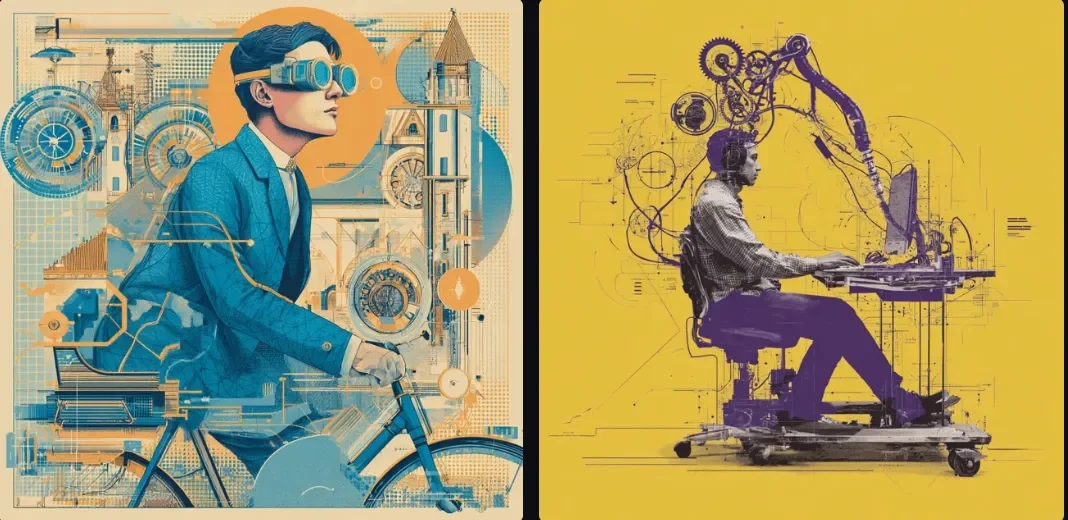
Images by MidJourney to the prompt “Pioneering the Future of Work”
Six months ago to accompany the best selling book Rethinking Work, we launched The Rethinking Work Show to gain and share insights and learnings from a spectrum of individuals across generations and industries from all over the world who are pioneering new ways of working.
Twenty one episodes later, three major shifts and four themes, have revealed themselves.
The Three Major Shifts
Work and Jobs are uncoupling: 200 years ago most people worked without having a job. A full time job as a primary way to earn an income has already begun to decline and this will accelerate over the next three years in part due to AI and in part due changing demographics and emerging mindsets. We may be at peak full time jobs but not necessarily peak income or opportunity. Companies are often arranged around jobs versus work which may not make sense in a world where “jobs” are just a silly phase work is going through.
A significant percentage if not the majority of a company’s employees in less than three years will be two types of employees that barely existed a year ago. These are agentic employees who will have their own email addresses, own logins and will be managed by newly trained HR and Talent teams. Another group will be fractionalized employees who have all the benefits of employees including health care but work 3 or 4 days a week as a result of AI replacing some work. This move to fractionalized employees will also be turbo-charged by new marketplaces are allowing people to have a primary form of income and health care augmented by other forms of income. Finally the fractionalized employee will be a necessity that companies will have to adjust to given the demographic reality of aging populations who may need to keep working to augment savings or to just to keep connected and challenge. Finally the rising need for care-giving for both elders and children will make full-time jobs a smaller and smaller share of how work gets done.
Everybody will need to re-skill and up-skill on a constant basis: A world with five types of employees ( Full-time, Contract, Free-lance, Fractionalized and Agentic) , plus talent spread across locations and AI increasingly handling significant work will require new leadership skills and training of different expertise.
We have entered an age of “Debossification” where managing, checking in, allocating and monitoring will be seen to be of little value. This combined with the decline of the value of knowledge will require a transformation of the work force.
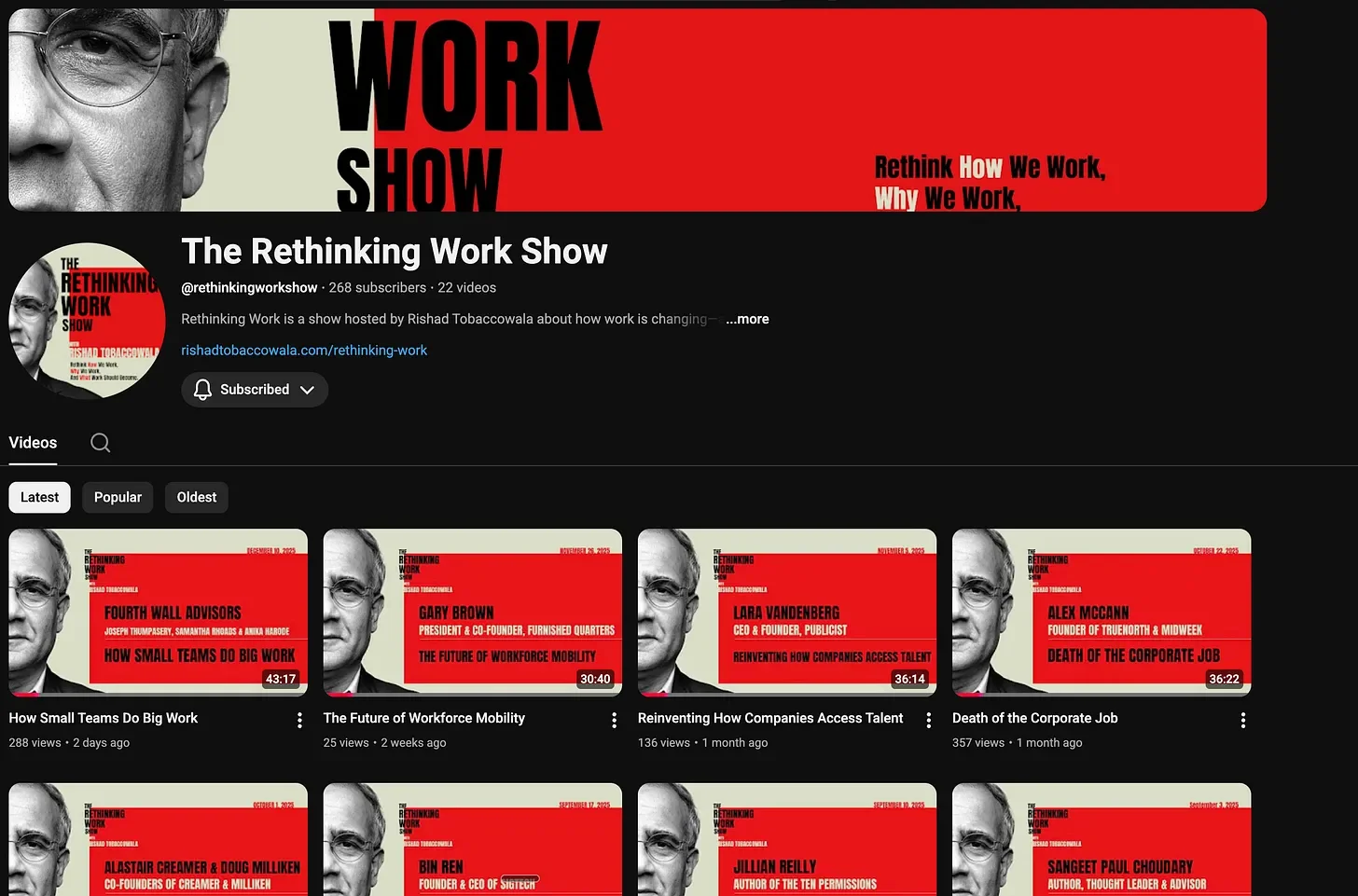
You can subscribe or access all the episodes on YouTube or on Spotify or Apple or specific episodes that might interest you via the individual links below. They will open your mind to the amazing rethinking of work that is underway and suggest ways you or your company can be best positioned.
The Four Themes
1. The office will be unbundled with talent combining three different types of locations to get work done: The three locations will include newly designed workspaces to maximize interaction and learning as well as present and pitch clients, third spaces like co-location spaces nearer where talent resides or events and experiences where teams spend time together and finally people working from home. Hybrid models will dominate but increasingly the demand for in-person presence will be customized to talent versus a one size fits model. The big shift will soon see the need to be in the office diminishing from 3 to 4 days a week to 3 to 4 days a month as leaders get retrained and companies find themselves at a cost and hiring disadvantage vs AI First/Talent Anywhere companies.
To learn more about the data and trends driving work from anywhere, listen to Harvard Business School Professor, Dr Prithwiraj Choudhury, the author of the new book “The World is Your Office. He brings data, facts and real stuff that makes one realize how silly the one model for everyone regardless of job, expertise or market forces plus forced march back to the office is. Just because one puts food in the cage the animals will not come back or stay a long while. Especially the best ones.
To understand how a company rethought its space for the new world listen to Andrew Graff the CEO of Allen & Gerritsen. By rethinking space he saved money, increased morale and turbo-charged new business.
How are architects rethinking space? Dan Cheetham CEO and Founder of FYOOG explains the keys to designing spaces that engage, inspire and delight. What if where people live became a core part of how they work?
Gary Brown, president and co-founder of Furnished Quarters, shares how workforce mobility is changing in a hybrid world, and why companies are shifting from hotels to flexible housing, what employees need to thrive on remote assignments, and how thoughtful living solutions can strengthen culture, retention, and performance.
2. Companies will increasingly access talent in far more flexible and agile ways: What happens when work stops being about full-time jobs and starts being about outcomes? Paul Suchman, Freddie Laker, and Juan-Carlos Morales of Chameleon Collective share how the rise of fractional leadership is reshaping companies, giving professionals more flexibility, and challenging traditional ideas of careers, culture, and collaboration.
What if companies could access top creative and marketing talent as easily as opening an app? Lara Vandenberg, founder and CEO of Publicist, shares how she built a platform that connects global brands with premium freelance talent, and why the future of work depends on flexible, trusted systems that empower both companies and creators.
What if you could tap into top talent, anywhere in the world, exactly when you need it? Luke Smith, CEO and co-founder of Croud, unpacks how the “talent on demand” model is reshaping teams and blending speed, scale, and flexibility without sacrificing culture or creativity. Since 2011, Luke has helped grow Croud into a full-service powerhouse, serving clients like Amazon Prime Video, Nespresso, and Ford. The company now spans 600 employees and a global network of on-demand experts known as “Croudies” across 118 markets and 86 languages.
What happens when AI becomes part of your workforce, not just your toolkit? MarkeTeam.ai Co-Founder Naama Manova-Twito and Board Members Clive Sirkin and Tony Weisman, share how AI coworkers are reshaping marketing workflows and why the future of marketing will be human-led, AI-empowered.
3. We may be seeing the beginning of the death of the corporate job as a new generation of talent turns away from them for a variety of reasons: What if the corporate job is no longer the default path to a meaningful career? Alex McCann, founder of TrueNorth, explains why so many young professionals feel lost at work, how Gen Z is redefining success, and why the future may belong to those who start with self-discovery instead of job titles. How can small teams now match, and even outperform, the output of much larger organizations?
The team at Fourth Wall Advisors is an example of a new type of firm. A 3 person hedge fund taking on the best of Wall Street. The team shares how AI-driven workflows, intentional design, and diverse, non-overlapping expertise are reshaping how work gets done. From reducing friction to unlocking deeper creativity and faster iteration, they explore why the future of high performance belongs to small teams built for curiosity, adaptability, and human connection.
What if being a company of one wasn’t just a structure, but a strategy? Flavia Barbat, editor-in-chief of Brandingmag, shares how professionals can build careers around clarity, substance, and intention in a world where content is everywhere but meaning is rare.
Is the most important approval you’ll ever need your own? Author and coach Jillian Reilly discusses her book The Ten Permissions, and why we struggle to let go of others’ expectations, and how to start giving ourselves permission to live and work on our own terms.
4. Talent and companies everywhere are now preparing for seismic changes that the new world of work is bringing: How is AI reshaping who holds power in the knowledge economy? Sangeet Paul Choudary, the best-selling author of Platform Revolution and Reshuffle explains how artificial intelligence is re-stacking the way knowledge is created, distributed, and monetized, and what this means for workers, companies, and the future of competitive advantage.
What if your career wasn’t just one job, but a collection of roles that reflect your skills, interests, and values? Ben Legg, co-founder and CEO of The Portfolio Collective, shares how the portfolio career model is helping professionals design more flexible, purpose-driven lives, and why the future of work may look more like a mosaic than a ladder.
How do we retrain millions of workers for jobs that don’t exist yet? Workforce futurist Andy Spence shares his learning about closing the skills gap, preparing for AI-driven change, and why retraining is the most urgent challenge facing the modern workforce.
How do you spot and grow the kind of leaders who can thrive in the age of AI? Jay Haines, co-founder and global president of Grace Blue, shares how expectations for leadership are shifting, what skills will define success in an AI-driven world, and why human potential still matters most.
What does a modern career path look like when the job market keeps changing?
Matt Moog is the Founder & CEO of Career Bird, a talent development platform explains how Career Bird empowers individuals to understand where they are, where they want to go, and how to get there, while giving companies the tools to retain top talent and foster continuous learning cultures.
What if the key to the future of work isn’t jobs themselves, but the skills that unlock them? David Timis, Global Communications & Public Affairs Manager at Generation, shares why building adaptable skills is more important than chasing job titles and how organizations like Generation are helping people prepare for meaningful, resilient careers in a changing world.
Why is culture a competitive advantage in the future of work and what makes for a great culture? Alastair Creamer and Doug Milliken, co-founders of Creamer Milliken describe culture as behavior where there is little to no gap between a company’s stated values and it’s lived value. They discuss accelerating culture change is essential for growth, how leaders can make transformation stick, and why the companies that thrive tomorrow will be the ones that reinvent from the inside out. Plus an incredible insight on how culture while about belonging is not about a space and the importance of “difference makers”
Rethinking Work is now reduced 66% to just $11 a copy on Amazon and just over Rs 300 in India. Available in many other countries around the world in hardcover and almost everywhere in digital format.
The book has sold tens of thousands of copies and is used by individuals and companies as a resource to understand and navigate the future of work. And here are all the places and formats the book can be bought.