Reducing Career Anxiety.

Image via ChatGPT
Many of us are anxious about our careers.
We may feel overwhelmed by the velocity of change.
We might wonder whether our skills and experiences are still relevant.
We fear that our jobs will be eradicated by AI.
Our anxiety is natural and human.
Work provides us with not just income, but also identity, community, purpose and growth.
Here is a distillation of perspectives, insights and exercises shared in this Substack over the past six years to help one gain agency over our careers and to anticipate and prepare for a rapidly changing work environment.
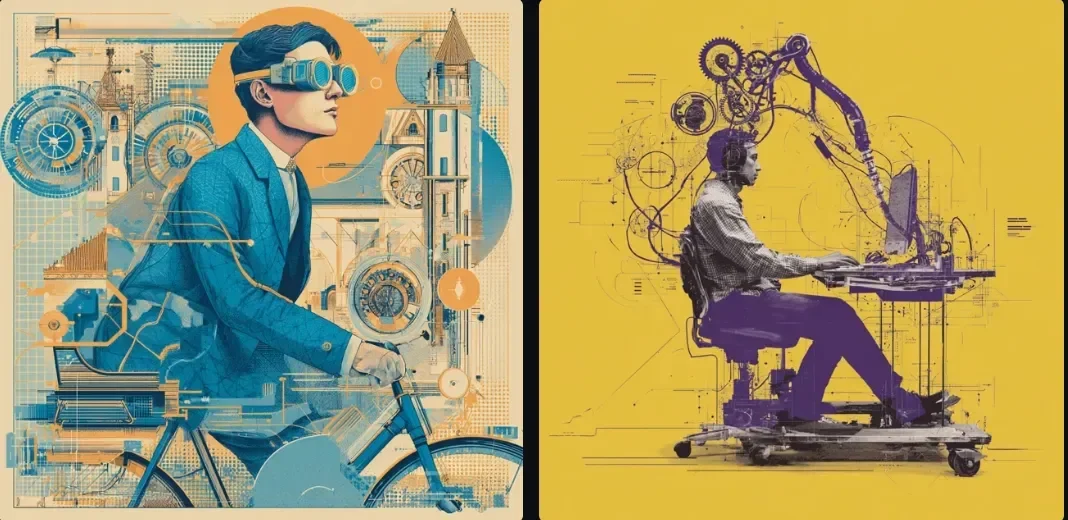
Images by MidJourney to the prompt “Pioneering the Future of Work”
1) Understand and align with the three major shifts changing the contours of work.
a. Work and Jobs are uncoupling: 200 years ago most people worked without having a job. A full time job as a primary way to earn an income has already begun to decline and this will accelerate over the next three years in part due to AI and in part due changing demographics and emerging mindsets. We may be at peak full time jobs but not necessarily peak income or opportunity. Companies are often arranged around jobs versus work which may not make sense in a world where “jobs” are just a phase work is going through.
b. A significant percentage if not the majority of a company’s employees in less than three years will be two types of employees that barely existed a year ago. These are agentic employees who will have their own email addresses, own logins and will be managed by newly trained HR and Talent teams. Another group will be fractionalized employees who have all the benefits, including health care but work 3 or 4 days a week as a result of AI replacing some work. This move to fractionalized employees will also be turbo-charged by new marketplaces that are allowing people to have a salary and health care augmented by other forms of income. The fractionalized employee will be a necessity that companies will have to adjust to given the demographic reality of aging populations who may need to keep working to augment savings or to just to keep connected and challenged. Finally the rising need for care-giving for both elders and children will make full-time jobs a smaller and smaller share of how work gets done.
c. Everybody will need to re-skill and up-skill on a constant basis: A world with five types of employees ( Full-time, Contract, Free-lance, Fractionalized and Agentic) , plus talent spread across locations and AI increasingly handling significant work will require new leadership skills and training of different expertise. We have entered an age of “Debossification” where managing, checking in, allocating and monitoring will be seen to be of little value. This combined with the decline of the value of knowledge will require a transformation of the work force.
To learn more and hear from dozens of talented people pioneering the future of work consider reading Pioneering the Future of Workwhich also lays out the key four themes driving the future of work and listen toThe Rethinking Work Showto hear from pioneers and Unbossing.where Reed Hastings of Netflix and others speak of new approaches to modern leadership.

2) Plan for the long term. Even if we are 50 we have 15 to 20 years of work ahead of us.
a. Aging is a “prejudice against our future selves”. Avoiding thinking about or thinking negatively about aging or our future selves. It is a form of self-discrimination.
b. Many of us will “fail” retirement. A lot of retirement planning is about making sure one has the financial means to retire and how to remain healthy, but that is not enough. Most people who can stop working soon find themselves without purpose or meaning or even identity since work is so central to identity, community, purpose and growth. The question of “Why am I waking up in the morning?” is rarely answered day after day after day with “To play golf” or “To travel”. If income was all that mattered why are all the tech bros in Silicon Valley with their billions continuing to work given their belief that universal basic income will be all we need when AI impacts our job?
c. AI, Time and the rapidly declining half-life of Knowledge: Just as careers are getting longer, the half-life of knowledge is declining faster and faster. Even if we are 30 our skills may lead to a forced retirement at 35 or 40 unless we upgrade and reinvent our skills.
Seth Green, Dean of the University of Chicago Graham School of Continuing Education distills decades of insights and learning in a conversation where he also shares many free resources at the University available to everyone globally to keep learning and growing.
Take a read and a listen to What Next? 50 Year Careers.

Photo: “Dawn’s Whispers: Graceful Hoopoe Silhouette at Sunrise” by Hermis Valiyandiyil
3) Recognize that the 50 years involve very different seasons: Careers have at least 3 seasons and to each season there is a particular approach and focus.
One of the three most popular posts of all time is Career Lessons Revisitedwhich distills my observations and learning over a 45 year career including:
The importance of finding the least sucky job possible at the start of of one’s career. Or these days why we may want to look for work first and then a job next.
The key to the middle years is that we build skills, relationships and reputation that belong to us and not just the company we work for. Too many people conflate the budgets they control and the Brand name of the company they work for with their own popularity. Another key in middle years is to focus on who we work for more than the company we work at. People build people. Companies do not.
Three decades into a career one still has two decades ahead and now is the time to learn, unlearn and relearn versus believing retirement, even if affordable, is approaching. It is also an era to practice letting go since every career has a midnight hour and the smart people leave at five to twelve.
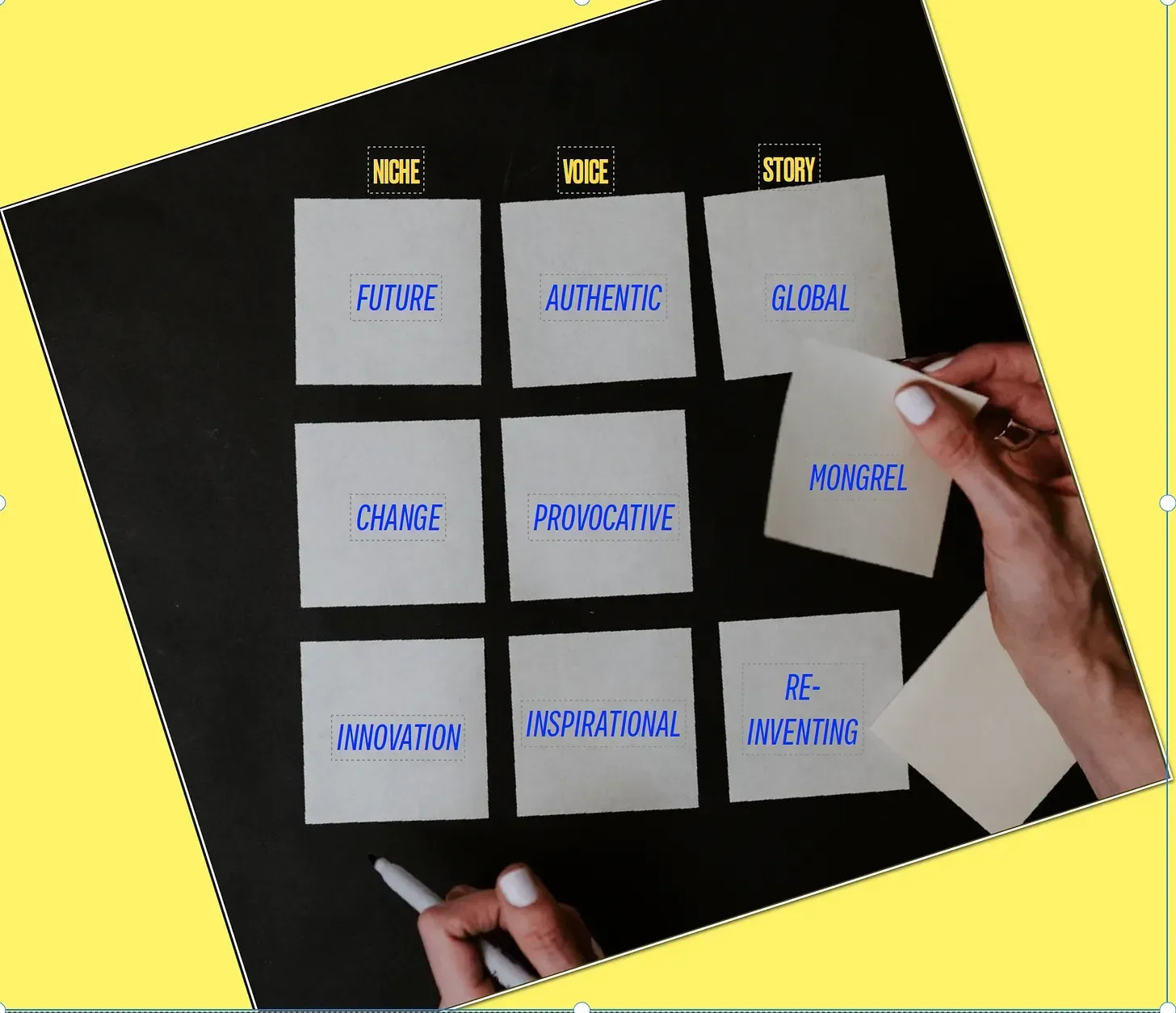
Graphic: The Nine Word Exercise by Rishad Tobaccowala.
4) Architect, hone and sculpt our reputation.
In order to maximize optionality we need to position ourselves and then build a reputation via credibility and a body of work.
In Career Architecting I share a nine word exercise that helps define our niche, our voice and our story.
It then takes our positioning and illustrates how to link it to market needs and develop the credibility and platforms to build a reputation.
This works for any age group, any industry and any country.

Photo by Rishad Tobaccowala
5) Keep a job for a long time in a firm by thinking like a Company of One.
The best way to keep a job or work you like for a long time ( even decades) in a firm of any size is to learn how to operate like a Company of One. A Company of One is not about I, me or mine but about:
a) Be known for expertise in specific skills, have a reputation for being collaborative and being a person of integrity.
b) Continuously keeping one’s skills up to tomorrow and not just up to date.
c) Maximizing optionality in many ways as possible.
When one has skills, reputation and choice one will always be in demand not just in the marketplace but at one’s current place of work.
The Company of One series are six posts filled with actionable exercises that will set anyone doing them free from anxiety.
One Single Thing.
Ben Thompson is one of the best strategic thinkers about technology and its impact on firms, societies and more. Almost everybody in technology, including the CEO’s of major firms reads him. He has an ability to clarify, illuminate, extrapolate and ruminate in ways that will leaves readers and listeners ( his writings are also available as a podcast) enlightened.
Here is a piece entitled Tim Cook’s impeccable timing which is a must read because through the lens of a retirement announcement, Ben takes us on a strategic romp across great horizons! It is free to read.
https://stratechery.com/2026/tim-cooks-impeccable-timing/