The Coming Organizational Meldtdown.

Image via Midjourney.
The biggest challenge of an AI age will be organizational design.
AI is like hydrochloric acid that burns through all the containers of the past. Different areas and tasks leak into each other while others evaporate away.
Since any change in organizational design impacts roles and responsibilities, spans of power, and compensation, it is likely to be resisted and therefore take time, be deeply emotional and challenge every human in an organization.
Six Provocations.
Earlier this week I shared six provocations with the most senior members of a large multi-national global organization:
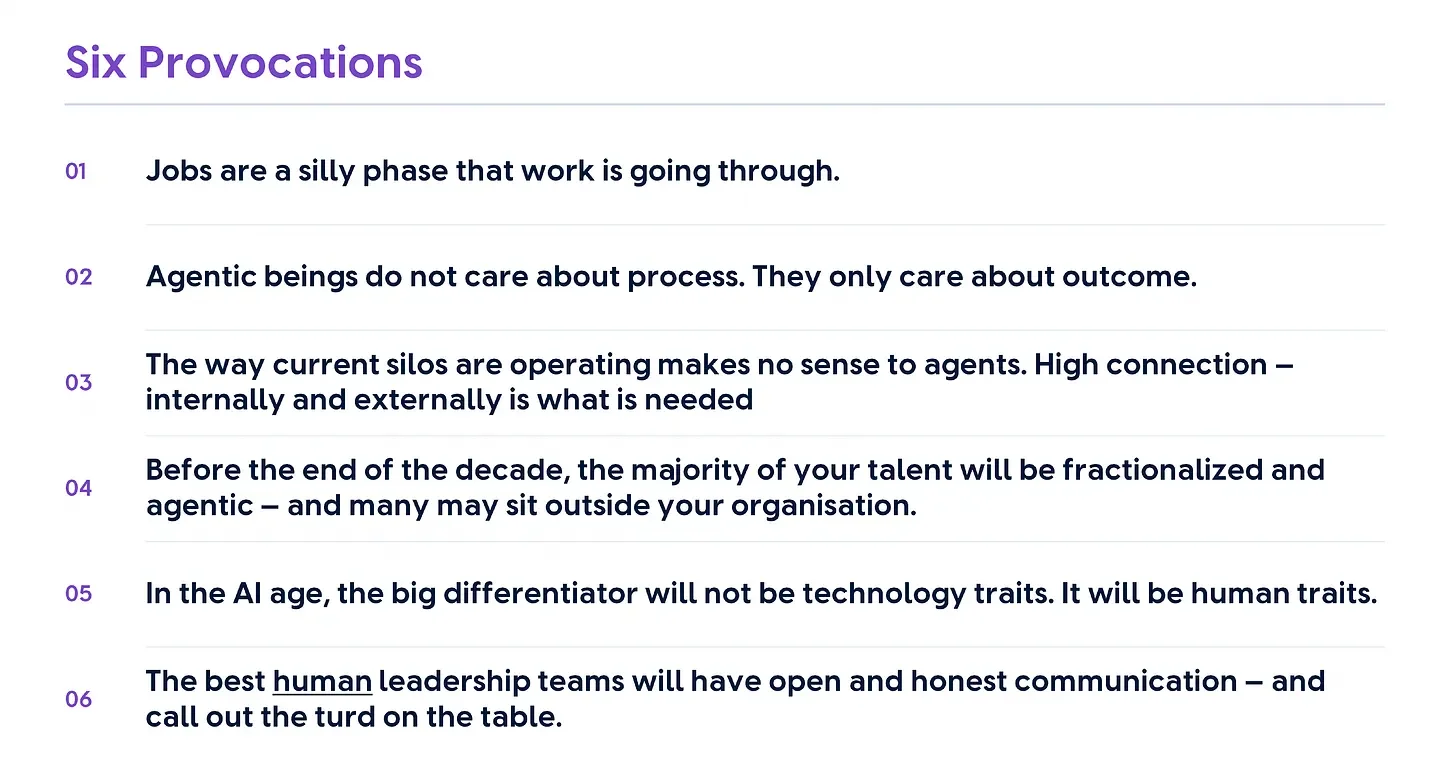
In most countries we are past peak full time jobs. Not necessarily peak jobs or peak work or peak opportunity but full time jobs. Jobs and work are uncoupling. Increasingly companies that are organized around jobs will be organized around work. Work drives the outcome while a job is a container of responsibilities which may no longer be fit for purpose.
Agents get work done and are focused on outcome rather than process. They focus on getting things done rather than how they are done.
Agents do not recognize current silos of an organization including the difference between marketing and sales or above the line and below the line.
Already many companies today have between 10 and 30 percent of their employees as agents. McKinsey has 1 agent for 2 employees on its way to a 1 to 1 ratio. As agents reduce the need for humans to do some of the work companies can re-allocate teams to higher order work but recently they seem to be focussed on reducing their work force with significant downsizing. Increasingly however companies will discover that introducing the concept of fractionalized employees where people work 3 or 4 days a week with pro-rated compensation but full health care ( fractionalized employees) is a better route than laying off 20 percent of people.
Most companies use the same combination of AI tools. AI is like electricity. A competitive edge only if ones competitor uses candlelight. The edge will be in combining AI with HI where HI is not Human Intelligence but Human Innovation, Human Inventiveness, Human Interaction, Human Imagination and Human Iteration.
Too many organizations are not addressing the real turd on the table which is the need to remake the entire organizational design with all the drama involved. Everyone thinks the brown thing in the middle of the table is a brownie with a recipe of efficiency and effectiveness versus the real shit which is the existential drama of reinvention .
Six Implications for Organizational Design.
1. A fusion of IT and HR: As IT spins up agents and the cost of tokens matches or exceeds the cost of human talent some companies will fuse IT and HR as Moderna recently did. More here: https://www.bbc.com/news/articles/cy0w8gvq84xo
2. AI first and HI next: Companies will stop using AI to automate the way they currently do work but begin by utilizing AI to get work done and then add HI to augment, enhance, quality control and feeling to the AI product and solutions.
3. New Metrics including Price Per Intelligence unit: Shelly Palmer recently wrote a great piece on a key measurement for companies called Price Per Intelligence Unit which is a must read: https://shellypalmer.com/2026/06/price-per-intelligence-unit/
4. Talent Diffusion: The return to the office dogma of the past two or three years will be softened ( most companies offer much more flexibility behind the scenes than their draconian announcements suggest) as five types of employees from full-time, free-lance, fractionalized, contract and agentic are combined to get work done. Speed, cost and access to talent in real time will be the competitive advantage versus bottling talent in building.
5. A New Partner Eco-System: Today most companies have vendors and suppliers whose roles and deliverables are organized around the way work was done. But as AI re-architects work including what is done internally and what is done externally most service organizations and partner eco-systems will be rethought. It is not just how charging for hours worked will not longer make sense in many cased but the need to completely re-imagine partnerships.
6. Training and upgrading the new edge: Everyone will need to unlearn and learn regardless of level and title. Organizations that invest in upgrading and refitting their talent will likely see an edge but this will require significant investment in people and development which most companies are not focused enough on.
The real challenge moving forward will be people, power, politics, process, and partnering versus technology moving forward.
One Single Thing.
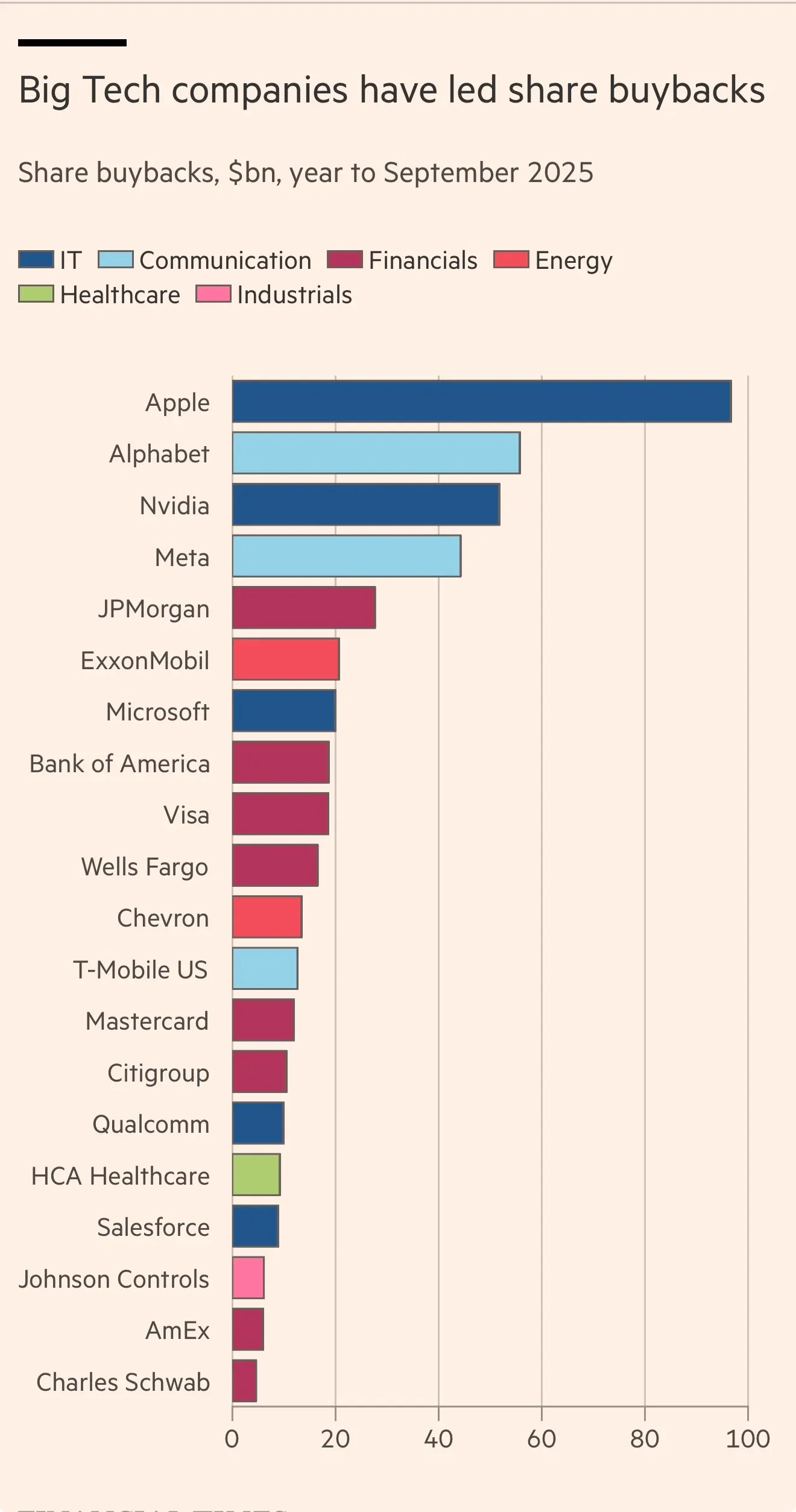
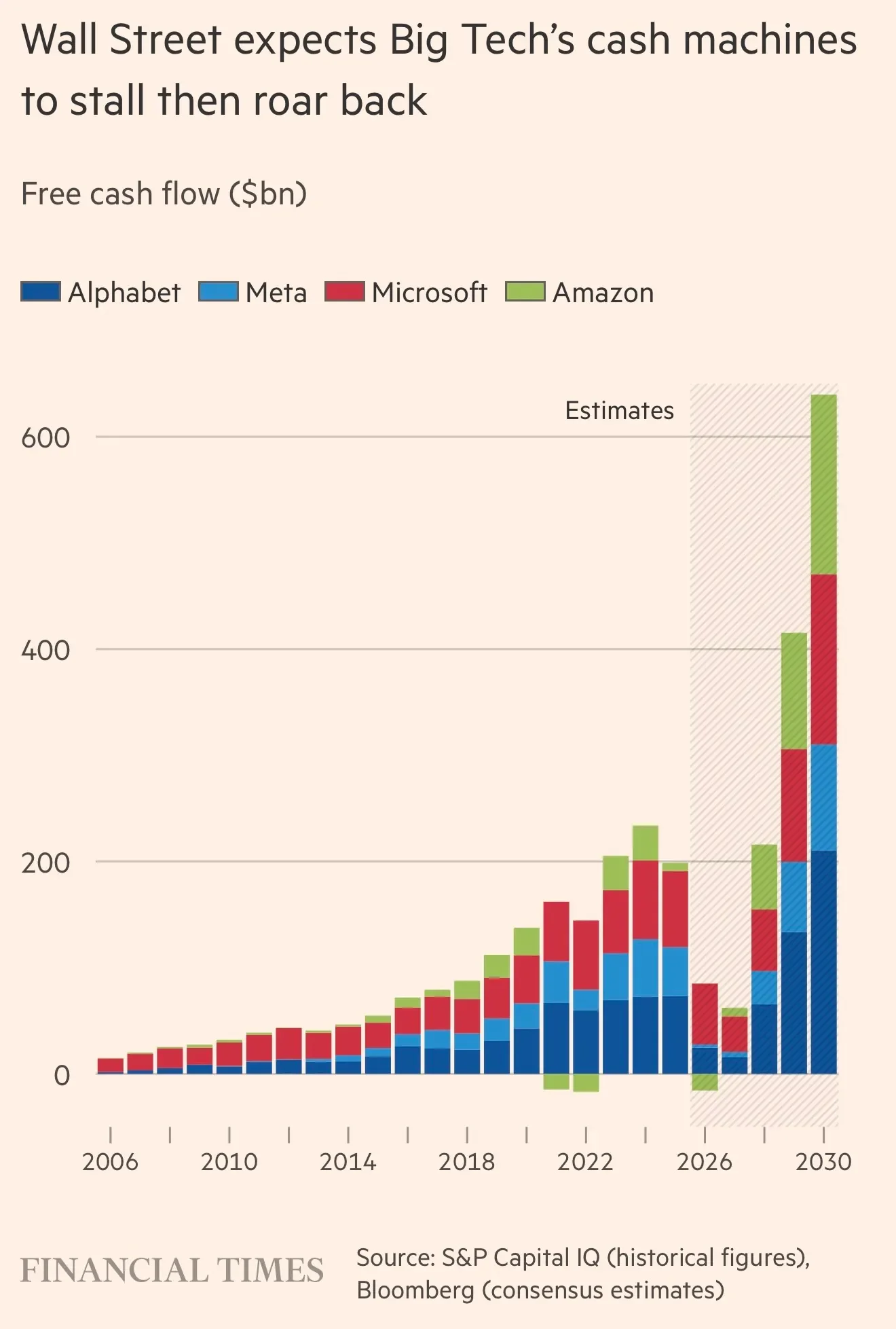
The Financial Times this weekend had an amazing piece which vividly brings to life both the level of spending in AI by leaders such as Alphabet, Amazon, Meta and Microsoft but also how these companies that used to generate massive cash flow and buy back stock that supported their stock and the overall indexes but are now issuing stock and are raising cash.
The article is only available to subscribers but here are two charts from the article which illustrate the changing dynamic: