
Tectonic Time: 5 Shifts.

Image using MidJourney
This Friday while flying back from a couple of speaking engagements in Sweden with European C level execs in the Real Estate and Marketing industries, I calculated it was my 70th flight, putting me on track to fly more than the previous record of 104 flights in a year when I had a full time job.
Looking back just to the beginning of this year between the companies I advise, the companies I have spoken at, the leaders who have been guests of the weekly What Next? Podcast and the Rethinking Work YouTube Show I host, I have interacted or spoken with more than 200 leaders and almost 100 companies in 8 months across 11 countries.
And increasingly there is a common feeling across all these companies and leaders that these times are more than transformational.
The changes underway feel bigger than the shifts felt during the Fall of the Berlin Wall, Post 9/11, The Great Financial Crisis, The Internet, The Rise of China and Covid.
The changes today are fueled by all these transformations interacting with each other at scale and some new forces to create far greater tremors and movement.
These are not just transformational times.
We are in Tectonic Times.
When the very ground under our feet moves, things rupture and quake, all shaking the foundations of what we believe, how we operate and what might happen.
The Five Tectonic Shifts.

Animation using MidJourney
1. Duality : Everything and its opposite is true at the same time.
Here are three examples of duality .
a) Scale matters more. Scale matters less.
Scale matters more than ever as we see the top 4 companies in AI spending ( Microsoft, Google, Amazon and Meta) on track to spend over 300 billion dollars in one year. For comparison this is just slightly less than half the revenue of the Walmart which is the worlds largest company ranked in sales. 300 Billion dollars is also 5x the total revenue of Accenture and 2x Accentures total total market cap.
Similarly Russia and China and US armies and spending give them significant advantage.
But scale matters less than ever as AI and other technologies enable asymmetric competition providing David with a sling shot to bring down Goliath. The fastest growing, most innovative and highest revenue per employee companies are small. A combination of agility, limited to no legacy structures and AI first/Talent Anywhere thinking are changing the rules of the game.
A combination of drones and new ways of thinking have allowed everyone from Ukraine to the Houthis to fight way above their weight class.
The smartest companies are combining small teams with large amounts of capital and other resources providing them with freedom to challenge and compete for a new age.
b) Globalization matters more. Globalization matters less.
Today two countries, the US and China, with 30 trillion and 18 trillion dollars of GDP dominate and increasing make the rules of the Globe ( for comparison Japan, India, Germany and France have only 4 trillion dollars of GDP each). If the world was not so connected Trump’s Tariffs or Taiwan’s hold on High End Chip making or China’s hold on Rare Earths would not matter but they do. And from Climate to Covid, Mother Nature refuses to acknowledge borders.
But at the same time the Globalization of Davos is clearly over and there is a far greater regionalization and country focus around the world. Covid illustrated the challenges of global supply chains. Europe’s dependence on Russian gas indicated a vulnerability. Strategic resilience now often is more important than comparative advantage provided by free trade and globalization.
c) Markets matter more. Markets matter less.
Market economics and different flavors of capitalism have created more wealth and lifted over 2 billion people out of poverty since 1990 with opening economies in China, India and many other places. Today rapid data transfers and interconnectedness places a premium on markets.
On the other hand, market economics has led to a blowback in many parts of many countries due to job losses and ways of life. Market economics have led to vulnerabilities for countries for key resources and materials making countries increasingly mercantilist and inserting themselves in markets. A new political order is rising everywhere which combines state and markets in different ways.
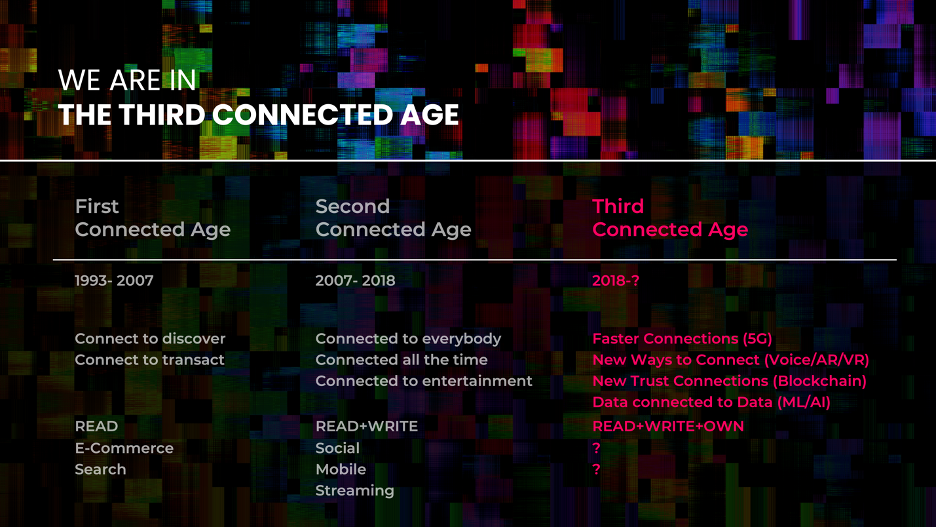
Image and Source: Rishad Tobaccowala
2. Third Connected Age : We have entered the Third Connected Age.
The First Connected Age began with the advent of the World Wide Web in 1993 where we connected to discover and transact which gave rise to Search and E-Commerce. During this age we consumed content.
In 2007 we entered the Second Connected Age where we were connected to everybody, all the time and to entertainment which gave rise to social, mobile and streaming. We consumed and created content but much of the value created was captured by the platforms rather than the content creators.
These Connected Ages continue to build on each other and roil everything from traditional media companies, elections, what people believe, polarization and much more.
But just as streaming, mobile and social reinforced each other and turbo-charged commerce and search we now have a new set of forces which began as early as 80 years ago (AI), 15 years ago (Blockchain), 7 years ago (5G…but not really available in the US though your phone says you have it…real 5G is 2 to 4 gigabytes per minute with almost no latency as seen in parts of China) and AR/VR which is still scaling but will clearly become important. And due to the Blockchain and the rise of competition in creator platforms from YouTube to Substack to Podcasts to OnlyFans, we will move to a read, write and own era as pointed out by Chris Dixon of Andreessen Horowitz.
AI is the topic of the day as a combination of all the data on the Internet, better algorithms and much better chips such as the NVIDIA GeForce RTX 5090 has turbo-charged this space. But it is not just AI but also Blockchain that is revolutionary and will likely change the nature of ownership, competition, data transparence. One impact in Finance as most recently seen in StableCoins.
This Third Connected Age will make the first two Connected Ages which were huge look small.
Think of the shifts already underway:
The value of knowledge is going to zero and the value of many types of experience is declining.
World class Knowledge driven companies like McKinsey have stated this is an existential threat and opportunity if played right. Traditionally, a strategy project with a client might require an engagement manager—essentially, a project leader—plus four consultants and a partner. Today, it might need an engagement manager plus two or three consultants, alongside a few AI agents and access to “deep research” capabilities. McKinsey today has 40,000 humans and 12,000 AI agents. Read more here.
Knowledge is being reimagined.
The interface of Search ( First Connected Age) and Streaming (Second Connected Age) is now joined by Conversation (Third Connected Age) as people look for outcomes and answers. This has already got companies thinking about massive reductions in traffic due to search and rewiring themselves for an Answer and Agentic Age. But in addition to the plumbing which is how one reaches the customer we are about to see the rise of poetry where due to Generative AI provides the ability to tell stories and have interactions at scale in personalized way that will disrupt the entire marketing landscape.
Personalization will increasingly be augmented by Anticipation in delivering outcomes and answers. Tech Stacks will be upgraded to Experience Stacks.
The fabric of communications is being rewritten anew.
Source: Nathan Halberstadt
3. Generation Ruptures:
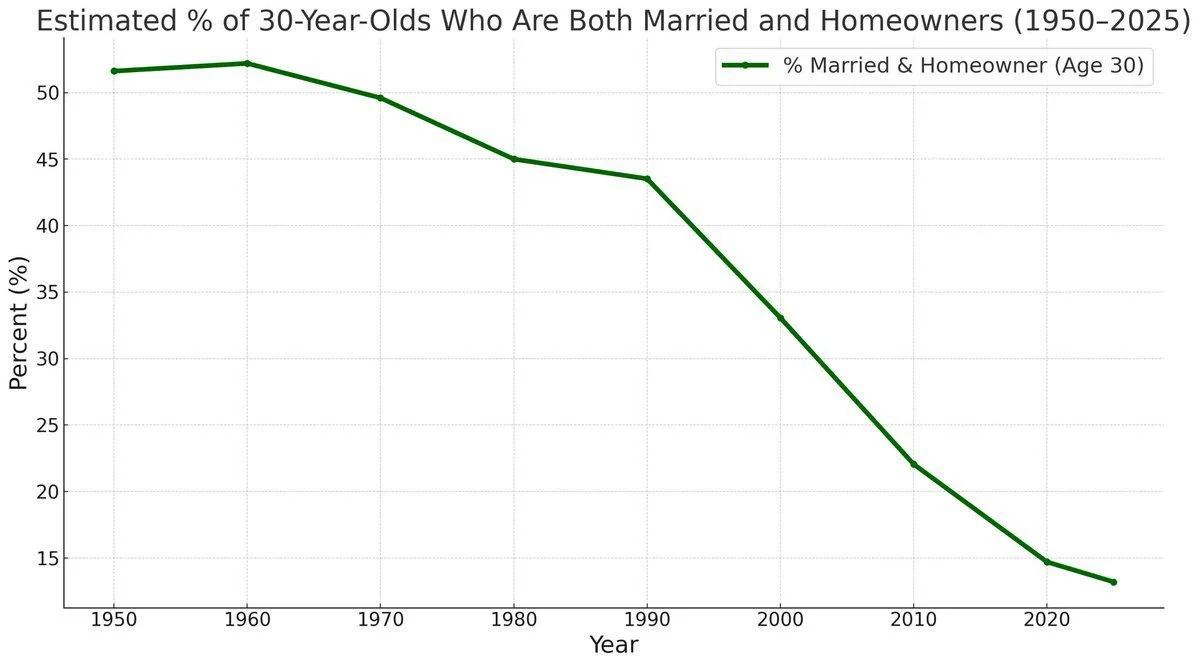
The above chart by Nathan Halberstadt first published in the Daily Wire and much discussed and shared. He has not released specifics on his data sources and there is some debate on the numbers but not the direction of travel.
Clearly younger folks are getting married and becoming home owners much later as some of this data shows
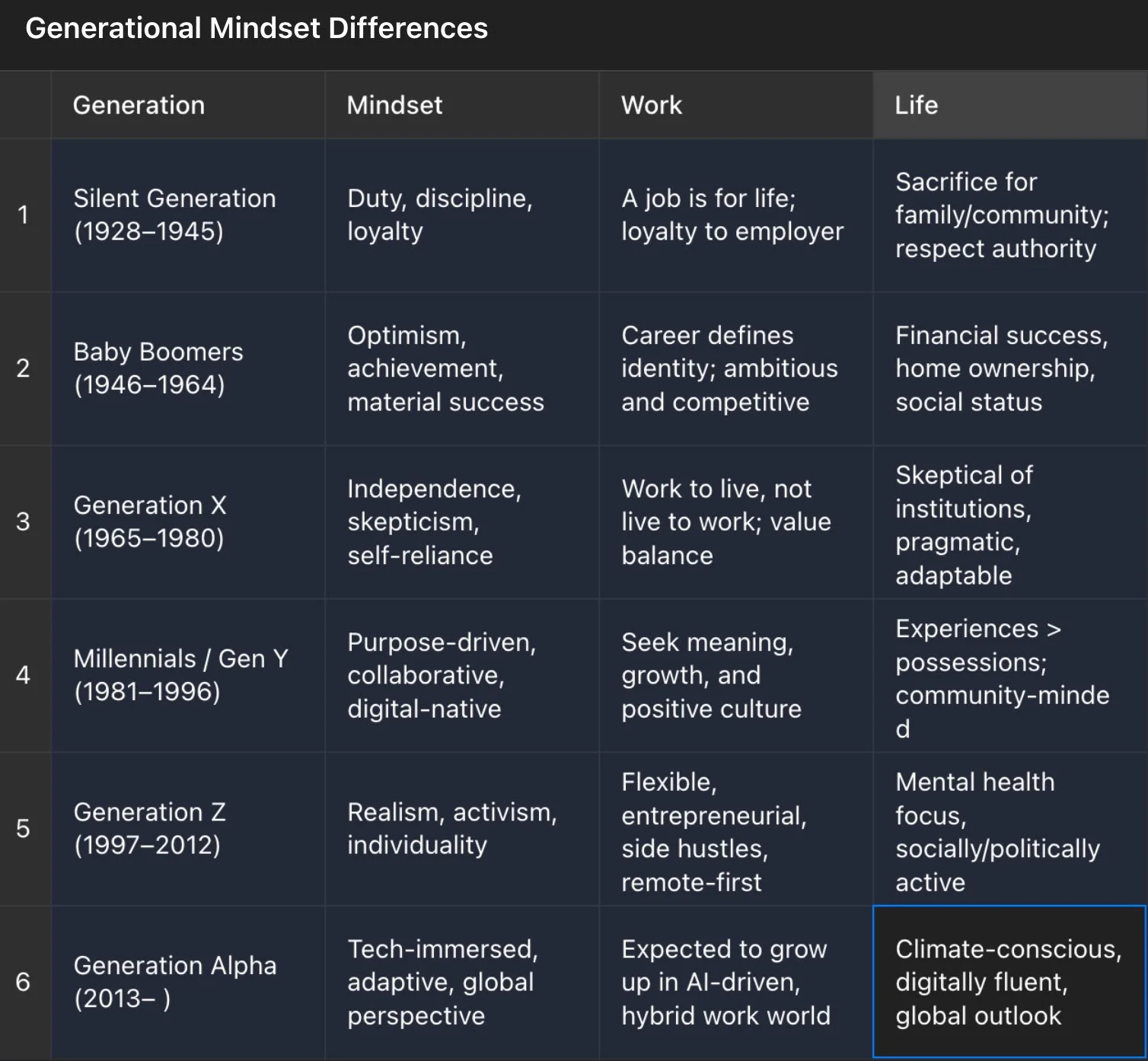
Marriage and home ownership rates are only two of many significant ways there is a marked difference in generations.
Today 66% of Baby Boomers believe in Capitalism but only 22% of GenZ do.
A small sliver of Baby Boomers want to work for themselves but 76% of GenZ want to launch a company. Today 67 percent of GenZ employees with a full time job have a side gig or side hustle to make money.
And here are more differences in mindset.
Source: ChatGPT 5
The irony is that companies that wax and sing hymns to personalization treat all their employees the same. One size fits all for RTO and much more. No wonder talent wonders what has infected managements mind!
Source: ChatGPT 5
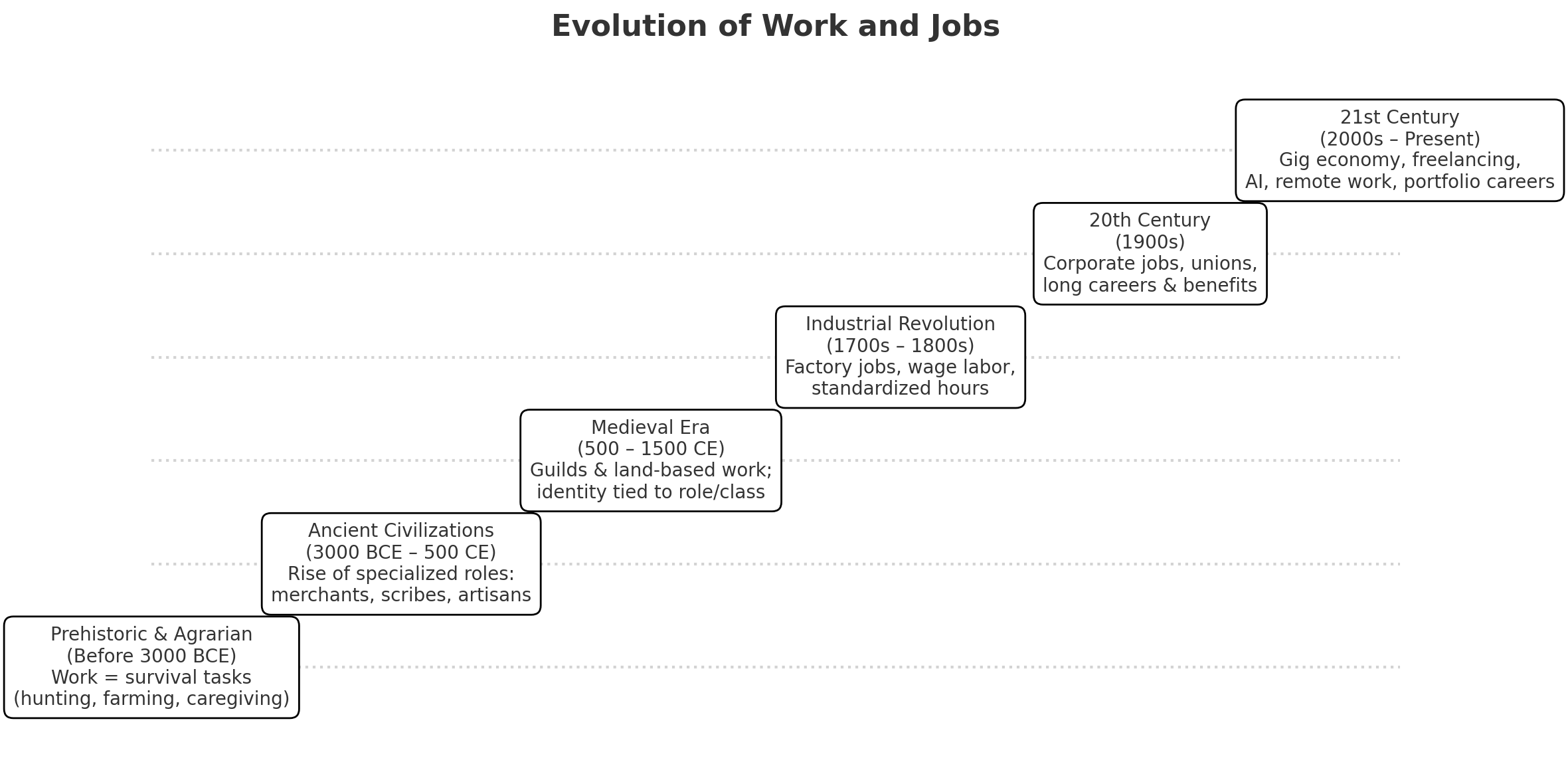
4. Work and Job Uncoupling: People have always worked but rarely had jobs. The idea of a job is about 200 years old and it looks like we are in the midst of a decline of full time jobs and a rise in the opportunity for different types of work.
Work is any activity humans do to survive or create value—hunting, farming, caregiving, crafting, etc. Jobs are a more modern idea: formal roles within an economy where you exchange labor for wages, usually under an employer. Jobs are structured, specialized, and often tied to contracts or salaries.
Prehistoric & Agrarian Societies
Work meant survival: hunting, gathering, farming. It was shared among families or tribes, with little concept of individual "jobs."
Ancient Civilizations
As cities grew, work diversified—merchants, scribes, artisans, priests. These roles were often inherited or tied to caste/class systems.
Medieval Era
Work was tied to land (serfs, farmers) or guilds (craftsmen, apprentices, masters). Identity and community shaped work more than wages.
Industrial Revolution (18th–19th c.)
This is when the modern “job” emerged: factory work, wage labor, set hours. Work became standardized and separated from the home.
20th Century
Rise of office jobs, corporations, unions, and the idea of a lifelong career at one company. Benefits like pensions and health insurance tied identity even more to jobs.
21st Century
Work is shifting again: freelancing, gig economy, AI and automation, remote work, portfolio careers. People may separate who they are from what job they do more than before.
Work has always existed—but the structure of jobs (formal, specialized, wage-based roles) is a relatively recent invention, only a couple of centuries old.
Today most companies are structured around jobs and jobs to be filled vs accessing talent and work to be done. But as demographic mindset differences, the shifts of the Third Connected Age and fractionalization of expertise that is increasingly distributed, ricochet of each other, companies will need to rethink their organization, talent base and leadership from the ground up.
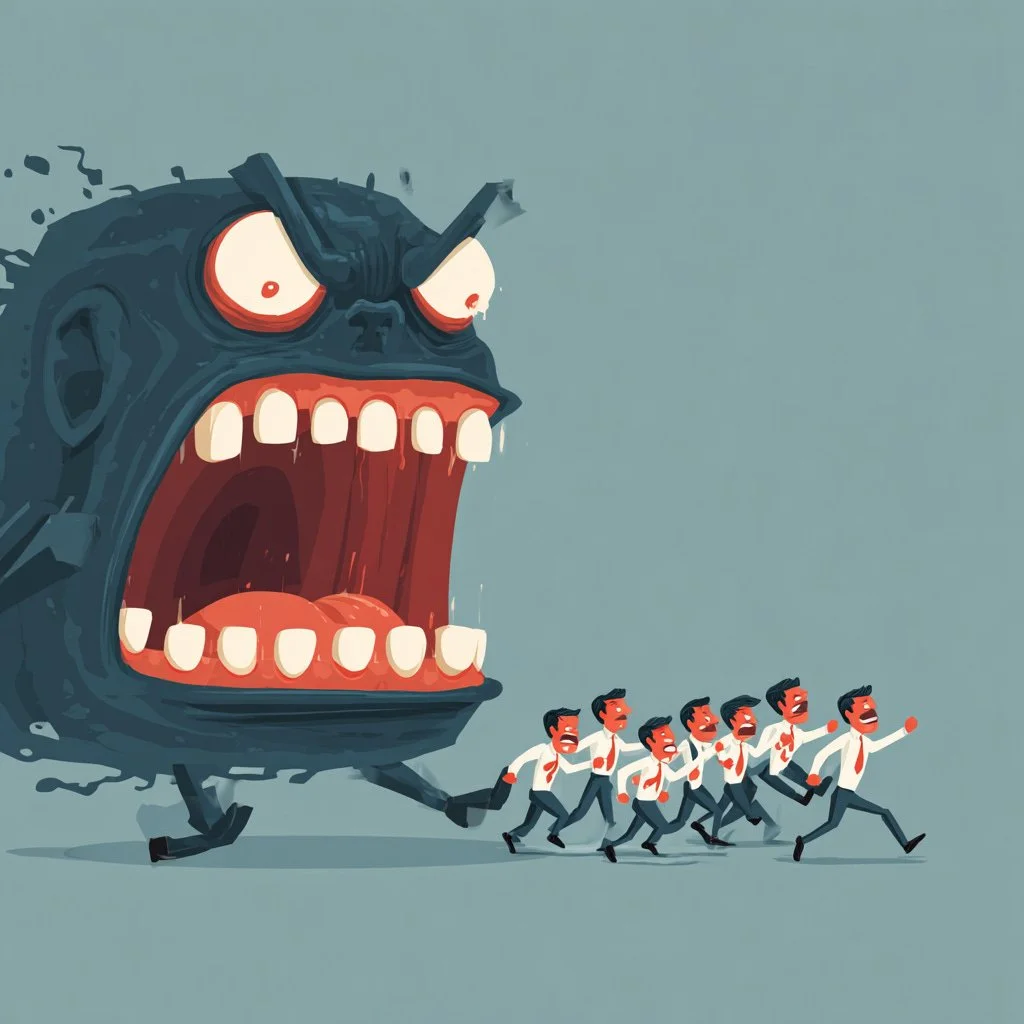
Image: Google Gemini Flash 2.5
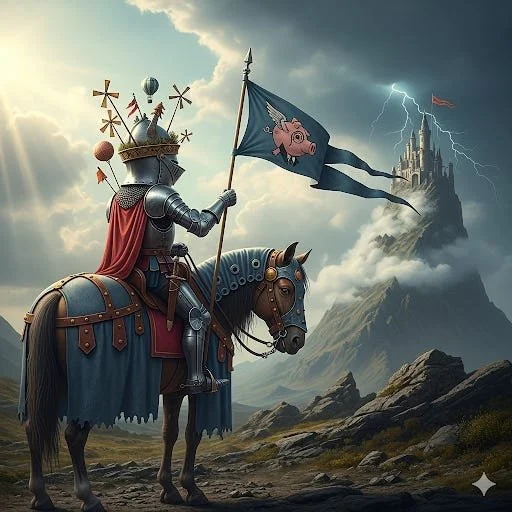
Image: Google Gemini Flash 2.5
5. Imperiled Leadership: Leadership is never easy. Today the quality of leaders has never been stronger in pure skills, motivation and drive but the challenges and fears have never been greater for a variety of reasons which include:
a) The Need for Dual Track Thinking: While it is critical to make this years numbers so is reinventing the business for a new age where the business model might be literally completely different. We see this in the struggle of traditional auto companies to ensure profits from internal combustion engines and hardware as they pivot to a software driven electric age. Or companies in the Food and Beverage space who have to balance peoples taste preferences with people’s health needs with the rise of GLP1 drugs and new FDA guidelines that may or may not align with science!
b) Debossification: Due to the generational shifts, distributed work and other factors no longer can one manage through a zone of control only but also has to be adept at managing through a zone of influence.
c) Political Heat and Changing Rules: Every act from changing the name of a firm to where one locates a factory to points of view on anything and everything is open to attack. This is true in India, China and now the United States. This makes some of the most amazing leaders censor themselves or curry favor in ways that are understandable to ensure the well being of their shareholders, but clearly comes at a cost whose price is still to be understood. The rules keep changing and uncertainty is at an all time high.
d) Personal Relevance: Today a leader can no longer stay up to date but needs to stay up to tomorrow. One has to constantly upgrade ones mental operating system. Find time to learn and to unlearn.
Again and again it is awe inspiring to see how so many leaders are rising to the occasion and finding ways to navigate and secure the future of their firms while remaining on the right side of markets, science and political reality.
But it is very very difficult and the pressure has never been higher.
Especially given we are in tectonic times as the five shifts of Duality, The Third Connected Age, Generational Ruptures, the Decoupling of Work from Jobs, and Imperiled Leadership, move in tandem rubbing off each other.

Change.

1. Change sucks.
When one has to change one has to unlearn and learn.
Twist oneself into new shapes.
Make mistakes. Look foolish. Be uncertain.
Change is not easy nor good.
It sucks.
But irrelevance is even worse.
2. Inner Dinosaur Disease ( IDD)
All of us suffer from Inner Dinosaur Disease.
We ourselves struggle to change and so we do the IDD 2-Step
Step one is the Deflection Dance.
We blame our inability to change on our bosses, a terrible work culture, stuck in the mud clients, P and L pressures or point to failed experiments in the past.
Step two is the Botox Bling.
Announce the retention of a Consulting firm who, over the next X months, will benchmark and develop a plan of action. Launch a Vision or Change 202X task force to “get out in front” of change. Hire a talent agency, next generation modern marketing firm, or niche agency, then issue a press release. Re-launch a quiet, unsupported brand or initiative with a small budget dedicated to a new way so there is something to point to.
3. Change is less about a company and it is more about people.
Companies do not transform.
People do.
Having a strategy, pursing M&A or acquire hires and re-organization are often necessary steps in making change happen.
But not sufficient.
Unless one explains to people why the change is good for them, incentivize them to do the new tasks and ways of behaving and provide training change will not happen.
No personal alignment. No incentive alignment. No training investment.
No change.
Just Boards with press releases and shiny puffed up consultant decks and excel spreadsheets with pivot tables galore.
4. Change is about what leaders do and not what they say.
Change is scary and like never before is there a need for trust and integrity as one enters a world of uncertainty.
If there are gaps between what leaders say, do and believe they will not be able to bring about change.
Today the challenge to change is not tech or strategy but aligned incentives, truthful conversation and trust.
Leadership must inspire with clarity. Be absolutely candid as to what is being done and how it is being done and show that they are doing exactly what they expect of others.
5. To deal with change think like an immigrant.
We are all immigrating at fast speeds into an unknown country called the future.
Things are different there. Current business models may not hold. Current knowledge and experience may matter less. New skills and mindsets could be important.
To thrive we should think like immigrants.
A) Immigrants think like outsiders: When big change happens the opportunities and challenges come from outside one’s category or group of power brokers one hangs out with. Tesla and Uber came from outside the automobile leaders. Dollar Shave Club shocked Procter and Gamble. The biggest mistake is to benchmark against current competitors, go to the same conferences and parrot what everybody else is saying.
B) Immigrants think like underdogs: When someone says they live in a castle surrounded by a moat, an underdog sees the moat as a source of water to flood one out of the castle. Today, AI technology is the slingshot that allows David to bring down Goliath. Scale matters less. Speed, ingenuity, agility matter more. Scamper do not strut.
C) Immigrants think short term pain is a worthwhile tradeoff for long term gain: Focussing on ensuring margins versus investing for the future, continuing to manage slow decline versus making the hard calls to change the trajectory is what is called for. As Ringo Starr might say about Change. “It don’t come Easy”.
Access for free the best of five years of writing on Change and other topics all curated and organized on one page…click here.

Selling Better.

Selling is critical not just to business but to life.
We all need to advocate for our point of view, convince others to align with us and to separate ourselves and our companies from others thorough storytelling that combines data, insight, ideas, emotion and examples.
Over the past five years I have written and taught workshops on selling better and here are the three most impactful exercises and approaches that everyone can use.
These have become more important today as AI places a premium 1) on outcome versus process, 2) changes where and how work gets done thus distributing more value creation often outside a firm and 3) and makes knowledge and experience less important than selling and adaptability.
The first is a Heuristic: SAVE
The second is an approach that leverages the Principles of Photography.
The third is how to write a presentation in 9 slides or less.

1. S.A.V.E.
S.A.V.E is a heuristic and filter that one can deploy both for business and personal interactions.
S= Solutions
A= Accessible
V= Value(s)
E= Experience
Solutions
People and potential Clients look for solutions, but companies often focus on products, services, and processes.
This is understandable since the purpose of an organization is to provide products and services and often the way to differentiate oneself is by focusing on the special inputs (e.g., data), ingredients (e.g., saffron), processes (e.g., “bespoke”, “hand curdled”), approaches (e.g., some sort of diagram of how the company comes up with results) or organizational structure (e.g., “our special way of working and organizational structure that is silo-less, client focused and efficient”)
All of this is well and good and often necessary but never sufficient.
Because what the buyer is asking is “can you show me some cool shit instead of showing me how your colon works?”
Ask how much of your selling efforts are about broadcasting a colonoscopy on your company’s methods, tactics, history, purpose, and strategy and how much is simply “here is an amazing solution, idea, innovation”.
Accessible
Today, most people are constrained for time and want things fast, friction-free and optimized for their personal situation.
Simplicity in understanding what is available.
Convenience in buying.
Flexibility in delivery and returns.
Optionality in payment terms.
Are our solutions easy to buy and ourselves easy to deal with?
For an organization this means being easily discoverable on all major platforms. Using language that is simple and free of buzz word bingo and jingo lingo. Being available to purchase or interact with across all channels and offering varied methods of delivery and payment.
Value
Value is always a key since in addition to time, money is often a constraint for most.
This often requires competitive pricing but is not necessarily about selling out with the lowest price.
Ideally one finds a way to price the outcome versus the input.
Buying cheap pigs could lead to poisoned hot dogs.
Smart archers use fewer arrows and can get to the bullseye of solution faster, so quality has great ROI but often one must find ways to illustrate and numerate quality.
Some approaches include truly differentiated solutions or people where the result or experience are so clearly superior that premiums are justifiable.
It is important to note that Apple, LVMH, Disney and many others do not differentiate on price but value.
Experience.
In the end people remember the experience and pay for the experience.
And much of business and marketing is creating seamless experiences or rectifying and correcting lapses in the experience.

2. Leveraging Photography.
Many of the techniques used by the best photographers are the ones we can use to become great at problem-solving.
The essence of photography
At its essence photography is driven by three variables:
a) Framing: What the photographer decides to focus on, how the camera is angled and positioned relative to the subject and what is left in and left out of the viewfinder.
b) Exposure/Lighting: This is a combination of aperture, shutter speed and how sensitive to light the film is (ISO speed)
c) Editing: Once upon a time with analog film only professionals had the tools of editing (darkrooms, chemicals, and papers) but today with digital capabilities of our phones we all can pre-edit by taking several test shots, give ourselves lots of editing options by taking a lot of pictures and then later with easy-to-use tools sculpt our pictures to our liking by cropping and filtering and more.
The essence of problem solving
The best problem solvers tend to be good at three factors:
a) Framing the problem by asking the right question: They want to know whether one is solving the right problem.
b) Getting the right input/data/facts so they can throw as much light on the problem: Can one get as much illumination as one can?
c) Interrogating and iterating the answer: The first answers tend to be somewhat right and often led to additional questions or additional fine tuning before one reaches a more robust solution.
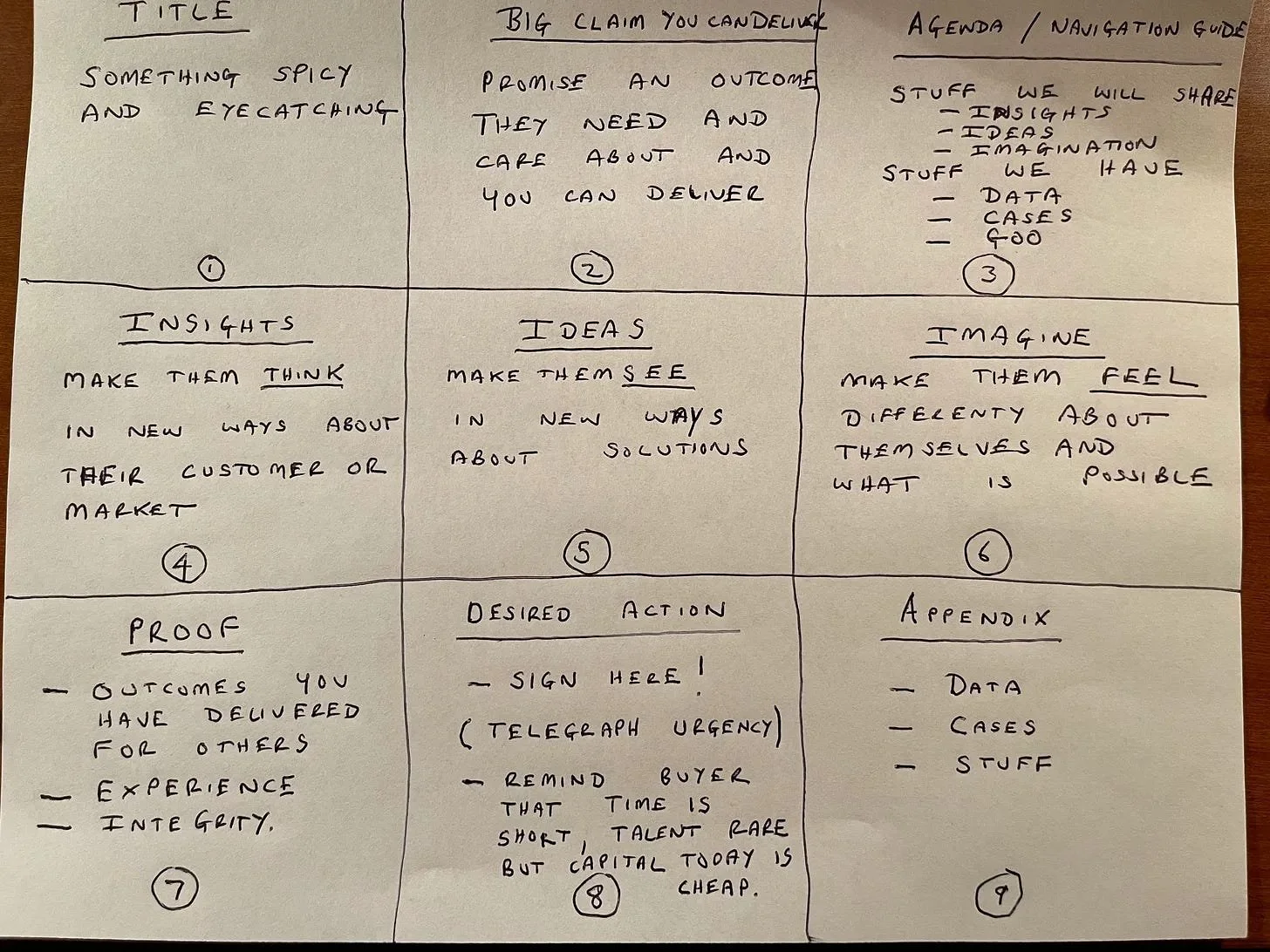
3. Rethinking Presentations: Why most decks should be no longer than 9 slides.
Think of all the presentation you have sat through or produced. Many were fifty, sixty or hundred slides long. How many slides do you remember? How many stood out or made a difference?
Presentations are often un-necessarily long because:
a) We often confuse volume with quality.
b) Many people feel without a huge deck they cannot justify their expenses or point of view.
c) Often firms are paid by time exerted so they are incentivized to bloat and be baroque.
d) We often focus too much time about the process, the background, the history, the tools, the sources of data versus delivering the idea, insight, innovation, or imagination.
If we need more than nine slides to tell our story, sell our point of view, or close a deal, we may not have anything truly convincing, differentiated, or interesting.
Over the years here is some learning gleaned from the best story tellers, salespeople, and communicators reduced to a simple exercise.
The best presentations are ones where you write the deck but never present or share it.
Begin with a letter size sheet of paper and a pen or pencil.
Place the sheet so it is in landscape mode.
Pretend you are playing tic tac toe and draw two vertical and two horizontal lines.
You now are looking at a slide view of nine slides on a single piece of paper.
Slide 9 is the appendix slide where you will list supporting material and will be the last slide you fill in.
Slide 8 is the Desired Action slide which highlights what you want to get from the meeting/ have the person you are presenting to act on.
This is the first slide that you fill in since this is what the point of the meeting you are having is.
Then the focus of your work is slide 4, 5 and 6 which you may want to label Insights, Ideas, Imagination. What insights about customer, consumer, marketplace, competition will you be sharing that get your audience to THINK differently? What one two or three big ideas are you delivering that will make their customers or consumers SEE them differently? What provocations, perspectives, points of view are you communicating that will get your audience to FEEL differently about their business, their future or you?
The goal of slide 4, 5 and 6 is to make sure you get the action you are looking for on slide 8.
Slide 7 is the Proof on why you or your firm should be believed, and this is where you show or share the cool results you have driven for other people.
Now you are ready to write the opening slides 1, 2 and 3 which are very key. Slide 1 should be a title that will make your audience come to attention, slide 2 a promise or some other benefit or outcome you will drive (e.g. your firm will generate 20 percent improvement or x or y) and then slide 3 which is the agenda slide or navigation slide which notes that you will be sharing ideas, insights, imagination and supporting material….but are ready to jump into any section based on what your audience is interested in first or how you have read the room at the beginning.
Finally slide 9 which is the appendix of all the supporting material that the first 8 slides are built on and can include data, cases, and other stuff.
Once you write this out you will find that you can make the entire presentation often without the presentation and at minimum you no longer have a long ponderous deck.
Instead, we have perspectives, provocations, points of view, insights, ideas, imagination, promises of delivery and a warehouse of stuff they can rummage through assuming they are interested.

How to be more Effective.
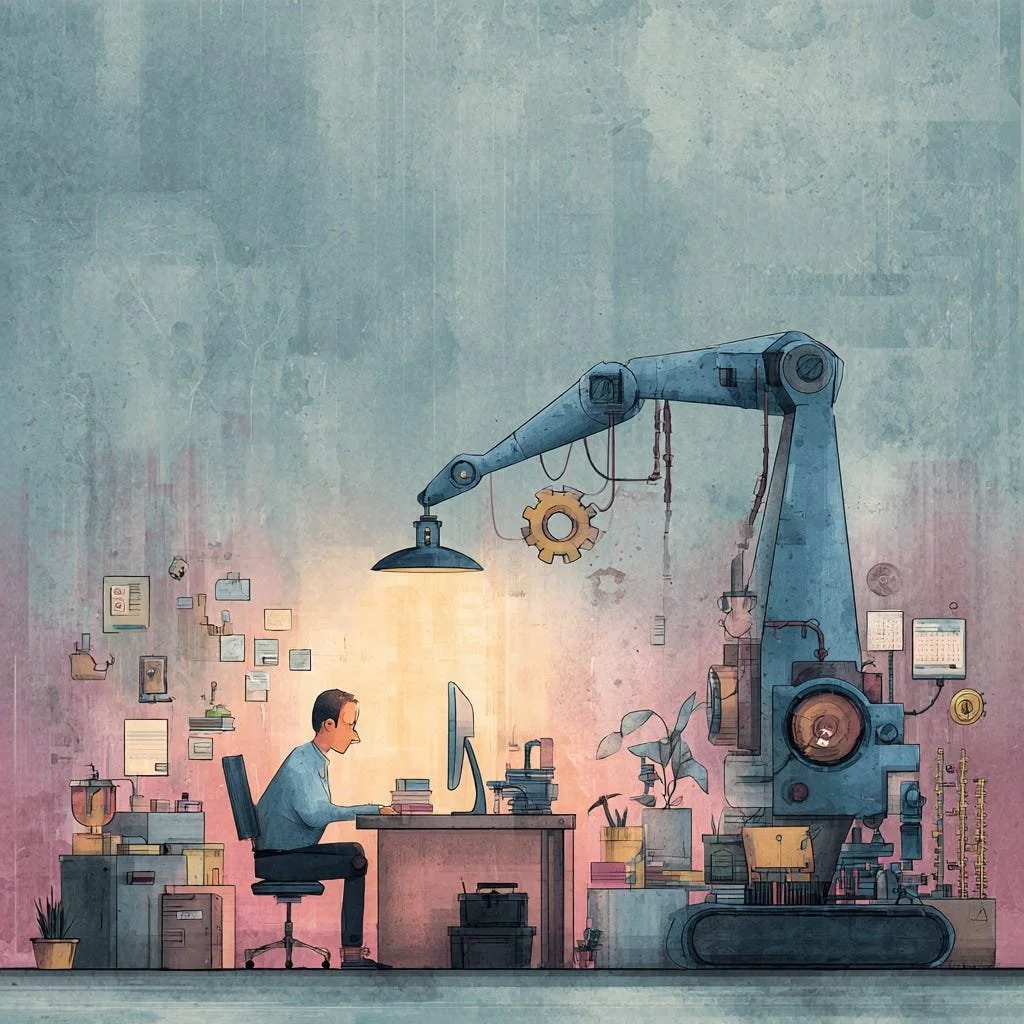
One of the dozen topics I have written on over the past five years is how to be more effective. You can access all the best pieces in section 4 here: https://rishadtobaccowala.com/100
The 3 keys to being effective are 1) leveraging the only asset one has which is time, 2) making sure that every interaction has the ability to be a tattoo moment, and 3) soaring through feedback.
1. Time is the essential asset.
Franz Kafka wrote “The meaning of life is that it stops”.
How we spend our days is, of course, how we spend our lives wrote Anne Dillard.
Tell me, what is it you plan to do with your one wild and precious life? asked Mary Oliver
Life is a journey through time in search of meaning.
A definition of success is the ability to spend time in the way that gives one joy.
To understand what is important before it is too late.
Successful firms and people use time differently than others.
Four behaviors/beliefs that are common to most successful individuals and firms:
The Power of Compound Interest/Compound Improvement: The most powerful concept in gaining wealth or knowledge is continuous growth over a sustained time period.
See early what others see late: Almost every successful person or company recognized a trend when it was a little stream rather than a gushing river and then committed to align with it.
Persistence: They just keep on going through adversity and setback and they remember Queen Elizabeth the First who said “Time dissolves more problems than man solves” or “that persistence isn’t just continuing to try— it is the runway that gives your talent time to take off.”
Focus: The key to effectiveness is to focus. Here are two filters on how to focus:
a) Comparative Advantage: We should spend our time doing things that we can do better than most people. Some focus areas are easy like being a spouse or a parent, since by definition we should be able to do this better than other folks. However, for many of the errands we run and the assignments we take on at work, it is important to ask if we can outsource or delegate or find a colleague who is better than us so we can focus on what we are best at.
b) Positive Outcome: We should try to choose how we spend our time in ways in which we create a positive outcome. Either we 1) earn a financial reward, 2) learn something new, 3) help someone else or the team get better or 4) the experience in itself feels good.
2. What one should bring to an interaction.
There are a lot of books and articles on meeting management and how to get the most out of gatherings.
Most of them are utter and complete BS because they all focus on how you can get the most out of an interaction, while the focus should be how can you give the most in an interaction.
If you go to a meeting with an “extraction” mindset versus a “giving” mindset you are likely face several problems including a) missing meetings where you may have been able to share your knowledge and therefore build goodwill b) become so focused on what you are looking for that you do not discover what you need.
Instead go to the meeting with this:
a) Generosity.
How can one leave the person or the people whom one is meeting with or presenting to with a gift?
Knowledge. Appreciation. Guidance. These are three ways to bring generosity to an experience.
b) Empathy.
How can one truly understand the other persons perspective and point of view because in doing so one will grow even if we might disagree with their perspective or view.
c) Attention.
When we have a great interaction, we feel that the person talking to us is paying attention to us.
They do not appear distracted looking away at some screen or signal they are participating grudgingly in the interaction. They are there in body and spirit.
People watch for tone of voice, facial expressions, and small gestures rather than one’s physical presence if one is paying attention paying attention.
While these are what you bring to a meeting ideally you want people to leave the meeting with these:
a) Clarity.
In a great interaction or meeting people come out with a clearer understanding of a situation, with greater precision of knowledge, and clear-cut next steps than before the meeting or interaction.
b) Belief.
It is one thing to be clear as to what must be done next but as important is to leave an interaction with a greater belief in your or your team’s ability to do what is necessary.A key is to leave someone feeling better about themselves after you meet them rather than worse even if you provide them with less than positive information by showing how you or another individual tackled the same problem, reminding them of the times they recovered when they were knocked back by a challenge or sharing your individual stories of tackling similar situations.
c) Energy.
We are living in a time of great change, accelerating velocity of business and multiple pressures.
This is leaving people often drained, burnt out and wanting to just curl up under a blanket from the noise and tension.
Great interactions leave people rejuvenated, replenished, and refreshed.
While clarity is about the mind, belief about the heart, energy is about the body.
Bringing energy to a meeting can boost others. Energy is contagious
The ideal interaction is a TATTOO interaction in that it so impacts people that they remember it for years. Read Tattoo Moments.
3. Feedback
To grow one needs to continuously improve.
A key ingredient to improvement is feedback.
Feedback however is both difficult to give and receive.
The six steps to giving better feedback.
Best practices suggest that there are six approaches that can help people give and accept feedback:
1. Focus on how the task or the process could have been improved rather than criticize the person: By focusing on how an assignment could be done better the emphasis is in on the product and not the person.
2. Compare the shortfalls to a higher standard that might have been met on another project or another time: By recalling assignments or times where the individual or team did a great job, one reinforces to the person or team that they are capable of having done better. The emphasis is on what was less than ideal on this occasion versus rather than believing the individual or team is incapable of doing a good job.
3. Be sensitive and aware of extenuating circumstances: We all have bad days and many times these are a result of something else distracting us or worrying us in our lives. It may be illness, family issues or other challenges. By empathizing with an individual and wondering if there is a reason quality has slipped indicates both concern and humanity.
4. Provide input as specific as possible as to what could be done better: Pointing out what went wrong or was less than optimal is only one half of feedback. The more important half is showing or teaching or guiding on how one can improve. Identify either steps or training or changes that need to be made.
5. Identify the next opportunity or project for a do-over or try another take: By showing both how one can improve and then identifying an upcoming opportunity to put the feedback to work concentrates the mind and channels emotions to action and the possibility of correcting the shortfall.
6. Provide personal help and perspective: If feedback is provide with examples of how the person providing feedback or other leaders have learned and improved, it signals that mistakes, mess-ups, and other shortfalls are par for the course in career growth. By also asking how you can help reinforces that you are on the persons side and are committed to building them to be better versus tearing them down.
Three ways of ensuring one is getting feedback
While we learn how to give feedback and not be scared of receiving feedback, how can we ensure that we get feedback?
1. Scan for signals: People are constantly providing feedback even if they are not vocalizing it. In some instances, you may gauge it in numerical signals from how well your writing is read, reacted to, or shared or whether you are invited to key meetings. Other times it is to watch facial and body language. You learn a lot by reading a room or a Zoom gallery.
2. Ask for feedback on a regular basis: One can do this with three simple questions framed in ways that ensure people are comfortable helping you since they are positive in tone:
a. What worked well?
b. If/when I do this next time what could be better?
c. Who do you think does what I need to do well and where can I learn more?
3. End of Day or Week Self Review: Most people know in their gut what worked or went well and what did not. Many successful individuals end the day or week with some variation of a quick three step review :
a. The Work: What went well with my work product that I feel proud about and what could have gone better?
b. The Team: What felt good and productive in the way I interacted with people and where could I have been better in some ways in handling my or someone else’s emotions.
c. The Improvement: What little improvement did I manage to make today or this week? A new habit. Learning a new approach. Strengthening a relationship.
We get better not by being better than other people but aiming to being better than we were yesterday. Every day.
To do so it is critical to help our teams and ourselves with feedback.
Spend an hour reading Section 4 here and become more effective tomorrow .
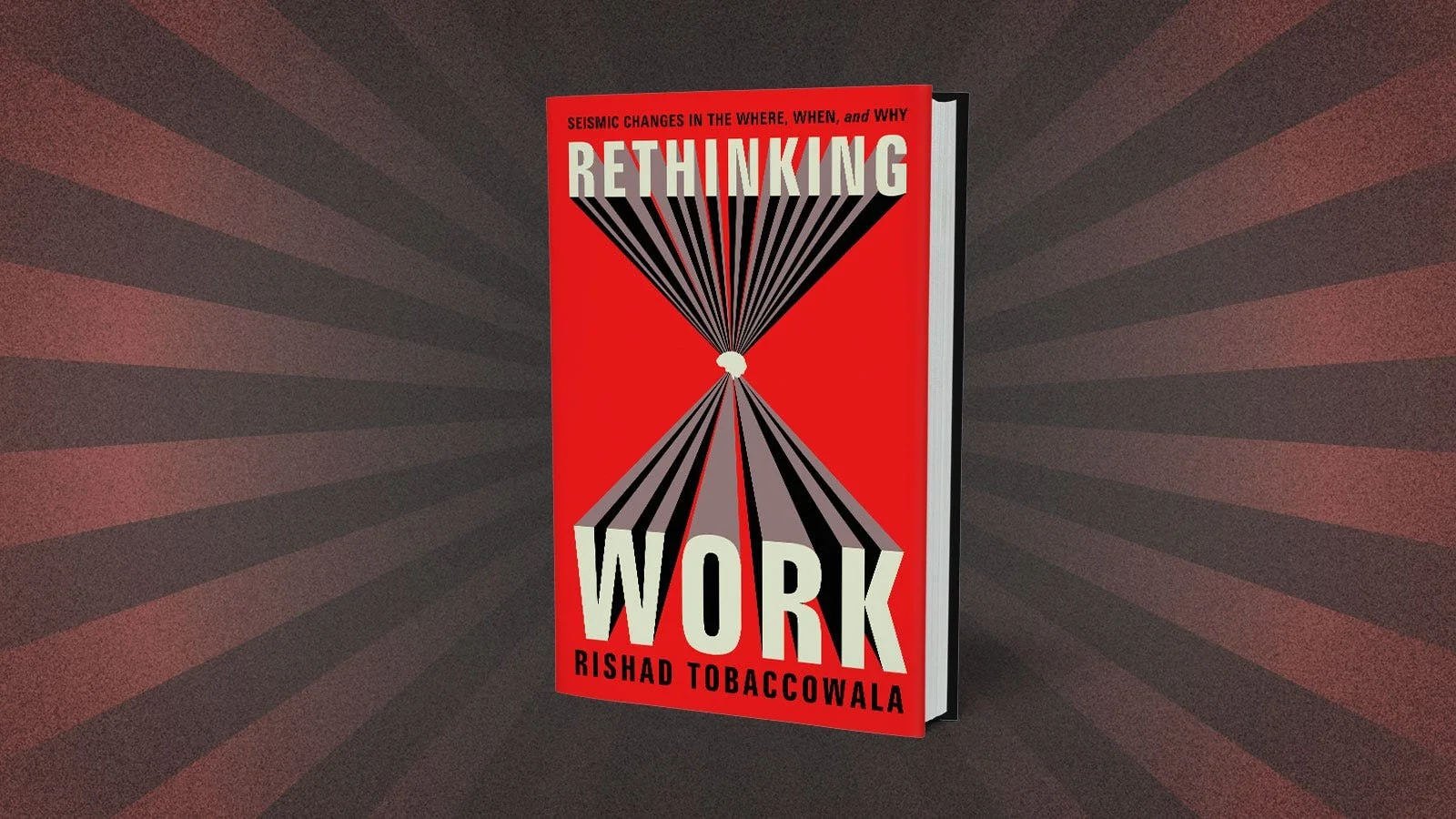
Check out the Rethinking Work Show. Every Wednesday on YouTube, Apple and Spotify. People pioneering the next generation of work while so many companies are are lost and looking in the wrong direction! The future is here and you can get a first look by subscribing at RethinkingWork.io. Its full of insights and free of any cost or ads.

Managing Careers.

Image using Midjourney
This 260th edition of “The Future Does Not Fit in the Containers of the Past” marks its 5th year anniversary ( 5 X 52= 260).
Over these past 5 years the content has spanned a dozen different topics including The Future, Managing Change, Creating Great Cultures and Future Forward Organizations, Leadership, How to Upgrade Our Mental Operating Systems, Strategy, Rethinking Media, Marketing and Creativity, Selling Better, Personal Growth, Wisdom, and Managing Careers.
The Substack has remained completely free and has grown from 100 to nearly 31,000 readers. Starting today, I will revisit each of the 12 topics combining the key points from the past with some new thoughts.
Today we begin with some thoughts on Managing Careers.
1. Plan Careers with a 50 year horizon.
With life expectancies nearing the mid-eighties, social security being pushed back and most people enjoying good health till the mid seventies, it is unlikely that we will be parked on a beach when we near sixty. And even if we do not have to work for financial reasons we will do for reasons of meaning, connection and growth. Thus if we are in our 40’s we have three decades ahead of us so it is never too late to learn new things and start again and if we are in our 20’s or 30’s we should try not to get hysterical or depressed about a lost business or a bad quarter.
Rather, we should not make job or career decisions with three month horizons but at least three year horizons. Ideally one should stay in a company as long as one is finding ways to grow. With time in a firm one builds relationships, reputation and acumen. Avoid switching from something that is working just because more money is offered unless we have financial stress. Remember that often the grass is greener on the other side because it is fertilized with bullshit. Wherever there are people there is drama and nonsense . By taking a longer term perspective our decision making will be better, our skills will mature, and we will take daily and weekly gyrations in perspective.
2. Having a job and having meaningful, purposeful, rewarding work are not the same thing.
We are likely to see a decline in jobs but an increase in the opportunity to find work.
This shift is already underway as full-time employment in a company via holding a job is being supplemented and complimented by part-time well paid opportunities outside holding a job. Every force from unbundling of the office, the rise of AI, the explosion in marketplaces such as Shopify, Etsy, Upwork and more will further drive this change.
Thus a career is a “career of work” and not a “career of jobs”. It is a “working” career not a “jobbing” career. We must prepare for a career that combine a series of jobs and gigs and projects, sometimes serially and often in parallel.
3. The people you work with and for are more important than most other things.
When given a choice between someone who could mentor us, teach us or help us grow versus a higher salary or a better known company we should go for the former. Our skill growth, our work satisfaction and our future potential are highly driven by the people we work with rather than the company we work for.
The ideal is to find a great person or team to work for in a well regarded company or to find your way to these leaders and teams.
To grow we must align with people who can help us grow.
This is particularly true in the first two decades of our careers.
4. Be data and reality driven.
Money never comes accompanied.
Whomever pays us expects we will deliver a quality product or service at a market competitive or even under market price. We are a unit of production that can be replaced by another unit of production that offers more for less.
Nobody is irreplaceable and beyond a point our personal drama is friction and heat and considered a hindrance so pouting and bad mouthing should be kept to a minimum if one wants to stay in an assignment.
Work is not a spa and there is a reason one is being paid.
It is a tough and fast moving marketplace. And change is so difficult because we have to constantly adapt and learn and twist ourselves into new shapes. This is harder the more senior and accomplished we are in a firm.Change sucks but irrelevance is even worse.
Facts matter. Truth has a habit of breaking in. Reality matters.
The market, the company and the future will never adapt to us. We have to adapt to it.
5. Learn to operate with “a company of one” mindset to maximize our optionality.
The best way to control our careers is to have options. There are many ways to increase our optionality.
The most powerful is to have “a company of one” mindset even if we are working for a company of thousands. It’s a way of being and operating and behaving. It is not necessarily about having to set up shop as a company of one.
To operate with “a company of one mindset”we need to combine craft, collaboration, reputation, and make investments in our own growth while keeping our costs under control.
It is key to work really hard at honing a craft, expertise and skill that the market is demanding since that is what people are buying. Second it is critical to be very collaborative since it is teams and network that make work happen. Individual contributors will be isolated without also being collaborators. The third is to build a reputation so people will think of and call us when there are opportunities inside or outside the company. Next, invest in our own growth program. Do not only depend on your future learning on the company for two simple reasons. First, they will invest to teach us what they need but that is not what the market might need. Second most companies are barely investing in training these days. We ourselves should subscribe to the latest and greatest AI engines, communities and much more. It is our career not theirs.
Finally to increase our options we should not price ourselves out of our dreams. Keep costs as low as possible so we do not have to keep working at a job we dislike to pay for things that impress others versus something that gives us purpose, meaning and joy.
The goal is to craft expertise, earn a stellar reputation, practice a growth mindset and build a fortress balance sheet so we have the option to walk away anytime people try to control us or make us feel less.
The option to walk away does not mean we should. In fact the option allows us to stay and deal with the drama and find ways around the problem. When we feel we have optionality outside we can stay in a company for much longer than if we did not.
Optionality is true power that comes from a Company of One Mindset.
6. Invest in the 6c’s to Future Proof.
The world keeps changing and technology is replacing a lot of knowledge, experience and even some skills ( from translation to coding).
Now the ability to learn, to grow relevant skills and expertise and to bring insight and crystalized intelligence (wisdom) to the task at hand is what matters.
Here are six skills we should work at that will stand the test time. They are the 6c’s : Cognition, Creativity, Curiosity, Connection, Convincing, Communication
Cognition: We need to upgrade our mental operating system which means unlearning and learning is key, particularly the more senior and accomplished one is. Today careers die when we stop learning. Clear an hour in every day to learn ( take it from anywhere but sleep and family). If you do not have time to learn be aware that we are becoming irrelevant.
Creativity: Creativity is an expression of self and a way to connect dots in new ways. To do so we need to combine our past and our futures, hone our voice and taste and bring our insights, intuition, instincts, imagination to the knowledge and processing bases of AI
Curiosity: Lets ask two questions as often as we can. Why not? What if?
Connection: The ability to connect and resonate with other humans, other firms, other expertise means we will need to hone our API’s and MCP’s ( Machine Context Protocols) but also our empathy and vulnerability.
Convincing: In a world where everybody has the same knowledge bases since AI will be like electricity , a commodity that we will all use, what we will need is the ability to story tell, inspire, and motivate.
Communication: When a Samsung phone can translate Mandarin in real time and coding will need English ( or our native language) the old advice of learning Chinese and Coding may be less relevant. Learning to write well and present to hold a room are skills that will help us thrive.
7. Practice Resurrection
Even if we are amazingly successful, we may find ourselves kicked to the curb, right sized, passed over for the promotion, layered, denied the prize, removed from the business, or marched out of an office…
The world will seem to end. Our self worth crushed. The story sullied. Our reputation tarred.
But we must practice resurrection
And rise like a Phoenix.
For in the ashes of our setbacks are the seeds of learning that will help us take flight again.
Ask anyone with great achievements and they will tell us how the stops at failure made their journey more successful.
8. Keep things in perspective.
Work is central to human satisfaction and happiness because it provides us not just income but also identity, community, purpose and growth.
We need to work seriously and with passion to excel.
But relationships and health are the other keys to happiness and very few people you work with will be at your funeral.
Notice how people who have lost a position are surprised that they are no longer popular. The reality often is people were not interested in the person but the Company and Client they worked at or budget they controlled.
So we should chill about our supposed fame, popularity and clout.
It will be gone and one day we will need to be by ourselves.
Time rather than money is the only real currency we have.
Many people will run out time long before they run out of money.
For many people work is a key part of a good life.
But there is much more than work to a great life.
Much more on Managing Careers in Section 6 here :https://rishadtobaccowala.com/100 and in Rethinking Work that is unleashing people and helping prepare for the future at Rethiningwork.io
