© Dolorès Marat, La Femme du musée Grévin, Paris, 1988.
Today we operate in an environment of Aliens (AI), Replicants (Agents) and Humans.
Workplaces are filled with anxious people fretting about jobs and concerned about the ability to re-invent, remain relevant and stay resilient.
Many companies speak about trust while monitoring movement and key strokes of employees.
They issue press releases about agility and personalization while enforcing a one size fits model on their talent. They stand at the ready to point to AI as the reason they are downsizing.
This is fear mongering.
A doctrine that pushes an agenda that talent has no choice, that power has moved to capital, and that agents properly harnessed can do a better job than people.
It implies that people are caught in a spider web of algorithms, have limited self-agency, must comply with return to office mandates regardless of their personal situation or work, and we are months away from agentic substitution via replicants.
In fact, like every other technology advancement to date, AI will place a premium on talent.
AI will be the slingshot that will allow David ( and Danielle) to play at the level of Goliath.
Talent will matter more than ever.
Humans are not a silly phase that intelligence is going through.
No AI, no company boss, no agentic thing should ever be able to take away agency from the wild, un-knowable, feeling filled, messy people that we humans are.
While Carrie Underwood implored Jesus to take the Wheel, it is important that each of us seize the wheel to drive ourselves to tomorrow.
The future is likely to be a fusion of digital, data driven, silicon machines and analog, feeling infused, carbon based people who learn to harness, complement and surprise the machines!
A world of alien intelligence combined with human intuition, human inventiveness, human imagination, human insight and yes even human ickiness!
To ensure our continued thriving and future we should begin to find ways to increase self-agency.
Here are four ways to do so.

© Dolorès Marat, Sur le « Napoléon Bonaparte », entre Marseille et Bastia, 2000
The Four Audits.
1. Calendar Audit: Look back at the past month. Calculate the hours spent collecting and distributing information, checking in on people, monitoring work, measuring results and allocating tasks. Then calculate the time spent creating, selling, guiding, mentoring and learning.
Reallocate time to creating, selling, guiding, mentoring and learning so it is more than two thirds of time spent. It is what machines will be able to do less well while first group of tasks will be automated away.
Minimize the colonization of one’s brain that comes through digital encroachment by ensuring at least one or two waking hours a day that are free of digital and AI. Walk in a garden, read an old fashioned book, write on parchment paper with a fountain pen, go to a museum, have a long conversation with another human.
2. Reputation Audit: Ask if we were separated from our company brand or our budget would people still call us? Are we only building value for others and leasing value from their budgets or are we also building value for ourselves? So many of us believe we are powerful and famous for ourselves while it is really our companies and budgets that are popular.
It is critical to build reputation, expertise, and networks that are that are ours wherever we go. Start building ourselves and not just our company or brand. Start growing our possibilities not just growing the possibilities for those who pay us.
This is not a zero sum game. The better we are and the more we grow, the better for the company and the clients we work for.
Companies do not transform. People do.
Companies do not reinvent. People do.
The more options we have the more we will stay loyal to the company that allows us to grow ourselves while growing them and their clients.
A world-class company should be filled with world-class people who can write their own ticket and therefore feel free to speak up, be innovative and take risks, helping take our firm and clients to the next level.
3. Work Audit: We should take a look at our LinkedIn Profile. Revisit our resume. Ask Chat GPT, Claude and Gemini to create our obituaries or answer if we are any good or tell us what work we are associated with.
Are the results a bunch of titles and roles and company names? If so we need to make sure that we do whatever it takes to build a body of work versus a collection of titles. In Jerry Maguire it was “ show me the money”. Today what is important for employers is to be ready when they ask “ show me the work”. Bodies of work reflect well on us. Titles are reflections of the organizations we climbed at.
What matters is the portfolio. The ideas. The content. The people we have impacted positively. The stuff we have built.
4. Believer Audit : Who have we helped guide, teach and mentor? What talent have we fostered and grown? Who and how many people will say we played a big part in their success? Who believes in us and will bet on us?
Start helping people. Traffic in generosity. Show care. Inspire others. No machine will ever do this with feeling and on its own volition. And nothing will feel as good as helping others shine and soar.
It is worth doing for itself but it creates amazing Karma.
A diaspora of talent who will help silently (or loudly ), and who will reach out when we are in need of a hand.
Conduct these four audits and begin to do whatever is necessary to move in the right direction.
They do not need budgets, approval of bosses or create any ethical quandaries.
Even better we should encourage that our bosses do them. Most of them are amazing people who need to unleash the leader within. Many need our help much more than we do theirs!
One Single Thing.
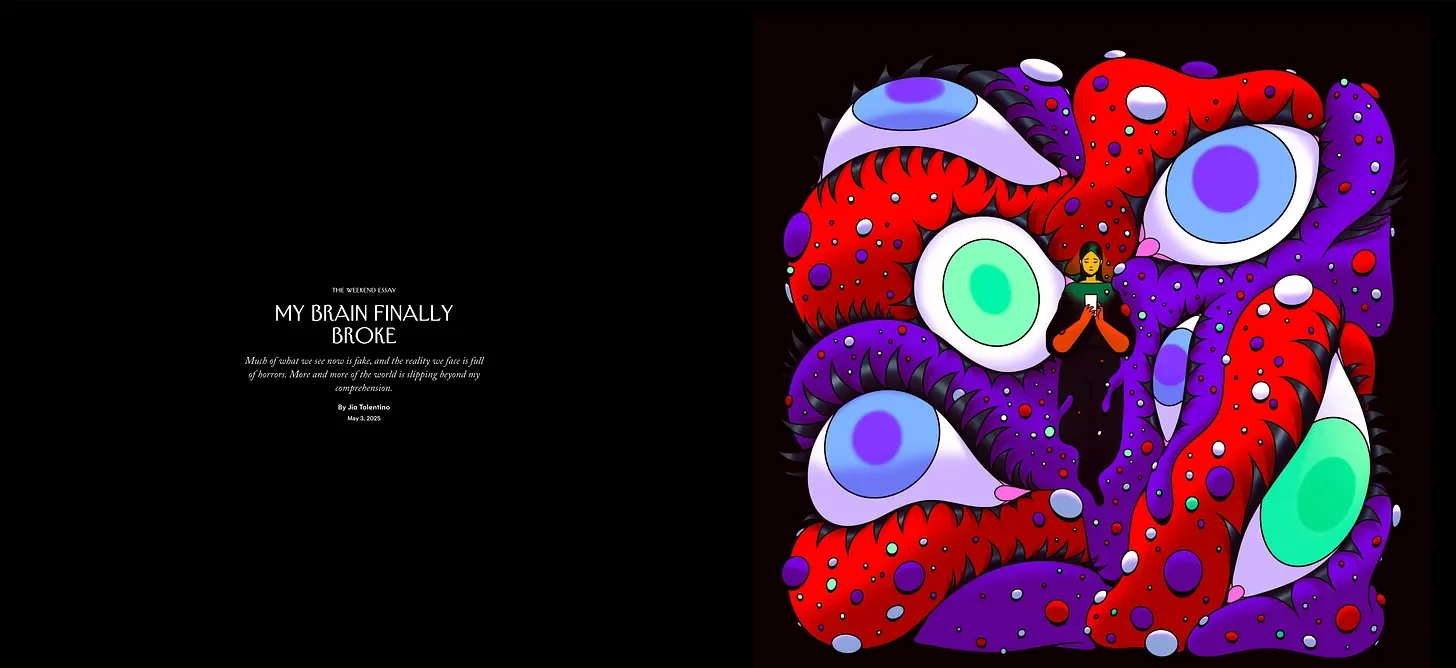
Read Jia Tolentino’s short essay: My Brain Finally Broke : https://www.newyorker.com/culture/the-weekend-essay/my-brain-finally-broke