Rethinking Organizational Design.
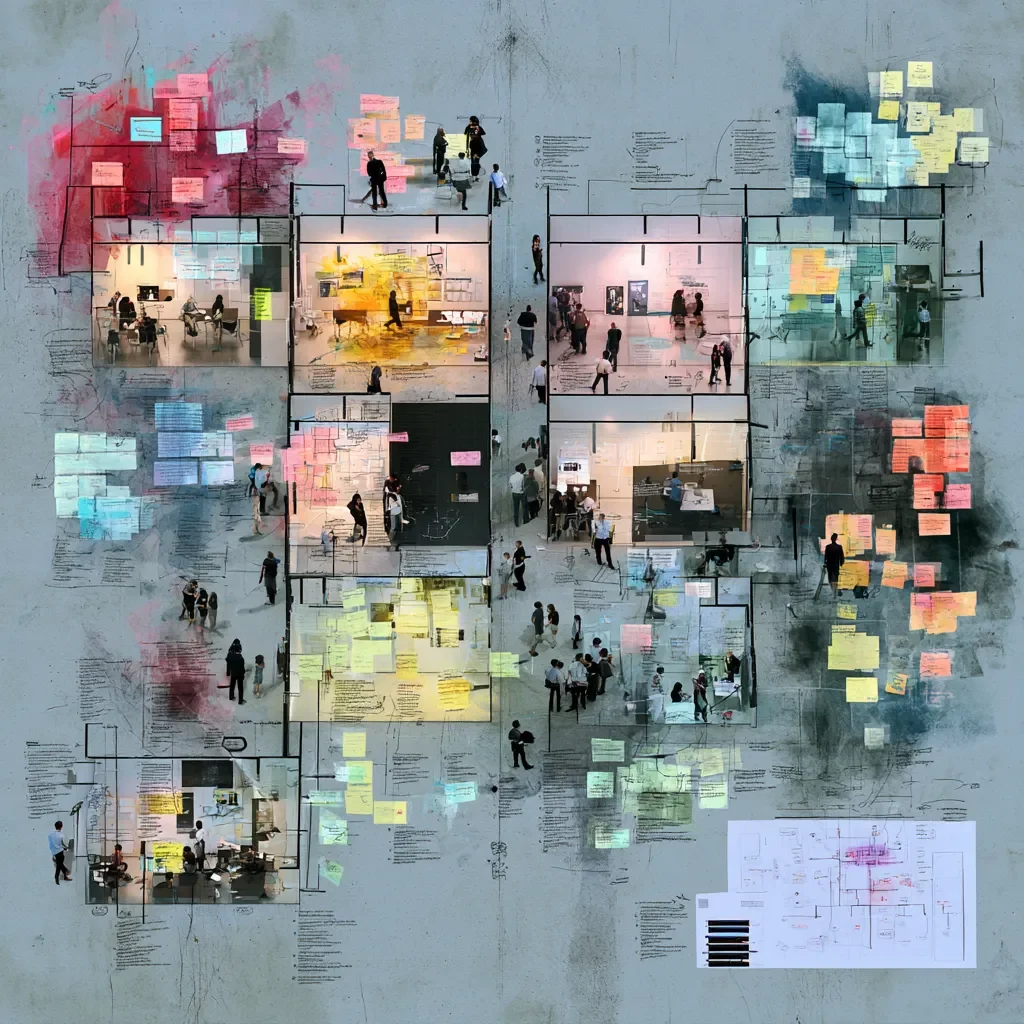
Image via Midjourney
The Future does not Fit in the Containers of the Past.
But what if most organizational design today are containers optimized for yesterday?
To create a redesign that is effective now and for years to come, we need to think about structure more broadly than is typical. Most people think of business structures from an organizational-chart perspective. They envision boxes and connecting lines that indicate who reports to whom or the flow of goods and services from the company to various markets. That’s why when people talk about restructuring, they focus on things like flattening the organization and eliminating some of the lines or streamlining the supply chain.
While all of this is important, it’s just part of what needs to be redesigned. An organizational chart is a two-dimensional view—what we need is a three-dimensional redesign.
For years, we’ve fooled ourselves into believing that the organizational chart represents how the organization works. That was okay in less complex, less volatile times, but it’s no longer acceptable. Consider that organizational charts and maps indicate how leaders want the company to operate, but the reality often is quite different.
For instance, the maps and charts document zones of control rather than zones of influence. A title represents a position that may be vested with authority but not necessarily the authority to determine how work is done. These charts also impose clarity where there often is none. Business is messy, and operations often shape-shift based on circumstance, ignoring the flowchart. The official organizational structures are also limited in scope, failing to account for all the external partners, freelancers, and other outside groups that have become necessities.
Consider the static nature of organizational design, driven by internal factors (that is, areas of expertise) and client/customer categories. In an increasingly globalized world filled with new marketplaces and transformed by technology, this design must be more organic, adapting to external stimuli.
Old structures will crumble in the face of new realities.
Yesterday..
1. The organization gave structure and directed work.
2. Tenure and experience were critical to advancement.
3. Most of the work was done inside an organization.
4. Fairness required a common set of rules and ways of working that apply to all.
5. Most people were full-time employees of the company.
Now/Soon:
1. The organization enables talent to create structure and direct work.
2. Expertise and constant learning in a changing world are more highly valued than tenure/experience.
3. Most of the work is done outside an organization by suppliers and by accessing talent as needed.
4. Fairness means customizing programs for each talent and giving everyone equal access to those programs.
5. Most staff are either contract workers, freelancers, fractionalized employees or agentic employees.
Because of these new beliefs and assumptions, organizations must rethink how they design everything, from compensation systems to decision-making processes.
On the most basic level, it means companies must design structures from the outside in rather than the inside out. In a fast-changing world, companies must create their processes and procedures based on marketplace realities (that is, emerging competitors and changing talent mindsets) rather than relying on “the way things have always been done around here.”
They should also embrace multiple models of working rather that a single model. Given the multiplicities in workplaces today, models need to differ based on country, competition for talent, and whether the focus is on current business or innovations.
And finally, it means outcomes and goals take precedence over process and control. Financial results, customer satisfaction, and talent attraction/retention should take priority over following strict procedures or maintaining tight control about how work is done.
To commit to this type of redesign requires trust—management must trust talent and teams to determine the best ways to drive financial results, customer satisfaction, and talent attraction and retention. By restructuring roles, talent takes the initiative while management guides and coaches.
Four key factors to drive organizational redesign.
Customer benefit. This may seem obvious, but company design often reflects internal requirements first and customers second. Given the increasing diversity and changing needs of customers, organizations should consider creating different designs for different customers. This might mean colocating with a customer or integrating with customer suppliers.
Talent advantage. In the past, points of differentiation included price, service, innovation, and so on. Today, the main differentiator is talent. Companies must organize in ways to ensure that their talent is satisfied and growing. Considering that talent often is spread across different locations, possesses different work-style preferences, and represents a wide demographic range, one organizational model doesn’t fit all. Instead, the model should accommodate the full range of talent.
Change adaption. The previous two points allude to this one: organizational design must be flexible, able to shift as changes occur. Competitors change. Laws change. Markets change. The design, therefore, must anticipate that these shifts will occur and be created in such a way that adapting a policy or revamping a process isn’t a big deal. This is an organic, evolving approach to design (versus an artificial, static one). To deliver on strategy, one needs to update the design continuously.
Permeability. Traditional designs are closed systems. Today, they need to be open. They must be capable of connecting and fusing with other companies in an increasingly connected, fast-moving world. A company and its deliverables grow by combining capabilities and products from different external firms or being part of those other firms’ deliveries.
Three Transformations Necessary.
It’s not going to happen overnight. Anyone who has ever had a kitchen remodeled or other major structural work done in a residence knows that the work often takes longer than expected. The same idea holds true with organizational renovation.The ambitious but challenging goal is to transform the organization so it’s aligned with the world’s technological, cultural, and market changes. Organizations will transform in the following ways:
From legacy structures to roots-and-wings design
Legacy structures tend to be companies built around the profit flows and products of today and yesterday. Legacy assets still generate cash flow, have customer and brand value, and contain talent. But they also motivate leaders to maintain the status quo; they hook organizations on profitable existing products and services, on structures and processes built in and for an era that is rapidly disappearing. Perhaps more destructively, they discourage disruption. Preserving the legacy is the main priority.
The transformation, therefore, is treating these assets as the roots of the company—as foundational pieces from which new life grows. They provide the basis for this new life to take wing and soar, to become organizational designs optimized for new customer segments or other future targets. Roots keep the business viable today; wings help it remain viable in the future.
Successful companies learn to combine roots and wings. Parts of the company are designed for today and others for tomorrow, but talent flows between the two models and leaders orchestrate this flow.
From bosses/zones of control to leaders/zones of influence
Essentially, this means moving from a structure where people’s power is based on their seniority, the amount/type of business they control, and how many people report to them, to a more organic system. In the former, turf wars are common, and people are incentivized to accumulate and retain power. In an organic system, the incentives are different—people are motivated to have influence and and respond to external realities.
From seeing people and labor as a cost that must be controlled to an asset that requires an investment
Talent now provides competitive advantage, and the best thing organizations can do is nurture that talent through its policies and processes. This means accommodating workers versus forcing workers to accommodate the company. It means more programs that cater to employee career goals.
When companies announce that they are replacing people with AI it is often because of other challenges including over-hiring, poor leadership and broken business models. AI is a sling shot that allows individuals to leverage their skills making every David or Danielle as powerful as Goliath.
Investing in making talent more productive and driving the revenue line is more sustainable model than generating productivity by reducing the cost line.
One Single Thing
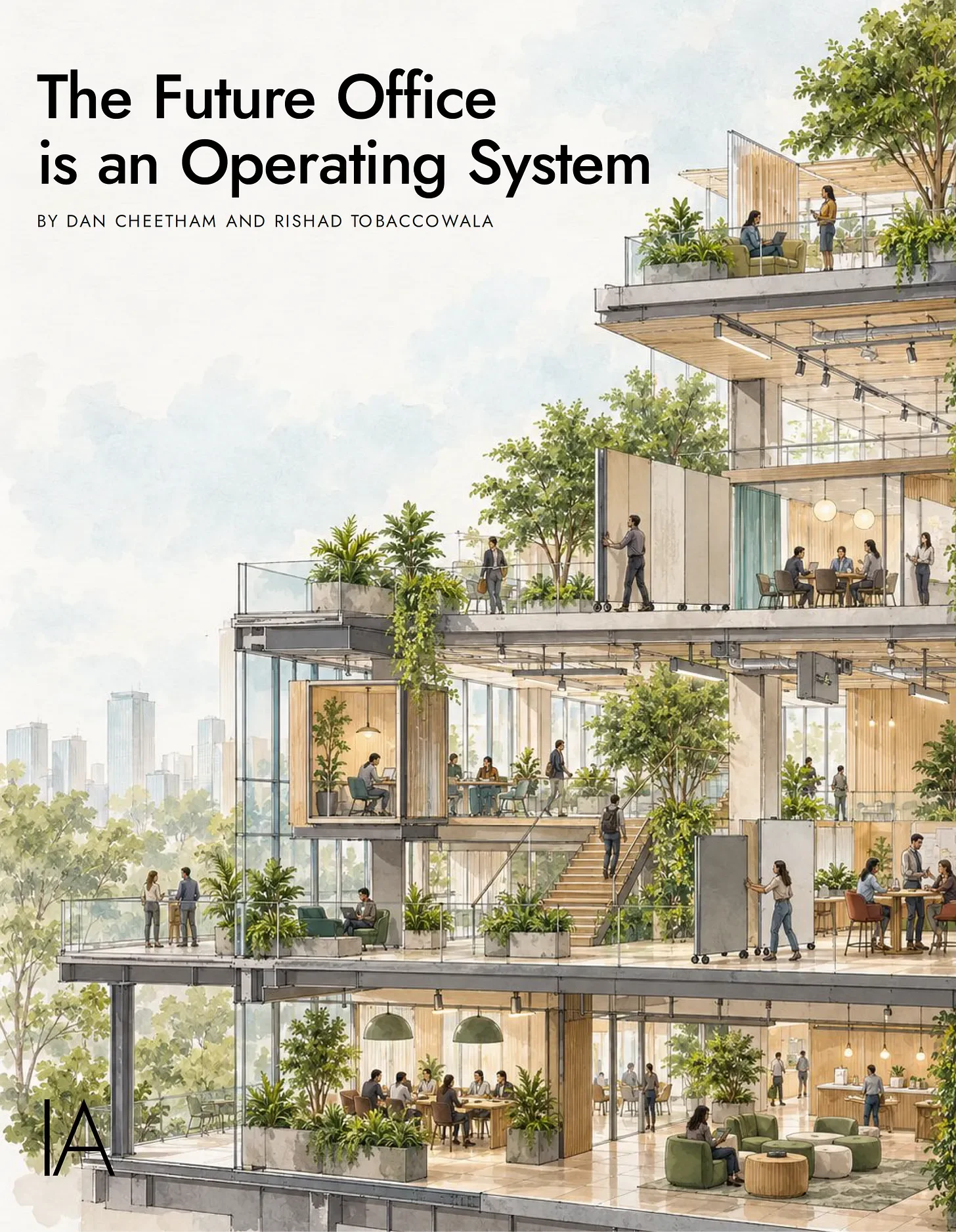
As organizational design changes so should the office. IA one of the largest Architectural Design firms in the country just published and distributed a piece co-written by Dan Cheetham one of their partners and myself on rethinking the office from a place to an operating system. If there is a container of the past it is the concept of the office as a place. You can download the piece here: