
Stories Endure. Technology Helps.

Shakespeare & Company. Paris, France. November 18, 2016. Photo by Rishad Tobaccowala
Every advance in technology has empowered story tellers.
Fire brought warmth and as our ancestors huddled around the flames they told stories.
Just as we do today when gathered around a fire.
The wheel allowed humans to go on journeys and new people to arrive from elsewhere.
At its core every novel is driven by one or a combination of two factors :
Someone new comes to town or into our lives initiatiating a series of incidents.
Or
A protagonist goes on a journey of exploration. These journeys may be external in search of a person, place or adventure or it might be an internal exploration of self-understanding.
The Printing Press enabled us to access far more stories including the very best ones across time.
Every year I revisit my two favorite books which were written 500 years ago and possibly are the best novel and play of all time: Don Quixote and Hamlet.
The Internet turbocharged story telling by giving more people a voice, reducing barriers to distribution and creating new forms of story telling from blogs to short videos.
And now there is AI which I refer to as Alien Intelligence (credit Mustafa Suleyman of Microsoft).
Will AI write stories for us versus humans writing stories?
Yes.
Will AI write humans out of future stories?
They might.
But the stories that will resonate the most among humans will be stories about us humans interacting with each other and possibly alien intelligence.
Because AI will never perfect the complexity of humans.
AI thinks in outcomes while humans are all about the journey.
AI thinks clearly and cleanly while humans are messy.
We do not answer questions with a “yes” or a “no” but a “maybe”, “it depends”, or we avoid the question all together.
A human is a bundle of complexity and the same person in a different mood is often a different person.
As Walt Whitman wrote:
“Do I contradict myself?
Very well then I contradict myself,
(I am large, I contain multitudes.)"
In addition every human is aware of the finiteness of time which machines cannot feel.
From Louis MacNiece’s “Sunlight on the Garden”
The sunlight on the garden
Hardens and grows cold,
We cannot cage the minute
Within its nets of gold;
Franz Kafka said “ the meaning of life is that it ends”
In fact it is our very messiness and awareness of the passing of time that may ensure our survival.
Humans do not compute.
We choose with our hearts and then use data to justify our choices.
And we live by stories.
Joan Didion wrote “ we tell ourselves stories in order to live”
And even in an agentic world we all have the agency to forge, invent and transform ourselves.
Nothing is written.
If you ever stop believing in the power of stories as the base DNA of being human, all you have to do is look in the mirror.
In the reflection there is a story.
One Single Thing.

A Lake in the Dolomites, Italy. June 6, 2026. Photograph by Rishad Tobaccowala.
The Layers by Stanley Kurtz (opening and closing stanza)
I have walked through many lives,
some of them my own,
and I am not who I was,
though some principle of being
abides, from which I struggle
not to stray.
Though I lack the art
to decipher it,
no doubt the next chapter
in my book of transformations
is already written.
I am not done with my changes.

A Bouquet of Wisdom.

Image by Mid-Journey.
50 years ago Jim McCann founded 1-800-Flowers. Last year he fired himself as a CEO believing a new era needed a new leader and that he had stayed in the role for too long…
On the latest episode of “Unbossing”, Jim shares his learnings from the past five decades with a very future forward perspective that will inspire everyone from a student to a CEO.
Here are a few of the take-aways:
1) Resume is a verb not a noun.
A resume is not a collection of past achievements but a spring board for future growth.
We should not be defined by just what we have done but what we can do. This requires a mindset of child-like curiosity, constant improvement and ongoing investment in relationships.
Our stories are alive and ever changing.
Our focus should always be to become a better person.
2) Relationships and Rituals.
1-800-Flowers decided to align with AOL versus a much bigger (at that time) Prodigy because Jim and his team resonated with Steve Case, Bob Pittman and Ted Leonsis who led AOL .
Jim believes in the importance of investing in relationships.
One approach is to take inventory of our relationships and focus on three categories:
Current strong relationships which we should continue to cultivate.
Lapsed relationships we would like to re-ignite.
New relationships that we would like to initiate.
To build great relationships we should focus on what we bring to others in the relationship versus what we take away.
Another way to strengthen relationships is to understand the power of rituals.
These might include leveraging the calendar to reach out to a new person every day/week or schedule to meet certain friends every few months. There are lots of ways to create rituals including inventing new rituals.
3) Fear of failing can lead to failing companies.
1-800-Flowers experimented with dozens of technologies that failed. But if they had not embraced and tried these technologies, it is unlikely that they would have had the success of being early with 1-800 numbers which allowed for convenience and 24 hour service, or cable television that allowed them to become a national brand or AOL and then the web that enabled new ways to reach and sell to consumers.
4) A key to success over time is to understand the real benefit a business delivers.
1-800-Flowers believes that it is not in the gifting business but in the connection business. The company helps people express themselves and connect to those who are important to them.
Every decision including those pertaining to technology are filtered through this lens. Thus one of the ways the company is looking at AI is how to leverage it to enable people to express themselves in uniquely personal ways.
Technology allows a company to deliver its goal. The goal is not to deliver the technology.
5) AI will require “unlearning”.
Jim believes AI is the sixth big change in how brands and business get built and he has been a pioneer in each of the first five: Franchising, 1-800 numbers, Cable, Online services like AOL and finally the Internet.
Each time there is a technology shift there is both opportunity and threat for existing businesses and brands.
Jim says almost every thing have we believe about business may have to be unlearned in the AI Age.
These include:
a) Lack of speed will kill: Slow and steady will lose the race and speed is critical. Jim shared that one of his biggest mistakes was moving too slow.
b) Scale is likely to matter much less in most categories and could be a disadvantage: Jim believes that many of the scale advantages of his own company might be used against it because AI is eliminating many of the moats of scale leaving many big companies with the disadvantages of complexity and sluggish movement that comes with size.
c) Almost all future competitors may come from outside the existing ones being monitored: Increasingly new companies hire some of the best talent from existing players in a category and give them a blank sheet of paper and capital but none of the tech, organizational or mindset debt of their former places of work. They change the rules of the game.
Every leader should assume that everything they believe is open to questioning except the importance of attracting and retaining talent, investing in trust/trusted relationships and creating truly differentiated personalized solutions.
An incredible conversation and distilled wisdom in 45 minutes wherever you listen to podcasts.
One Single Thing.
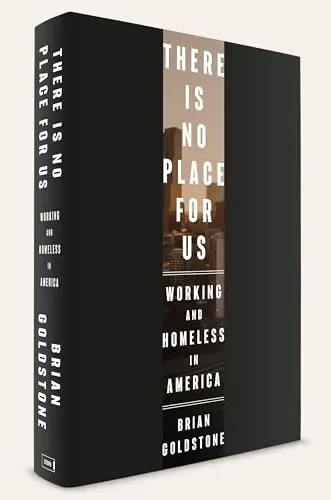
“There is no place for us” is one of the best books I have read. It is about those who work full time but are homeless.
It recently won the 2026 Pulitzer Prize for Non-Fiction.
Fact filled, deeply researched and grippingly written “There is no place for us” may change the readers perspectives on a range of issues.
Here are some selected lines from the introduction:
Today there isn’t a single state, metropolitan area, or county in the United States where a full-time worker earning the local minimum wage can afford a two-bedroom apartment.
Some 53 million Americans, or almost half the country’s workers between the ages of eighteen and sixty-four, hold jobs that pay a median hourly wage of $10.22, which amounts to a mere $21,000 a year-below the poverty line for a family of three.
It used to be that owning a home was held up as an ultimate goal, a reward for diligent effort and perseverance. Now simply having a home is elusive for many. The myth that hard work will lead to stability has been shattered, revealing a stark disconnect between the story America tells about itself and the deepening precarity.
This is a book about what we are not seeing…
Making Meetings Suck Less.
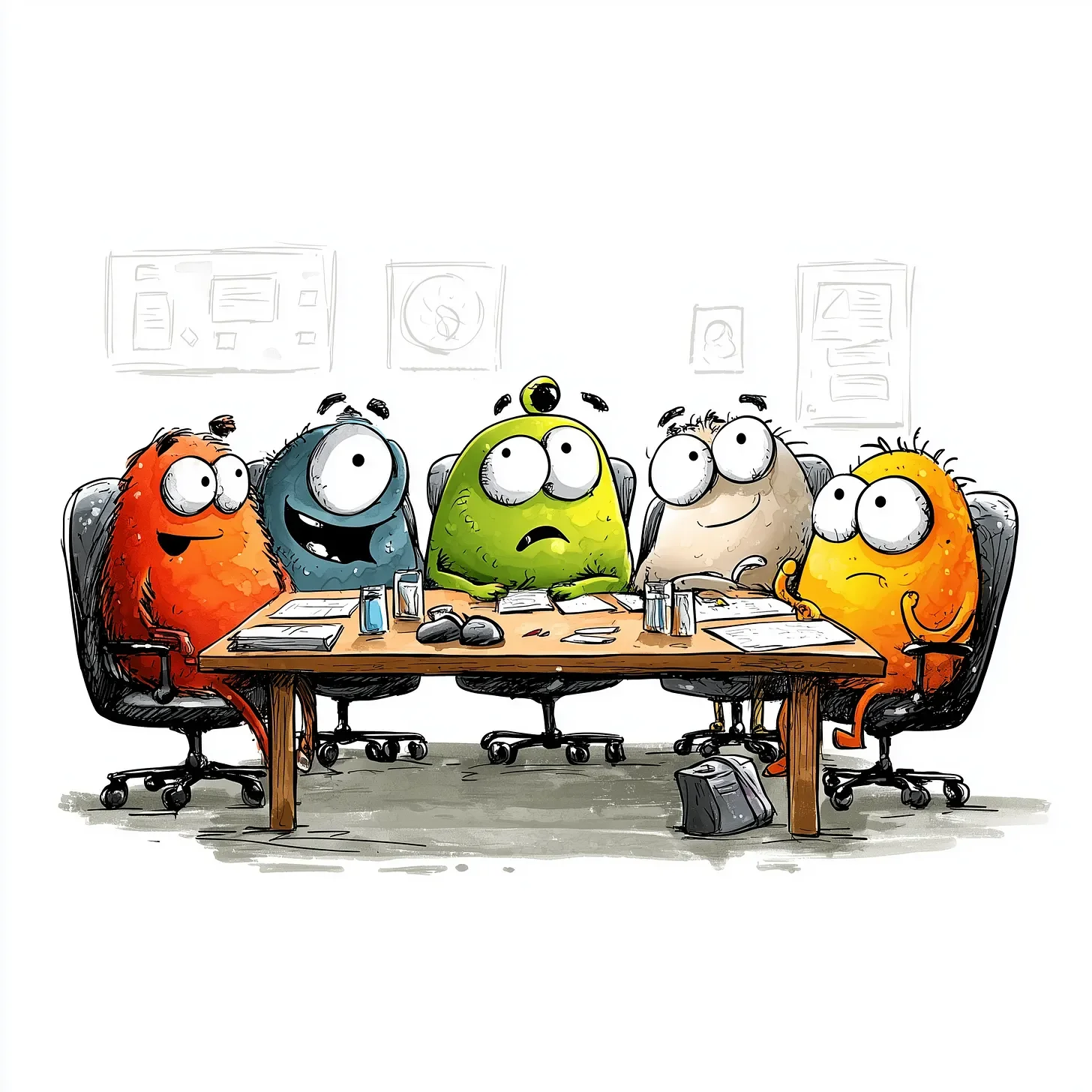
Image by Pixelbala via MidJourney
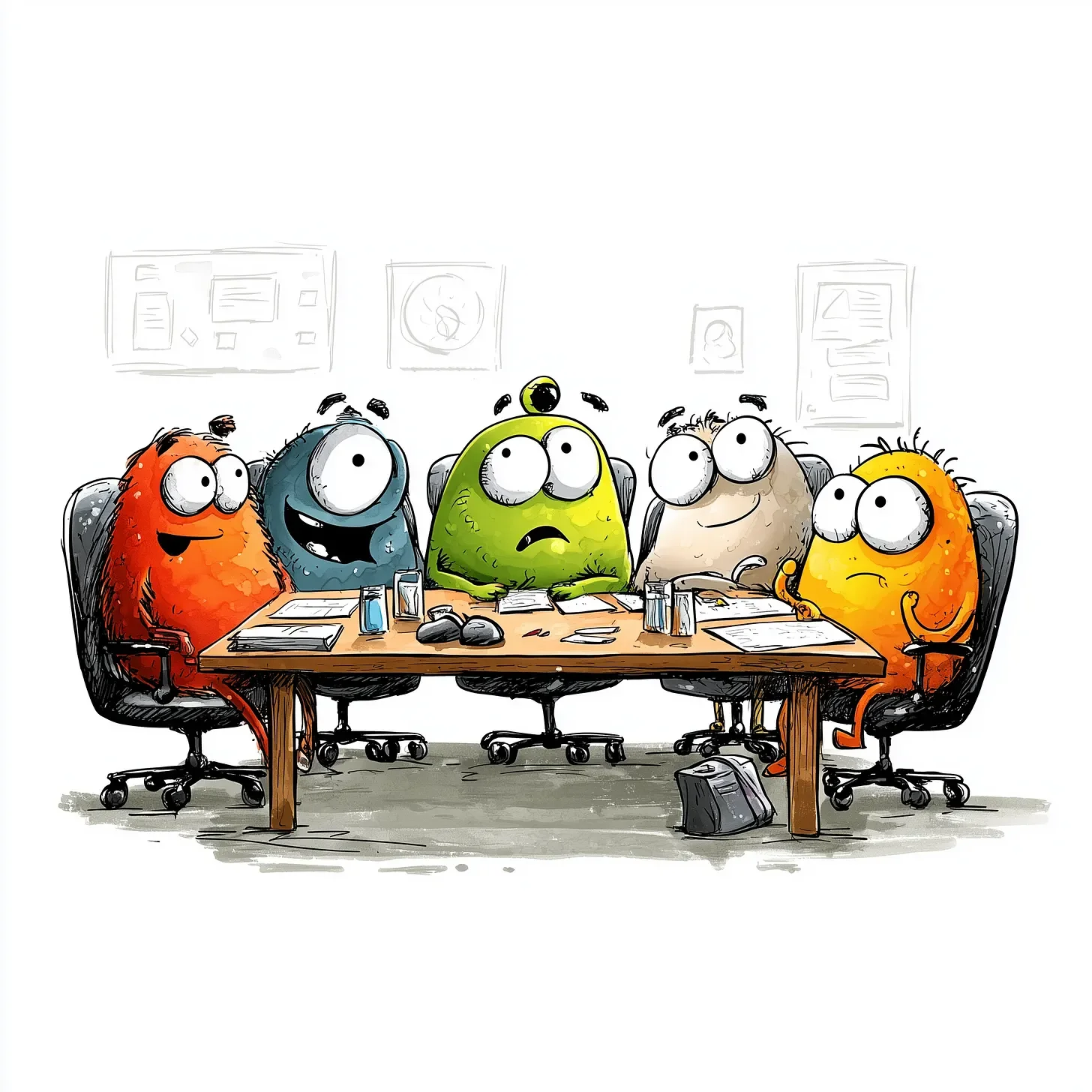
A majority of the time at work is spent in meetings.
Many are a waste of time.
In a recent episode of What Next?Rebecca Hinds discusses her book “ Your Best Meeting Ever”
We discussed when one should schedule a meeting, how best to run meetings and why AI is likely to create even more useless meetings.
1. Meetings are a result of “visibility bias”
In many companies (and this thinking animates the “return to the office” crusade of many mangers) what is visible is valuable.
Meetings become a status symbol that telegraphs that one is productive and important.
The knee jerk reaction of many of is to convene a meeting.
Often meeting are about “showing” productivity versus moving ahead.
2. Most of us are struggling with meeting debt.
Meetings are the most expensive form of collaboration sucking large swaths of time as they ooze in every direction of our calendars.
Like old legacy tech debt, many of us have to grapple with meeting debt.
Meetings that were put on the calendar and still occur long after they have outlived their utility.
We feel guilty to remove or eliminate these and so like barnacles they grow on the hull of the business.
3. “Meeting doomsday “is a key way of calendar cleansing.
“Meeting doomsday” is an exercise where individuals eliminate all meetings on their calendar and start with a blank sheet of paper.
Tobi Lutke at Shopify once asked his IT department to remove all meetings with more than two attendees across everyone’s calendars. Over the next year productivity increased by 25 percent.
4. Meeting Minimalism.
When meetings are added back to a calendar the key is to practice meeting minimalism :
Length: Can less time be scheduled?
Cadence: Can they occur less often?
Attendees: Does everyone who is invited really need to be there?
Agenda: Fewer items make for more productive time.
5. Meetings should only be scheduled if they pass through a 4D and a COE Lense.
Most meetings should really be an email, a memo or some form of asynchronous communication rather than gathering people into a real or virtual room .
4D: A meeting may be needed if one or more of the four interactions are called for:
Debate: There is significant disagreeement and one needs to debate alternatives.
Decide: A decision has to be finalized.
Discuss: A discussion of different perspectives is called for.
Develop: Feedback or other conversation to develop a person or an idea.
COE: Meetings may also be necessary in the following situations:
Complexity: When there is a great deal of ambiguity.
One-Way: The decision cannot easily be reversed or rescinded.
Emotion: The discussion or decision is likely to be emotional.
6. AI is likely to bring new levels of dysfunction.
Here are examples of absolute batty BS that is leaking into meetings:
Lots of “note taking” apps but few people: We have all attended meetings where note takers outnumber people. In addition to being disrespectful to the people who show up does the preponderance of notetakers imply that the entire meeting could have been a document?
Avatars instead of Humans: Even some CEO’s are sending their AI digital twins to answer questions. Imagine if the code hallucinates. We now have a “corrupt” CEO!
Flashy decks filled with foolish drivel: Now that AI can create awesome looking decks it is harder and harder to ascertain fact from fiction, or well thought out work from machine processed points.
Rebecca shares ways to overcome this AI tsunami and more.
Listen to the entire conversation to make your meetings suck less .
Available on all podcast platforms.
Spotify below:
One Single Thing.
Last month one of the greatest Indian photographers, Raghu Rai, died.
This is the beginning of his obituary from The Economist which contains many of his photos:
“It was hard to walk down a street with Raghu Rai. One friend estimated that, in a ten-minute trot to tea, he had stopped at least 100 times. He had seen what others did not see. A shadow on a wall that dramatized a woman passing, and the way her sari fell. Three sleeping dogs composing the centre of a terrace. Two commuters at a railway station standing stock still, reading their newspapers, while the crowd surged past them. Two old men walking in opposite directions, one a well-suited businessman, the other a bent, ragged beggar. This was seeing that did not miss an inch of space; seeing, or darshan, that recognized the connection between all things. Through his camera he met his god.”

A photo taken at Church Gate Station Bombay (Mumbai)

"Guide Yourself By The Stars And Not The Passing Ships"

What would it be like to get some career advice from someone who has mentored over 30 CEO’s of billion dollar companies?
David Kenny has had a four decade long career beginning as a consultant at Bain to co-founding and leading Digitas which he sold to the Publicis Groupe where he was part of the Directoire+ . David then went on to leadership roles at Akamai, The Weather Company, IBM Watson and Nielsen. Today David is a director at Nielsen and Best Buy (he was a former Chairman of both) as well as Flutter. David recently stepped down as the Chairman of the Board for Teach for America due to term limits.
David joined Drew Ianni and myself on the latest Unbossing Podcast and in just 30 minutes provided a master class of how to lead and thrive in changing times by not just learning but unlearning and not just leading but unbossing.
The links to the show are below but here are some highlights:
1. It is important to remember what has not changed.
Much is shifting in a world of uncertainty. The big changes are not just AI, but also shifting consumer behavior, new employee expectations, and the changing perception of the US globally.
In a world of change it important to keep in mind what has not changed which include that we all have limited time and resources. We are all limited in how much we have. We can be more productive but we cannot create more time.
Another thing that has not changed is most humans are kind and decent and want to do the right thing.
2. Guide ourselves and our companies by the stars and not passing ships.
Too many companies are focusing on the next shiny object including launching dozens of AI pilots to show that they are doing things to mollify financial markets or Boards of Directors.
This is the equivalent of guiding companies by vibe or news release. Technology should be subservient to the goals and values of a company.
3. Expertise will matter less while curiosity and particularly resilience will matter more.
Expertise will matter less in an AI age. Knowledge is becoming free and expertise is often easily accessible in many areas. What will matter more is the ability to ask questions and learn.
David reminds us that even the best talent will make a lot of mistakes and suffer set backs. It is those who learn to overcome mistakes that thrive. The ability to practice resurrection will be key.
4. Diversity is a competitive advantage and it is about meritocracy.
Inclusion is the best way to unleash all the talent in an organization. It allows a company to get the most out of people.
It is critical that inclusion is aligned with business outcomes and meaningful results and not for just the sake of inclusion.
DEI creates much more of a meritocracy by providing an opportunity for all talent to compete and the lack of it is what is non meritocratic!
5. Two Things to Unlearn
Among the many things we need to unlearn are the following beliefs:
a) That Humans are better than Machines: Increasingly this is not true and in many areas machines will do much better job than humans. We should be outcome focused versus input obsessed.
b) Hierarchical Organizations : Increasingly defunct. AI is changing organizational design and the reality is that those those on the front lines with connection and relationships with customers have more real time information and ability to solve problems and leverage opportunities.
6. Speed without direction can kill a company.
Velocity is speed with direction. Today so many AI pilots are about speed without any connection to the direction of the company. It is not how fast but how aligned the direction of travel is with the north star of a company.
7. A little fear is good but managing by fear should be eliminated.
A little fear is motivating. Especially the fear of a person or a company becoming irrelevant.
To manage our own fear swe should ask what we fear and what is the worst that can happen? Often trial and error overcomes fear versus being frozen because of fear.
On the other hand, managing through fear demotivates a company and can be very corrosive. Managers who leverage fear hurt a culture much more than the supposed success they may deliver.
Companies must weed the garden by removing those who manage by fear.
8. Companies are making a mistake by not hiring youth because of AI.
Generation Alpha today uses AI as an operating system while Gen-Z uses it as search and the rest of us are figuring it out.
The young can teach us a lot about how to run things in an AI age and it is a mistake not hiring them if a company truly wants to become AI first.
9. Management is very different than being on a Board.
Boards are keeper of values of a company. To ensure that the company does not lose its true north.
Boards are a team sport and the Chair of a Board is like a coach.
Boards should never manage but be a back stop and gut check for management.
Much much more on the podcast:
Unbossing guests have included Reed Hastings the co-founder of Netflix, Tariq Hassan the former CMO of McDonalds, and Jim Lesser the Chief Brand Officer of Service Now. Future guests include Janet Foutty the decade long CEO of Deloitte Consulting, Ann Mukherjee the former CEO of Pernod Ricard and a leader at SC Johnson and Pepsi, Jim McCann the founder and CEO of 1-800 Flowers, Sarah Personette the CEO of Puck and leader at Twitter and Meta among many others.
Listen to Reed, David and others on Unbossing wherever you listen to Podcasts. Here are Apple, Spotify and YouTube links:
Apple:
Spotify:
YouTube:
One Single Thing
Last week one Pulitzer Prize winners was a story titled: He’s Dying. She’s Pregnant. It won for feature photography and is a must read.
Here is the link: https://www.washingtonpost.com/health/interactive/2025/tanner-shay-martin-baby-colon-cancer-end-of-life-planning/

Anti-Internet Writing.

Image by MidJourney
This is the 300th edition of “The Future Does Not Fit in The Containers of the Past”.
400,000+ words published 300 Sundays in a row, covering 12 different themes, subscribed to by 32,000 individuals.
For this 300th issue, ChatGPT, Claude and Gemini accessed all 299 prior posts and provided a critique and analysis of the entire body of work over the past six years.
Below is a synthesis from the 3 engines:
1) Four Lenses.
All the writing can be viewed through four lenses:
The World. The Firm. The Craft. The Self.
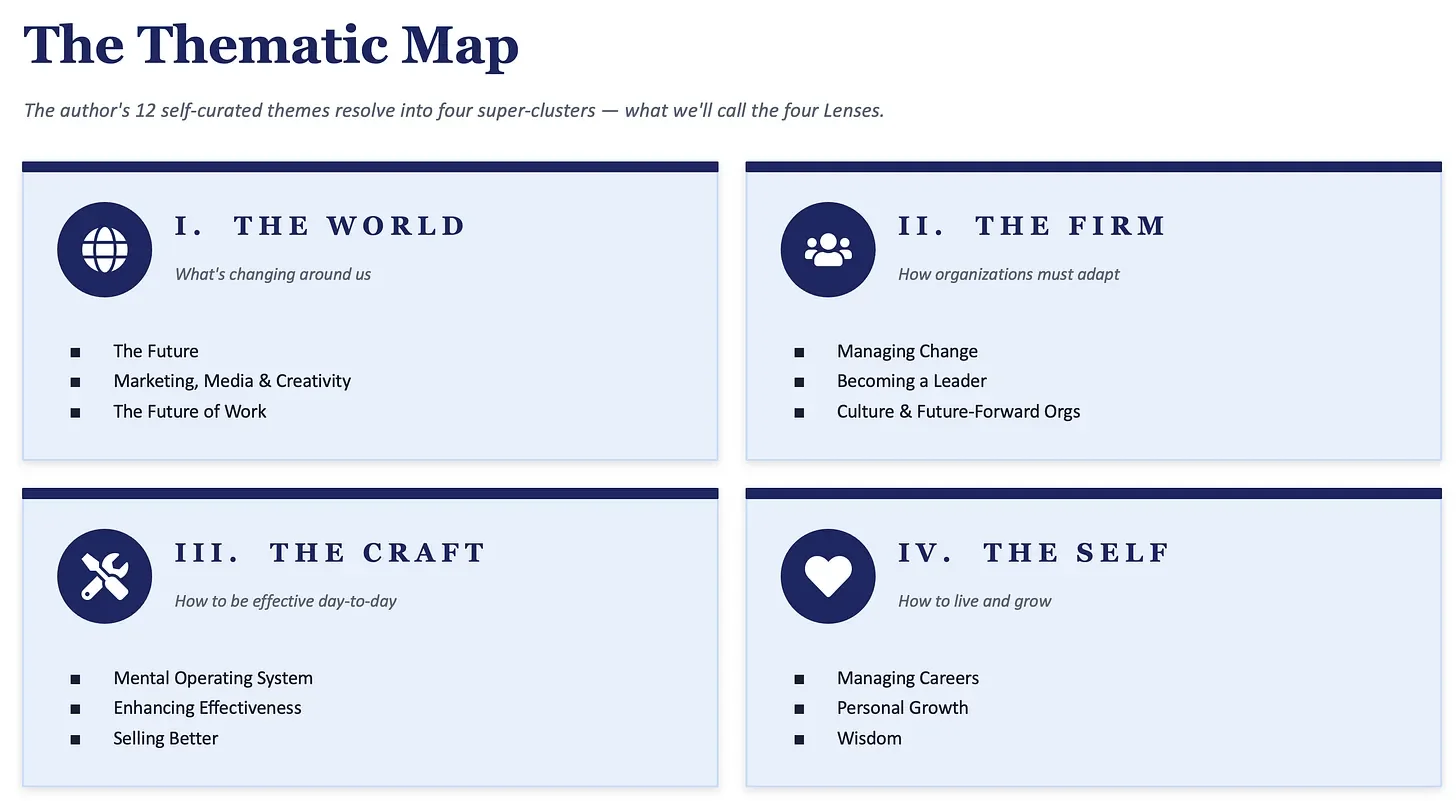
A curated selections of posts from each theme organized by lense is accessible here:
https://rishadtobaccowala.com/100
2) An Operating System for Modern Leadership.
Google Gemini took a bird’s-eye view, analyzing the connection between these 299 posts into a larger whole:
“Rishad Tobaccowala’s Substack, “The Future Does Not Fit in the Containers of the Past,” is a high-frequency (weekly) masterclass in navigating the intersection of technology, humanity, and business.
Reaching its 299th edition as of May 2026, the archive functions less like a series of blog posts and more like a modular book on “Modern Wisdom.”
If you zoom out: This is not just a Substack. It’s a serialized operating system for modern professionals. Each post = small upgrade. Entire archive = full system. Leverages framework thinking: “5 shifts,” “6 keys,” “10 lessons”.
Actionable inspiration. Not just insight but what to do next. Very operator-focused.
3) “Anti-Internet” Writing.
ChatGPT calls it “ anti-internet writing” because:
a) It has a distinctive quality in its tone and voice: Calm, reflective and non-urgent. Authority without aggression. It blends a CEO memo, a philosophy essay and a personal letter while avoiding hot takes, outrage or trend-chasing.
b) The content is evergreen as it is not tied to news cycles.
c) It distills half a century of learning and makes it available without any monetization.
Instead of analyzing on tone of voice and style, Claude did a meta take on how the thinking has evolved over the past six years:
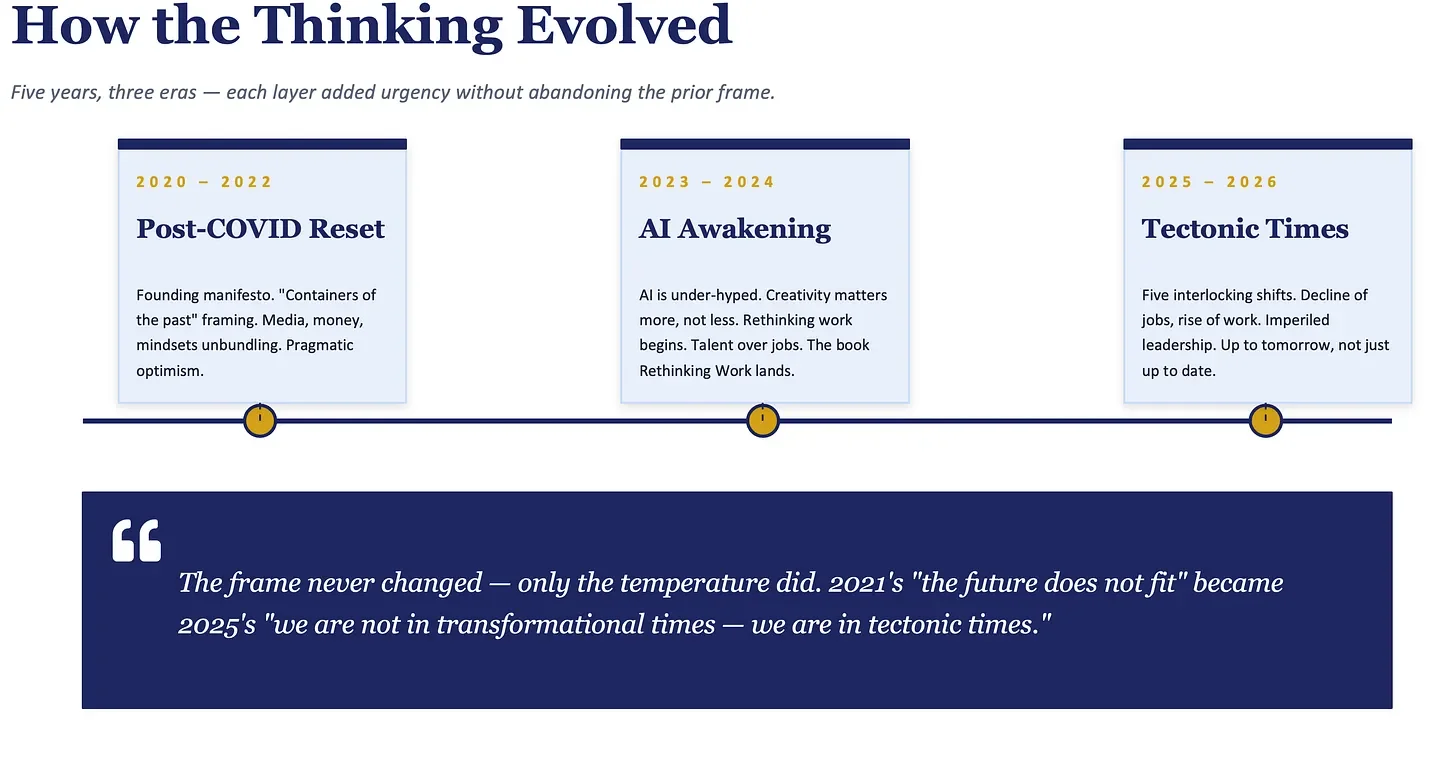
4) Tectonic Times
Most companies and leaders today are rightly fixated on AI. But technology including AI is but one of five shifts underway. One of the shifts is the need for leaders to reinvent how they lead to remain relevant in these tectonic times.
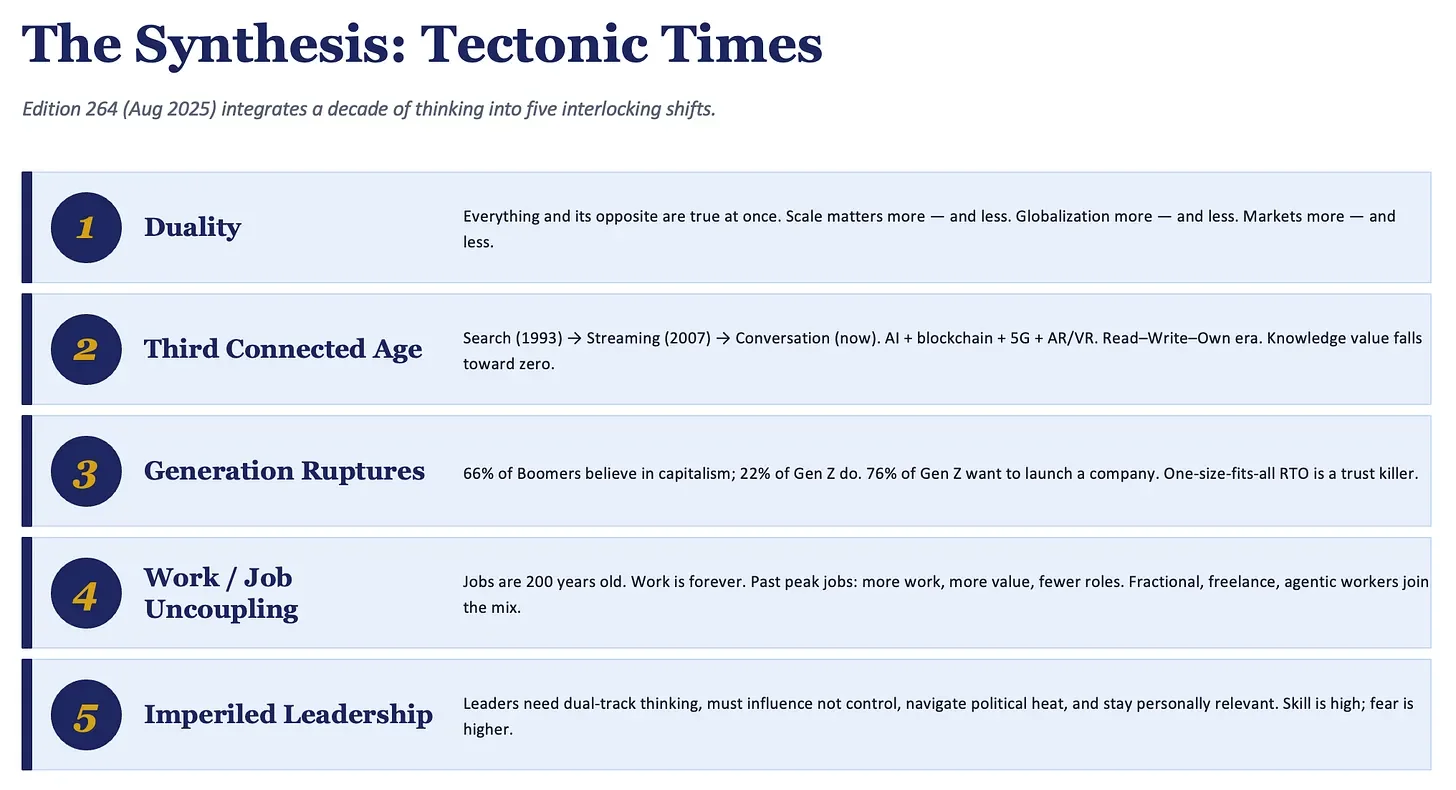
5) A Distillation of the Four Lenses.
Here are four slides which distill each of the four lenses (World, Firm, Craft and Self) that my writing covers:
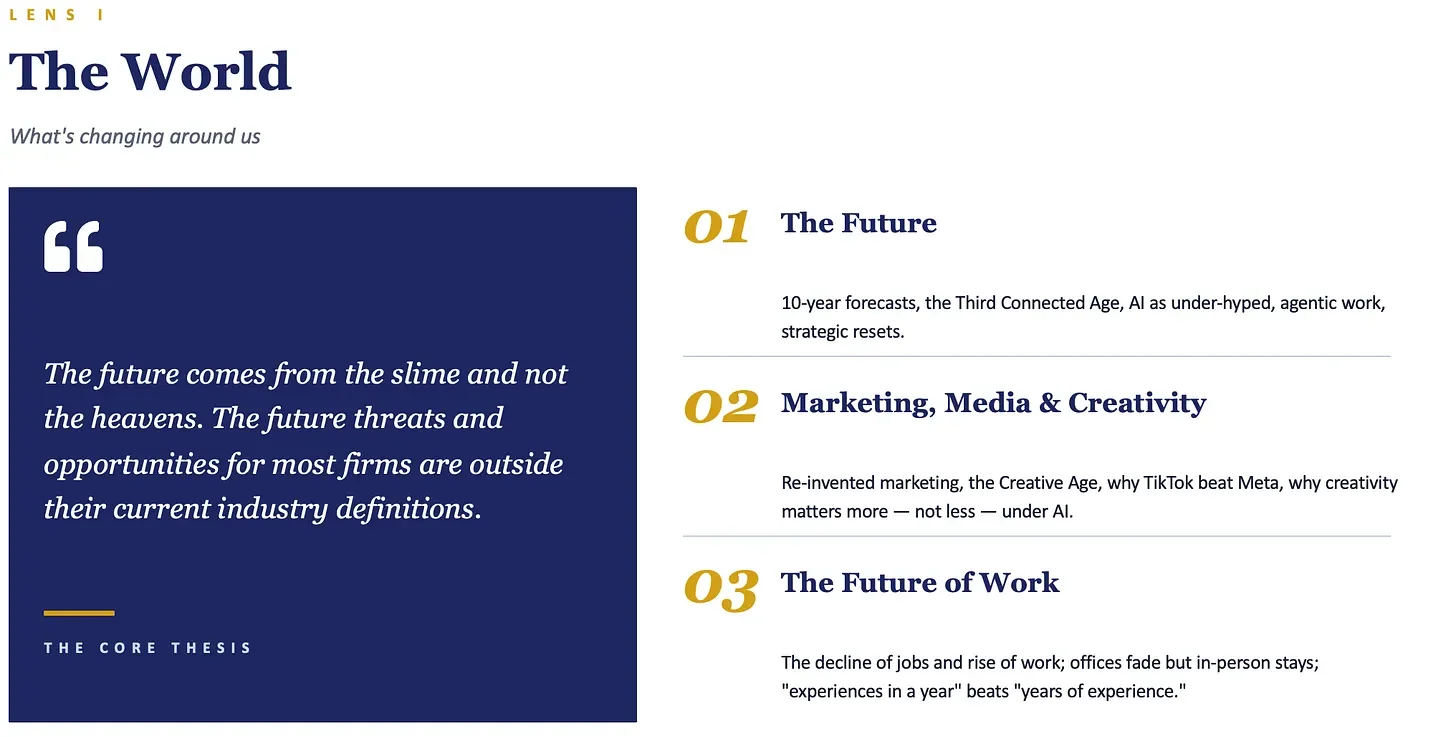
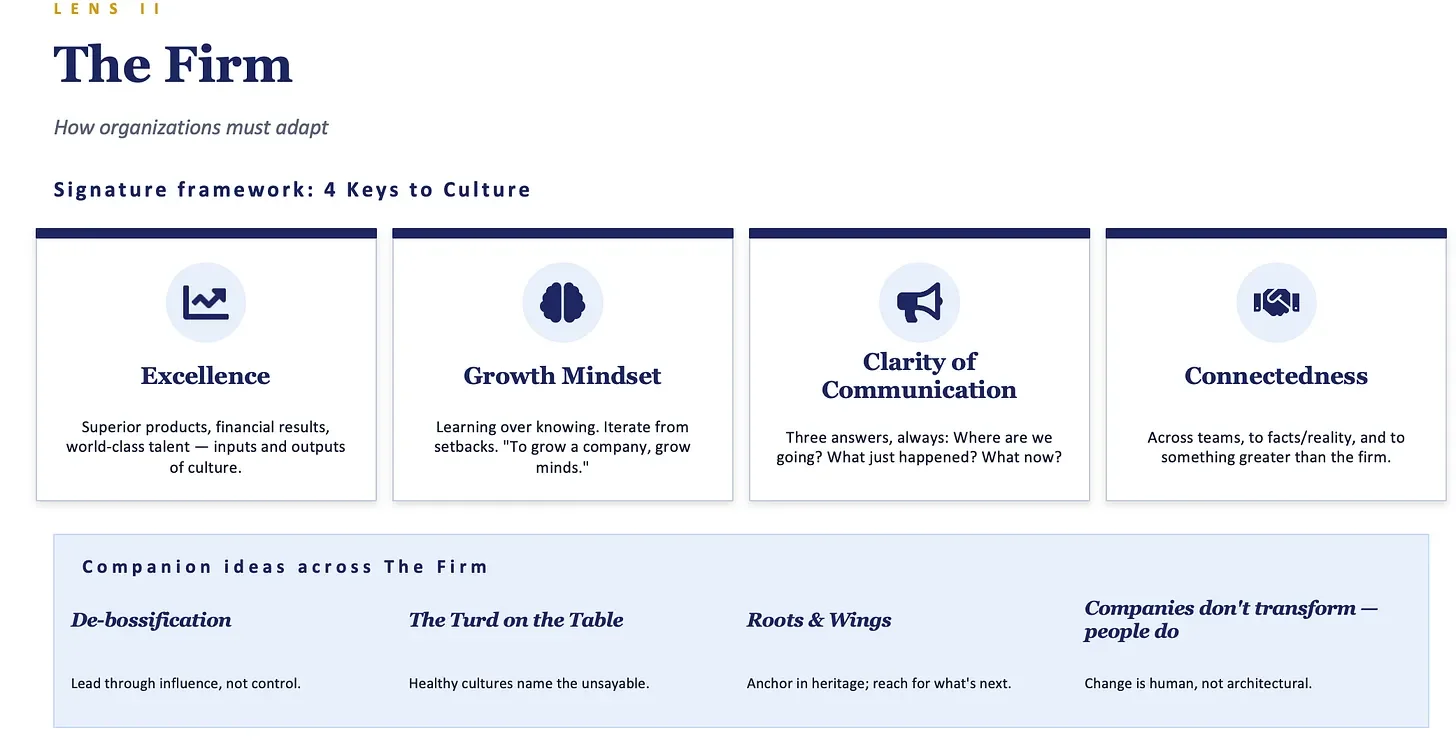
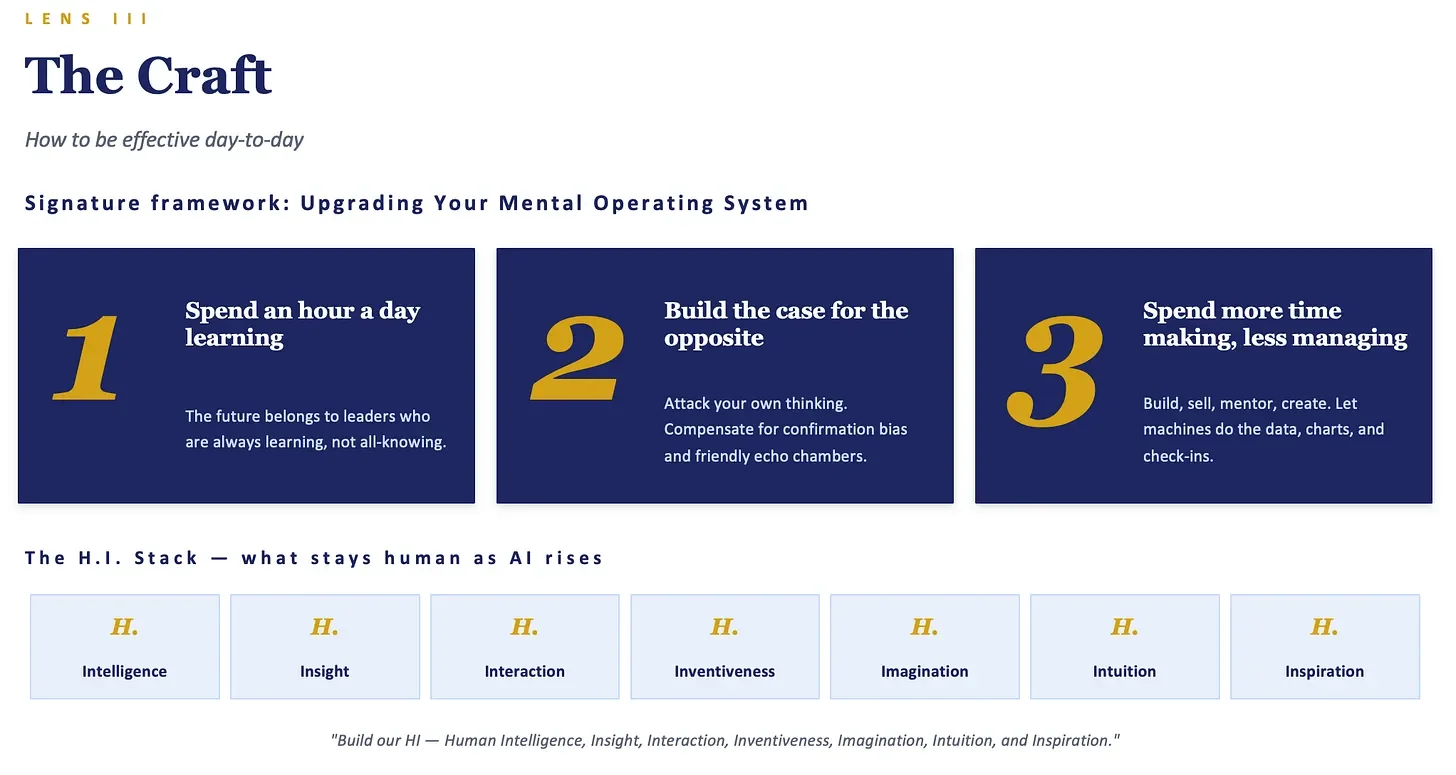
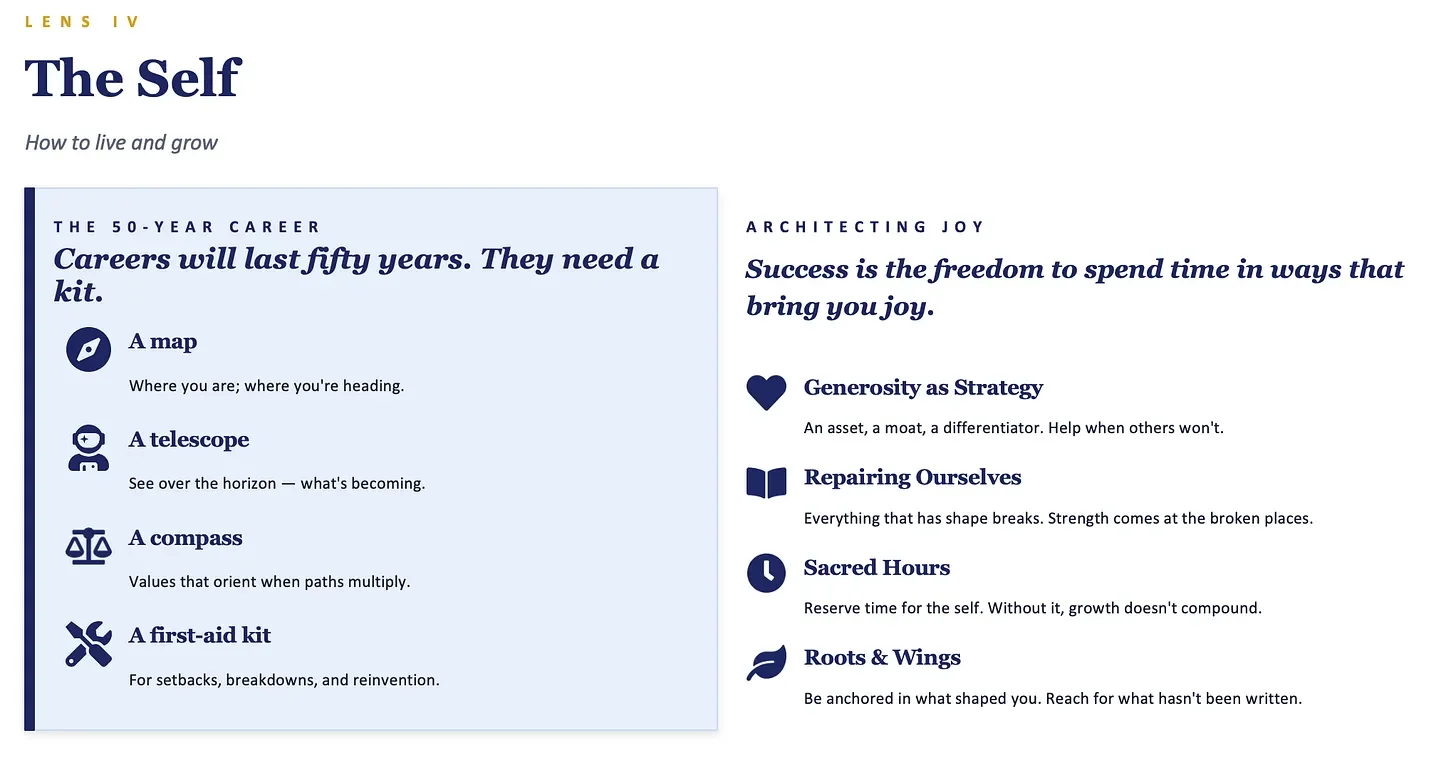
Every single key piece that comprises the themes and makes up the lense is available to access on this one page: https://rishadtobaccowala.com/100
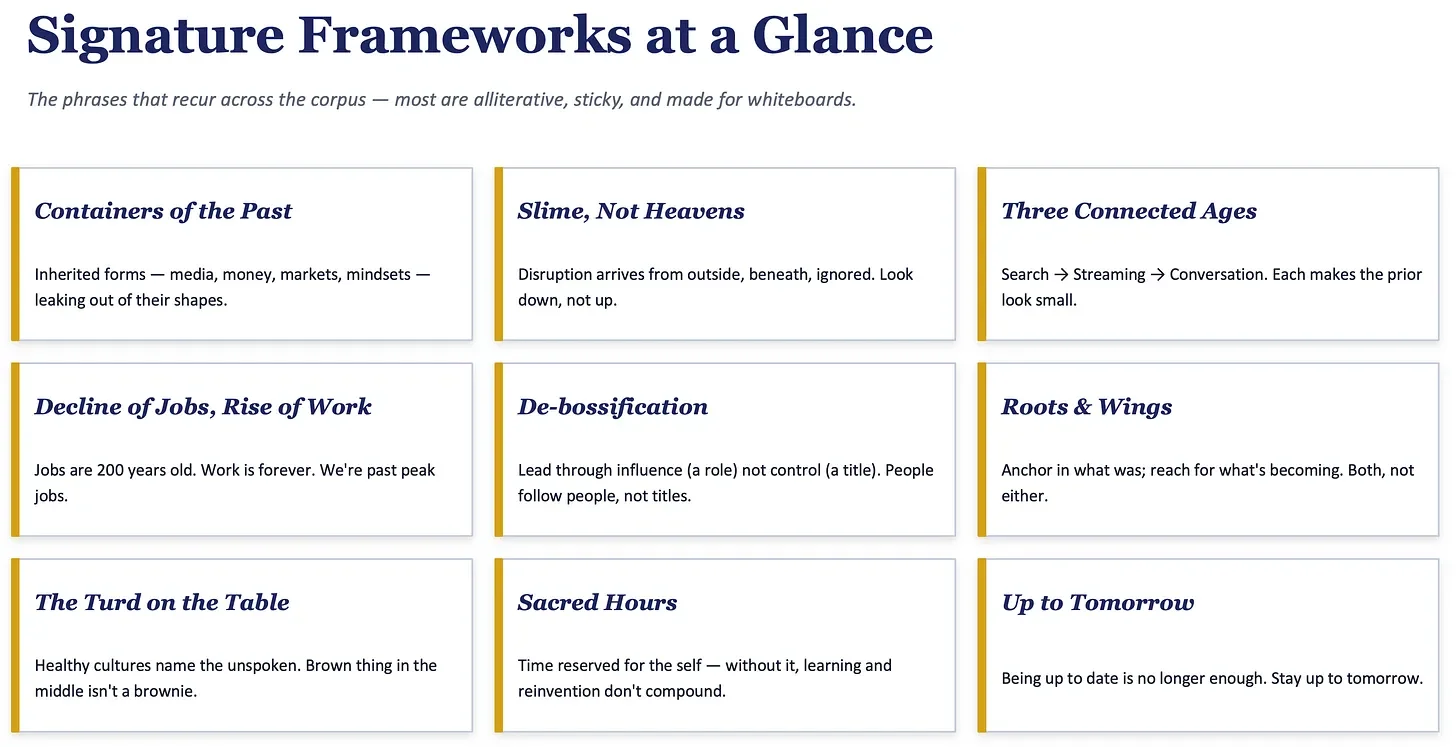
6) The Key Frameworks and Takeaways.
The best way to learn and remember is via frameworks and summarized takeaways.
The writing has included dozens of usable frameworks to help people think differently including how to solve problems leveraging photography.
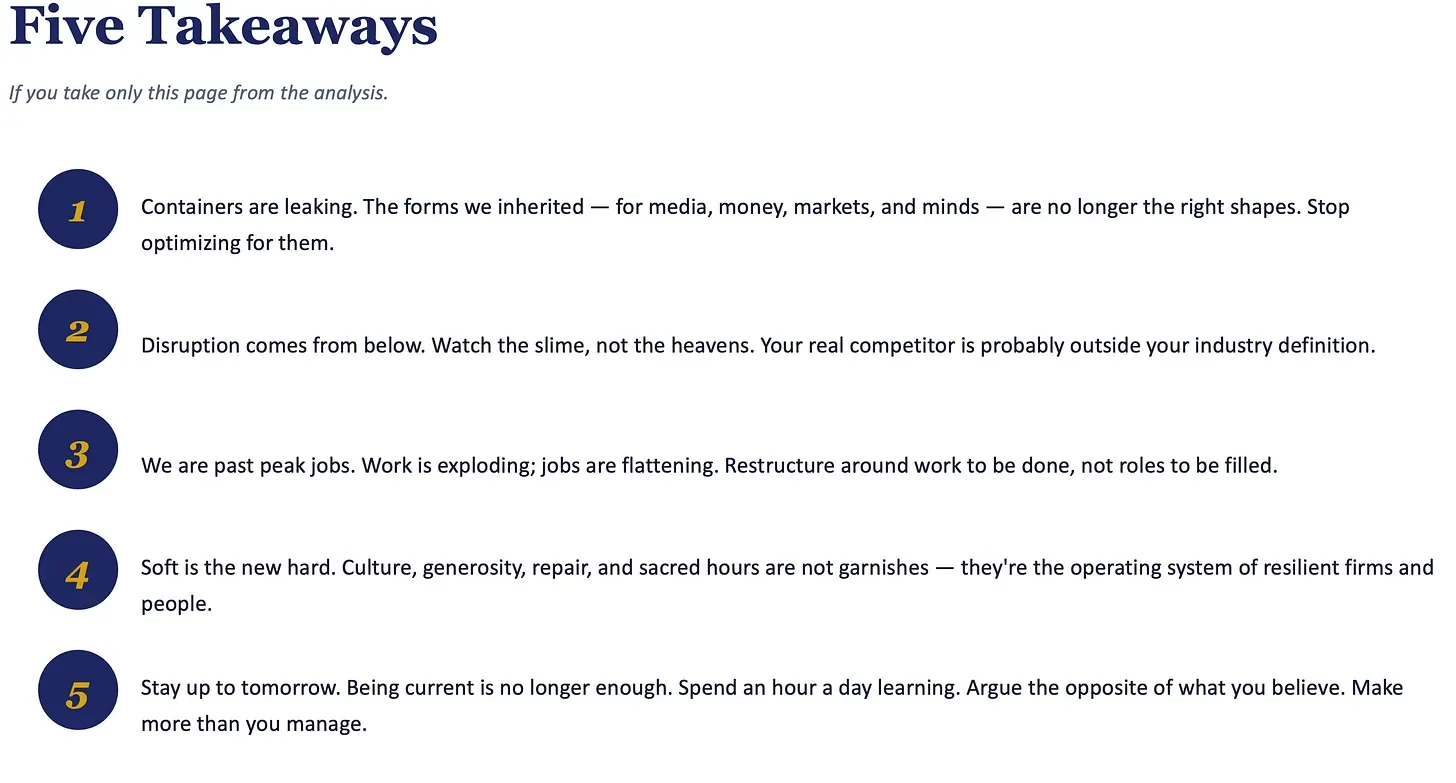
Here is a sampling of 9 frameworks and 5 takeaways:
7) Tensions/Blindspots
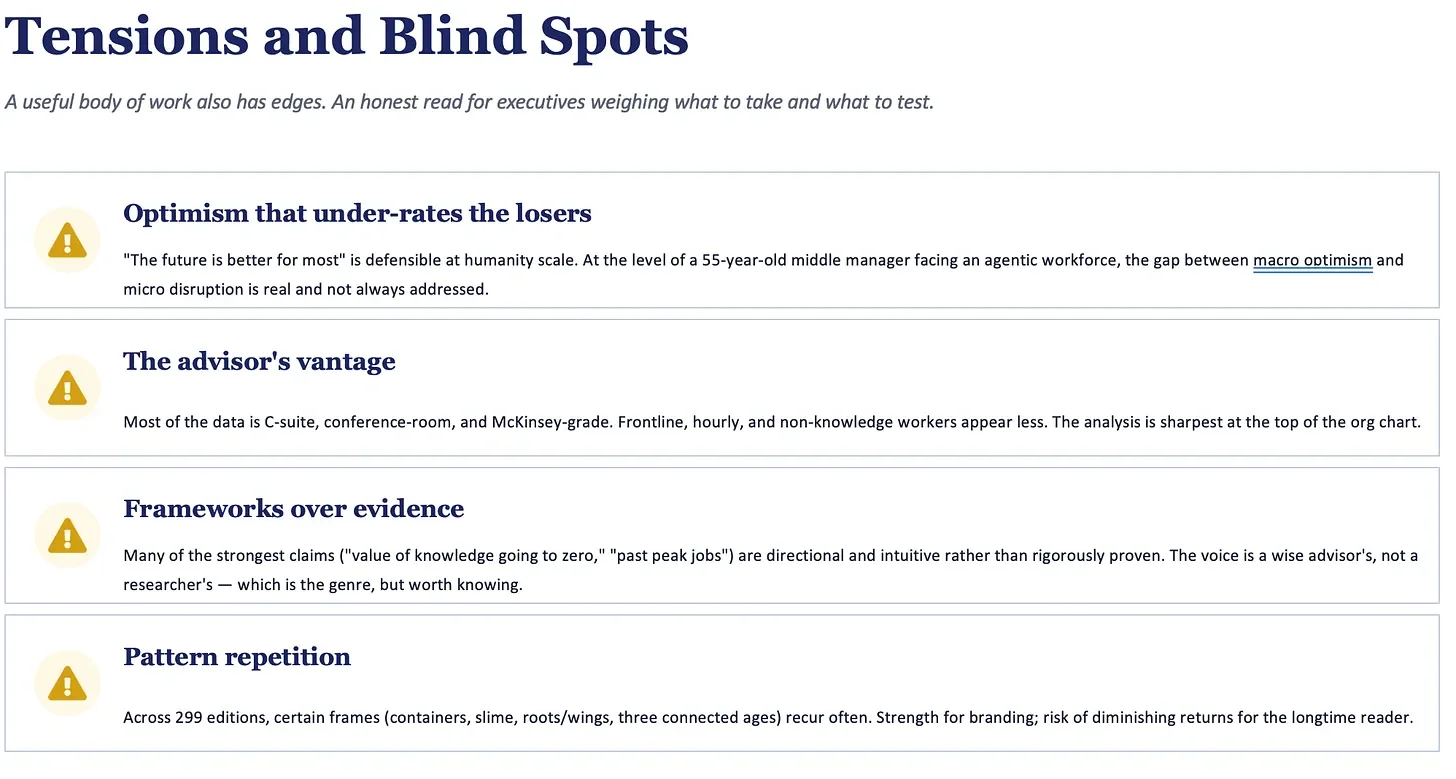
Four key weaknesses are identified including: 1) a macro optimism that may overwhelm micro disruption; 2) the writing is for white collar knowledge workers who are middle to senior leaders and top of organization; 3) little original research; and 4) some key themes repeat.
With the exception of original research, future writing will work to address the blindspots and tensions.
In these 300 posts written over 6 years, the internet has rapidly transformed and the use of generative AI engines is changing the way we work, how we interact, and lead our lives. However, despite the tectonic times and Third Connected Age, staying human will also include “anti-internet” writing like this Substack.
One Single Thing.
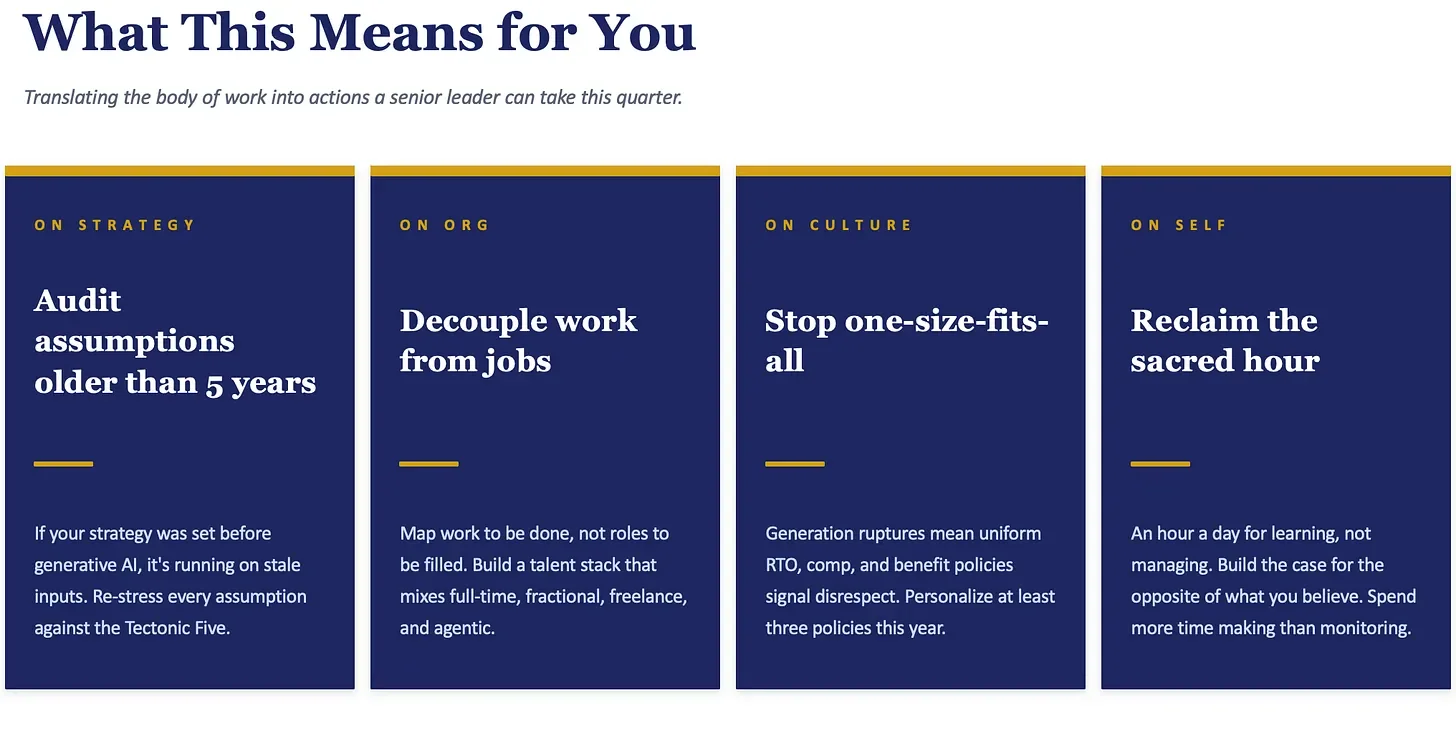
If asked to distill learnings into one single slide it is the one below:
Thank you for being a reader. If you believe this writing and thinking can be useful to others please share this post and encourage people to subscribe. It has been free and will remain free and continue to be issued just once a week every Sunday morning.