Emotional Data.
Between the data and the reality falls the shadow.
The shadow is the emotion, the stories, the messiness that humans have contained within us.
Today in the idolatry age of data and ai, those who rely on only on numbers and computation get it wrong and wrong and wrong.
People do not compute.
We choose with our hearts and then use numbers to justify what we just did.
Brands exist because humans are not computational, rational or decisive.
If it was just about data why would we buy expensive cars, luxury products and pay for experiences when we can watch the same experience for free on television?
Brands do not differentiate on the data but on provenance, design, story-telling, cultural resonance, mindset relevance and a spectrum of emotion.
Marketers who only believe in data will soon be unemployed since machines will do all the optimizing, personalizing and modelling better than any of us.
Even in an age of Agentic buying, humans will feed their desires and their dreams and a whole lot of constraints into our agents. Otherwise we would have to accept a 6 am flight on the now defunct Spirit Airlines since it was the most rational decision.
Our very existence and those of our children is a reminder of the power of emotion over data.
The ROI of children in mathematical and numerical terms makes no sense.
On a data driven basis, Russia should long time ago have overwhelmed Ukraine and Iran should have folded. The numbers were all superior on the side of Russia and the US. But the emotion, the raw need to survive and the asymmetrical thinking that a David brings against a Goliath spits in the face of data.
Data centers need gigawatts of energy while a human needs a cup of coffee and two slices of toast.
Our lack of logic will overwhelm the machines.
The love of a mother for a child and the power of desire overwhelms all rationality.
People vote not on data and facts but rather because of fear, hope, worry and vulnerability all of which machines fail to understand even though they may feign such understanding.
Taste, judgement, curation, sensitivity which people believe humans will need to differentiate are primarily emotional rather than rational.
Two different teams can interpret the same data in completely different ways so was it the the data or the people that came up with the recommendation? The most successful will not emit data but provide perspectives, provocations, points of of view and plans of action that fuse data and humanity.
The future is as much story as it is spreadsheet.
Artificial Intelligence or Cleverness will be a commodity like electricity.
Human Insight, Human Imagination, Human Inventiveness, Human Interaction and Human Inspiration will be the differentiator rather than the data.
There will be data data everywhere and so much AI that we will sink. We need insight, imagination, inventiveness and inspiration to help us think.
Like money, data is a great servant but a terrible master.
The math is already in the AI.
It is time to infuse the feeling.
Sir John Hegarty has described “Creativity is an expression of self.”
It is time for data that resonates with the human soul.
It is time for emotional data.
One Single Thing.
I have had the opportunity to learn and work with Sir John Hegarty and his team on some programs and I believe this conversation between Sir John and myself is worth a read and listen. The entire story is linked below but do read the how Sir John describes creativity at a minimum.
One day someone told Sir John Hegarty that the greatest art of all might be music.
Sir John believed it might be the second greatest art for and the greatest of all art is human life.
Human life is an act of creativity.
Sir John defines creativity as follows: Creativity is an expression of self.
Listen to the greatest creative people and you will hear them saying:
“Here is what I wanted to say”
“This is what I wanted to show”
“What I am trying to build”
There are two types of creativity one is pure and the other is applied.
Pure creativity is a spark that leads to the iPhone, creating the Simpsons or designing the Guggenheim in Bilboa. and also drives the greatest iconic works of art, product design and brand building.
Applied creativity is creating the next version of the iPhone, a new episode of The Simpsons or designing the stairs inside the Guggenheim.
Pure creativity is the greatest wealth creator and generator of growth ever.
Creativity drives innovation and the best creativity does not come from A/B testing, mathematics or focus groups.
It feeds on curiosity, instinct, exposure to differing perspectives, feelings and things that do not compute.
This AI versioning is not creativity that builds brands and growth but a smart way to get variations of a theme cost effectively get the lower funnel sale of a Brand that was which was built due to a different form of creativity.
A human creativity of self expression and not a machine variation of optimization and data co-relation.
AI will unleash human creativity but will not replace human creativity.
Read and listen to the entire piece here.
Navigating Career Bending Times.
Created by the author using Midjourney
These are career bending times.
A fusion of forces are reshaping the contours of our careers.
Whether we are early or in the middle or more senior in tenure.
Whether we work for a small, medium, or a large firm.
Whether we are self-employed, a free-lancer or a “full-time” employee.
Regardless of our industry, our country, or our expertise.
The Forces.
There are six forces each of which alone might have changed the contours of our career but now they are all occurring at the same time, are intertwined with each other, and are becoming increasingly powerful:
1. Demographic and Societal Change: Four generations at work. Major mindset differences between youngest and oldest generations. Aging and declining populations everywhere but Africa. Today the largest increases in working populations are over 60 years old. And 62% of Gen-Z have a side- gig, side-hustle or passion project while working full-time! In most countries there is a severe push back against immigration which is impacting the economics of different industries in different ways.
2. Technology: While AI is the significant driver of technology today it is not the only one. Blockchains are creating new financial instruments and trust marks.Biotech breakthroughs are coming fast and furious. Robotics manifests AI in physical ways. All of these are roiling every industry from manufacturing to services.
3. Multi-polar globalization: Globalization but with different centers of power versus a US dominated world order is underway. While the US and China are the dominant economies by far ( their combined GDP of 50 trillion accounts for 40 percent of the total GDP of the world) we are seeing the shape shifting of different alliances with Europe, Japan, and India among others combining in different ways. There is no steady state.
4. The Unbundling of Work: Work is being uncoupled from jobs and from the office. Jobs are a phase that work is going through. Companies and careers will soon be optimized around getting work done versus the filling of jobs. This will have huge societal impact but is inevitable. In addition the office will be a museum. A monument to the past, a place where the history and culture of an organization is shared and a proof of solidity and continuity projected. But real work is being done everywhere.
5. Work/Life Reset: One long term impact of the 2020 to 2022 post Covid trauma was as someone wrote: “And isn’t this the whole point, post-Covid: to actually live your life?” Many people who believed work was life now believe work is an important and key part but just one part of a well-lived life. Companies who believe Covid changed our mindsets on where we work still do not understand that what it did was make us ask why we work and who we work for?
6. The melting, decaying, and liquefying of industry shapes and boundaries: With Apple offering 3.5percent interest on a FDIC insured savings account up to 250,000 dollars that you can fund with one click and loaning you funds from their balance sheet with their Buy Now and Pay Later program ( now through Klarna) they are for all purposes a bank. The New York Times is a global multi-media life-style business with a third of their revenue coming from non news products. Volkswagen recently announced lay-offs of 50,000 workers as new technologies ( electric and self-driving) and new competition (Chinese in particular) is decimating the proud German auto industry. The categories we work in are shapes shifting.
Each of these forces are intertwined with each other. Modern technology and marketplaces allow for side-gigs and side-hustles and unbundled work. AI powers Biotech and re-configures jobs. New trade barriers move jobs and manufacturing to different countries as does the rise and fall of population.
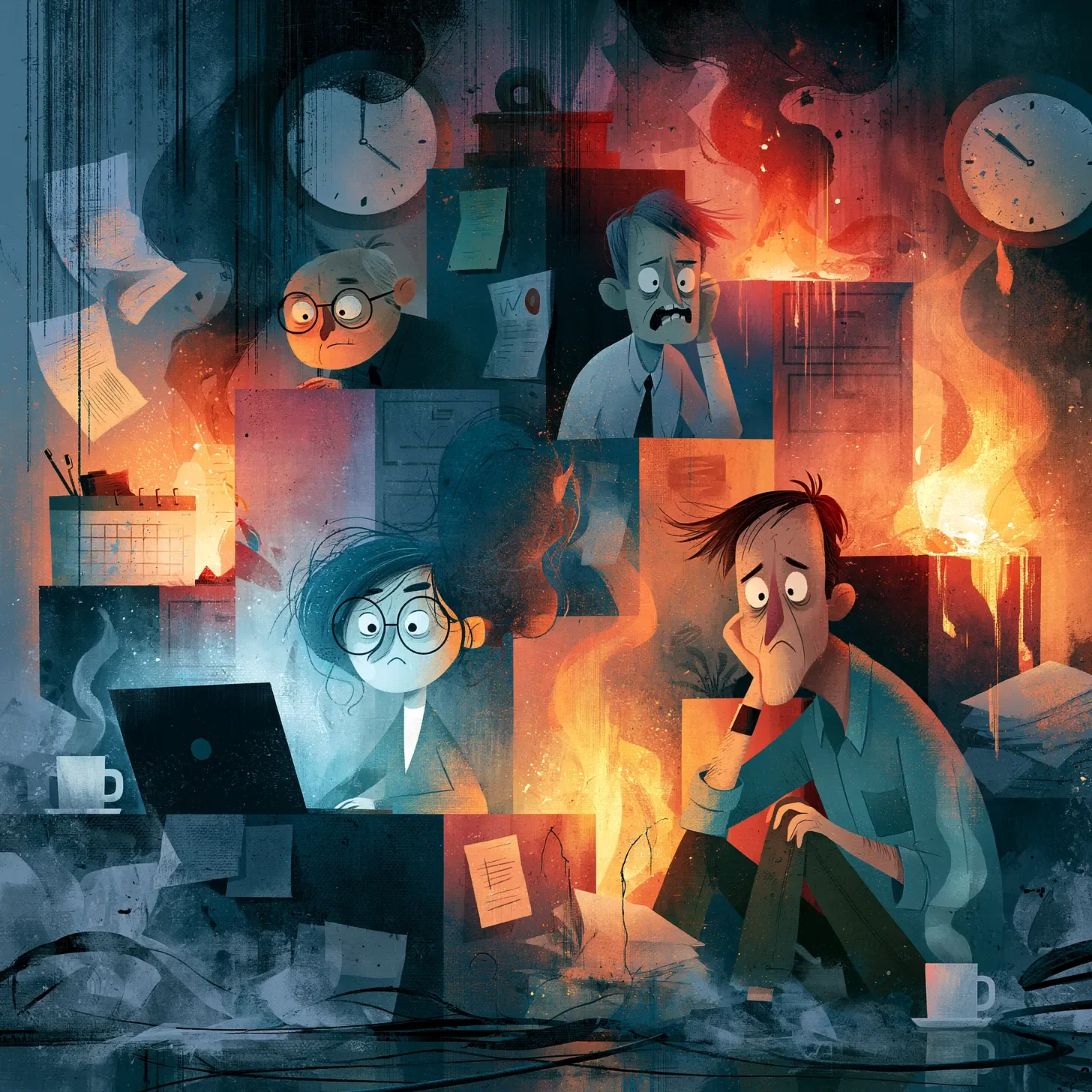
Created by the author using Midjourney
The Career Implications.
While the future is often hard to predict one can be quite sure that in the next few years the current waves of change will grow into a tsunami, and everybody will be impacted in some way or the other.
1. We are now going to have 50-year careers: Extended life spans, limited government pensions, incentives for elder people to stay in the workforce, machine enabled work will have us working for multiple decades versus a 30-year career. Ageism will soon be seen as a prejudice against our future selfs.
2. Life-Long Training and Education: Even three decades into a career well into the 50’s one may need to go back to school, re-skill and re-tool. And the days of saying “We will be retired before all these new things happen” will not be realistic. Investing in continuous learning will be key to stay relevant. Most companies who are cutting people thinking that AI will replace them should actually invest in retraining their people since AI will be like electricity a commodity that every one has versus a competitive advantage. In fact for every dollar spent in AI companies will need to spend the same to upgrade their talent.
3. We will increasingly be working like gig workers and there will be many other changes to the design of organizations: A job will not be a title, a position and a static role but a constantly changing number of tasks, outcomes and deliverables In a globalized and connected marketplace of unbundled and distributed work we will all become gig workers even if we spend long time in a firm since all firms will become increasingly agile and connected, looking to put the best people on the most appropriate tasks very much like the way Hollywood or TV production works.
4. We will be work in tandem with machines: Almost every job will leverage AI or will be infused with some other technology. The productivity increases of modern technology will mean anyone trying to avoid it will be intriguing to talk about but unlikely to be able to compete.
5. We will work in smaller and delayered companies with many of us operating as “Companies of One”: a) AI software, b) Platforms that enable access to marketplaces and talent ( Shopify, Fiver) , c) a need for shapeshifting agility as categories re-invent themselves ( Finance, Auto, Healthcare, Education at a minimum which account for half of US GDP), d) a demand for flexible cost structures in a high velocity world, e) a work-force where free-lance workers are greater than full-time workers (2027 in the US) and f) scar-tissue of over hiring (see tech and media companies today) will significantly reduce the size of most companies, eliminate multiple layers and focus on experts and deliverables versus generalists and process. We are likely to see an eco-system of some very large companies in every industry (the whales) and millions of smaller firms ( plankton). AI has turbocharged the number of new businesses started in the US to almost 6 million!
6. Leaders and Coaches and Learners versus Bosses and Manager and Know it Alls: In this new world people will likely value, ask for and measure three things:
a) what does an individual help make, build, ship, change or impact?
b) what value do we add to the machine or how do we collaborate with other people or plug into a role on a project so that 1+ 1=3 ?
c) what creativity, vision, empathy, or imagination do we bring to inspire and grow people and business ?
The key will be how one can lead, train, and grow talent to unleash their potential.
The big corner offices, the gauntlet of handlers, receptionists, and other awe-inspiring fear mongering scaffolding of the pre-2020’s will all be seen as the crutches of the insecure and the fearful causing most talent to rapidly re-route around such blockages and blockheads.
People’s “zone of influence” and “zone of impact” will be far more important than our “zone of control” or “size of kingdom”.

Created by the author using Midjourney
Re-inventing and Staying Relevant.
A complete re-imagining and re-thinking is underway which is why all of us feel some combination of fear, challenge, excitement, and even horror!
The drumbeats of a changing reality are beating in the marrow of our blood even if we do not wish to listen to their forceful thump-thump…
We will all need to bend ourselves into new forms, skills, and shapes.
A few keys to remaining relevant will be:
a. Plan for the long term: Plot careers over phases recognizing different eras as well as our own differences as we age with a look both ahead and behind. Read Career Lessons Revisited a distillation of usable and actionable learnings on re-inventing over time.
b. Build expertise. Hone a craft. Be known.Learn and earn a niche or niches. Have a voice and learn to tell a story. Read Career Turbocharging for an exercise if you are looking for a job, thinking of switching jobs or re-inventing yourself and a job.
c. Do not outsource your career growth to anyone else:Be responsible and control the upgrading of your mental and skill operating system to keep on learning.Here is one way: Learning to learn.
And here is one page with thoughts on a dozen topics to thrive in the future you may wish to bookmark. Look at Section 1, 2 and 10 in particular.
It will be a career bending time.
Which is far better than a career ending time!
One Single Thing.
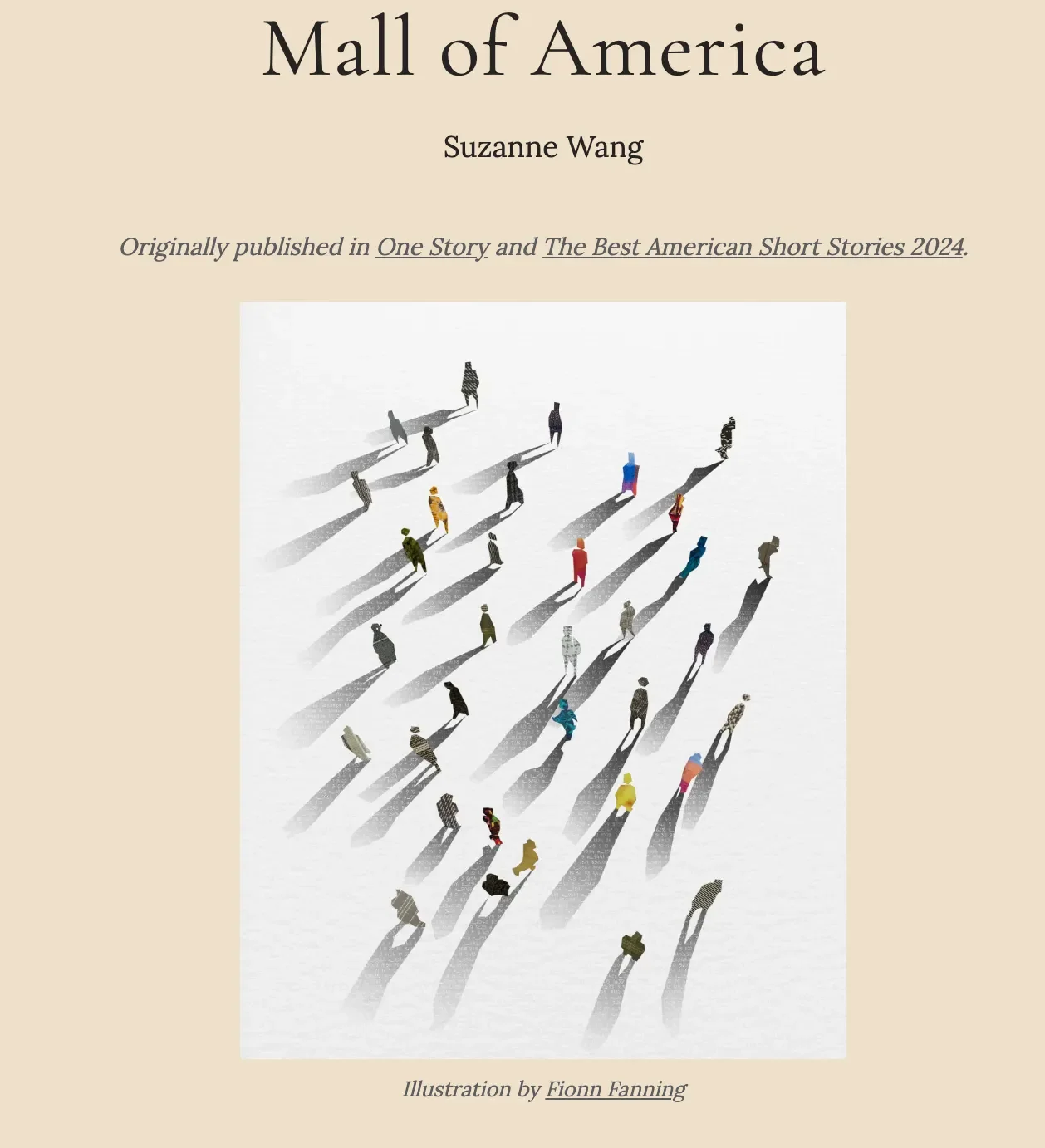
To imagine where the world of AI, surveillance and data driven marketing is taking us read this incredible story. It will blow you away and you will never think of your marketing job, your data job or AI the same.
The entire story has been made available for free by the author Suzanne Wang here:
https://suzannewang.com/mall-of-america
It is amazing.
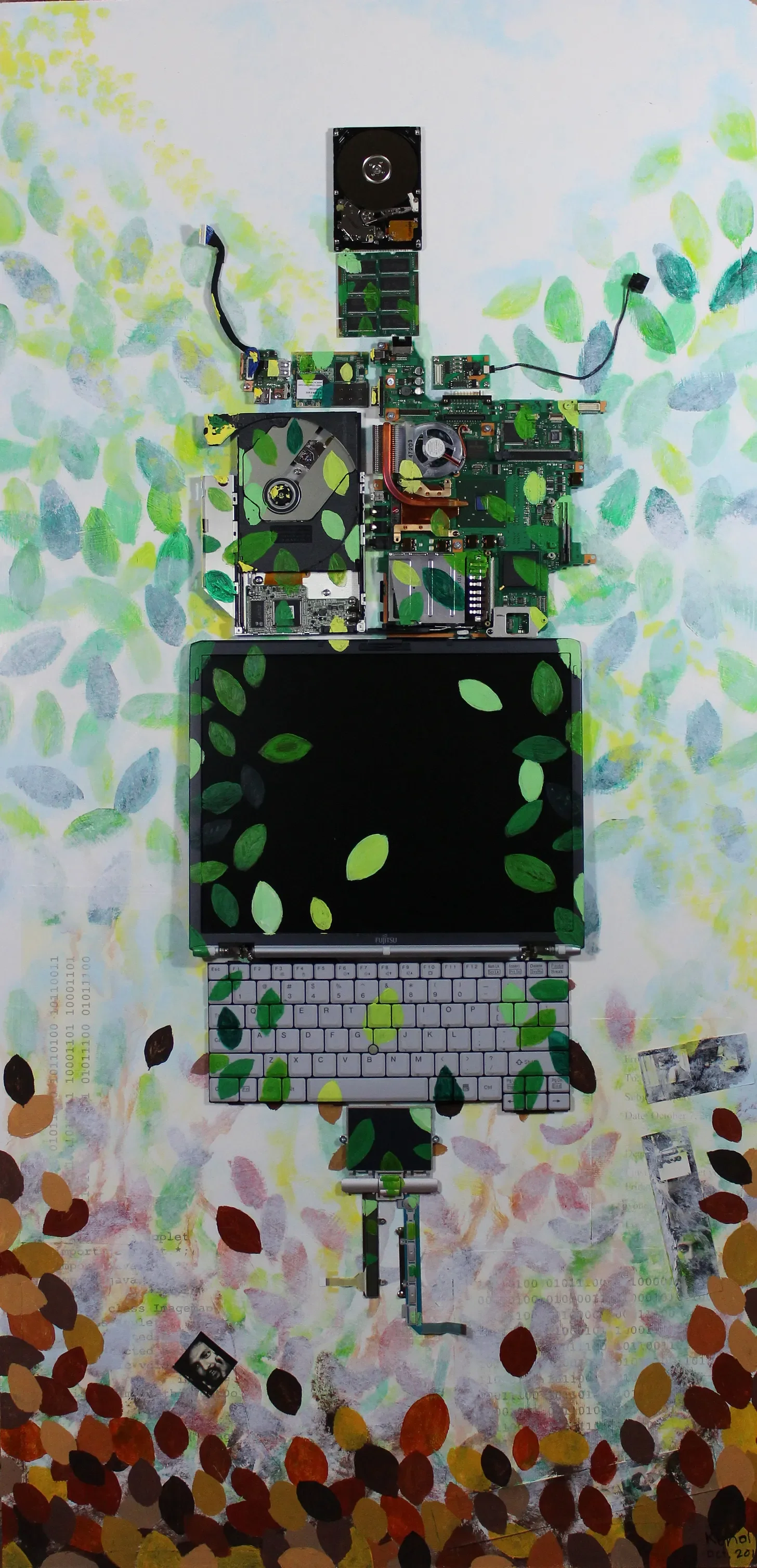
Machine. Memory. Art. Impermanence.
Kunal Sen
Kunal Sen is an accomplished technologist and artist.
He received a PhD. in AI in the 1980’s.
Over a 20+ year career in digital technology, he designed electronic medical systems, authored technical publications, and led digital evolution and technology initiatives at Encyclopedia Britannica and Merriam-Webster where he was the Chief Information Officer.
While he continued to work in technology , beginning in 2012, Kunal shifted his primary focus to visual arts and painting.
He also authored the critically acclaimed memoir Bondhu: My Father, My Friend, reflecting on his life and his relationship with his father the legendary film director and screenwriter Mrinal Sen.
Kunal joined me in a conversation filled with deep knowledge about the interaction between AI, Art and Humans that is accessible at the bottom of this post.
It is a fascinating history of digital media, the rise of AI, the importance of memory, the quirks of being a human and a homage to art. Whether one is in business or technology or the creative arts it is a conversation everyone will learn from.
Below are some key takeaways.
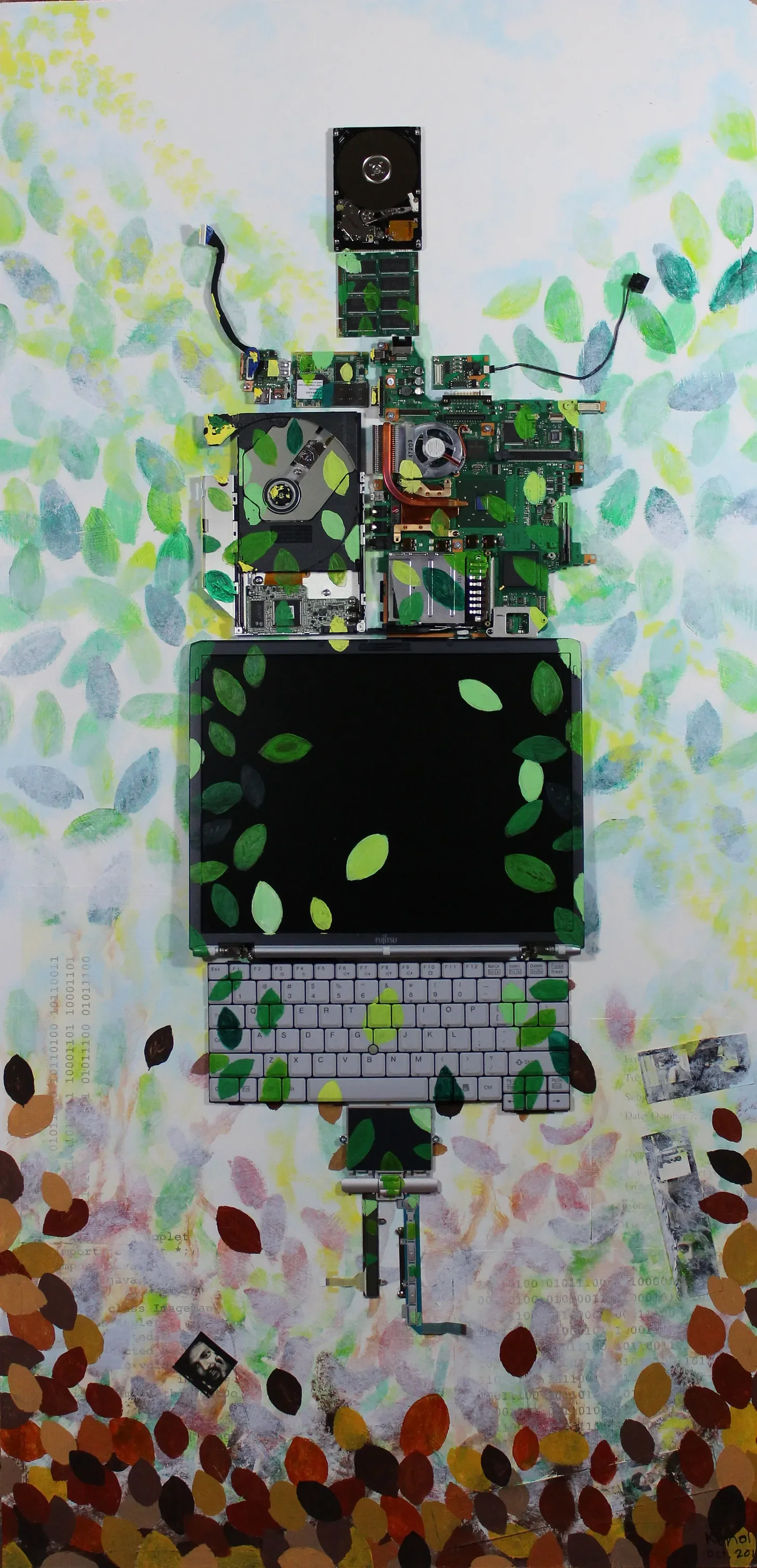
All the art featured in this post are by Kunal Sen.
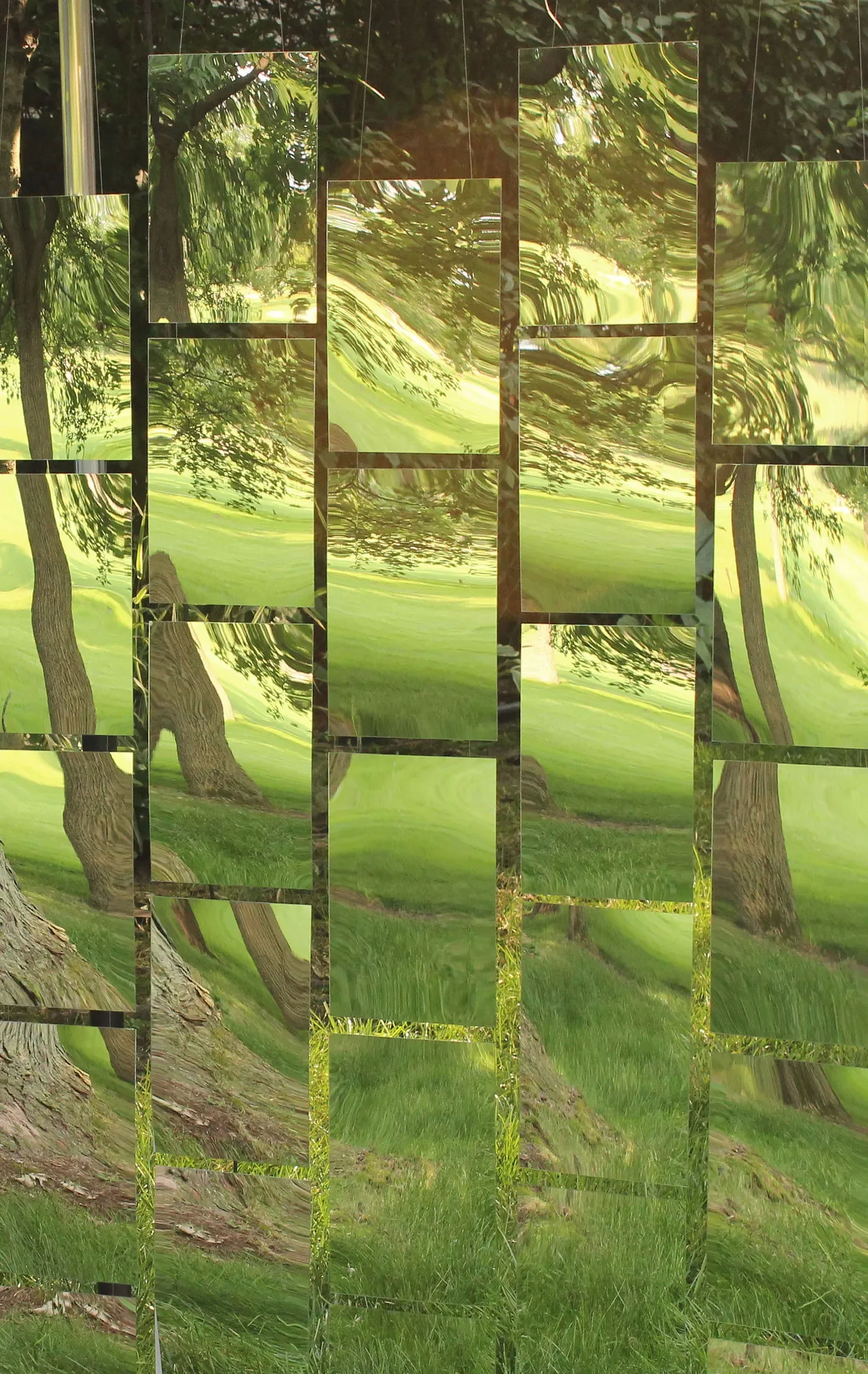
Kunal Sen
The life changing impact of books.
Nearly five decades ago as a student in the city of Calcutta (Kolkata) India , Kunal wandered into the remainder section of a book fair containing “stray” books for sale and picked up a title called Design for a Brain (1952) which builds the case that the human mind is a machine.
The book inspired Kunal to switch from studying Physics to AI.
And while Kunal was doing his PhD in AI the same technologies that runs everything from ChatGPT and more were being developed.
Kunal today continues to be a prolific reader of books and publishes a review each quarter of all the books he has read for all of us to learn from.
And he is writing his second book, a novel following his memoir “Bondhu”.
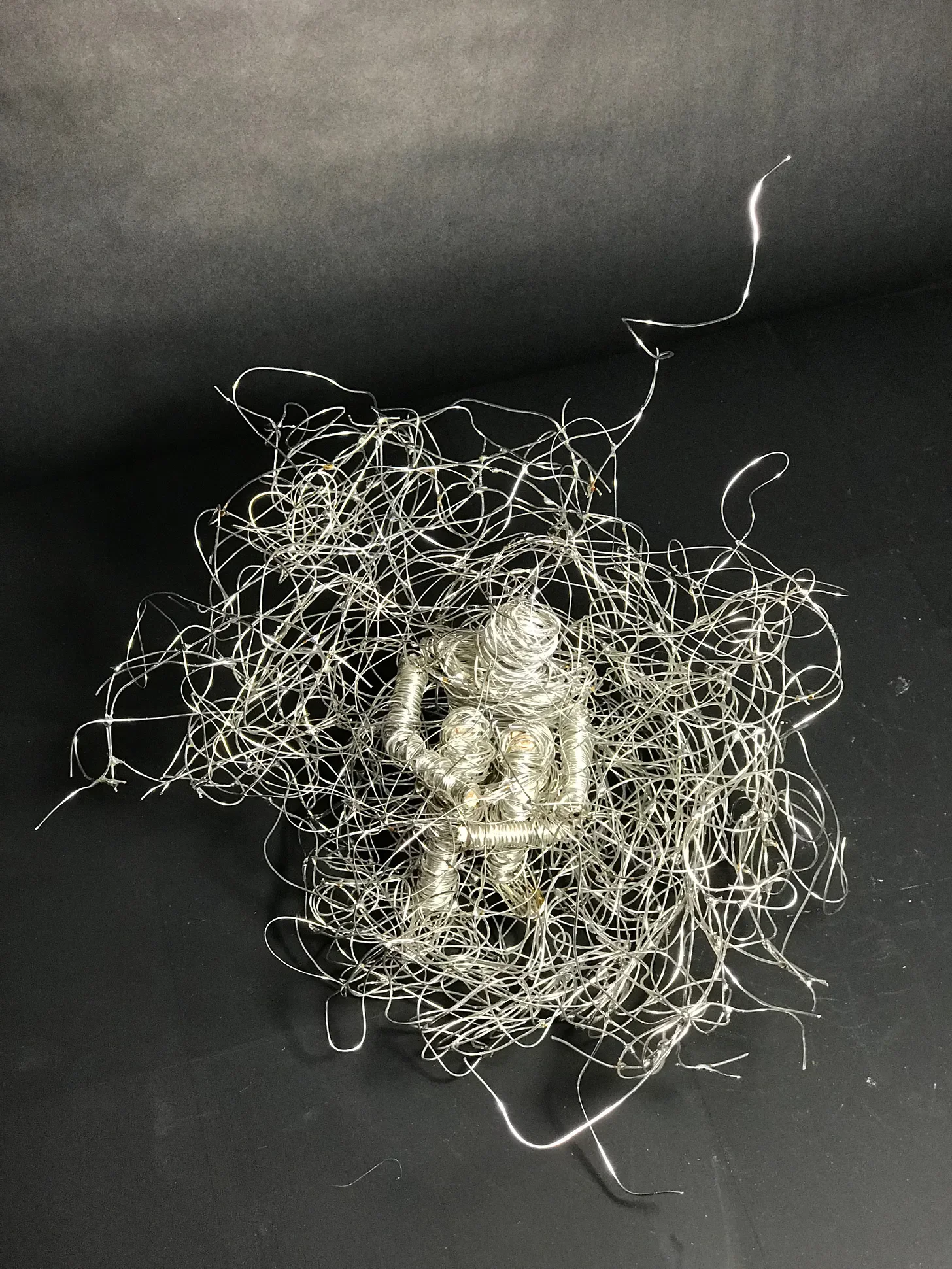
Kunal Sen
Encyclopedia Britanica was a forerunner of challenges facing traditional media and the challenges of AI.
The Encyclopedia Brittanica was a pioneer in embracing technologies including creating the first CD-ROM products, going online, leveraging search and much more.
The big challenge was not leveraging the technology but as the format changed the economics of a highly trusted, deeply edited, print product which cost $1500 to $2000 collapsed because one could not charge the same for a CD-ROM especially when a product from Microsoft called Encarta was being given away for free.
A switch to free with a reliance on advertising was not sufficient because the market was not yet developed and the dot com bust occurred.
Eventually the free model was replaced with a hybrid model of subscription for all access and some highly ranked content available for free but monetized through search advertising.
In addition a pivot to educational organizations that needed access to trusted content and were willing to pay subscriptions combined, with the recent launch of highly intellectual free games funded by advertising helped address the financial problems.
When one thinks of all challenges magazine and print companies have faced on the Internet it is profound that if they had paid attention to Encyclopedia Brittanica’s learnings they would have saved a lot of heartache. They were early in understanding freemium models, monetizing games, the importance of recurring revenue and the importance of building different revenue streams long before others did.
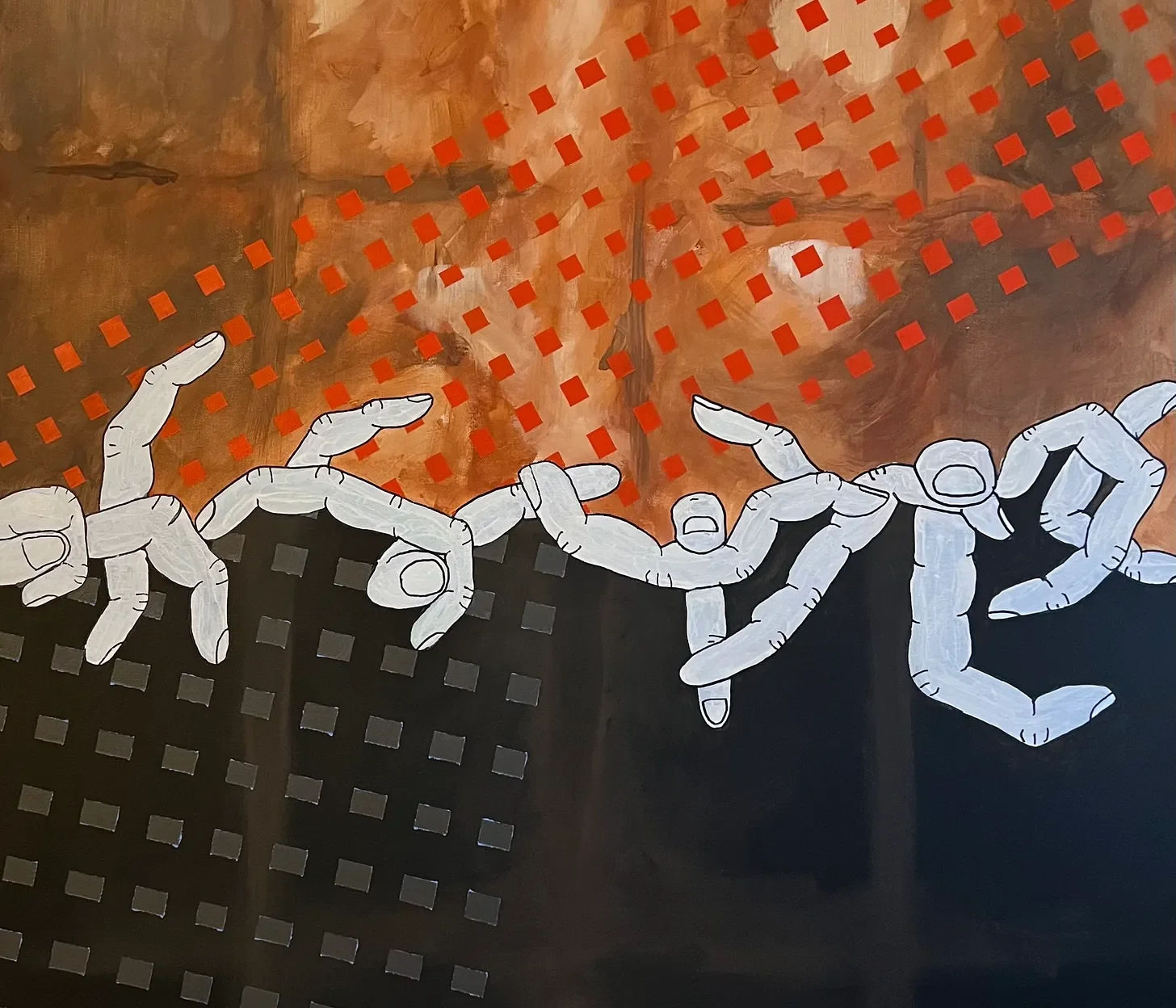
Kunal Sen
Memory and Trust.
Now in the age of AI, the Encyclopedia is also grappling with how to leverage AI’s effectiveness in content production while retaining the trust and credibility of the brand which is based on human curation.
One of the tools that Encyclopedia Brittanica created was a tool for editors to write stories collaborating with AI. While there was efficiencies in the creation of the pieces the Editors found that fact checking and proof reading the AI took much more time than humans.
The editors trusted the machine output less than human output.
Humans have a much higher bar to tolerate mistakes from other humans than machines. An example is that today autonomous cars are much safer than humans but humans are far more skeptical about the abilities of the machines.
Another example of trust is the importance of a formal account of record.
Of trusted memory.
When the Encyclopedia stopped publishing a print edition the Library of Congress which had bought a new edition every 3 years for over 200 years ( not to replace the previous edition but to augment it), called Kunal with a concern.
The reason that the Library of Congress had bought each new print edition was that it allowed someone to check on the state of knowledge or culture over the decades by checking articles on the same subject across the years. A digital edition was not a static document changing in real time and even if a snapshot of all the content were taken once a year it would be difficult to capture the experience of navigating the content.
Today the past as it is digitized is disappearing and often cannot be accessed without the old hardware, browsers and plug ins. And when every single interaction is personalized and every AI conversation can provide different answers each time one asks what goes into the record?
What are the challenges when everything is impermanent and there is no shared memory?
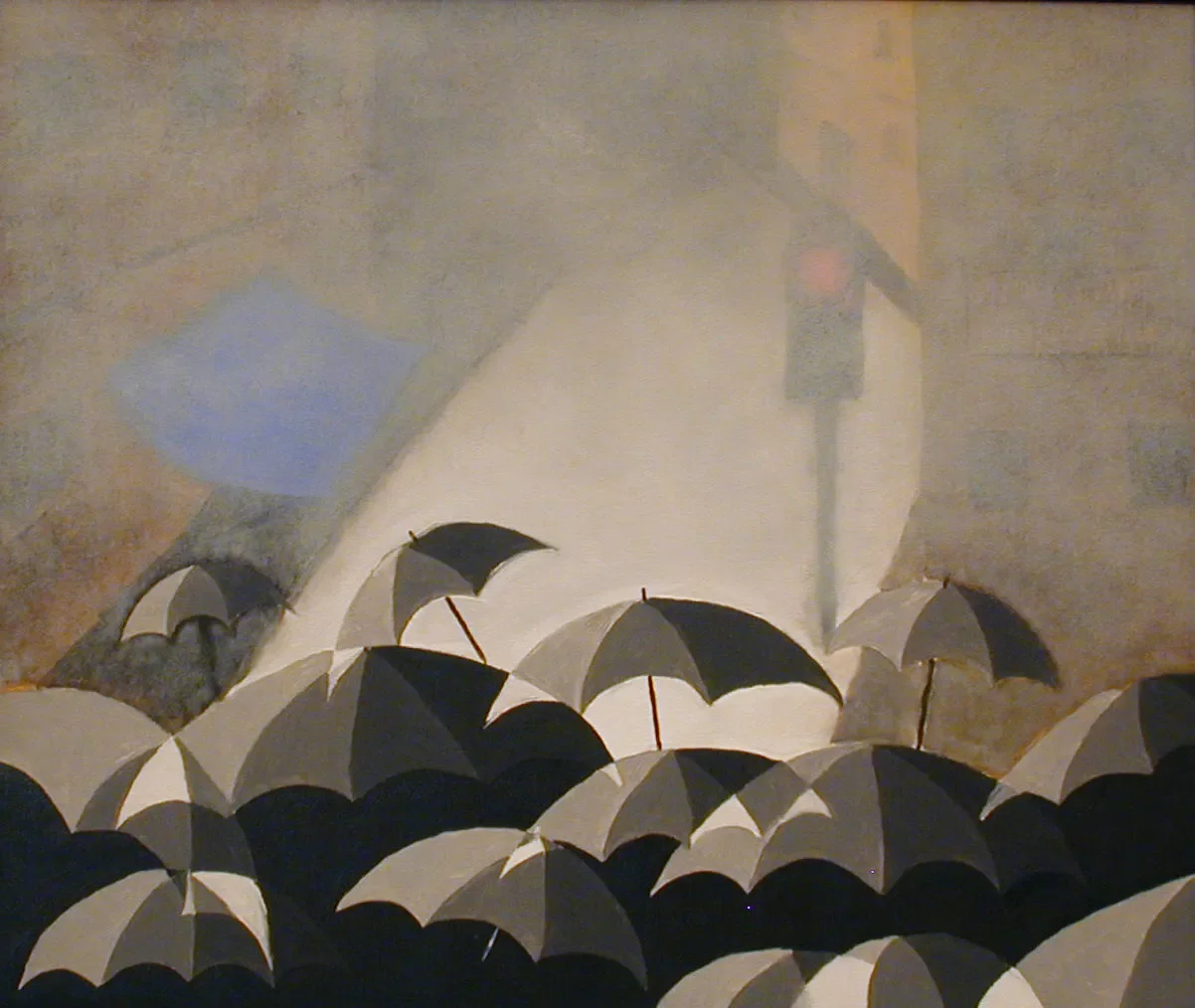
Kunal Sen
Art and Impermanence.
Given Kunal’s AI expertise and his sensibility as an artist one of the most fascinating parts of our conversation was about whether AI can be creative and make art.
Kunal believes that AI can be highly creative in that it can make things that are novel and useful. All humans are born creative but in time due to society and education most of us end up being less creative .
AI chatbots while trained have not been schooled. In addition they have a setting called temperature that allows one to dial up their randomness and rule breaking. Therefore it preserves its creativity.
AI can make moves that no human would have conceived of such as move 37 when it played AlphaGo with the then world champion, Lee Sedol.
After the game Lee said that he could not imagine any human making such a creative move.
On AI making Art however Kunal was skeptical since he believes true art has three attributes. 1) Creativity 2) Intentionality in that somebody had a reason to do something and 3) Shared Experience.
Machines can be creative but can they be intentional or is a human causing the intention? Even if machines had intention it is in the third attribute of shared experience that suggests machine generated creativity to fall short of being art.
Because when we see a work of art we soon begin to imagine what the artist may have been feeling or seeing when he or she created it. There is no such “he” or “she” in AI art and this psychologically impacts us the viewer.
Kunal also reminds us that most literature and art is grounded in the passing of time and the impermanence of life. Machines do not have to grapple with death. As Franz Kafka stated “the meaning of life is that it ends”.
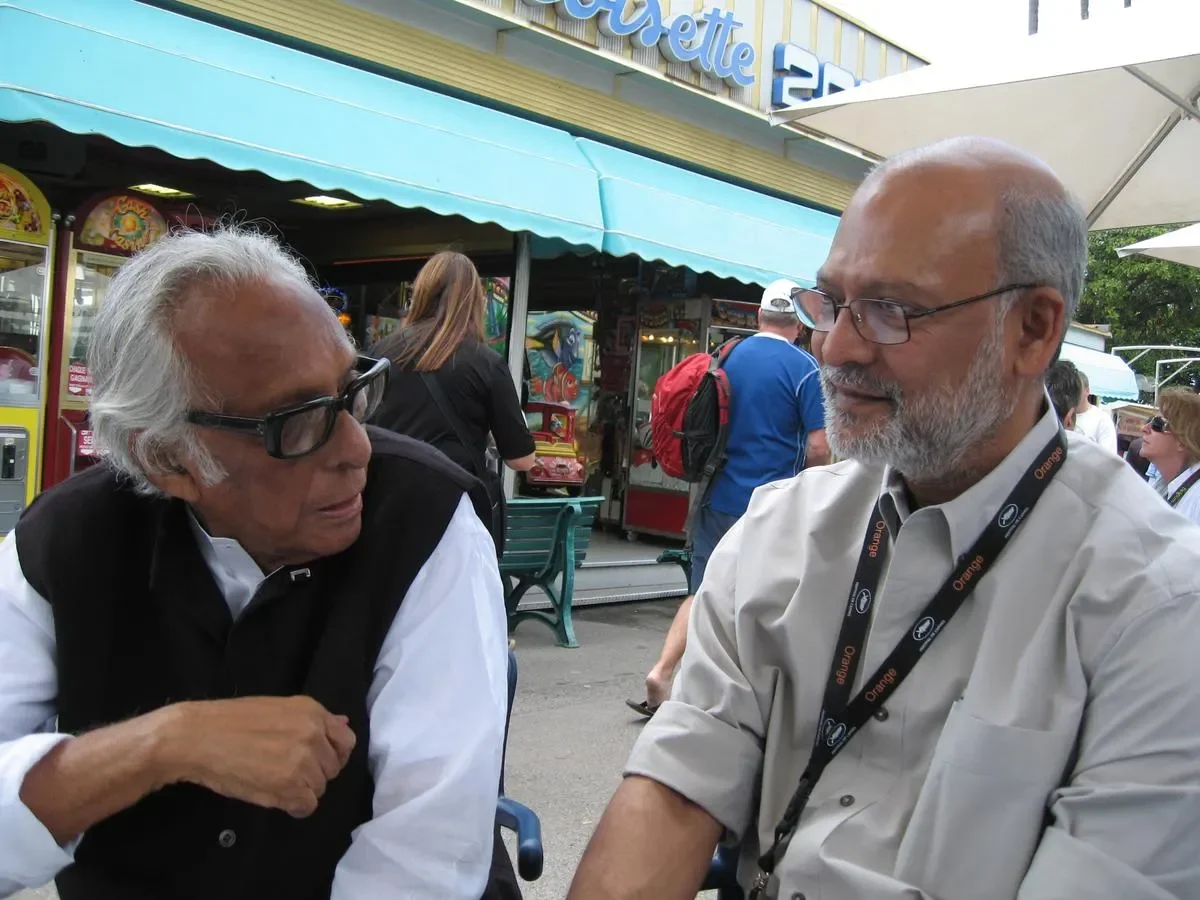
Kunal Sen with his father Mrinal Sen at the Cannes Film Festival in 2010.
The four points above are a small portion of an incredible conversation which will enlighten the listener about AI, Science, Art and the Human Experience in ways one would never expect.
More about Kunal Sen and his art here: https://www.kunalsen.com/
My conversation with Kunal is an episode called “Science, Art and AI in the Human experience” and is the latest What Next? episode on every global podcast platform.
Here it is on Spotify:
One Single Thing
https://www.poetryfoundation.org/poems
The greatest poetry in the world. All in one place. All free to access.
Here is one short poem:
The Red Wheelbarrow
so much depends
upon
a red wheel
barrow
glazed with rain
water
beside the white
chickens
Burning Lessons.
In 1995, a project manager at a San Francisco software company drove twelve miles into a Nevada dry lakebed because a man in a bed sheet holding a plastic flamingo told her to.
She never went back.
That woman was Marian Goodell. Nearly thirty years later, she is the first and only CEO of Burning Man Project.
An event that started on a beach in San Francisco with a few hundred people has evolved into the construction of a temporary city of 80,000 in the middle of the desert where nothing except ice is sold and which is then completely eradicated leaving no sign of having existed!
Marian arrived as a command-and-control project manager, learned to let it go, and built something genuinely collective.
Then her co-founder passed away. Then the pandemic came. Then the rain nearly broke the event. Then the tickets stopped selling.
Each challenge demanded something different, and each time, she had to decide whether to take the tiller herself or trust the community to sail the boat.
For a frame of reference watch this two minute video which is a trailer on the just released HBO documentary on Burning Man.
In the latest episode of Unbossing, Drew Ianni and I spoke with Marian.
She has many lessons to share from running Burning Man including how to you sometimes need to burn your former ways of working to transform into a way more relevant as the world changes.
The entire episode is a masterclass on leadership that everyone should listen to.
Here are some key takeaways for every one who wants to lead through tectonic times:
1) Leadership styles need to evolve as the situation evolves.
Great leaders adapt their style of leadership to the circumstances they face and the teams they lead. Some time one leads in a collaborative way and another in a command and control style.
In today’s tectonic times where the foundations of many businesses are shaking the one size fits all model explains the rapid turnover of many leaders.
Marian explains how collaborative decision making and collective decision making each have their uses but are very different.
2) Community and Culture are the keys to organizational health.
Every institution and organization succeeds and fails based on how well it understands and protects it’s culture while incorporating the input of its community.
It is a balancing act between “a way” and “ a people”.
The “way” of Burning man is that of decentralization, radical self-expression and participation.
The “people” of burning man come from all over the world, include starving artists and technology billionaires who look to be transformed by being challenged by the environment, who seek to connect and find themselves by fusing with art and theater.
Many reject top-down management.
To protect this culture and community Marion both decided not to hold a Burning Man in 2021 since Covid was still in the air, too many people were still suffering from trauma, not enough people had been vaccinated and there was not enough time to hold a safe and high quality event.
But Marian also attended the “Renegade Burn” where 12,000 people created their own Burning Man putting into practice the cultural DNA of decentralization, self-expression and participation.
Some things are never under one’s control and how one reacts to rebellion may determine the long term health and community of an organization.
Today many people have created their own versions of Burning Man all over the world without permission. There is no franchise model but just a way.
3) Burning Man provides lessons for the modern leader.
Zone of Influence vs Zone of Control: In a distributed world with knowledge available to everybody a management style of command and control is being replaced by one of influence. The ideas of radical self-expression, decentralization and self-reliance seems to be a pre-cursor of the future of corporate design and career management.
Importance of Generational Sensitivity: Today there is a huge rupture between the young and the old on issues from capitalism, the willingness to work in a corporation, risk taking and much more. Often people are speaking past each other. As the audience at Burning Man grew older the organization went out of its way to understand and welcome a new generation who in turn leveraged social media to promote the experience Instagram in particular). Listening has never been as critical.
The future is about combining story and spreadsheet: Successful leaders balance art, play and creativity with operational and financial discipline. One without the other leads to genetically deformed firms that cannot navigate the tides of change.
Take a listen and some of the lessons may have you burning some of your own beliefs:
One Single Thing
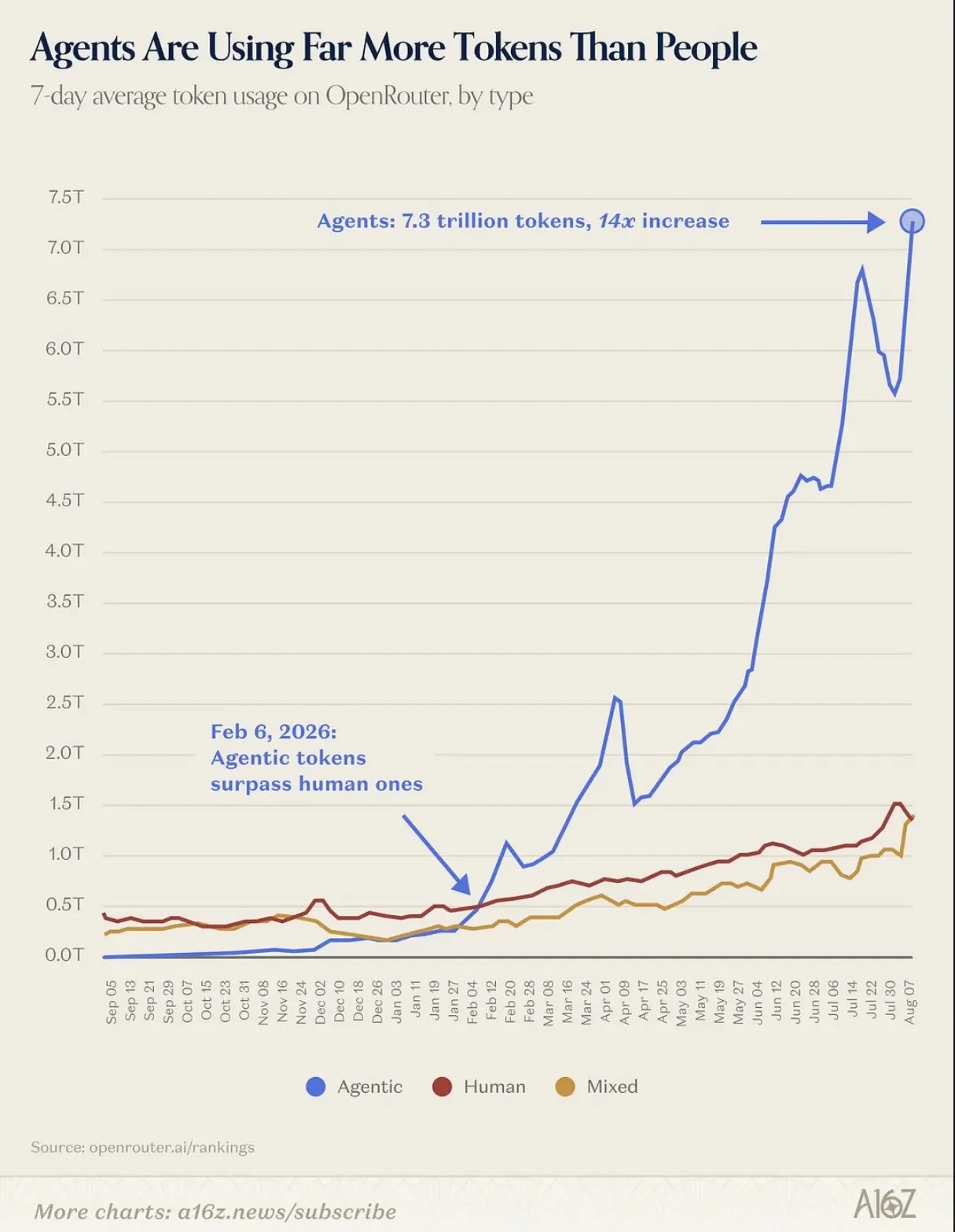
The agents are using AI more than humans!
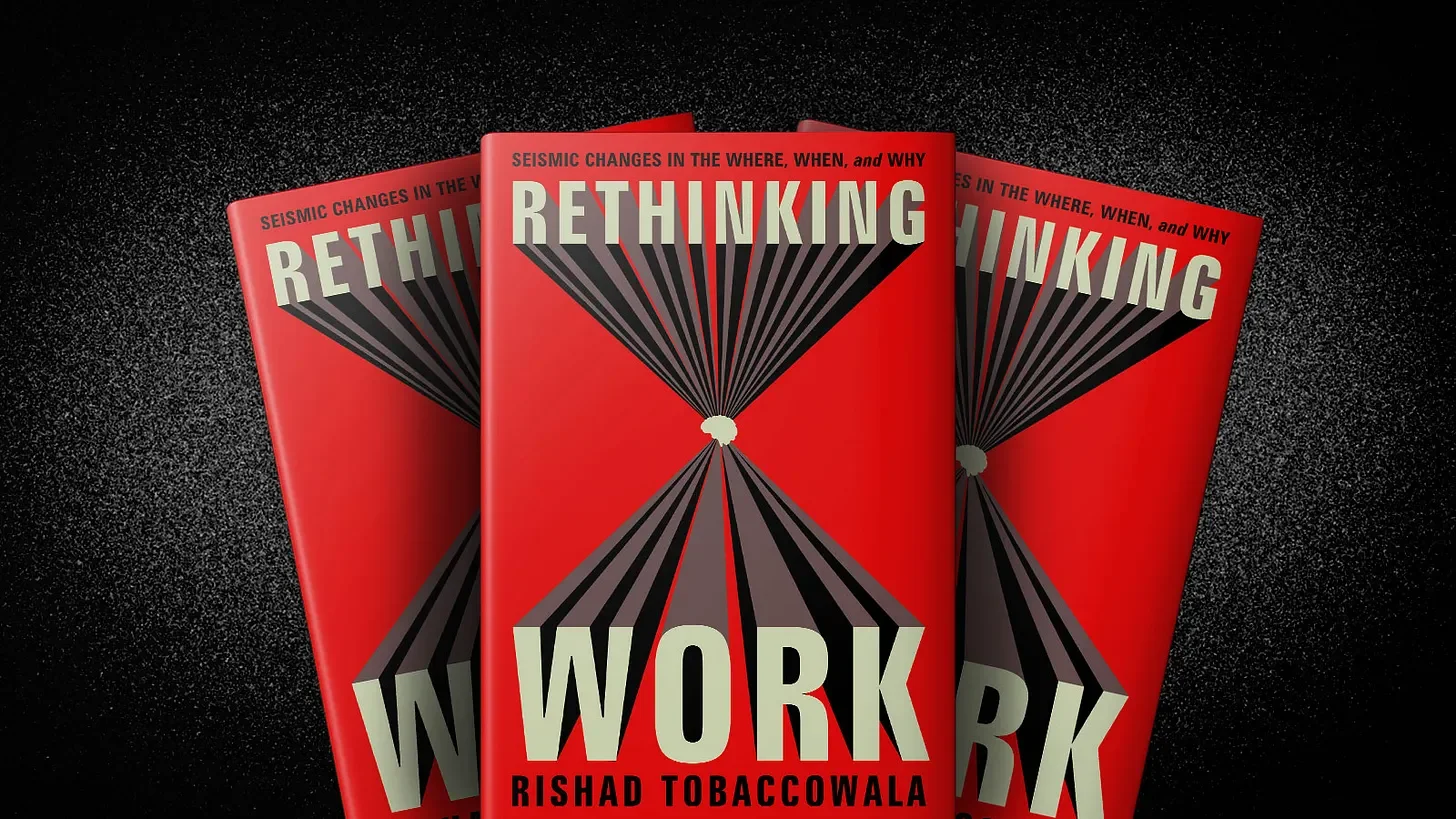
Rethinking Work: A Reintroduction.
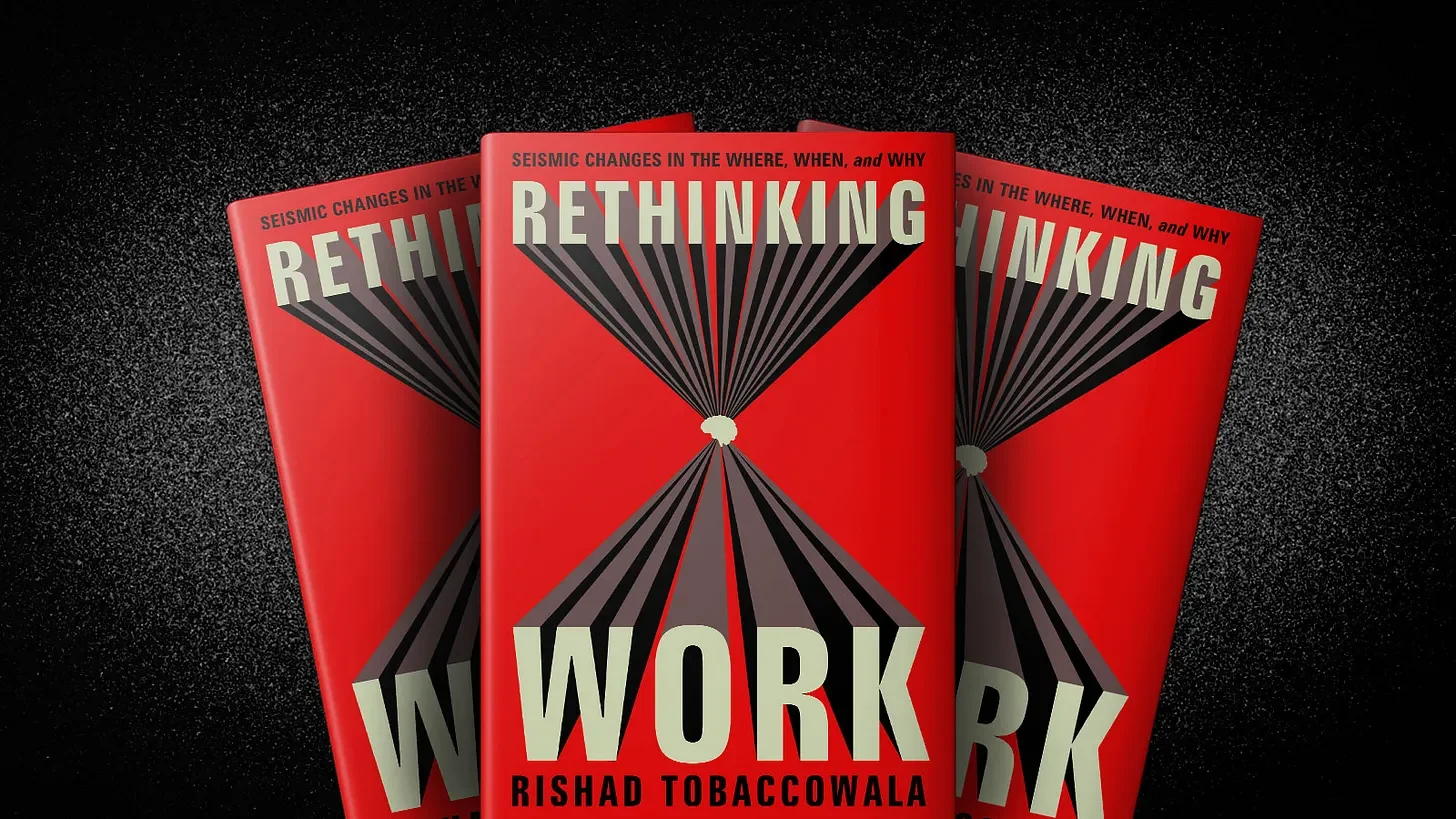
Over 3 years ago, as my agent was shopping the manuscript of “Rethinking Work” he first approached HarperCollins who had published my first very successful book, Restoring the Soul of Business: Staying Human in an Age of Data, because they had the first right of refusal on my next book.
Despite the financial success of the first book and even though though the acquiring editor wanted to offer an advance, HarperCollins passed. The acquiring editor explained that the new Publisher ( my original publisher had left for academia) believed I was not writing a book of business but a book of science fiction!
She wondered why I was making a big deal about AI ( this was just before ChatGPT), and questioned my belief that work would change more between 2020 and 2029 than in the next fifty years requiring completely new ways of working, an era of “de-bossification” and dramatically different organizational structures.
A week later McGraw-Hill bought the book and paid an advance.
A few months into writing the book a major strategic change at McGraw-Hill led them to decide to focus only on text and educational books and withdraw from business book publishing. They gave back the book rights and let me keep the advance.
Within 48 hours HarperCollins purchased it.
The launch of ChatGPT and the departure of the sceptical publisher allowed my acquiring editor to buy the book as he had always wanted to.
Rethinking Work has proven to be both prescient and highly actionable.
Every single thing predicted has happened or is about to happen.
A few months ago Fidelity Investments had many of their leaders read the book and then had me participate in a work session with them. One of the questions I was asked was given the year since the book had been published what I may have got wrong.
The speed of change. The future of work is even faster than anticipated and the last section of the book which I believed would happen by 2029 will happen in 2027.
As a result this book is probably more relevant now than when it was published and so I am sharing most of the Introduction ( which was written 2 years ago) for those who want a cliff-notes version.
A. Five Interlocking Forces Sculpting the Future of Work.
FORCE ONE—Generational Shifts: For the first time, four and possibly five generations will work in the same firms. The youngest employees in their twenties are Gen Zers, and they are about to become the largest component of the workforce. The eldest employees are baby boomers, the youngest of whom are turning sixty, and they have dominated the workplace in numbers, income, and impact until now. In between are millennials and Gen X. The mindsets, expectations, and worldviews of each group are significantly different. In addition to the rise of Gen Z, we are seeing a rapid aging of the workforce and declining population growth.
FORCE TWO—Technology: We are entering an AI-infused age when the cost of knowledge may soon be zero. More than half of the workforce in high-income countries are knowledge workers. Imagine the implications when this new AI reality become prevalent. Every job will be changed. How many will be lost and what new careers will be forged?
FORCE THREE—Marketplaces: Today hundreds of market-places such as Upwork allow talent to be procured from anywhere. Etsy and Shopify allow individuals to access customers from everywhere. App stores and cloud services from Apple, Amazon, Google, Microsoft, and OpenAI allow small and medium firms to access billion-dollar tech.
FORCE FOUR—New Ways of Working: Demographics, technology, and marketplaces are now enabling vastly different ways of working, which is giving rise to a world of side hustles and side gigs.
FORCE FIVE—The Long-Term Impact of COVID: COVID is just one of the five factors creating seismic change at work, and its biggest impact may not be on where people work but on the emotional rewiring it caused when, during the pandemic’s nearly three years, people reconsidered the role of work in their lives.
Consider a few statistics:
By 2027, 86.5 million people, or half the workforce, will be doing some freelance work.
In 2022, more than one-third of US workers and two-thirds of those under age thirty juggled different “gigs” (rather than work full time at one job). The “fractionalized” employee (my term) is becoming a reality.
According to research conducted by the McKinsey consulting firm, 80 percent of people who worked at home during COVID liked it, and 41 percent asserted they were more productive than they were working from the office. Fifty-nine percent of respondents (in a study conducted by Owl Labs) said they would be more likely to choose an employer that offered remote work over companies that didn’t.
But the need to rethink work goes beyond even these statistics about remote work and the shift from full-time to part-time and gig jobs. For instance, people used to work primarily for income and achievement. While these factors are still important, we’re seeing a growing number of people choosing jobs based on meaning (the work is fulfilling, satisfying them on a deeper level), community (connection with like-minded people), and social purpose. Millennials and Gen Zers, especially, are searching for work experiences that fit their personal beliefs and styles
The Who, What, Why, Where, When and How of Rethinking Work.
WHO WILL PEOPLE WORK FOR? Until recently, most people worked for someone else for a relatively long period of time—a large corporation, the government, an educational institution, and so on. But communication technology advances, new business models.and marketplaces, and changing generational mindsets are transferring power to the individual. This transfer gives people work options, and they’re exercising them in all sorts of ways. For instance, a growing number of individuals are choosing to work for themselves. Zoom, Slack, and other platforms facilitate work processes; Etsy, Shopify, and Substack help users leverage their capabilities and scale themselves and their ideas to growing markets. Others are opting for greater control over whom they work for. Digital natives have lived through 9/11, the Great Recession, and. COVID, and their attitudes have changed—they believe much more in themselves than in organizations. As a result, people are rejecting the old model of working for one organization for a decade or longer. Instead, they’re choosing to be gig workers, to create start-ups, to become fractionalized employees, to dedicate themselves to and work for a cause. To mix and match employers. Just as employees have numerous options, so too do organizations. This book will help leaders capture talent by structuring jobs in ways that appeal to this new work sensibility.
WHAT WILL ORGANIZATIONS LOOK LIKE? Like nothing in the past. We will no longer have a single organizational model or design but instead have a wide range of operating styles, structures, and sizes. In the past, organizational models were like classical music, with a conductor, orchestra, and well-rehearsed score. In the future, they will be like jazz, involving different players who take the music in surprising, unpredictable directions. Companies will be fluid, forming and reforming themselves to fit the market and emerging needs. They’ll mix full-time and part-time workers, in-office and remote employees, teams and individual performers; they’ll shift alliances continuously, collaborating with a range of suppliers, consultants, and others as need dictates.
WHY WILL PEOPLE WORK? People have always worked for a variety of reasons—income, identity, community, social purpose, and personal meaning. As noted earlier, COVID and shifting social norms are causing more people to choose jobs and careers based on factors other than income. Empowering technologies also make it easier for people to pursue meaningful work. But another trend has a profound effect on why. In the past, one full-time job rarely satisfied all our reasons for working. The law firm partner was well paid but found little personal satisfaction in his job. Or the social worker found satisfaction in helping others, but she was micromanaged, hampering her personal work style. Today, however, we’re seeing a shift to people satisfying all or most of their whys by having more than one job—two-thirds of those under age thirty are combining different gigs. A mix of roles—side hustles, volunteer positions, and so on—is much better able to satisfy all our work requirements than a single job can.
WHERE WILL PEOPLE WORK? In the metaverse. At home. In morphing offices that will bear little resemblance to traditional places of business. In planes. And perhaps in the not-so-distant future, in self-driving cars. According to a Stanford University study, “Compared to 2019 levels, employees’ average distance from their home to their employer has risen 2.7 times: The mean distance to work rose from ten miles in 2019 to twenty-seven miles at the end of 2023. The share of workers living more than fifty miles from their employer rose more than five-fold.” COVID certainly has powered this trend, but so too has our entering the Third Age of the Internet—AI, 5G, the metaverse, blockchain, cryptocurrency, and other developments are reshaping industries and companies. US companies have formed alliances with organizations in India, China, Brazil, Russia, Vietnam, and elsewhere; people work virtually and sometimes physically far from home, and they will do even more of this in the future. It’s not just that people are working remotely. It’s that they are working on teams with members from seven different countries, and that their customers and suppliers are located on different continents. In the future, being a global company isn’t just a description of office locations but of a mindset—we are becoming workers of the world. To answer this “where” question, I’ll offer advice about how to maximize flexible workspaces, creating policies and cultures that cater to locational agility.
WHEN WILL PEOPLE WORK? Whenever. The nine-to-five day has long since passed. Until recently, work was confined to certain days and hours because of rigid structures—we all needed to work together in the same place for efficiency, for people to be managed properly. Now we require temporal flexibility for many reasons. Most obviously, if we’re doing business with people on the other side of the world, the time zones are different. Less obviously, efficiency is less important than innovation, disruption, and agility. These qualities are less likely to emerge if we confine our work to rigid schedules. Great ideas surface in the middle of the night, when we’re exercising, when we become inspired by a piece of music at the symphony. We need to feel empowered to call, text, or email our colleagues to obtain their feedback and ideas at this moment of inspiration. This doesn’t mean that we become 24/7 workaholics. Instead, our work hours become fluid, dictated by work projects, time frames, and our own preferences—we might need to take time off to recharge in the middle of the traditional workday, and we might need to meet virtually with colleagues at midnight.
HOW WILL LEADERSHIP CHANGE? We are witnessing the decline of the manager and the rise of a new type of leader. In the past, the managerial role was essential to efficient organizational operation—they managed by walking around and checking in on their people. In an increasingly distributed world where people often work virtually, you can’t manage by walking around. Younger generations, especially, hate being monitored. While employees used to rely on managers for news and expertise, they can now use YouTube, Khan Academy, Open AI, and other online tools to learn what they need to know. Managers, therefore, are becoming anachronisms, while a new type of leader is becoming crucial for organizational success. This type of leader displays three traits: a growth mindset (growing people and businesses, macro-imagining possibilities rather than micromanaging employees); improvisation skills (the agility to pivot on a dime); and a thirst for learning (in a world of rapid change, continuous learning is the only way to survive).
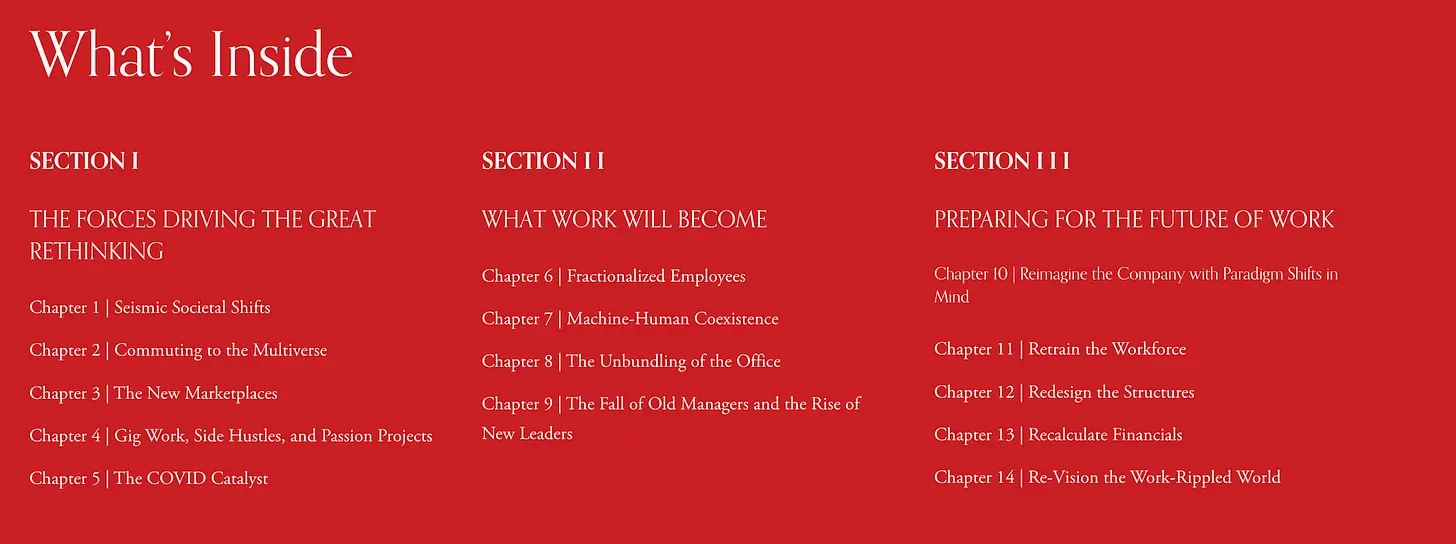
This book is divided into three sections. The first section examines why we need to rethink work—the factors that are causing traditional structures and styles to be ineffective. The second section analyzes the ways in which work needs to be rethought. The third section addresses what we can do about it—the steps that organizations can take to change themselves so they’ll be prepared for the Great Rethinking.
This book is for everybody who works, whether you are a longtime senior leader or a brand-new employee, whether you work in a large company or for yourself, and whether you work in a developed or developing market.
Work is central to our lives and as it gets redefined, nothing is as important as being informed and provided with tools to thrive in the coming transformation.
The book is available in physical, digital and audio formats in the US, parts of Europe and India. Will be published in October in Brazil. Many options to buy across formats and from big to independent stores here.
Any chapter can be read in any order:
One Single Thing.
On one of the two main stages at SXSW (South by SouthWest) an editor of Fortune Magazine interviewed me on how one can navigate the future of work. Listen to the first five minutes and you will never thing about work, your company or your job the same way ever again: