Strategic Implications of an AI Age.

Image via MidJourney
What is strategy?
Strategy is Future Competitive Advantage.
What will the future look like? What will people need and expect? How will demographics, technology and other global shifts create new competitors or recharge current competitors and how will categories blur, blend and maybe even disappear?
Amidst these new expectations and changing competitive dynamics what advantage does a company offer? A differentiated or better product? A competitive moat of network effects, scale or some other dynamic? A better experience?
Many companies underestimate the exponential impact of technology and they also make the cardinal mistake of defining their category and competitive set looking backward versus forward.
One example among many is the auto category which defined the key drivers of their category in ways that did not see a Tesla or an Uber or a BYD for years after they began to scale. How could software be as, if not more, important than hardware? How could electric be better than internal combustion engines? Do most people need the expense of owning cars or do they just need access to mobility?
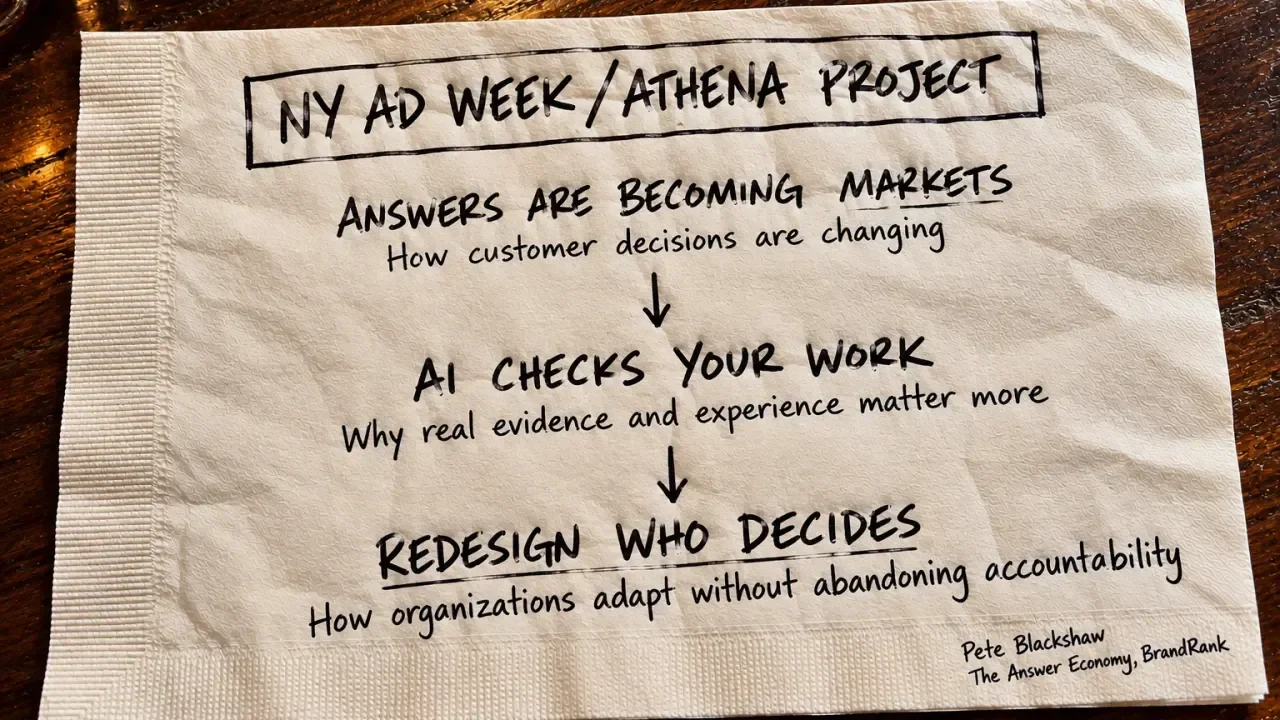
Image via Pete Blackshaw
Strategy in an AI Age.
Companies today make the mistake of working on an AI strategy rather than asking how AI will impact every element of their strategy and business model.
AI is like electricity. Every competitor will have access to it and just like electricity is not a differentiator for companies neither will AI.
At this stage a few things appear to be clear:
1) AI is exponentially increasing its capability at speeds never seen. The AI we have today is the worst it will be and is likely to be twice as powerful within months.
2) In data and logic areas such as mathematics it has far surpassed human intelligence.
3) In areas such as medicine, a combination of AI and biotech will truly change the contours of human health before the end of this decade.
4) The workplace will now have three forms of producers. Raw AI or Alien Intelligence. Agentic AI or replicants. And Humans. All markets and workplaces will combine and need to engage with Aliens, Replicants and Humans.
5) The world of media and marketing will see three dramatic shifts which will need every firm to question their brand, data and communication strategy and investments to date.
a) The three current interfaces of streaming, scrolling and searching will be supplemented and soon dominated by the interface of conversation. This conversation will not just be between companies and their replicants (agents) but customers and customers agents. The conversations will involve information sharing, transactions, real time customization and pricing and much more.
b) Every company will need to revisit its data strategy and possibly write off many of their investments: For years companies leveraged data to find the right person at the right time in the right place. This was plumbing. Now the key will be to ensure the right interactions and messages are sequenced in the right order. This is the poetry. The future is plumbing and poetry. In addition the conversations between consumers and their agents and a firm and their agents reveal much more about real time preferences and interests than much of the so called valuable first and second party data that companies have bought and hoarded. People are spending much more time with their answer engines than their search engines and the data is far richer, deeper and emotional.
c) Brands will continue to matter but they will be architected and re-enforced differently: My friend and colleague Pete Blackshaw just published a book called “The Answer Economy” and also writes a great Substack with the same name. He reminds us that in this age, visibility, vulnerability and readiness matter a great deal more than many other metrics of marketing. Read this amazing overview in which Pete summarizes the key issues that many top business leaders recently discussed at The Athena Project’s Third Annual Salon at Boston Consulting Group. A ten minute read that will put you and your firm ahead of the curve!

Image via MidJourney
Key Strategic Implications.
1) AI is less about technology and more about talent and organizational design: AI is like hydrochloric acid that burns through an organizational structure . AI focuses on outcomes and does not care about the silos and processes. Companies have to realize that AI is less about technology and more about people, power, politics and partnering! Messy stuff that is not solved through an AI partnership or a press release or nonsense about how one is replacing people with AI.
2) AI is about existential opportunities and risks: Every company should leverage the efficiencies and effectiveness that AI enables. But they are unlikely to provide any sustainable strategic advantage since every company will be leveraging the same AI to gain the same results.
The real opportunities and risks are to re-imagine one’s business model. This is because AI means consumers and customers now have superpowers, behave differently and have different expectations. In addition the competitive landscape has changed with AI first or new business model companies without legacy structures or tech debt convincing companies to rethink their existing partnerships, suppliers and vendors.
If strategy is future competitive advantage and the competition and the consumer/customer expectation have changed due to AI why are firms applying AI to their current strategies vs re-imagining their strategies?
An example of a company that re-imagined its business for the previous revolution (analog to digital age) is the New York Times. It did not just find ways to use digital to cut the costs of gaining subscriptions or distributing the print paper but instead re-architected the future of a primarily local (New York) , print driven, news focused company into a global, multi-media, life-style company with news!
3) Margin will need to come from new ways to differentiate: Story-telling, communication, big budgets, wide distribution and many of the levers of generating revenue and growth will still matter but diminish in a world of individuals as media companies, consumers with superpowers, agentic/replicant transactions and interactions plus the rise of conversation as interface.
4) Talent/Humans will be key: For every dollar companies allocate to AI they will have to allocate as much to attracting, retaining, and upgrading talent. It is unlikely in a fast moving and highly competitive AI world that a tech moat will stand for long. Rather it will be in re-imagining of organizations, re-wiring processes, innovating new markets and inventing new ways to build brands and revenue. There may be fewer people in some organizations as they are supplemented by AI but many companies will use AI to grow into new businesses while leveraging talent in new ways. We will see an increase in revenue per human but that does not mean fewer humans.