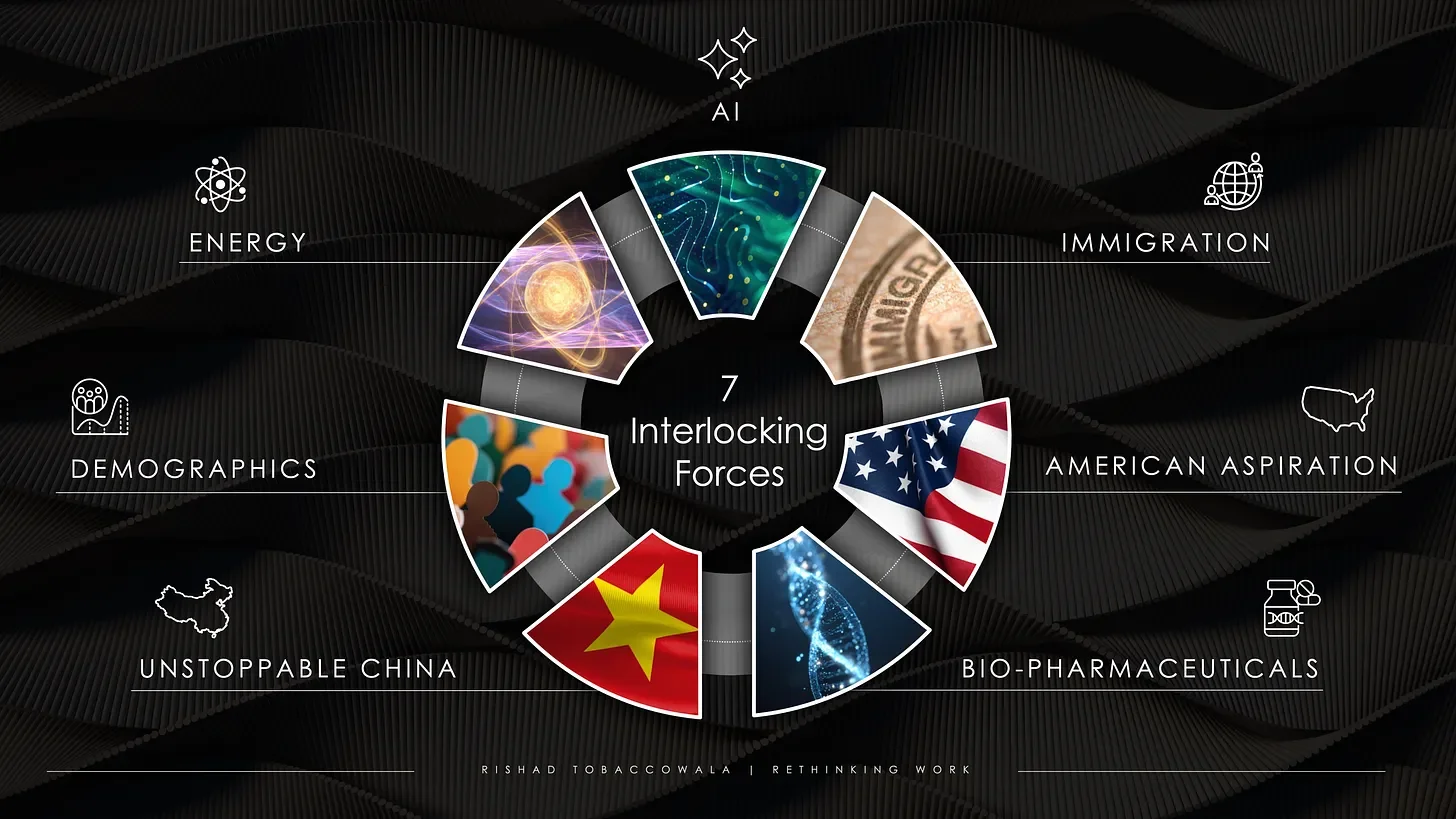
Strategic Reset: The 7 Interconnected Forces.
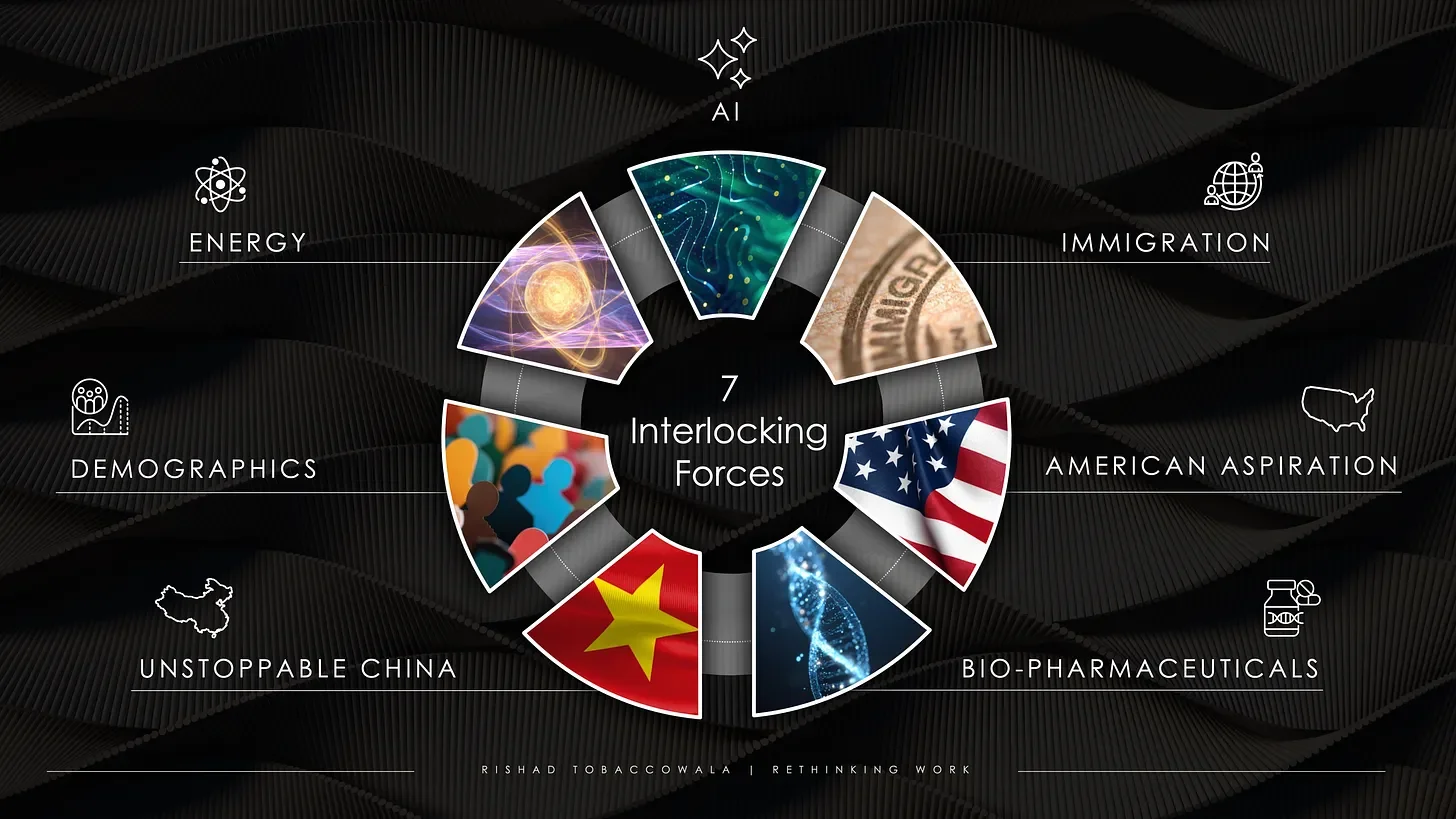
Image by Ben Damiano for The Rethinking Work Platform
Strategy is “future competitive advantage”.
As the contours of the future are being reshaped, every individual and firm should revisit their own strategy in light of seven interconnected forces.
These forces impact everything from affordability to politics to the future of work and to the outlook and challenges for every industry.
The Seven forces are AI, American Aspiration, Bio-Pharmaceuticals, China, Demographics, Energy and Immigration.
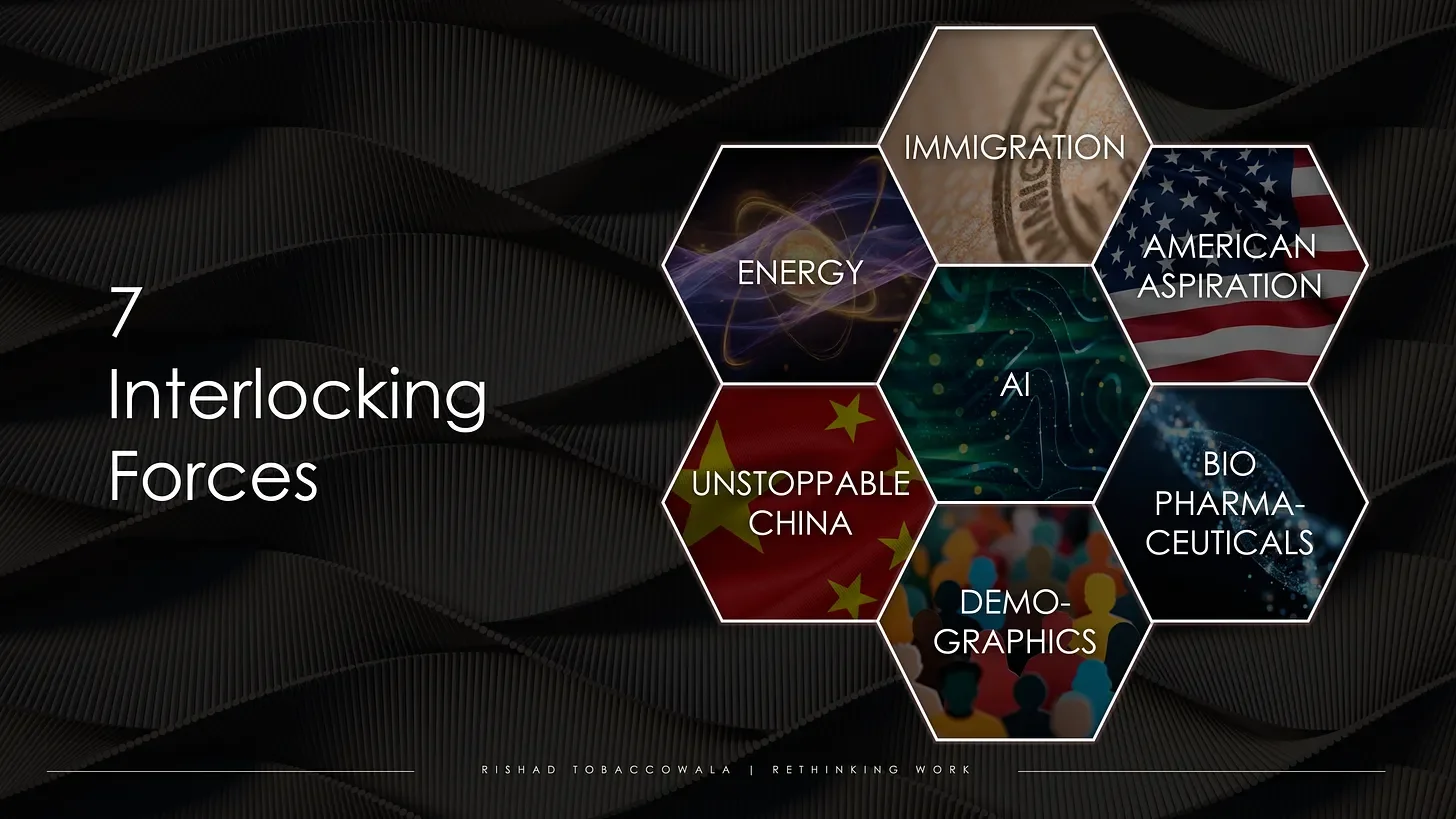
Image by Ben Damiano for The Rethinking Work Platform
1. AI: Alien Intelligence (a far more apt name than Artificial Intelligence) in 2026 will surprise with its speed and impact on every job and every business. For those believing it will be a year or two before one sees the impact on the financial contours of business two developments this past week which were 1) the integration of Google Gemini into all parts of the Google eco-system and the integration of its open shopping protocol with Walmart, Shopify and others and 2) the launch of Claude Cowork quantum jumped the rate of change. AI is still under-hyped.
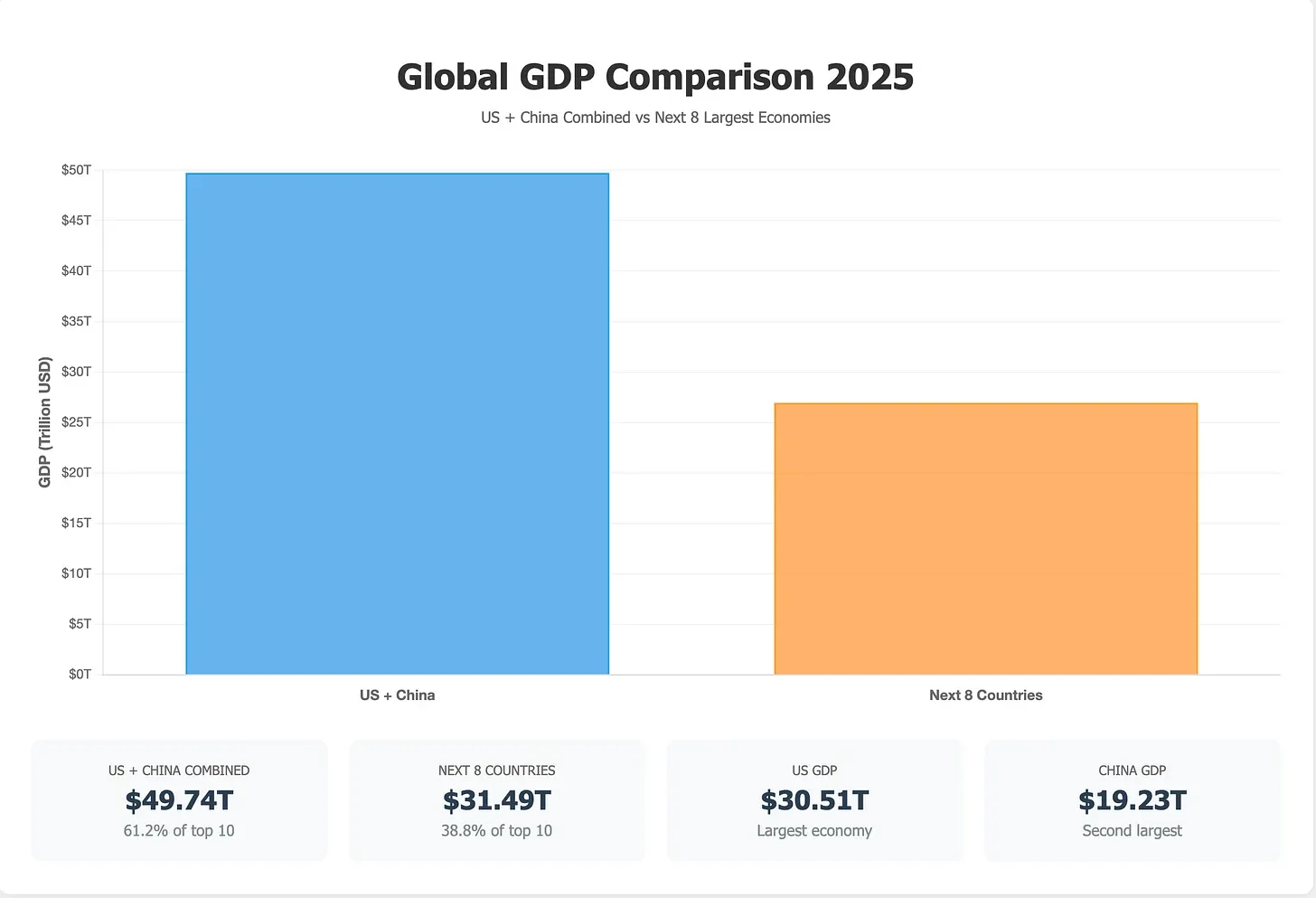
Source: Claude from Anthropic
2. American Aspiration: Whether one likes it or not America along with China dominates the world. These two countries account for nearly half of global GDP and almost all of modern AI, Bio-Pharma, and Energy innovation in the world. The total GDP of the next 8 countries ( Germany, India, Japan, UK, France, Italy, Canada and Brazil) combined are that of the US and just over half of the US and China combined. America is now beginning to leverage its weight on its own behalf. And China is unstoppable. This reality is making the EU rethink its past assumptions and structures while creating new partnerships between all the other countries in the world looking to reduce their dependency on the two giants.
Source: Claude from Anthropic
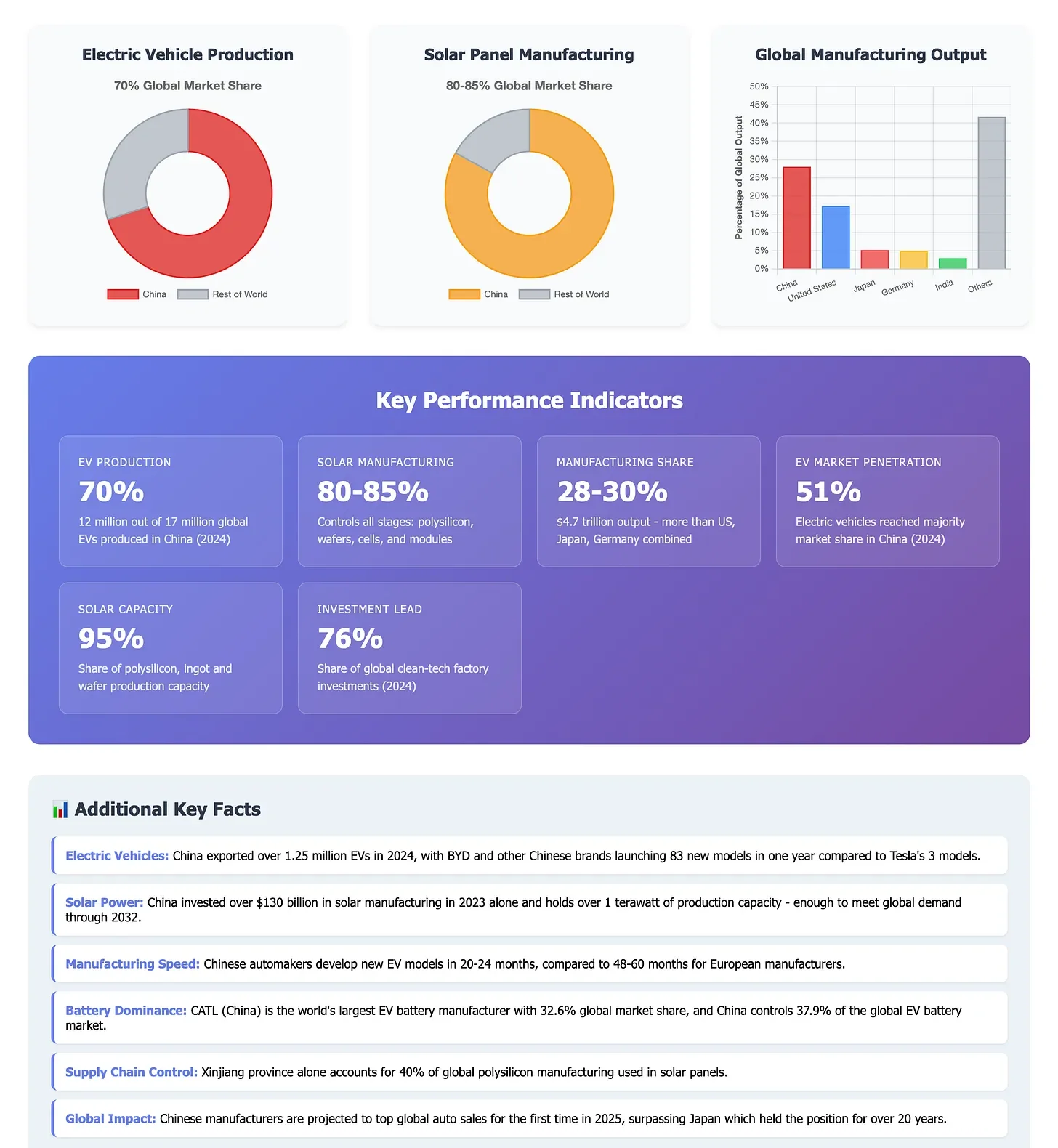
3. Unstoppable China: I have travelled to 23 cities in China and spent a lot of time with regional leaders who reinforced their belief that China would regain its place as the world’s most important country. They would do this by never repeating what they believed was the mistake of two hundred years ago when they fell behind in technology. China today in many areas has caught up with and is leapfrogging even American technological prowess.
The chart above shows their leadership in electric vehicles, solar and manufacturing.
Keep in mind that a large part of the future of AI is Physical AI which which will include robotics which needs manufacturing acumen and not just software wizardry. And manufacturing is a Chinese specialty.
China is no longer just a fast follower or copy cat innovator but now leads in many areas of primary and pioneering research.
From the Seoul Economic Daily last week:
Chinese universities are dominating the top ranks in global university rankings based on research output, a shift from the early 2000s when American institutions held all top 10 positions.
In the early 2000s (2006-2009), seven American universities ranked in the global top 10 according to Leiden University’s methodology, with Harvard University in first place. At that time, Zhejiang University was the only Chinese institution on the list, ranked 25th.
However, in the 2020-2023 compilation, Harvard fell to third place, losing the top spot to Zhejiang University. Notably, eight of the top 10 positions are now held by Chinese universities. Harvard is currently the only American university in the top 10. Zhejiang University is the alma mater of Liang Wenfeng, founder of DeepSeek, the Chinese artificial intelligence company that has shocked the global tech industry.
Chinese pride is also making many Chinese forgo western brands for local brands which is creating havoc with many western companies including the automobile and cosmetic categories who placed all significant bets on China. Last year Luckin Coffee overtook Starbucks in China forcing it to spin off its business.
Source: Claude from Anthropic.
4. Energy: Energy has always been key factor in the economy of countries which was reflected most recently in the US and Venezuela encounter. India has been careful to stay neutral on Ukraine since it is an oil hungry country and needs to buy Russian oil at lower prices. The Saudis recognize that fossil fuels are not the future and are diversifying into tourism and technology to prepare for the future.
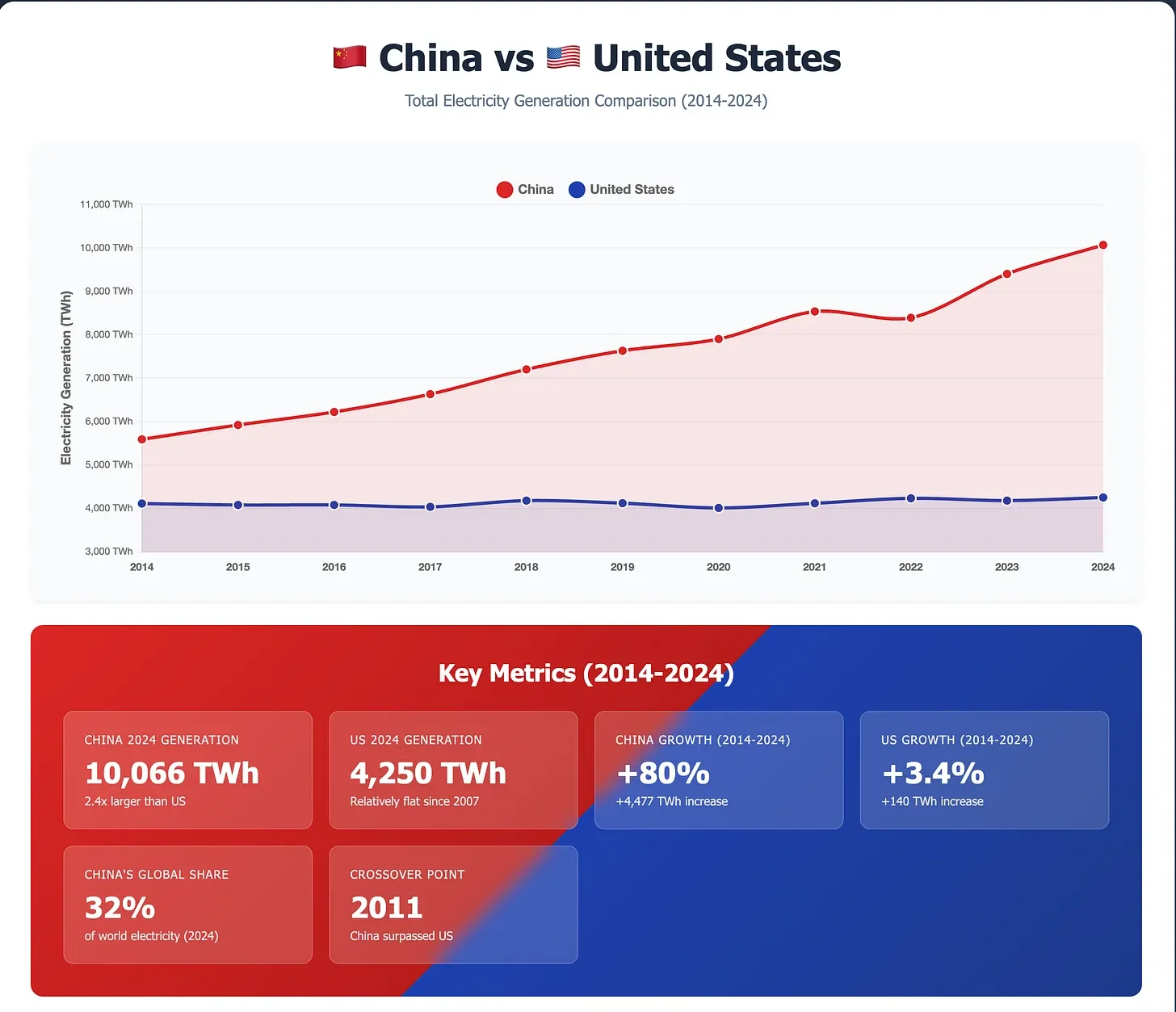
Energy is a key force that interlocks with other forces.
The chart above shows the interlocking of Energy, with the previous 3 forces of AI, American Aspiration and Unstoppable China.
A key input for all the data centers that will be critical to AI is going to be electricity. China today produces 32 percent of all global electricity and 2.5 times the electricity produced by the United States. This cheap electricity combined with open weighted models driving Deep Seek, Qwen and other other Chinese foundational models might provide a long term edge vs. US foundational models.
The drive for energy is increasing electricity prices in the US and creating backlash against the construction of huge data centers in many communities which in turn impacts politics in the US.
Source: Claude from Anthropic
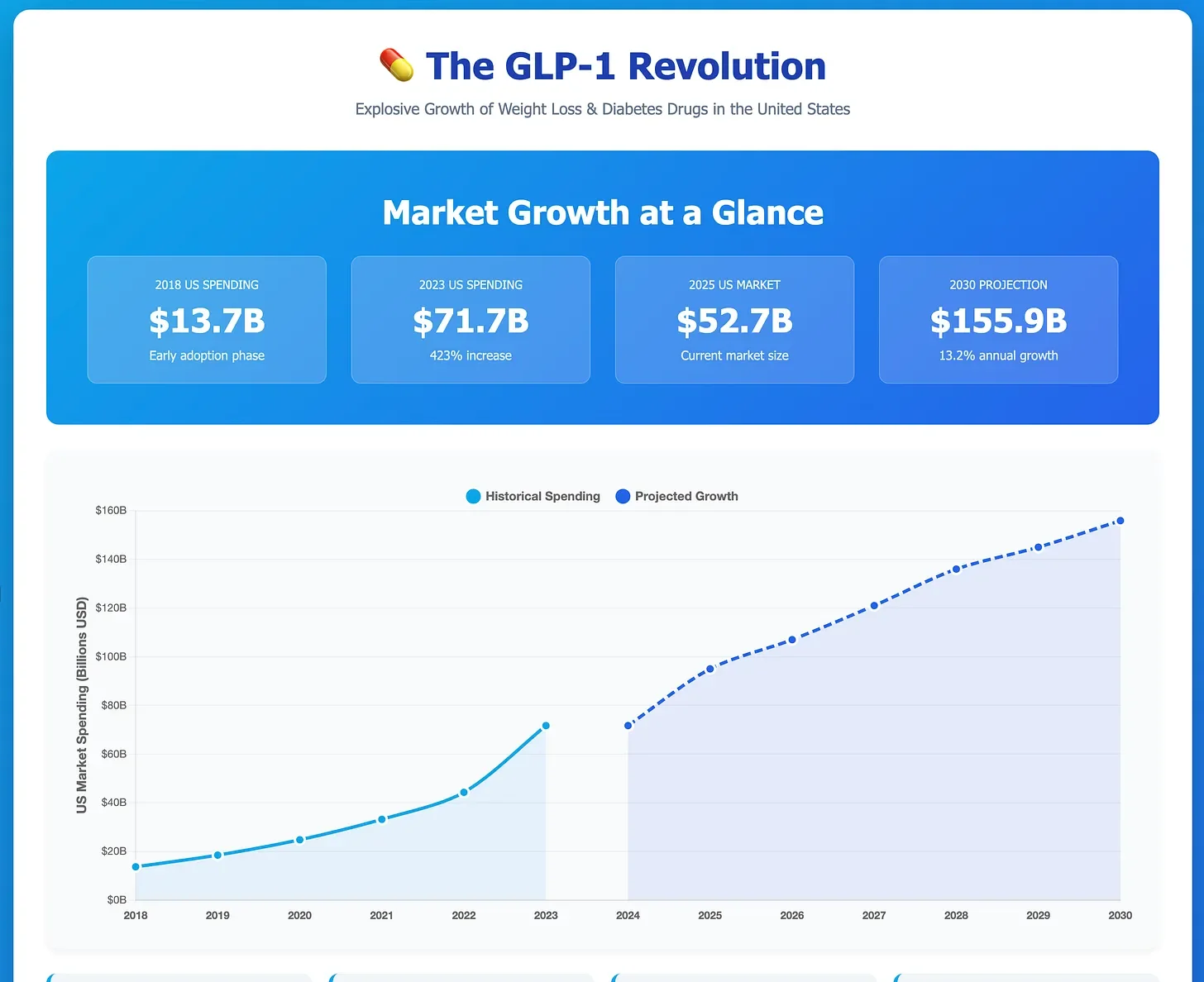
5. Bio-Pharmaceuticals: 20 percent of US households have used GLP-1 and now with the availability of availability in a pill form ( vs. injection) it is likely that in a few years up to half of all US households will be on GLP-1. In many ways the reduction in obesity due to the use of GLP-1 will have a positive impact on health care but also create new challenges and for the entire food industry, including fast food restaurants.
But GLP-1 is but one of many major breakthroughs and changes coming. Combine AI, Bio-Tech and modern Pharmaceuticals and we have the age of Bio-Pharma. It is important to remember that the Co-founder and CEO of Google DeepMind, Sir Demis Hassabis, and Google DeepMind Director, Dr. John Jumper were co-awarded the 2024 Nobel Prize in Chemistry for their work developing AlphaFold, a groundbreaking AI system that predicts the 3D structure of proteins from their amino acid sequences.
While many of us maybe fixated on AI’s impact on helping us create better content and more impactful marketing, all of this is a side show to the great ambition of AI which are in the world of medicine where drug discovery and personalized medicine are being accelerated and in manufacturing via physical AI ie. Robotics including surgical robots.
Source: Claude from Anthropic
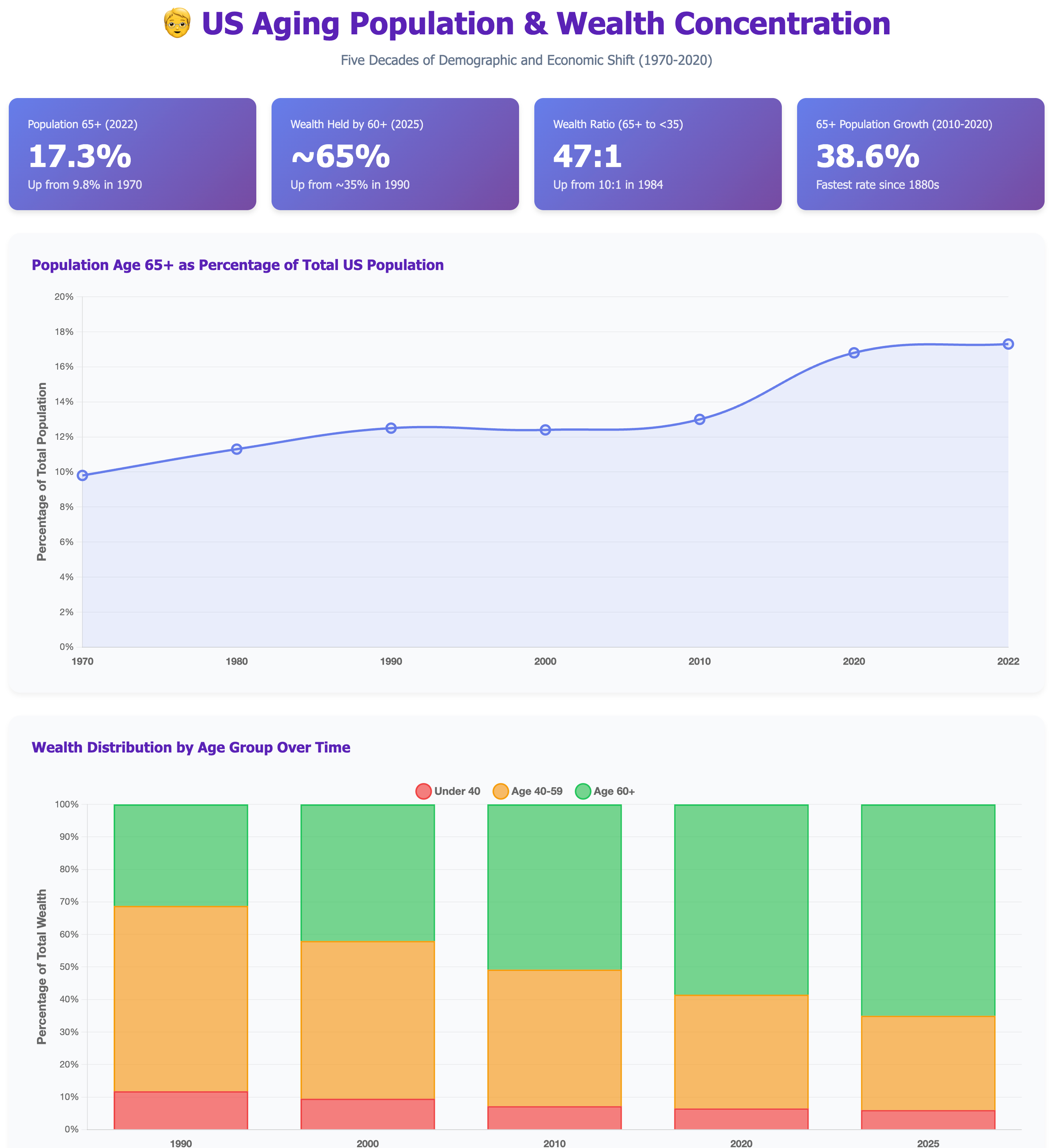
6. Demographics: Something as old school as demographics can explain a lot of what is going on in any country. The above chart shows how older Americans are growing as a share of population and how they are now dominating wealth in the US. Those over 65 have doubled from 9.8 percent to 17.3 percent of the US population over the past five decades and now those 60 plus control 65% of all American wealth! They now have 47x the wealth of someone under 35 up from 10x five decades ago. If money speaks then it has the voice of older people. While many marketers and politicians focus on younger folks the money is with seasoned.
Breakthroughs in Bio-Pharma as well as Robotics driven by AI may postpone the great wealth transfer from Baby Boomers to millennials and GenZ as more people live into their 90’s and beyond. This is particularly true for wealthy people who have access to the very best medical care.
Their success in generating wealth explains why 66 percent of Baby Boomers believe in capitalism. On the other hand, only 22 percent of Gen-Z believe in capitalism as they find themselves struggling to get and keep jobs, buy property or pay off their education debts. Two thirds of GenZ who have a full time job have a side gig or side hustle to make money and maximize optionality. In many cases, they see their main job as venture capital money to fund their own business with 72 percent of GenZ wishing to work for themselves.
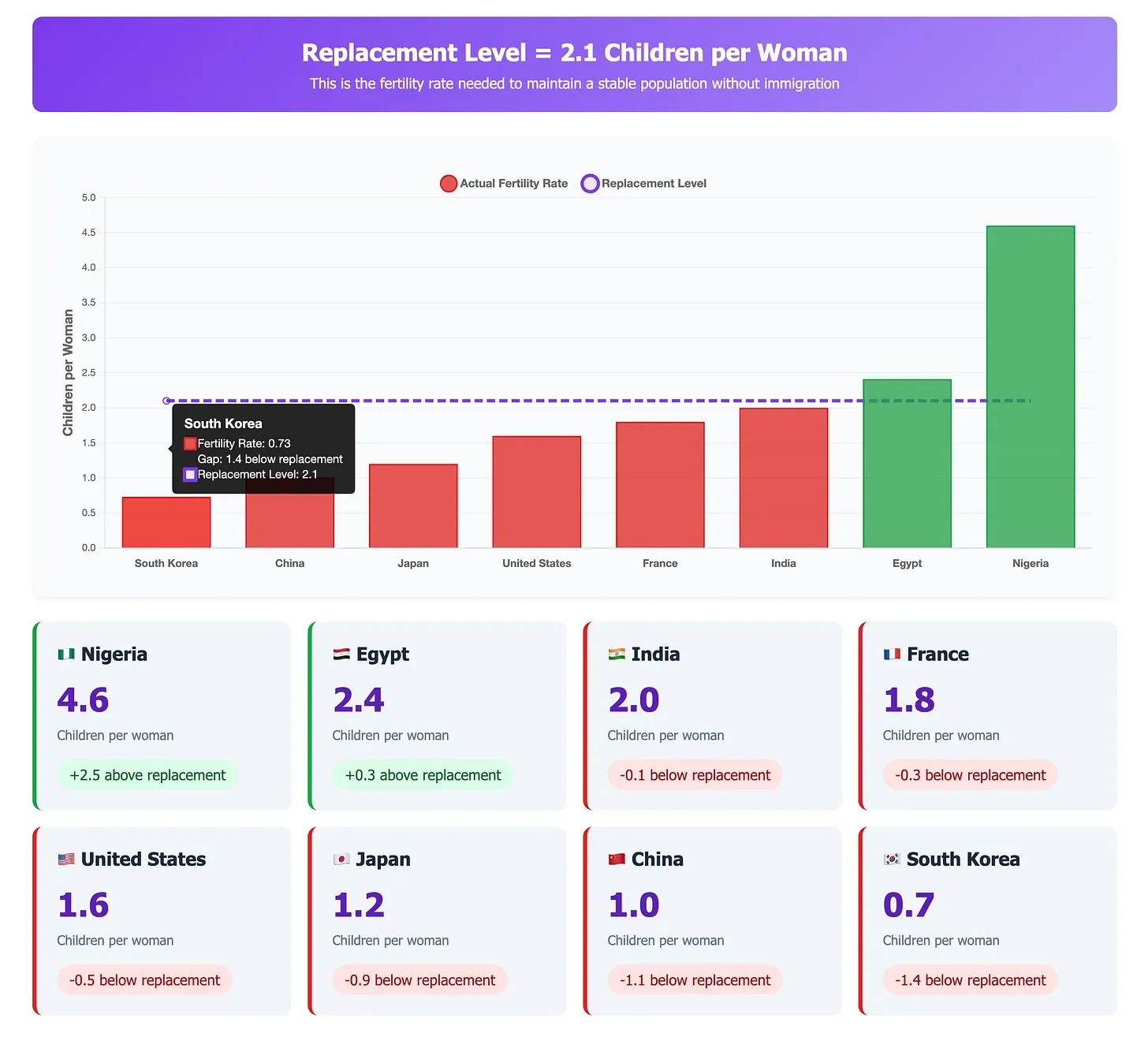
There are many demographic factors impacting the future,but globally the growth of older people and their wealth is one of two major factors. The other one is the impending decline in population in wealthy countries which is depicted below:
Source: Claude from Anthropic
7. Immigration: Everywhere in the world immigration is a critical issue whether it comes to politics, availability of workers, prices of housing and much more. One chart that may provide a sense of the future of immigration is above.
In every advanced economy, population is set to decline. It takes 2.1 children per woman to keep the population the same in any country. Today South Korea, Japan and China are suffering significant population declines and are likely to have half their current populations thirty or so years from now.
All of Europe is well below replacement rate to keep the population the same. The range in Europe spans from a low of 1.1 children per woman in Malta to a high of 1.8 in France. The number for the EU overall is 1.4.
In the US there are 1.6 births per women which is well under the replacement rate and the only reason the population remains stable is because of immigrants and longer lives. The US is now set to becomes an aging and shrinking country without immigration. Today as Japan ages and shrinks it will increasingly need to depend on robotics to replace workers and care givers or be more open to immigrants. France is trying to increase the age for pension eligibility reflecting its aging and declining population combined with a back lash against immigrants. This challenge will accelerate with bio-pharma extending the age of people and the increased rise of nationalist parties.
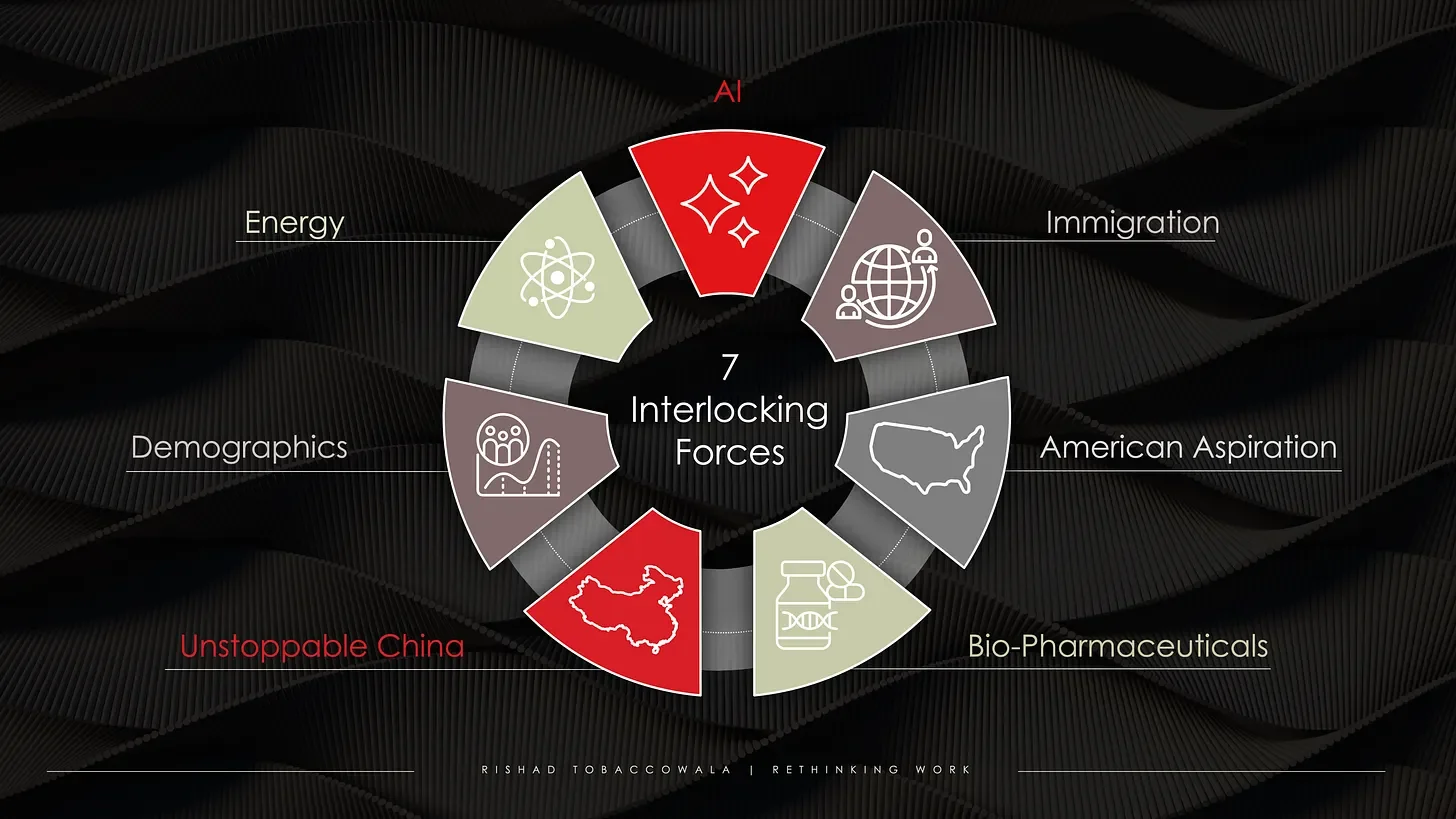
Image by Ben Damiano for The Rethinking Work Platform
Everything is Connected: These 7 forces and their interconnection should be front and center for every company and for every individual developing their future strategy. From politics to affordability to positioning careers to how power ebbs and flows can all be clarified by looking through the prism of these seven forces.
The Auto industry is impacted by American Aspiration in the form of tariffs, by Unstoppable China via reduced sales in China as BYD and other local companies dominate the market and now expand to Asia and Europe, by AI and Energy which changes the basic technology of cars.
Similarly Education is impacted by the personal tutoring made possible by AI, the loss of international students due to a clamp down in Immigration.
“There is a tide in the affairs of men, Which taken at the flood, leads on to fortune. Omitted, all the voyage of their life is bound in shallows and in miseries. On such a full sea are we now afloat. And we must take the current when it serves, or lose our ventures.” William Shakespeare.
The seven interlocking forces are the tides of change.

Talent is the Key in an AI Age.

Image by Midjourney
The most important component of long-term sustainable advantage for any firm –regardless of its size--is its ability to attract, retain, inspire, and grow talent.
Talent is the sustainable advantage.
It is talent and only talent that creates and/or preserves every other form of sustainable advantage whether it be innovation, new ideas or superior service.
If a Brand is experience it is employees who ideate, create, design, and deliver the experience.
If cost management is a key goal, then focusing on a fewer better paid and trained employees working at their full potential with minimum external monitoring, but maximum internal motivation is likely to yield lower costs than hiring the cheapest labor.
AI is a force multiplier and a form of leverage. It is a tool when placed in talented and trained hands can create exponential value compare to it being placed in less talented and trained hands.
Almost every company will end up with the same AI tools. Many will believe their secret sauce will be their first party data but in a world where decisions will be made by Agents and the depth of interaction with a chat interface reveals incredible insights and motivations in real time this may be less true and many companies first party proprietary information while important may not really be a key differentiator.
It will be well trained, highly motivated and well rewarded people.
Companies that focus on technology and technology partnerships alone, will find that without well trained and incentivized people the technology as well as data does little to provide a differentiating advantage. ( A reason a company like Google and many others succeed are that they have tech and data and amazing talent. Note Meta’s recent efforts on acquiring even more talent even after they have scaled data and tech.)
Julie Sweet of Accenture and recent studies from BCG, Mckinsey and others underline the reality that for every dollar of tech spending on AI , companies will have to spend multiples of that in training, upgrading and re-skilling talent to win.
Talent as advocates.
Today every individual is a media company if they wish to be. No longer do we just have access to multiple platforms for distribution but due to AI a plethora of new tools for creation. Potentially the most powerful influencers and media impact a company has is the aggregated power of the storytelling and reach of its talent.
Employee advocates attract other employees and are the best salespeople to convince potential customers.
So maybe instead of focusing on the next technology and media partnership we should focus on our people.
Talent Satisfaction.
In addition to Net Promoter Scores, ESG goals, ROI metrics we should better understand the people who drive the results we are monitoring.
Let us focus on the players rather than the equipment, the field, or the scoreboard.
Instead of monitoring the coming and goings of talent from the office and other forms of surveillance that makes people believe they are animals reporting into and out of cages we should measure employee satisfaction.
There are several ways to evaluate employee satisfaction from observed metrics such as average tenure, turn over, percent of offers accepted, the premium one has to offer to hire a person, to exit interviews, custom surveys, focus groups, town halls, and tracking comments on third party sites and more.
Regardless of how and what one measures what is key is that every manager up to the CEO recognize and be motivated so that a huge portion of their success and compensation is based on how they lead, nurture, and grow people.
Many studies of the best CEO’s show they tend to focus on three key areas which are strategy, capital allocation and people rather than operations, revenue generation, investor relations or customer management.
What Does Talent Want?
Regardless of industry, country or demographic group, research conducted for Restoring the Soul of Business: Staying Human in the Age of Data and then Rethinking Work identified nine components that drive talent.
Three that attract people to a firm. Three that retain people in a firm. Three that allow people to thrive in a firm.
Three reasons people join a firm:
1. Money: People expect to be paid fairly.
2. Fame (Recognition): We all want to be recognized and feted for what we do even if it is to be acknowledged for a well completed project
3. Power (Autonomy): For some people this is authority but increasingly it is autonomy to be able to get a job done in ways and places that fit versus being monitored and micro-managed.
Three reasons people stay in a firm:
While money, fame and power are important in attracting people to a company many will stay with a firm even when offered more money, fame and power elsewhere because of purpose, values and connections.
1. Purpose: Talent cares about the purpose of the company and people ask about the purpose companies serve beyond making a profit.
2. Values: Over time employees stay with companies whose values they find resonate with theirs.
3. Connection: If someone feels connected to their manager, their clients, and their colleagues they are more likely to persevere through the ups and downs of a career.
Three reasons people thrive in a firm.
1. Freedom: Companies that recognize that they work for talent rather than talent works for them and approach talent as something they access versus own ensure that people have the flexibility and freedom to be who they are.
2. Identity: Great leaders and companies recognize that while work and their firm are part of the identity and story of their talent, they are just a part of far more complex and broader lives. Companies that operate with this insight are more likely to get people to feel a sense of belonging since they are seen as people and not replaceable widgets.
3. Growth: A career lasts for four or five decades in a world that is changing fast. Skill sets need to be continuously refreshed and kept relevant. Companies that focus on the future and constantly transform ensuring their growth will always be able to access talent since people care about ensuring they are growing and remaining relevant and will work at firms who allow them to grow skills that are valued outside the firm. By making talent highly attractive to the outside is the way to ensure continued access to them.
Talent plus Technology will allow companies to win and not just technology alone and definitely not threatening talent that they will be replaced by technology.

On Rules and Rulers.

Image by gemini to prompt ‘‘rules and rulers”
We all have people who rule over our work lives and sometimes other part of our lives.
We have internal rulers we measure ourselves and others with.
We research for rules that make a good life.
Three thoughts to consider:
1. Not all rulers are leaders. Many leaders are not rulers.
True leaders tend to exhibit six key behaviors:
a) Competence: They have expertise and capability in their field.
b) Realism: They accept, acknowledge and deal with facts, hard data and the reality of situations.
c) Integrity: They engender trust. They are transparent in their dealings.
d) Empathy: They care about others including institutions and not just themselves.
e) Vulnerability: They acknowledge mistakes and surround themselves with expertise they can lean on or who can speak truth to them.
f) Inspiration: They realize people choose with their hearts and justify what they do with numbers. They move people to see beyond the challenges of today to a better tomorrow.
Leaders may not have titles, employees or zones of control but they are likely to have respect, followers and zones of influence.
Rulers often have leadership qualities but sometimes they do not.
Some come to rule not through the talent and disciplined behaviors of leadership, but primarily though some combination of power brokering, fear mongering, ignorance peddling, or inheritance.
If you strip away the trappings of power, the ability to punish, the pomp and circumstance of an office, an institution or a company from a person, can they continue to influence, motivate and make an impact?
Leaders often worry they are not good enough to the challenges at hand and so we build scaffolding teams around them and constantly work to improve.
Rulers tend to fear that they will lose power and often turn to intimidation to offset and distract from their internal hollowness which are chasms echoing with insecurity.
2. We all have different rulers with which we take measure of ourselves and others.
We all have different measures and definitions of success.
Money. Fame. Power. Family. Creativity. Expertise. Connections. Peace. Charity…
We evaluate ourselves and others according to these different benchmarks.
It is important to understand what drives us and what drives other people.
This allows for different people to find common areas of motivation and therefore co-operation.
Not understanding the internal rulers that we gauge and measure ourselves with, or other peoples’ benchmarks of success often leads to conflict.
As important is how we are to be measured by others.
Steven Levitt of the University of Chicago has stated if you understand someone’s incentives, you can do a pretty good job of predicting their behavior.
Three simple questions one should ask in order to enhance partnerships, relationships, teamwork and understanding of other people.
a) How do you define success?
b) How are you being measured/evaluated?
c) How can I help you succeed?
If you are a parent, you may be able to influence definitions of success. If you are a boss, you may be able to influence measurement and evaluation metrics. Everyone can help everyone else achieve their goals.
In most cases it is really difficult to convince people that their measures might be wrong.
You either align with, come to understand, accept or try to work with them.
Or help them come to some form of self-understanding and realization through stories and emotion. It is unlikely that facts or figures or demeaning and making fun of them will work.
3. Some “rules” for a good life that have stood the test of time and are worth considering:
In the end one realizes that all the advice on health, wealth, career, and life can be distilled down to a few “rules”:
a) Health: Sleep enough. Move more. Ingest in a balanced and moderate way.
b) Money: Spend less than you earn. Reduce expenses so you do not price yourself out of your dreams. Diversify assets. Invest for the long term by buying and holding and leveraging the power of compounding.
c) Career: Find mentors. Celebrate connections. Continuously learn. Be patient keeping in mind that one will have a multi-decade career. Align with technological trends.
d) Life: Understand that life brings with it loss. Be grateful. Be true to your word. Care more.
The challenge then is in the doing.
In the living the imagined life vs imagining what it might be.

On Time.

Bad Weather by Martin Parr
As the year ends we are all poorer in time but ideally richer in learning and experiences.
Some quotes on time to understand what may have happened in the past and help prepare one to best seize the future…
Time is the essential asset.
“The meaning of life is that it stops”. Franz Kafka
“How we spend our days is, of course, how we spend our lives” Anne Dillard.
“Tell me, what is it you plan to do with your one wild and precious life?” Mary Oliver
Time and Careers.
“Persistence isn’t just continuing to try—it’s the runway that gives your talent time to take off.” Shane Parish and Barry Demp
“Short-term results come from intensity. Long-term results come from consistency.” John Maxwell
“ I fill the cracks in the road to success made by forces beyond myself” Viviana Andazola Marquez’s
“If everything you do needs to work on a three-year time horizon, then you’re competing against a lot of people, but if you’re willing to invest on a seven-year time horizon, you’re now competing against a fraction of those people, because very few companies are willing to do that. Just lengthening the time horizon, you can engage in endeavors that you could never otherwise pursue. At Amazon we like things to work in five to seven years. We’re willing to plant seeds, let them grow—and we’re very stubborn. We say we’re stubborn on vision and flexible on details” Jeff Bezos
Time and Aging.
On getting older..
“His face was like a mirror, and it was better not to look” L Annette Blinder
“Only a couple of years had passed in fact. But he looks considerably hammered at by the interval” Anon
“His face was fuller, his center of gravity lower” Anton Chekov
“My guillotine is time” Trevor Moore
Time and Loss.
“Life changes fast. Life changes in the instant. You sit down to dinner and life as you know it ends, A single person is missing for you, and the whole world is empty.” Joan Didion
We will lose everything we love in the end. But why should that matter so much? By definition, we do not live in the end: we live all along the way. The smitten lovers who marvel every day at the miracle of having met each other are right; it is finding that is astonishing. You meet a stranger passing through your town and know within days you will marry her. You lose your job at fifty-five and shock yourself by finding a new calling ten years later. You have a thought and find the words. You face a crisis and find your courage.” Kathryn Schultz
Time and Impermanence.
“We are imperfect mortal beings, aware of that mortality even as we push it away, failed by our very complication, so wired that when we mourn our losses we also mourn, for better or for worse, ourselves. As we were. As we are no longer. As we will one day not be at all” Joan Didion
“All of this is made more precious, not less, by its impermanence. No matter what goes missing, the wallet or the father, the lessons are the same. Disappearance reminds us to notice, transience to cherish, fragility to defend. Loss is a kind of external conscience, urging us to make better use of our finite days. As Whitman knew, our brief crossing is best spent attending to all that we see: honoring what we find noble, denouncing what we cannot abide, recognizing that we are inseparably connected to all of it, including what is not yet upon us, including what is already gone. We are here to keep watch, not to keep.” Kathryn Schultz
Time and Change.
“I felt myself twisted into a new more complex shape.” Derek Raymond.
“No one who lives long enough can be surprised to find their biography has been molded by distant events, by other people’s wills, with little or no participation from our own decisions. Those long processes that end up running into our life — sometimes to give it the shove it needed, sometimes to blow to smithereens our most splendid plans — tend to be hidden like subterranean currents, like tiny shifts of tectonic plates, and when the earthquake finally comes we invoke the words we’ve learned to calm ourselves, accident, fluke and sometimes fate.” Juan Gabriel Vásquez's
“I have walked through many lives,
some of them my own,
And I am not who I was,
though some principle of being
abides.
Though I lack the art
to decipher it,
no doubt the next chapter
in my book of transformations
is already written.
I am not done with my changes.” Stanley Kunitz
On Making the Most of Time.
“The business of life is the acquisition of memories. That is all there is.” Carson from Downton Abbey
“I’m not telling you to make the world better, because I don’t think that progress is necessarily part of the package. I’m just telling you to live in it. Not just to endure it, not just to suffer it, not just to pass through it, but to live in it. To look at it. To try to get the picture. To live recklessly. To take chances. To make your own work and take pride in it. To seize the moment. And if you ask me why you should bother to do that, I could tell you that the grave’s a fine and private place, but none I think do there embrace. Nor do they sing there, or write, or argue, or see the tidal bore on the Amazon, or touch their children. And that’s what there is to do and get it while you can and good luck at it.” Joan Didion
Happy New Year!

Career Architecting.

These days I find myself spending a lot of time providing guidance to seasoned and accomplished leaders across industries and around the world as they grapple with their future. Other times parents ask how their grown children who are early in their careers can ensure success in these tectonic times.
While each conversation is different and customized to the specific person and situation, there is one framework and approach that I believe everyone might find useful regardless of where they are in their career journey.
It is one I have used for decades and it works whether you work in a small company, a large company or for oneself.
It involves five steps.
Step one: The Nine Word Exercise.
To start we must understand who we are and what we are currently good at, or would like to be known for in the future.
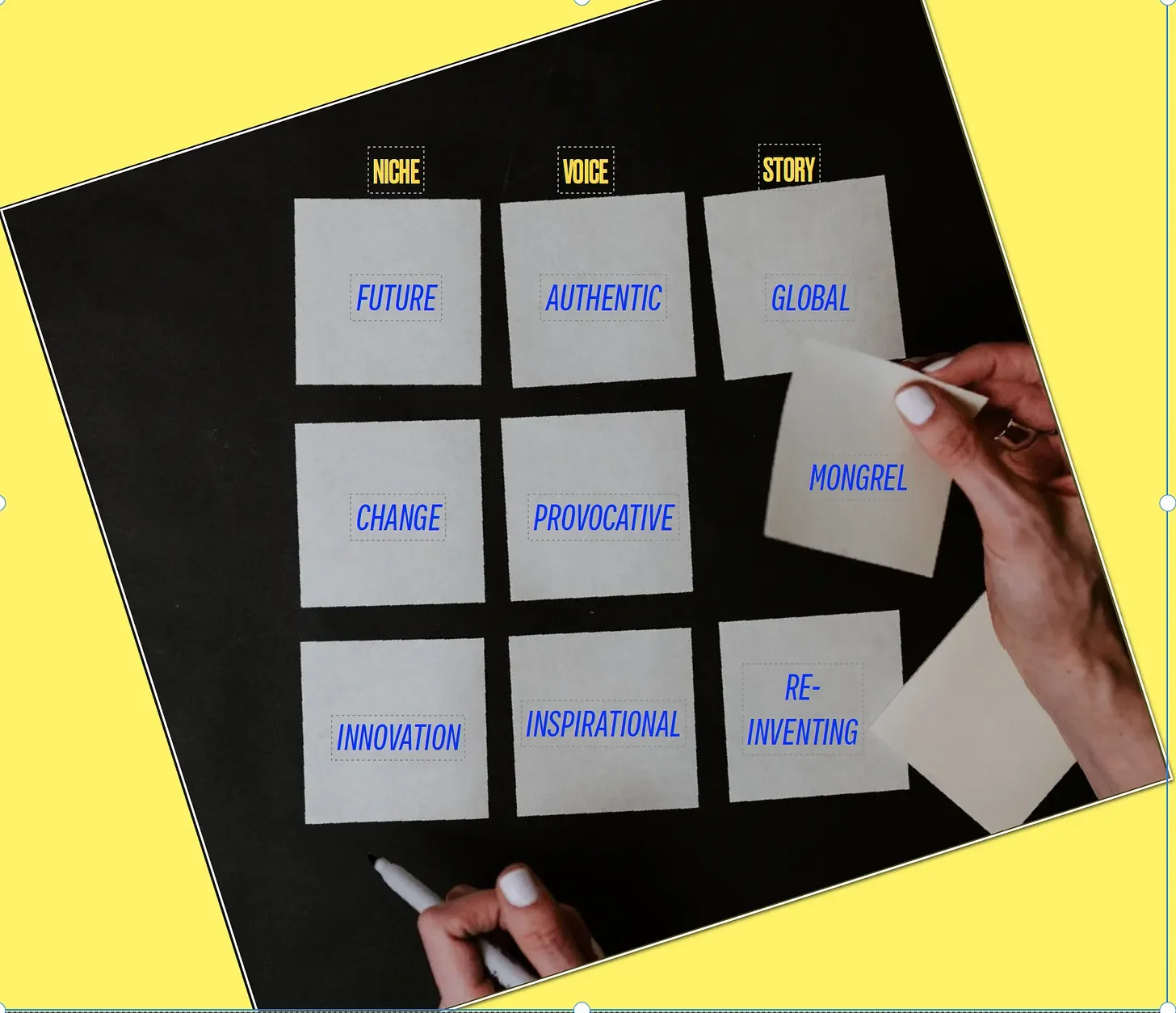
One way to do this is the 9 word exercise.
Do this exercise both by yourself and get people who know you well to share their input.
Niche: Find three words that best describe what you believe you are very good at. In my case the words are future, change and innovation.
Voice: People do not follow skills or titles but they follow people. So who are you and what is your voice? This is something we often need to ask other people for their perspectives because it is hard to hear ones own voice. In my case I have been told my voice is authentic, inspirational and provocative.
Story: Three words that define your story. Why should people believe you? What makes you who you are? In my case I am global, a mongrel ( have done multiple things across a career) and reinventing (starting new firms, pioneering new initiatives, and six and half years ago becoming a Company of One.)
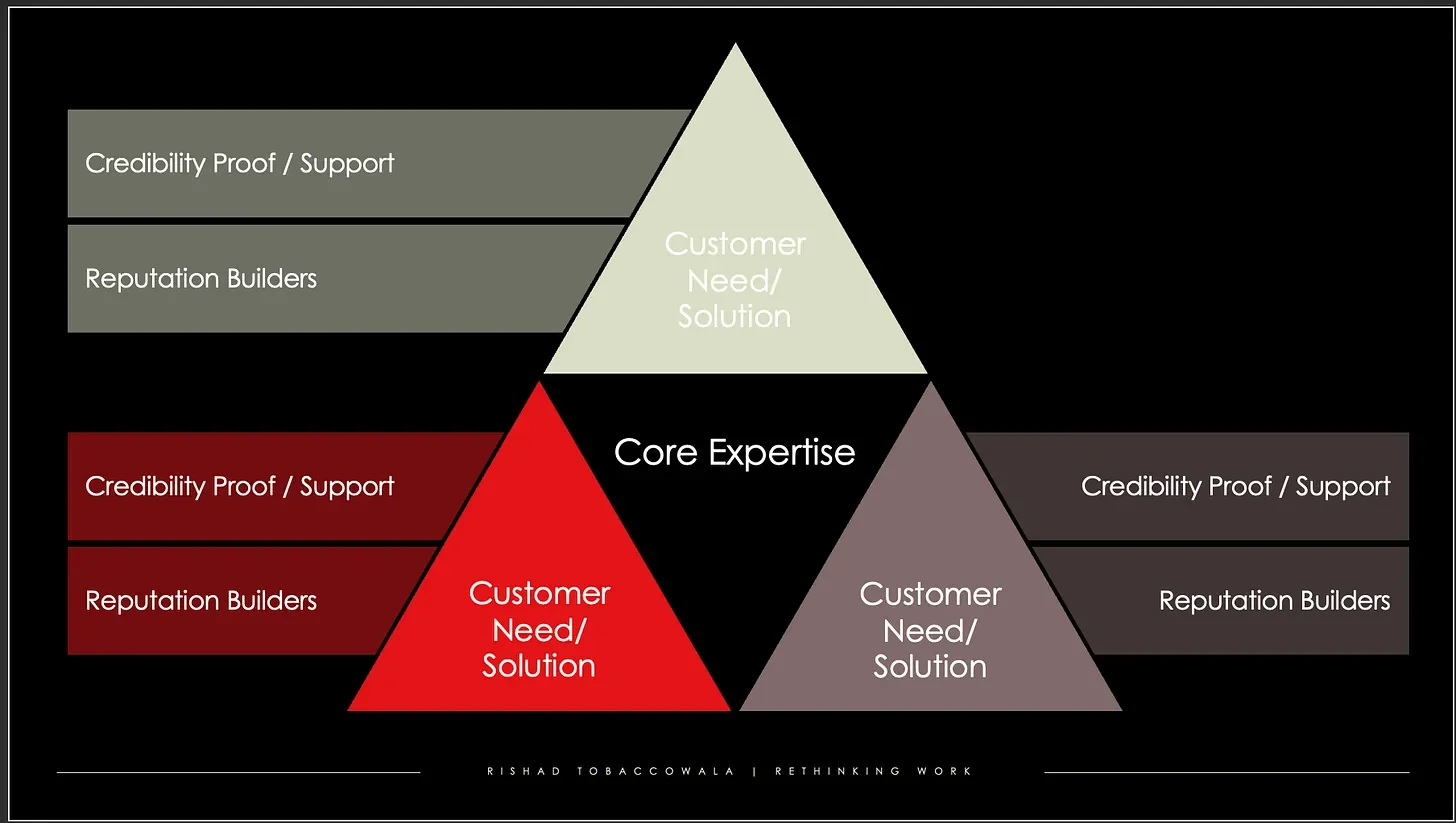
One or a combination of these words will help you unearth your core expertise.
Expertise is what people will look for rather than knowledge or even experience both of whose value is plummeting in an AI Age.
My core expertise : Reinvention
Helping people see, think and feel differently about how to grow themselves, their teams and their business through reinvention.
Try the nine word exercise. For over two decades it has worked for almost everyone who has asked for advice.
Steps two and step three: Reframe Expertise and Develop Credibility/Reputation
Once you have a core expertise it is important to reframe the expertise in ways that specifically address or solve customer needs. Ideally consider 3 ways you can express your expertise to meet market needs.
Once have translated your expertise to delivering on customer needs or providing solutions start listing or finding ways to ensure credibility as well as build a reputation that can attract and prove to buyers that you can solve their issues and challenges.
This model worked when I worked for a 100,000 plus person company and below is how I have successfully applied it to my second career of working as a company of one.
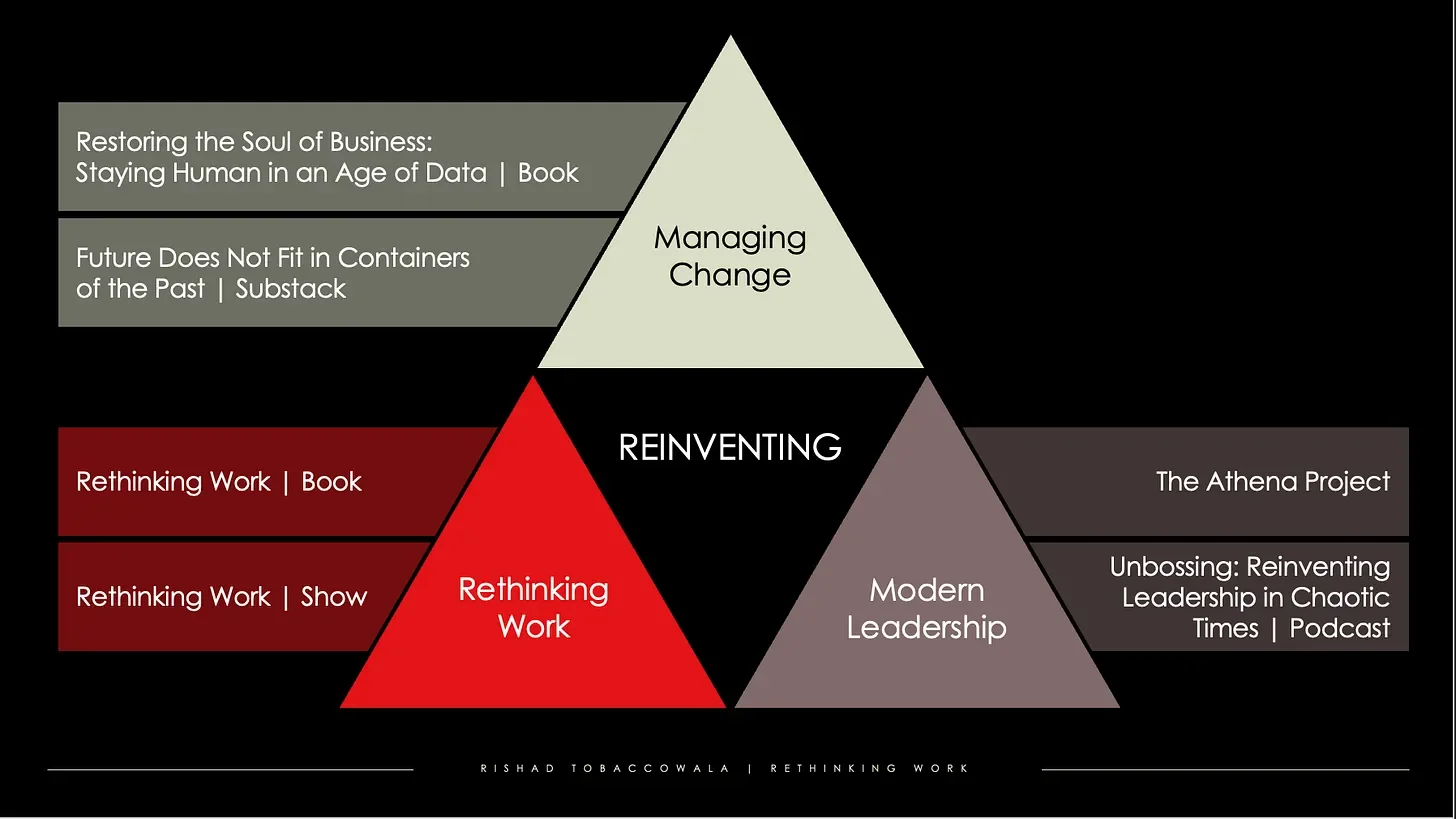
While Reinventing is my core expertise I have reframed it in ways that address specific challenges and opportunities that companies and leaders are grappling with:
a) Managing Change: Companies do not change. People do. How to ensure people change when change is really difficult? Change is much more than strategy, M&A, and re-organization. It includes growing employees future hopes and dreams and not only on growing the company, as well as incentivizing correctly and making significant investments in learning and retraining.
b) Rethinking Work: Companies need to get work done. Yesterday’s models centered primarily on offices, full-time jobs and many types of old scale are all in rapid decline due to a number of seismic shifts including generational ruptures, AI, the rise of gig work and much more. How should a company or a firm look for an AI First/Talent Anywhere Age while preserving quality, culture and competitive advantages?
c) Modern Leadership: Leadership will be key in the future but how does one lead in a world of five types of talent including Agentic Talent, a world where zones of control are being replaced by zones of influence, and where knowledge is free and much of past experience needs to be unlearnt? How does manage a multi-decade career where full time jobs get harder to retain as one grows more seasoned?
Expressing expertise in ways that solve and address a company or a customers problems is a key step but as important is proof and validation that one has the expertise and reputation to do so.
This requires one to constantly learn new skills to maintain credibility and update ones reputation.
In my case I have not rested on the laurels of distinguished multi-decade full time global career but anticipated and reinvented for the future over the past six plus years operating as a company of one to scale and deliver proof through books, substacks, podcasts, shows, and leadership projects (The Athena Project which combine events and community and content).
This ensures that companies and customers a) have constant proof of relevancy of services, b) see continuous iteration and honing of expertise and c) allows for expanding ones networks that provide new learning, perspectives and opportunities.
All of these work in synergy to unleash a flywheel. This way my one to many (content), one to some ( speaking) and one to one( advisory) monetization of my expertise feed off each other just as the skills of helping firms with rethinking work, managing change and/or modern leadership resonate and build of each other.

Step 4: Generous Partnering
A career can be long lasting if one has a vibrant and widespread network.
The best way to build such as network is to be generous.
To aggressively help others. To be there when people need guidance. To do favors. To look beyond the economics and the day to day transaction. To build good will.
This allows one to grow because it attracts people who want to work with you or bring you ideas or give you the opportunity to help them and their firms.
While I might ostensibly operate today as a company of one, any success I have is primarily due to all the people who help me constantly. This includes amazing companies like my multi-decade employer Publicis Groupe with whom I still remain connected, albeit in a small way, or more recent partners such as BCG or University of Chicago or SAP who help build out The Athena Project or teams at HarperCollins who have published and support my writing career, or Private Equity Companies like who place me on their company boards. The list goes on and on.
In a fast moving world its not just APIs ( Application Programming Interface) or MCP’s ( Model Context Protocols) that matter but HHG ( Human to Human Generosity) that makes wonderful things happen.

Step 5: Maximize Revenue Streams while Minimizing Costs.
Today when people find themselves stuck and frozen in place a key reason is financial.
We cannot afford to walk away from our firms given our needs for health care and income. Or we have a cost structure that requires us to cling to a job we do not like.
The solution for these very real problems requires time to find ways to reduce ones cost structure while finding new opportunities or additional ways of making income ( free lancing, side gigs, teaching, getting on boards). The idea is to reduce costs, build a few months of living expenses and some small new ways of income.
This allows one to either take a risk or be prepared for a “right-sizing".
The key is to remember that a career is 50 years long.
If one wants to reboot and reinvent one can do it gradually over 2 to 5 years by 1) identifying a core expertise 2) translating how that expertise can be expressed in ways that deliver solutions to companies 3) building credibility and reputation 4) being generous and 5) finding ways to maximizing revenue streams while minimizing costs.
These five steps will work even if you wish to spend decades at a company as I did. This is because the reasons a company keeps you is for expertise, for solving client problems, for keeping on top of your game and using your reputation to help the firm, and to work generously and collaboratively with everyone while maximizing revenue and minimizing costs.
This approach just makes sure that one has options in a changing world.
It allows you to stay for decades in a career because you have options and it allows one to navigate the shocks of the modern market place where we may need to go before we want to.
Along with relationships and health, meaningful and rewarding work are keys to contentment and growth.
We are not just working at a job which is like working on a a slab of marble but rather we are architecting a cathedral which is our career, our craft and our work.
So let us look up and beyond…
Career Architect!