
Identity Reinvention.

Have you been thinking about reinventing your career?
Are you at a stage of life that you find yourself either climbing the wrong ladder or have found there are no upward rungs available to you? Are are beginning to realize that time is running out as you get older? Or that meaning has drained from your work?
Or you may be thriving and yet the time has come for something else but you do not want to retire or cannot retire. A time where an internal feeling or a voice is speaking truth to you but also leaving you confused and a little scared. You are concerned about if and what and how to move forward?
A majority of people in middle to late career are also grappling with these questions more now than ever before. A combination of tectonic shifts driven by a) work and jobs uncoupling, b) the rise of AI, c) the struggle to manage and lead teams across generations and time zones, d) the need to take care of aging parents or children are leaving many overwhelmed, stressed and directionless.
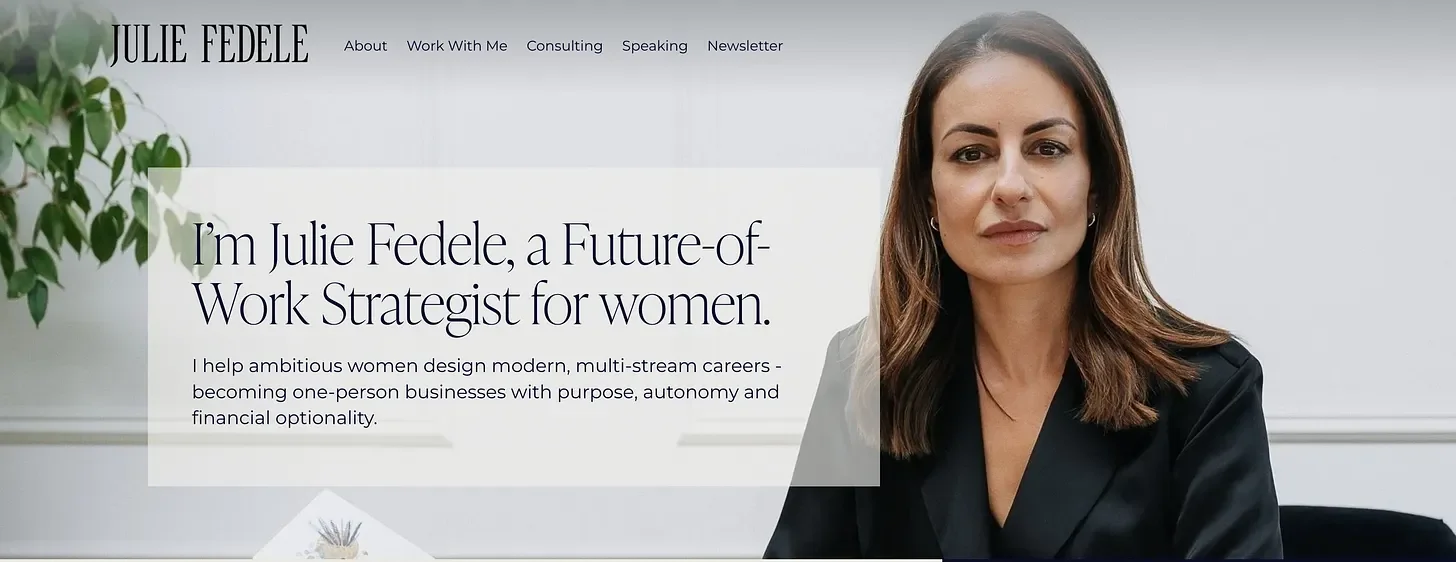
On “ The Rethinking Work Show ”, I had the opportunity to have a discussion with Julie Fedele who after 15 years of being a successful corporate leader reinvented herself. Today Julie has a multi-income stream career including being a work strategist and coach for women. Julie and I had a conversation sharing and comparing learnings and insights on reinventing one’s work identity. You will learn from someone like Julie herself who created a new identity mid-career. You will gain insights and findings she has compiled while guiding her clients. And you will learn from my own experience as someone who began a different second chapter after a very successful multi-decade first chapter. We share both the good and the bad. Take advantage of our experience so that you do not have to scrape your knees when learning to cycle.
After listening to our conversation I am convinced that there are few places where in less than 45 minutes without any cost that you will learn more about the real challenges of career reinvention. We provide practical and realistic advice. We share the nuanced moves one needs to make. Expect to be fired up with actionable inspiration about plotting your future career moves. And because we discuss all the benefits of one’s existing job while giving you the ability to start planning options, we may leave you embracing your current role with greater fervor and clarity versus just muddling along.
I have shared just 10 of many take-aways from our conversation below. And here are the links so you can listen to the entire conversation:
YouTube.
Spotify (also on Apple as The Rethinking Work Show):
10 Takeaways on Identity Reinvention.
1. Climb the right ladder or ask if you wish to climb a ladder at all: In time many of us may discover that we are climbing a ladder that we no longer want to climb. For some of us we realize we do not want to climb any ladder!
2. Few people understand or care about our job titles outside our company or industry: Too often we describe what we do by sharing out title versus what we deliver and what are skills are. The way we present ourselves on LinkedIn may not be the way to present if we want to reinvent. There is a translation problem in that we speak about what we do and what we are expert at, rather than what others want to hear which is how we can help them or solve their issues.
3. It was not us who were important but our budgets and companies: Too many people realize that nobody calls when they no longer have their old title or a budget. Many of our close “friends” were friends of our budgets and companies and not us. Be generous and helpful and stand for something that is separate from a work title. Learn to operate like a company of one even when in a company of thousands by building expertise, reputation and networks that are about yourself versus just the firm. One of the most popular pieces in this Substack is called “ A Company of One” and it is here:
4. Three keys to the new work and identity are a) excavating evidence, b) “light you up” energy and c) market need: We should do an archeological dig in our past to find evidence of our expertise, look for work that “lights us up from inside” versus impressing those outside and focus on addressing a market need.
5. Successful moves require phases and patience: It is critical to realize that moving from one career to another will take time and one needs Plan B’s to address income and health care needs. The best time to plan for next is when one has a job. And if one does not have a job when looking for work it is critical to be realistic about the time it will take and not give up.
6. Change is uncomfortable: Moving from a corporate career to something different and more aligned with what one wants presents challenges beyond money and health care. There are struggles with a lack of identity, an absence of structure with an empty calendar, and a feeling that one is no longer needed. Many people will not believe you are taking a different path and expect you to announce a big new role! Others might speculate about your reasons for moving in not so pleasant ways.
7. Portfolio careers no longer occur only at the end of a career: Very often people who finish a full time job begin a portfolio career of board seats, volunteer work, writing and other activities. These days one can and should think of launching a portfolio career early or mid-career. The key is to create optionality. Today 70 percent of GenZ folks have a side gig or hustle while holding a full time job.
8. Untie versus cut: Increasingly if you are well regarded in your firm you can work with your management to loosen your ties with your company without cutting them. Even if you have to leave completely do so with as much elegance and grace as possible. Where you worked, the people you worked with and the learnings you gleaned will always be a part of you.
9. Companies are starting to look for talent in new ways: As AI and demographic changes of aging population make more and more experienced people work outside of a firm, smart HR teams are focussing on connecting to and leveraging external talent as much as internal talent. In an agentic age the crystalized intelligence, seasoned judgement and new cutting edge AI expertise is likely as available outside a firm as they are inside a firm.
10. It is more up to us than we think: The future does not adapt to us. We have to adapt to the future. We have agency not just agents. Over time people regret “the errors of omission” more than “the errors of commission”.
The chances we did not take.
The choices we did not make.
The changes we did not let happen…
One Single Thing.
It’s not just our careers but also communications, marketing and leadership that are being reinvented! Come and learn from these leaders in Chicago on July 16 and 17 at the Velocity Conference:
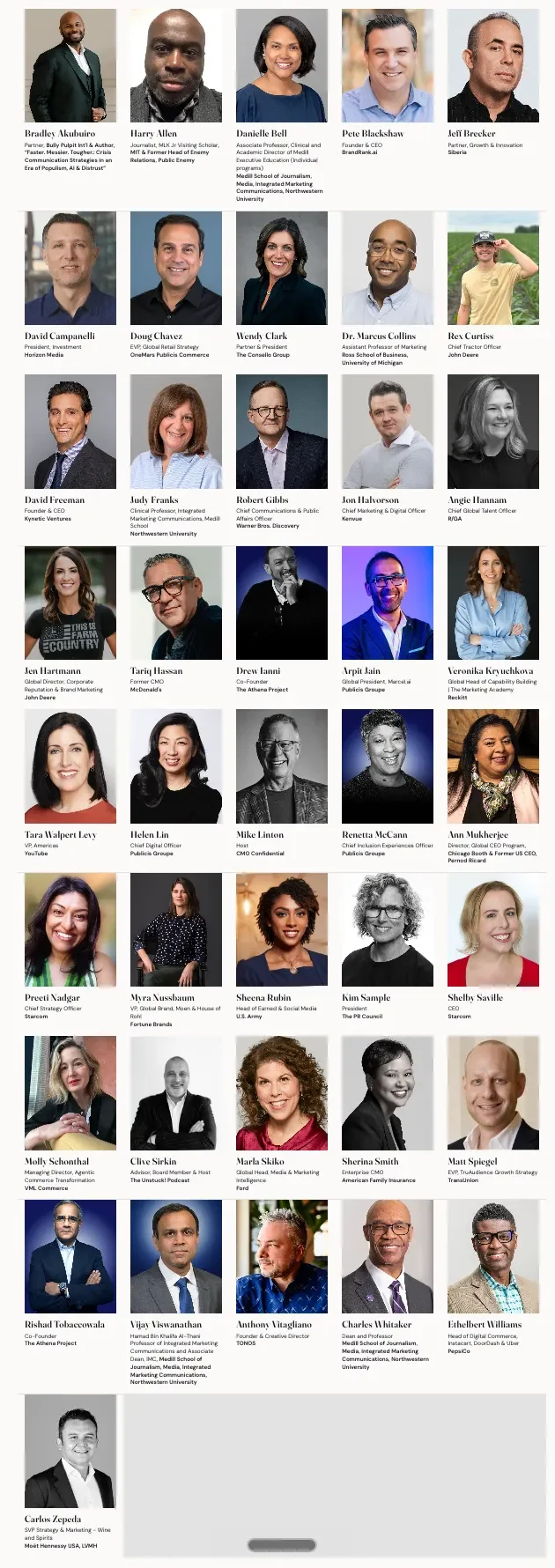
Northwestern’s Medill School of Communications where Integrated Marketing Communications was invented ( in part by the late Professor Don Schultz) and The Athena Project on Modern Leadership ( which Drew Ianni and I co-founded) announce the first annual Velocity Conference where some of the most amazing leaders and pioneers will convene. The annual Don Schultz award will be part of the program and the 2026 honoree is Wendy Clark.
Above are some of the speakers. Tickets are very limited for the conference on July 16 and 17 in downtown Chicago. You can see agenda, request tickets, and much more at https://velocitychicago26.com/

The Coming Organizational Meldtdown.

Image via Midjourney.
The biggest challenge of an AI age will be organizational design.
AI is like hydrochloric acid that burns through all the containers of the past. Different areas and tasks leak into each other while others evaporate away.
Since any change in organizational design impacts roles and responsibilities, spans of power, and compensation, it is likely to be resisted and therefore take time, be deeply emotional and challenge every human in an organization.
Six Provocations.
Earlier this week I shared six provocations with the most senior members of a large multi-national global organization:
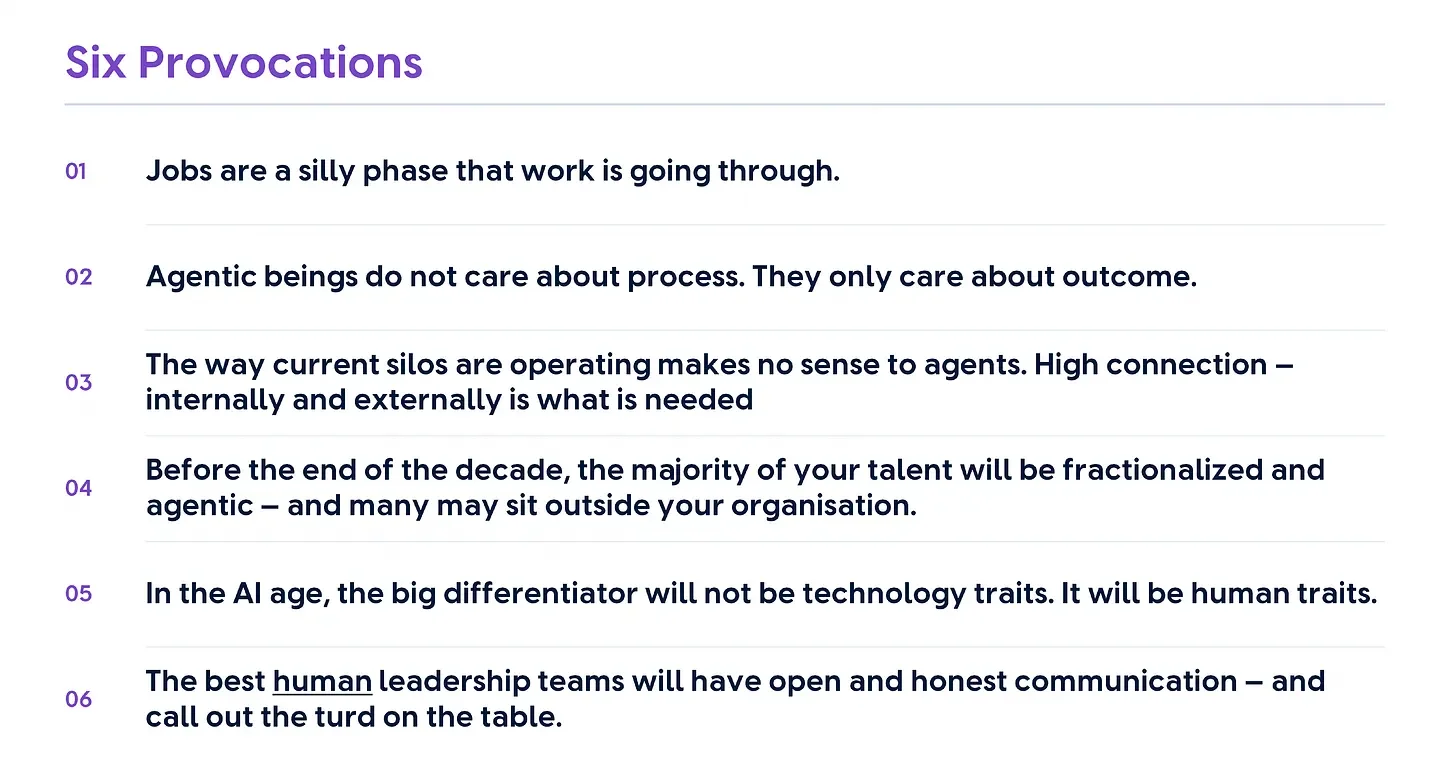
In most countries we are past peak full time jobs. Not necessarily peak jobs or peak work or peak opportunity but full time jobs. Jobs and work are uncoupling. Increasingly companies that are organized around jobs will be organized around work. Work drives the outcome while a job is a container of responsibilities which may no longer be fit for purpose.
Agents get work done and are focused on outcome rather than process. They focus on getting things done rather than how they are done.
Agents do not recognize current silos of an organization including the difference between marketing and sales or above the line and below the line.
Already many companies today have between 10 and 30 percent of their employees as agents. McKinsey has 1 agent for 2 employees on its way to a 1 to 1 ratio. As agents reduce the need for humans to do some of the work companies can re-allocate teams to higher order work but recently they seem to be focussed on reducing their work force with significant downsizing. Increasingly however companies will discover that introducing the concept of fractionalized employees where people work 3 or 4 days a week with pro-rated compensation but full health care ( fractionalized employees) is a better route than laying off 20 percent of people.
Most companies use the same combination of AI tools. AI is like electricity. A competitive edge only if ones competitor uses candlelight. The edge will be in combining AI with HI where HI is not Human Intelligence but Human Innovation, Human Inventiveness, Human Interaction, Human Imagination and Human Iteration.
Too many organizations are not addressing the real turd on the table which is the need to remake the entire organizational design with all the drama involved. Everyone thinks the brown thing in the middle of the table is a brownie with a recipe of efficiency and effectiveness versus the real shit which is the existential drama of reinvention .
Six Implications for Organizational Design.
1. A fusion of IT and HR: As IT spins up agents and the cost of tokens matches or exceeds the cost of human talent some companies will fuse IT and HR as Moderna recently did. More here: https://www.bbc.com/news/articles/cy0w8gvq84xo
2. AI first and HI next: Companies will stop using AI to automate the way they currently do work but begin by utilizing AI to get work done and then add HI to augment, enhance, quality control and feeling to the AI product and solutions.
3. New Metrics including Price Per Intelligence unit: Shelly Palmer recently wrote a great piece on a key measurement for companies called Price Per Intelligence Unit which is a must read: https://shellypalmer.com/2026/06/price-per-intelligence-unit/
4. Talent Diffusion: The return to the office dogma of the past two or three years will be softened ( most companies offer much more flexibility behind the scenes than their draconian announcements suggest) as five types of employees from full-time, free-lance, fractionalized, contract and agentic are combined to get work done. Speed, cost and access to talent in real time will be the competitive advantage versus bottling talent in building.
5. A New Partner Eco-System: Today most companies have vendors and suppliers whose roles and deliverables are organized around the way work was done. But as AI re-architects work including what is done internally and what is done externally most service organizations and partner eco-systems will be rethought. It is not just how charging for hours worked will not longer make sense in many cased but the need to completely re-imagine partnerships.
6. Training and upgrading the new edge: Everyone will need to unlearn and learn regardless of level and title. Organizations that invest in upgrading and refitting their talent will likely see an edge but this will require significant investment in people and development which most companies are not focused enough on.
The real challenge moving forward will be people, power, politics, process, and partnering versus technology moving forward.
One Single Thing.
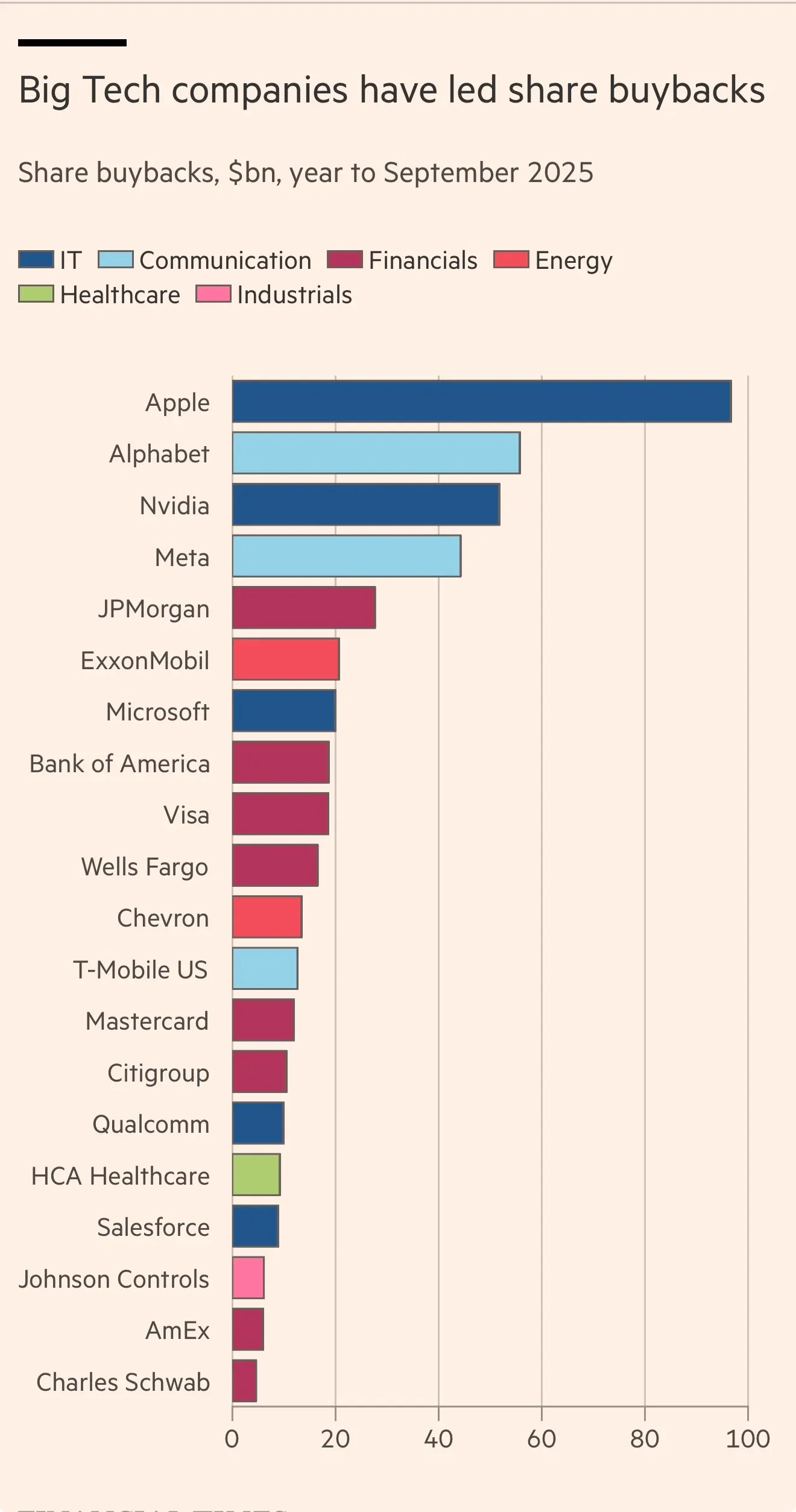
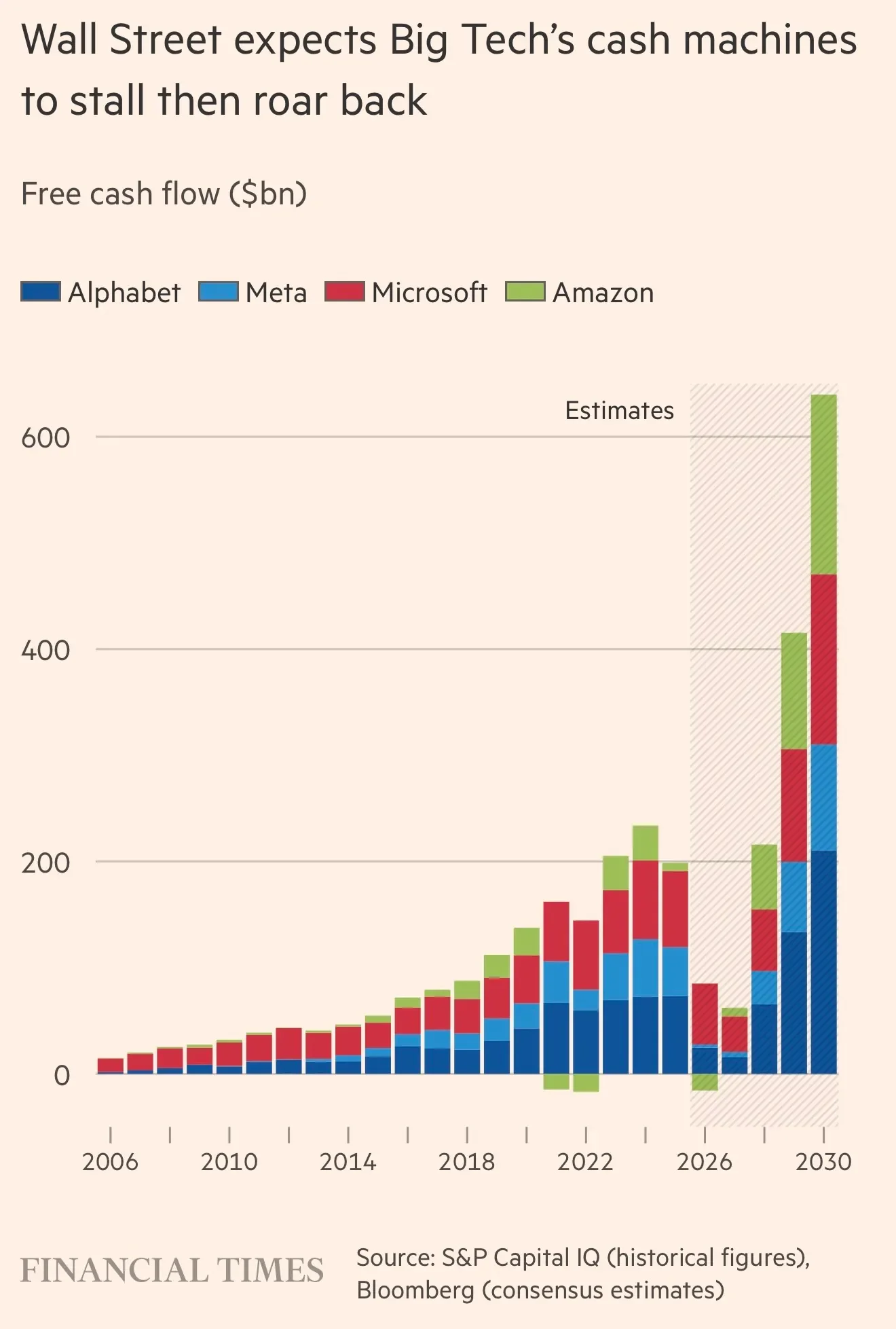
The Financial Times this weekend had an amazing piece which vividly brings to life both the level of spending in AI by leaders such as Alphabet, Amazon, Meta and Microsoft but also how these companies that used to generate massive cash flow and buy back stock that supported their stock and the overall indexes but are now issuing stock and are raising cash.
The article is only available to subscribers but here are two charts from the article which illustrate the changing dynamic:

Stories Endure. Technology Helps.

Shakespeare & Company. Paris, France. November 18, 2016. Photo by Rishad Tobaccowala
Every advance in technology has empowered story tellers.
Fire brought warmth and as our ancestors huddled around the flames they told stories.
Just as we do today when gathered around a fire.
The wheel allowed humans to go on journeys and new people to arrive from elsewhere.
At its core every novel is driven by one or a combination of two factors :
Someone new comes to town or into our lives initiatiating a series of incidents.
Or
A protagonist goes on a journey of exploration. These journeys may be external in search of a person, place or adventure or it might be an internal exploration of self-understanding.
The Printing Press enabled us to access far more stories including the very best ones across time.
Every year I revisit my two favorite books which were written 500 years ago and possibly are the best novel and play of all time: Don Quixote and Hamlet.
The Internet turbocharged story telling by giving more people a voice, reducing barriers to distribution and creating new forms of story telling from blogs to short videos.
And now there is AI which I refer to as Alien Intelligence (credit Mustafa Suleyman of Microsoft).
Will AI write stories for us versus humans writing stories?
Yes.
Will AI write humans out of future stories?
They might.
But the stories that will resonate the most among humans will be stories about us humans interacting with each other and possibly alien intelligence.
Because AI will never perfect the complexity of humans.
AI thinks in outcomes while humans are all about the journey.
AI thinks clearly and cleanly while humans are messy.
We do not answer questions with a “yes” or a “no” but a “maybe”, “it depends”, or we avoid the question all together.
A human is a bundle of complexity and the same person in a different mood is often a different person.
As Walt Whitman wrote:
“Do I contradict myself?
Very well then I contradict myself,
(I am large, I contain multitudes.)"
In addition every human is aware of the finiteness of time which machines cannot feel.
From Louis MacNiece’s “Sunlight on the Garden”
The sunlight on the garden
Hardens and grows cold,
We cannot cage the minute
Within its nets of gold;
Franz Kafka said “ the meaning of life is that it ends”
In fact it is our very messiness and awareness of the passing of time that may ensure our survival.
Humans do not compute.
We choose with our hearts and then use data to justify our choices.
And we live by stories.
Joan Didion wrote “ we tell ourselves stories in order to live”
And even in an agentic world we all have the agency to forge, invent and transform ourselves.
Nothing is written.
If you ever stop believing in the power of stories as the base DNA of being human, all you have to do is look in the mirror.
In the reflection there is a story.
One Single Thing.

A Lake in the Dolomites, Italy. June 6, 2026. Photograph by Rishad Tobaccowala.
The Layers by Stanley Kurtz (opening and closing stanza)
I have walked through many lives,
some of them my own,
and I am not who I was,
though some principle of being
abides, from which I struggle
not to stray.
Though I lack the art
to decipher it,
no doubt the next chapter
in my book of transformations
is already written.
I am not done with my changes.

A Bouquet of Wisdom.

Image by Mid-Journey.
50 years ago Jim McCann founded 1-800-Flowers. Last year he fired himself as a CEO believing a new era needed a new leader and that he had stayed in the role for too long…
On the latest episode of “Unbossing”, Jim shares his learnings from the past five decades with a very future forward perspective that will inspire everyone from a student to a CEO.
Here are a few of the take-aways:
1) Resume is a verb not a noun.
A resume is not a collection of past achievements but a spring board for future growth.
We should not be defined by just what we have done but what we can do. This requires a mindset of child-like curiosity, constant improvement and ongoing investment in relationships.
Our stories are alive and ever changing.
Our focus should always be to become a better person.
2) Relationships and Rituals.
1-800-Flowers decided to align with AOL versus a much bigger (at that time) Prodigy because Jim and his team resonated with Steve Case, Bob Pittman and Ted Leonsis who led AOL .
Jim believes in the importance of investing in relationships.
One approach is to take inventory of our relationships and focus on three categories:
Current strong relationships which we should continue to cultivate.
Lapsed relationships we would like to re-ignite.
New relationships that we would like to initiate.
To build great relationships we should focus on what we bring to others in the relationship versus what we take away.
Another way to strengthen relationships is to understand the power of rituals.
These might include leveraging the calendar to reach out to a new person every day/week or schedule to meet certain friends every few months. There are lots of ways to create rituals including inventing new rituals.
3) Fear of failing can lead to failing companies.
1-800-Flowers experimented with dozens of technologies that failed. But if they had not embraced and tried these technologies, it is unlikely that they would have had the success of being early with 1-800 numbers which allowed for convenience and 24 hour service, or cable television that allowed them to become a national brand or AOL and then the web that enabled new ways to reach and sell to consumers.
4) A key to success over time is to understand the real benefit a business delivers.
1-800-Flowers believes that it is not in the gifting business but in the connection business. The company helps people express themselves and connect to those who are important to them.
Every decision including those pertaining to technology are filtered through this lens. Thus one of the ways the company is looking at AI is how to leverage it to enable people to express themselves in uniquely personal ways.
Technology allows a company to deliver its goal. The goal is not to deliver the technology.
5) AI will require “unlearning”.
Jim believes AI is the sixth big change in how brands and business get built and he has been a pioneer in each of the first five: Franchising, 1-800 numbers, Cable, Online services like AOL and finally the Internet.
Each time there is a technology shift there is both opportunity and threat for existing businesses and brands.
Jim says almost every thing have we believe about business may have to be unlearned in the AI Age.
These include:
a) Lack of speed will kill: Slow and steady will lose the race and speed is critical. Jim shared that one of his biggest mistakes was moving too slow.
b) Scale is likely to matter much less in most categories and could be a disadvantage: Jim believes that many of the scale advantages of his own company might be used against it because AI is eliminating many of the moats of scale leaving many big companies with the disadvantages of complexity and sluggish movement that comes with size.
c) Almost all future competitors may come from outside the existing ones being monitored: Increasingly new companies hire some of the best talent from existing players in a category and give them a blank sheet of paper and capital but none of the tech, organizational or mindset debt of their former places of work. They change the rules of the game.
Every leader should assume that everything they believe is open to questioning except the importance of attracting and retaining talent, investing in trust/trusted relationships and creating truly differentiated personalized solutions.
An incredible conversation and distilled wisdom in 45 minutes wherever you listen to podcasts.
One Single Thing.
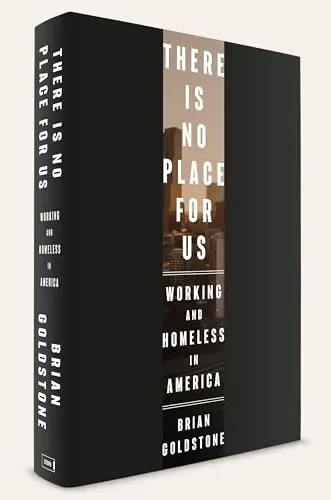
“There is no place for us” is one of the best books I have read. It is about those who work full time but are homeless.
It recently won the 2026 Pulitzer Prize for Non-Fiction.
Fact filled, deeply researched and grippingly written “There is no place for us” may change the readers perspectives on a range of issues.
Here are some selected lines from the introduction:
Today there isn’t a single state, metropolitan area, or county in the United States where a full-time worker earning the local minimum wage can afford a two-bedroom apartment.
Some 53 million Americans, or almost half the country’s workers between the ages of eighteen and sixty-four, hold jobs that pay a median hourly wage of $10.22, which amounts to a mere $21,000 a year-below the poverty line for a family of three.
It used to be that owning a home was held up as an ultimate goal, a reward for diligent effort and perseverance. Now simply having a home is elusive for many. The myth that hard work will lead to stability has been shattered, revealing a stark disconnect between the story America tells about itself and the deepening precarity.
This is a book about what we are not seeing…
Making Meetings Suck Less.
Image by Pixelbala via MidJourney
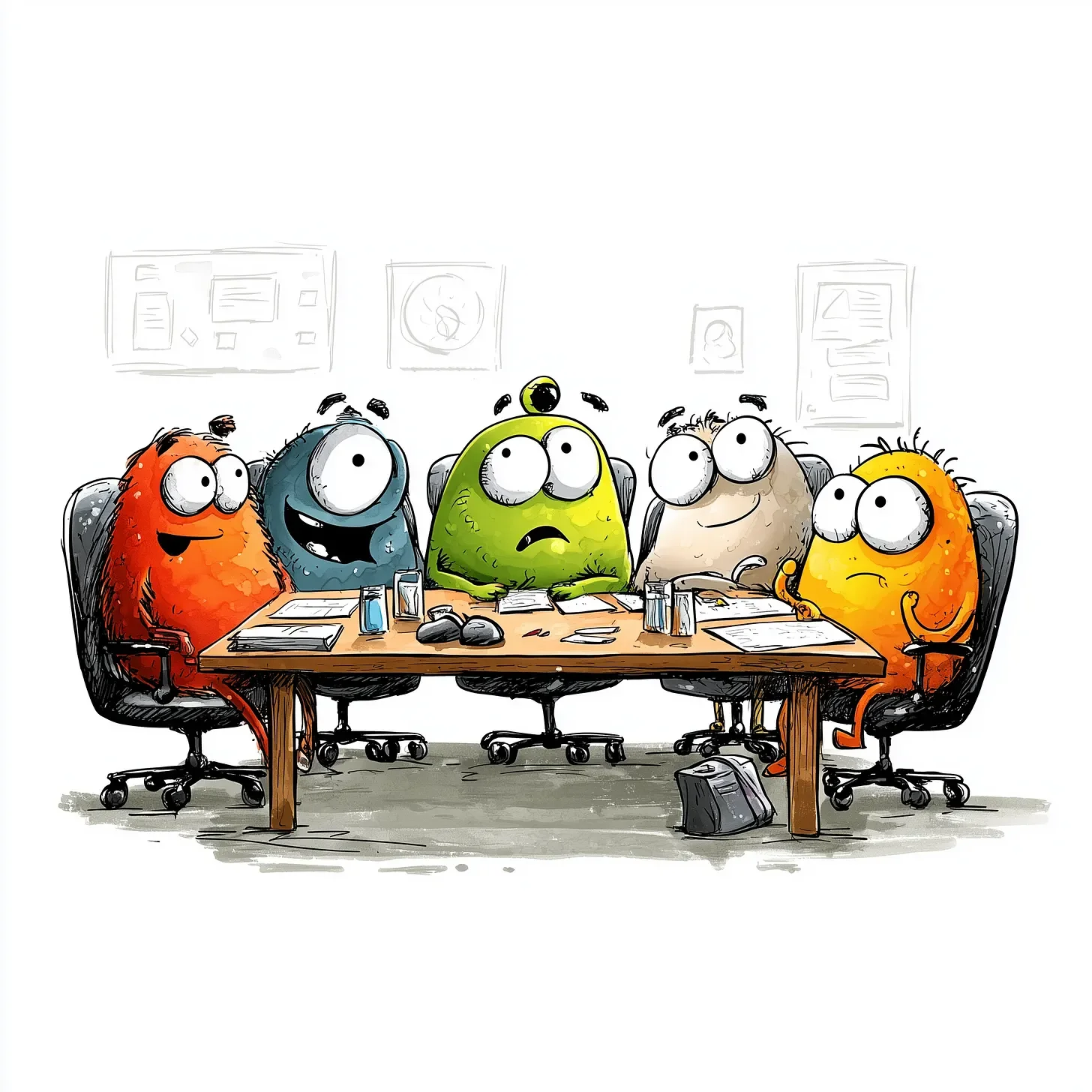
A majority of the time at work is spent in meetings.
Many are a waste of time.
In a recent episode of What Next?Rebecca Hinds discusses her book “ Your Best Meeting Ever”
We discussed when one should schedule a meeting, how best to run meetings and why AI is likely to create even more useless meetings.
1. Meetings are a result of “visibility bias”
In many companies (and this thinking animates the “return to the office” crusade of many mangers) what is visible is valuable.
Meetings become a status symbol that telegraphs that one is productive and important.
The knee jerk reaction of many of is to convene a meeting.
Often meeting are about “showing” productivity versus moving ahead.
2. Most of us are struggling with meeting debt.
Meetings are the most expensive form of collaboration sucking large swaths of time as they ooze in every direction of our calendars.
Like old legacy tech debt, many of us have to grapple with meeting debt.
Meetings that were put on the calendar and still occur long after they have outlived their utility.
We feel guilty to remove or eliminate these and so like barnacles they grow on the hull of the business.
3. “Meeting doomsday “is a key way of calendar cleansing.
“Meeting doomsday” is an exercise where individuals eliminate all meetings on their calendar and start with a blank sheet of paper.
Tobi Lutke at Shopify once asked his IT department to remove all meetings with more than two attendees across everyone’s calendars. Over the next year productivity increased by 25 percent.
4. Meeting Minimalism.
When meetings are added back to a calendar the key is to practice meeting minimalism :
Length: Can less time be scheduled?
Cadence: Can they occur less often?
Attendees: Does everyone who is invited really need to be there?
Agenda: Fewer items make for more productive time.
5. Meetings should only be scheduled if they pass through a 4D and a COE Lense.
Most meetings should really be an email, a memo or some form of asynchronous communication rather than gathering people into a real or virtual room .
4D: A meeting may be needed if one or more of the four interactions are called for:
Debate: There is significant disagreeement and one needs to debate alternatives.
Decide: A decision has to be finalized.
Discuss: A discussion of different perspectives is called for.
Develop: Feedback or other conversation to develop a person or an idea.
COE: Meetings may also be necessary in the following situations:
Complexity: When there is a great deal of ambiguity.
One-Way: The decision cannot easily be reversed or rescinded.
Emotion: The discussion or decision is likely to be emotional.
6. AI is likely to bring new levels of dysfunction.
Here are examples of absolute batty BS that is leaking into meetings:
Lots of “note taking” apps but few people: We have all attended meetings where note takers outnumber people. In addition to being disrespectful to the people who show up does the preponderance of notetakers imply that the entire meeting could have been a document?
Avatars instead of Humans: Even some CEO’s are sending their AI digital twins to answer questions. Imagine if the code hallucinates. We now have a “corrupt” CEO!
Flashy decks filled with foolish drivel: Now that AI can create awesome looking decks it is harder and harder to ascertain fact from fiction, or well thought out work from machine processed points.
Rebecca shares ways to overcome this AI tsunami and more.
Listen to the entire conversation to make your meetings suck less .
Available on all podcast platforms.
Spotify below:
One Single Thing.
Last month one of the greatest Indian photographers, Raghu Rai, died.
This is the beginning of his obituary from The Economist which contains many of his photos:
“It was hard to walk down a street with Raghu Rai. One friend estimated that, in a ten-minute trot to tea, he had stopped at least 100 times. He had seen what others did not see. A shadow on a wall that dramatized a woman passing, and the way her sari fell. Three sleeping dogs composing the centre of a terrace. Two commuters at a railway station standing stock still, reading their newspapers, while the crowd surged past them. Two old men walking in opposite directions, one a well-suited businessman, the other a bent, ragged beggar. This was seeing that did not miss an inch of space; seeing, or darshan, that recognized the connection between all things. Through his camera he met his god.”

A photo taken at Church Gate Station Bombay (Mumbai)