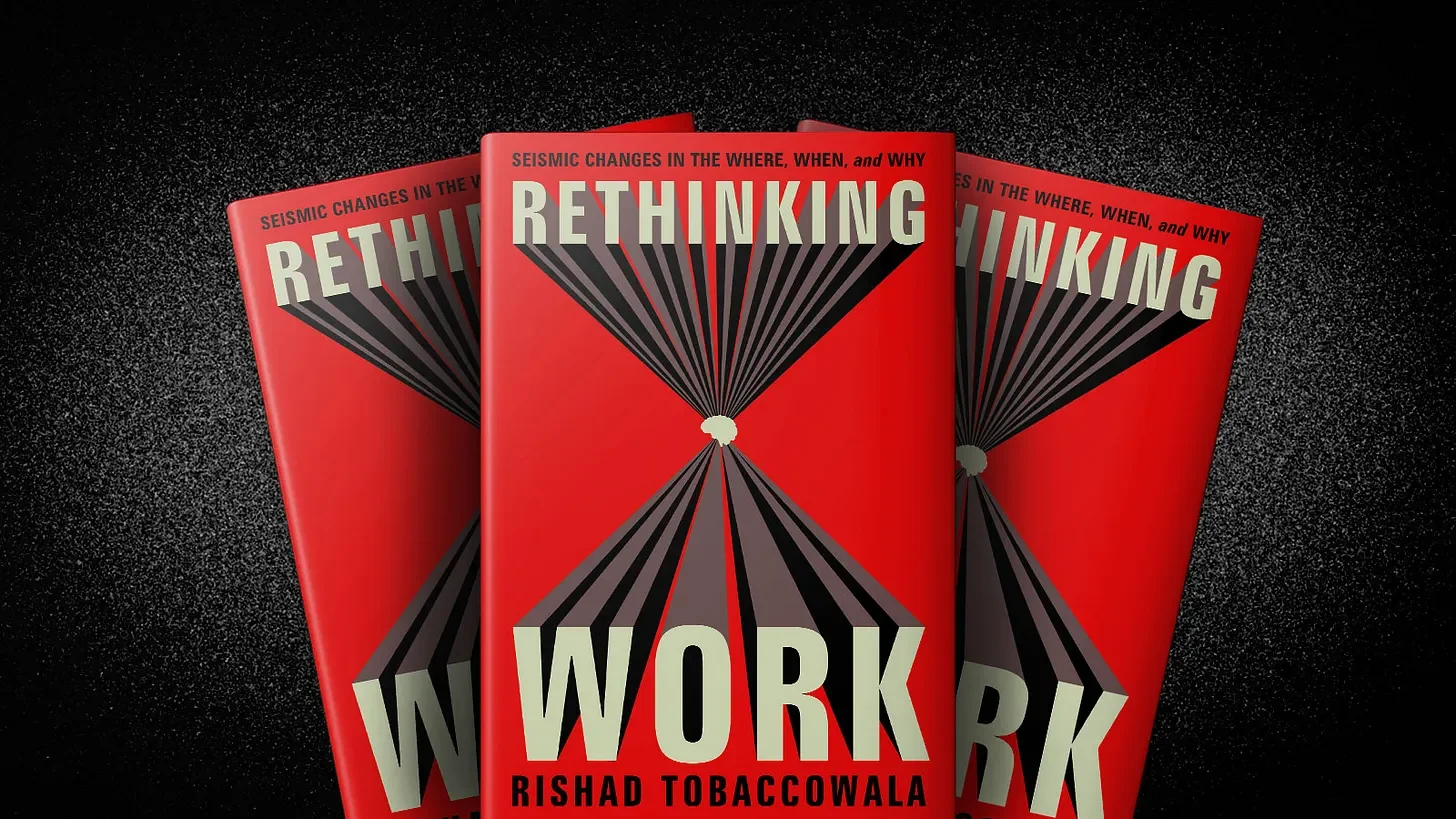
Rethinking Work: A Reintroduction.
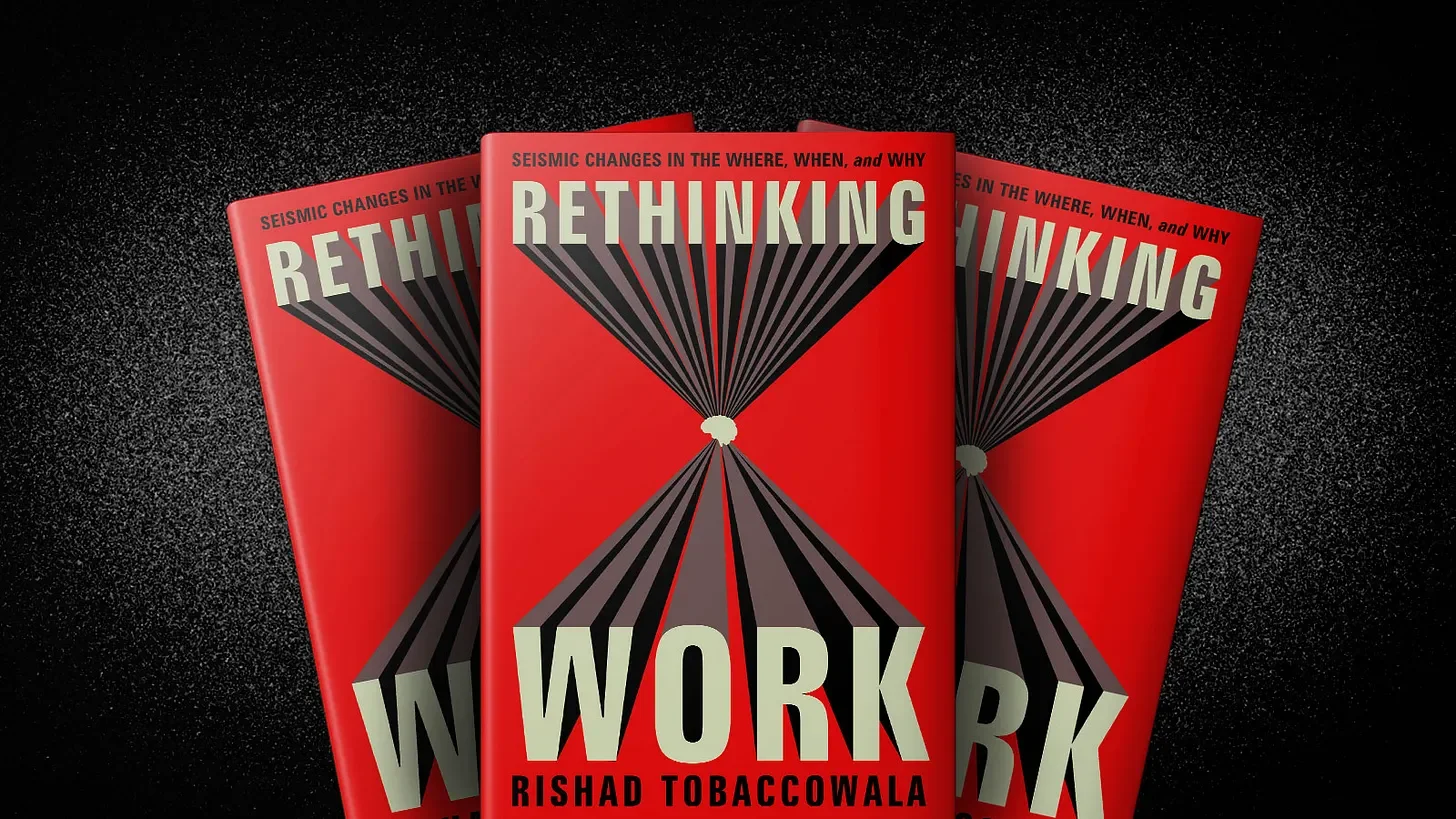
Over 3 years ago, as my agent was shopping the manuscript of “Rethinking Work” he first approached HarperCollins who had published my first very successful book, Restoring the Soul of Business: Staying Human in an Age of Data, because they had the first right of refusal on my next book.
Despite the financial success of the first book and even though though the acquiring editor wanted to offer an advance, HarperCollins passed. The acquiring editor explained that the new Publisher ( my original publisher had left for academia) believed I was not writing a book of business but a book of science fiction!
She wondered why I was making a big deal about AI ( this was just before ChatGPT), and questioned my belief that work would change more between 2020 and 2029 than in the next fifty years requiring completely new ways of working, an era of “de-bossification” and dramatically different organizational structures.
A week later McGraw-Hill bought the book and paid an advance.
A few months into writing the book a major strategic change at McGraw-Hill led them to decide to focus only on text and educational books and withdraw from business book publishing. They gave back the book rights and let me keep the advance.
Within 48 hours HarperCollins purchased it.
The launch of ChatGPT and the departure of the sceptical publisher allowed my acquiring editor to buy the book as he had always wanted to.
Rethinking Work has proven to be both prescient and highly actionable.
Every single thing predicted has happened or is about to happen.
A few months ago Fidelity Investments had many of their leaders read the book and then had me participate in a work session with them. One of the questions I was asked was given the year since the book had been published what I may have got wrong.
The speed of change. The future of work is even faster than anticipated and the last section of the book which I believed would happen by 2029 will happen in 2027.
As a result this book is probably more relevant now than when it was published and so I am sharing most of the Introduction ( which was written 2 years ago) for those who want a cliff-notes version.
A. Five Interlocking Forces Sculpting the Future of Work.
FORCE ONE—Generational Shifts: For the first time, four and possibly five generations will work in the same firms. The youngest employees in their twenties are Gen Zers, and they are about to become the largest component of the workforce. The eldest employees are baby boomers, the youngest of whom are turning sixty, and they have dominated the workplace in numbers, income, and impact until now. In between are millennials and Gen X. The mindsets, expectations, and worldviews of each group are significantly different. In addition to the rise of Gen Z, we are seeing a rapid aging of the workforce and declining population growth.
FORCE TWO—Technology: We are entering an AI-infused age when the cost of knowledge may soon be zero. More than half of the workforce in high-income countries are knowledge workers. Imagine the implications when this new AI reality become prevalent. Every job will be changed. How many will be lost and what new careers will be forged?
FORCE THREE—Marketplaces: Today hundreds of market-places such as Upwork allow talent to be procured from anywhere. Etsy and Shopify allow individuals to access customers from everywhere. App stores and cloud services from Apple, Amazon, Google, Microsoft, and OpenAI allow small and medium firms to access billion-dollar tech.
FORCE FOUR—New Ways of Working: Demographics, technology, and marketplaces are now enabling vastly different ways of working, which is giving rise to a world of side hustles and side gigs.
FORCE FIVE—The Long-Term Impact of COVID: COVID is just one of the five factors creating seismic change at work, and its biggest impact may not be on where people work but on the emotional rewiring it caused when, during the pandemic’s nearly three years, people reconsidered the role of work in their lives.
Consider a few statistics:
By 2027, 86.5 million people, or half the workforce, will be doing some freelance work.
In 2022, more than one-third of US workers and two-thirds of those under age thirty juggled different “gigs” (rather than work full time at one job). The “fractionalized” employee (my term) is becoming a reality.
According to research conducted by the McKinsey consulting firm, 80 percent of people who worked at home during COVID liked it, and 41 percent asserted they were more productive than they were working from the office. Fifty-nine percent of respondents (in a study conducted by Owl Labs) said they would be more likely to choose an employer that offered remote work over companies that didn’t.
But the need to rethink work goes beyond even these statistics about remote work and the shift from full-time to part-time and gig jobs. For instance, people used to work primarily for income and achievement. While these factors are still important, we’re seeing a growing number of people choosing jobs based on meaning (the work is fulfilling, satisfying them on a deeper level), community (connection with like-minded people), and social purpose. Millennials and Gen Zers, especially, are searching for work experiences that fit their personal beliefs and styles
The Who, What, Why, Where, When and How of Rethinking Work.
WHO WILL PEOPLE WORK FOR? Until recently, most people worked for someone else for a relatively long period of time—a large corporation, the government, an educational institution, and so on. But communication technology advances, new business models.and marketplaces, and changing generational mindsets are transferring power to the individual. This transfer gives people work options, and they’re exercising them in all sorts of ways. For instance, a growing number of individuals are choosing to work for themselves. Zoom, Slack, and other platforms facilitate work processes; Etsy, Shopify, and Substack help users leverage their capabilities and scale themselves and their ideas to growing markets. Others are opting for greater control over whom they work for. Digital natives have lived through 9/11, the Great Recession, and. COVID, and their attitudes have changed—they believe much more in themselves than in organizations. As a result, people are rejecting the old model of working for one organization for a decade or longer. Instead, they’re choosing to be gig workers, to create start-ups, to become fractionalized employees, to dedicate themselves to and work for a cause. To mix and match employers. Just as employees have numerous options, so too do organizations. This book will help leaders capture talent by structuring jobs in ways that appeal to this new work sensibility.
WHAT WILL ORGANIZATIONS LOOK LIKE? Like nothing in the past. We will no longer have a single organizational model or design but instead have a wide range of operating styles, structures, and sizes. In the past, organizational models were like classical music, with a conductor, orchestra, and well-rehearsed score. In the future, they will be like jazz, involving different players who take the music in surprising, unpredictable directions. Companies will be fluid, forming and reforming themselves to fit the market and emerging needs. They’ll mix full-time and part-time workers, in-office and remote employees, teams and individual performers; they’ll shift alliances continuously, collaborating with a range of suppliers, consultants, and others as need dictates.
WHY WILL PEOPLE WORK? People have always worked for a variety of reasons—income, identity, community, social purpose, and personal meaning. As noted earlier, COVID and shifting social norms are causing more people to choose jobs and careers based on factors other than income. Empowering technologies also make it easier for people to pursue meaningful work. But another trend has a profound effect on why. In the past, one full-time job rarely satisfied all our reasons for working. The law firm partner was well paid but found little personal satisfaction in his job. Or the social worker found satisfaction in helping others, but she was micromanaged, hampering her personal work style. Today, however, we’re seeing a shift to people satisfying all or most of their whys by having more than one job—two-thirds of those under age thirty are combining different gigs. A mix of roles—side hustles, volunteer positions, and so on—is much better able to satisfy all our work requirements than a single job can.
WHERE WILL PEOPLE WORK? In the metaverse. At home. In morphing offices that will bear little resemblance to traditional places of business. In planes. And perhaps in the not-so-distant future, in self-driving cars. According to a Stanford University study, “Compared to 2019 levels, employees’ average distance from their home to their employer has risen 2.7 times: The mean distance to work rose from ten miles in 2019 to twenty-seven miles at the end of 2023. The share of workers living more than fifty miles from their employer rose more than five-fold.” COVID certainly has powered this trend, but so too has our entering the Third Age of the Internet—AI, 5G, the metaverse, blockchain, cryptocurrency, and other developments are reshaping industries and companies. US companies have formed alliances with organizations in India, China, Brazil, Russia, Vietnam, and elsewhere; people work virtually and sometimes physically far from home, and they will do even more of this in the future. It’s not just that people are working remotely. It’s that they are working on teams with members from seven different countries, and that their customers and suppliers are located on different continents. In the future, being a global company isn’t just a description of office locations but of a mindset—we are becoming workers of the world. To answer this “where” question, I’ll offer advice about how to maximize flexible workspaces, creating policies and cultures that cater to locational agility.
WHEN WILL PEOPLE WORK? Whenever. The nine-to-five day has long since passed. Until recently, work was confined to certain days and hours because of rigid structures—we all needed to work together in the same place for efficiency, for people to be managed properly. Now we require temporal flexibility for many reasons. Most obviously, if we’re doing business with people on the other side of the world, the time zones are different. Less obviously, efficiency is less important than innovation, disruption, and agility. These qualities are less likely to emerge if we confine our work to rigid schedules. Great ideas surface in the middle of the night, when we’re exercising, when we become inspired by a piece of music at the symphony. We need to feel empowered to call, text, or email our colleagues to obtain their feedback and ideas at this moment of inspiration. This doesn’t mean that we become 24/7 workaholics. Instead, our work hours become fluid, dictated by work projects, time frames, and our own preferences—we might need to take time off to recharge in the middle of the traditional workday, and we might need to meet virtually with colleagues at midnight.
HOW WILL LEADERSHIP CHANGE? We are witnessing the decline of the manager and the rise of a new type of leader. In the past, the managerial role was essential to efficient organizational operation—they managed by walking around and checking in on their people. In an increasingly distributed world where people often work virtually, you can’t manage by walking around. Younger generations, especially, hate being monitored. While employees used to rely on managers for news and expertise, they can now use YouTube, Khan Academy, Open AI, and other online tools to learn what they need to know. Managers, therefore, are becoming anachronisms, while a new type of leader is becoming crucial for organizational success. This type of leader displays three traits: a growth mindset (growing people and businesses, macro-imagining possibilities rather than micromanaging employees); improvisation skills (the agility to pivot on a dime); and a thirst for learning (in a world of rapid change, continuous learning is the only way to survive).
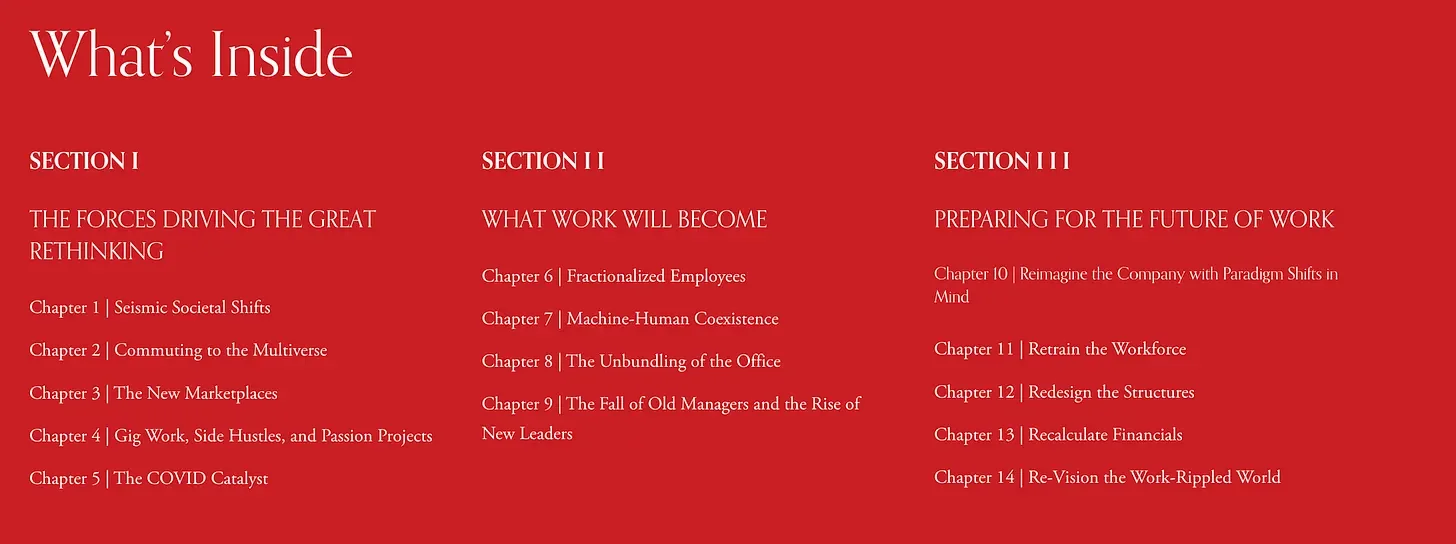
This book is divided into three sections. The first section examines why we need to rethink work—the factors that are causing traditional structures and styles to be ineffective. The second section analyzes the ways in which work needs to be rethought. The third section addresses what we can do about it—the steps that organizations can take to change themselves so they’ll be prepared for the Great Rethinking.
This book is for everybody who works, whether you are a longtime senior leader or a brand-new employee, whether you work in a large company or for yourself, and whether you work in a developed or developing market.
Work is central to our lives and as it gets redefined, nothing is as important as being informed and provided with tools to thrive in the coming transformation.
The book is available in physical, digital and audio formats in the US, parts of Europe and India. Will be published in October in Brazil. Many options to buy across formats and from big to independent stores here.
Any chapter can be read in any order:
One Single Thing.
On one of the two main stages at SXSW (South by SouthWest) an editor of Fortune Magazine interviewed me on how one can navigate the future of work. Listen to the first five minutes and you will never thing about work, your company or your job the same way ever again:
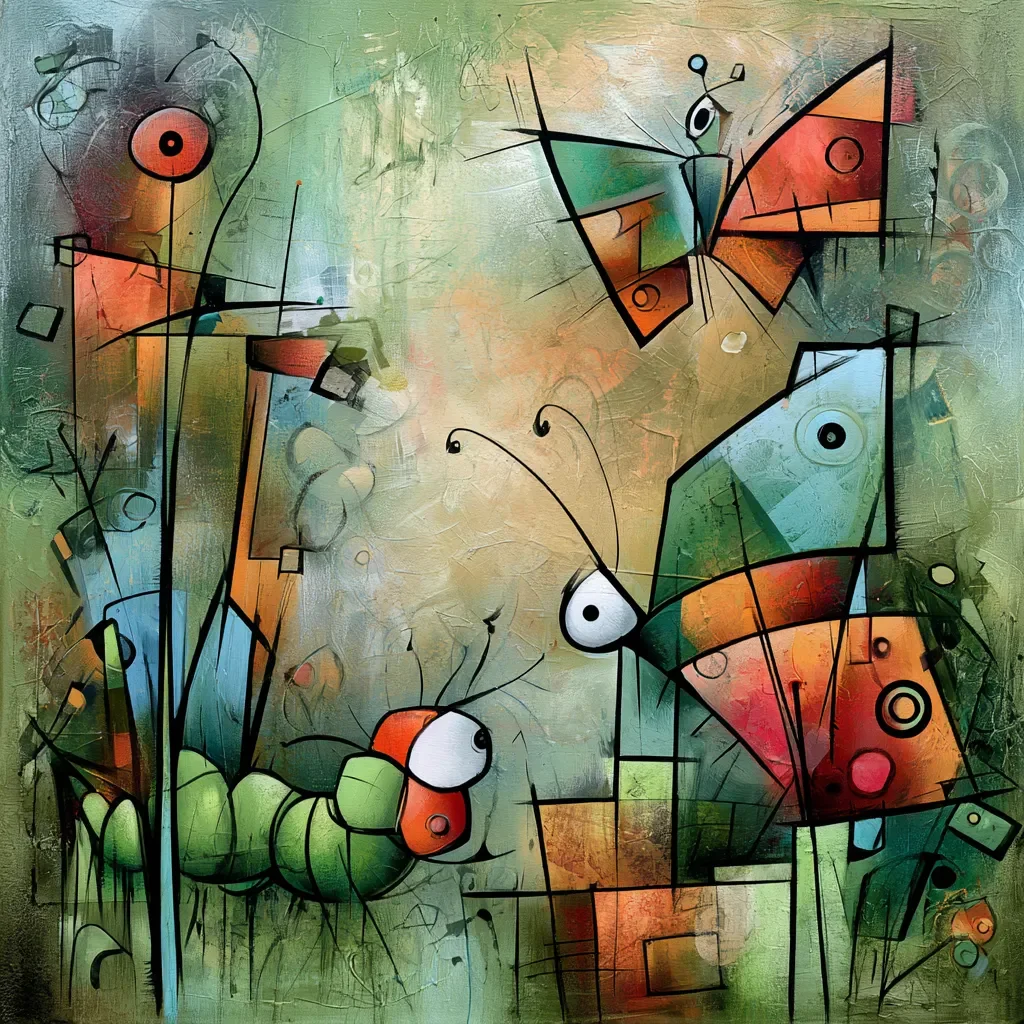
From Caterpillar to Butterfly.
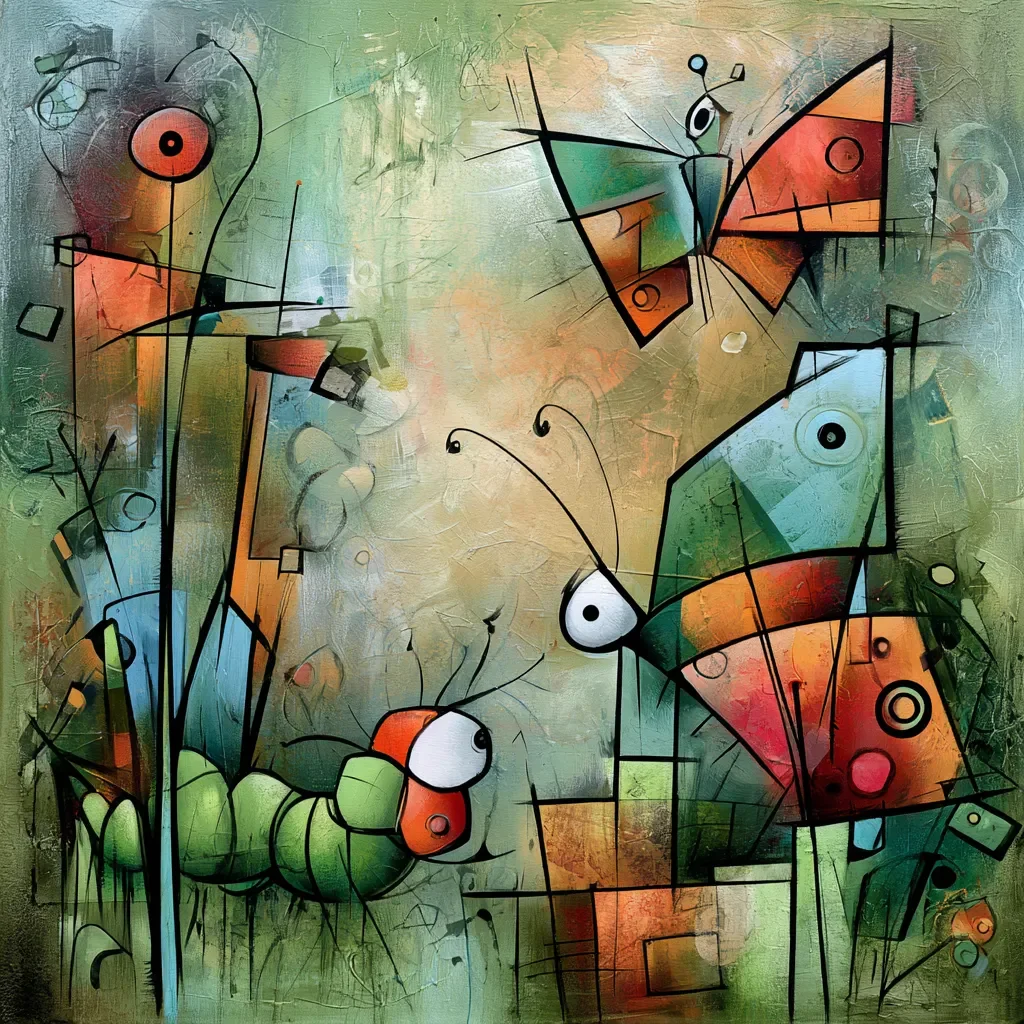
Image via Mid Journey.
Every individual, team and firm has the ability to transform.
Six learnings.
1. The future does not fit in the containers of the past.
We are all interested in the future since we will be spending the rest of our lives there.
And the future by definition is unknowable since it is yet to unfold.
From organizational structure to how markets are organized, the existing ways of doing business have been optimized on what has come before. The challenge for most of us is to realize that the future refuses to be contained in the containers of the past whether it be media, money, markets or mindsets.
Future prognosticating is often aligned with crystal ball gazing, scenario planning and blue-sky thinking. We look ahead and above. We watch market leaders and todays visionaries and time after time we are surprised that the future did not come from where we were looking but from those we looked down upon or were outside the “velvet rope” or who never appeared on our radar.
The future came from the slime while we looked for signs from the heavens.
The biggest threats and opportunities come from outside one’s categories.
2. Change sucks. But irrelevance is even worse
Adapting to the future requires change.
Change is neither good or bad but difficult.
Change sucks.
It requires one to step into the unknown.
To twist and turn into a new transformed self, team or firm. To leave the safety of the known path. Lift anchor and sail into a foggy horizon with no guarantee of safe harbor.
Difficult as it is…
Irrelevance is worse.
Individuals, teams and companies that wish to transform must endure change.
3. Companies do not transform. People do.
Michael Tyson said, “Everyone has a plan till they get punched in the face”.
Boards and leadership of firms come quickly to the realization that everything is easy until people get in the way.
Technology moves fast but people move slow.
Technology is clean but people are messy.
Telling people that change is good, threatening them with job loss if they do not change or creating communication materials and slogans to goad them into a cult like devotion to the new dear leader or the way forward rarely works in the short run and will likely fail after the threat of flagellation fades.
Too many companies are focussing on efficiency, effectiveness and enterprise technology versus talent and existential opportunities and threats to re-imagine their businesses.
If we want our organization or our teams to grow and change we will need to deliver answers to four questions to our teams:
Why are the recommended changes good for them?
How can they help us re-imagine the company to grow ?
What are the monetary or other incentives to change?
When and where will training be provided to help them learn the new skills needed?
Change does not happen because of M&A, press-releases, re-organizations, or announcing this or that AI partnership.
An organization changes and grows when the people in the organization change and grow.
4. The turd on the table.
To transform people need to face reality.
We need to call out the turd on the table.
It is something that is brown and moist, and people know it is a piece of poisonous waste, but they pretend it is a brownie. They are aware of the stink but perfume over the aroma. Here are some flavors of turd:
Toxic cultures. Organizations are highly defensive about their cultures, even when they become cult-like and inflexible or fear-driven. Telling a leader that the culture has become poisoned requires courage.
Major industry shifts. A leader may refuse to address big changes in customer behavior, or the competitive landscape, or mammoth technology changes requiring tough decisions (such as Kodak and digital emergence). It’s easier to rationalize or deny shifts than articulate the business-altering trend and the need for rethinking everything. Today like never before every industry needs to be re-imagined.
People problems. The boss or some person with influence is acting like a jerk, or is playing favorites, or is blind to internal or external developments. In many ways, this is the biggest turd on the table, in that it requires confronting a powerful individual about his or her issues.
5. Upgrade ones mental operating system.
In our pockets we all carry a device that has upgraded its mind 17 (Android OS) or 18 times (Apple iOS) in the past 18 years.
These same mobile devices contain applications from Open AI, or Google, or Anthropic, or xAI or some other frontier models which are improving themselves constantly and doubling their capability every few months.
How many times have we upgraded our own mental operating systems in the past 18 years?
If the future does not fit in the containers of the past then it also does not fit in the mindsets of the past.
Successful people and successful companies rarely get defeated by others.
Rather, they sometimes defeat themselves because they fail to change their frameworks, worldviews, mindsets and approaches as the world changes around them.
Their strategies go stale.
A definition of strategy is “future competitive advantage”.
Thus any company or leader working to a strategy that is more than five years old should revisit the assumptions they made years ago about the future. In a world of AI, Generational Ruptures, New Globalization and Technology that has empowered consumers and customers with “God-Like Power”, many firms may may be operating on an irrelevant picture of the future.
The future does not bend to us. We have to bend to the future.
We have to upgrade ourselves to remain relevant and not just be up to date but up to tomorrow.
6. Think like an immigrant.
We are all immigrating to an unknown country called “ The Future”.
We can all learn from immigrants to thrive in this undiscovered country
a) Immigrants often think like outsiders.
Individuals and companies that thrive over the long run view their business from external perspectives and not just internal perspectives.
They understand the viewpoints of future competitors, changing consumer and customer needs and they realize the biggest threats and opportunities come from outside their categories ( eg. Tesla and Uber came from outside the traditional Auto Industry, Google and Meta changed the content industry more than any newspaper, magazine or television conglomerate).
But many leaders and businesses benchmark against existing competitors, go to the same conferences, and stay in the lane of well trodden paths of thinking.
Maybe its time to think like an outsider.
b) Immigrants often think like underdogs.
Underdogs use technology, drive, and ingenuity to find ways to leverage what they have or what others have to change the rules of the game.
They do not view the moat surrounding the castle as a something to navigate but a source of material to flood the castle with by changing the rules of the game!
Today AI is the slingshot that allows David to bring down Goliath.
Even Meta was surprised that what they thought was a moat which was their social graph was used against them. TikTok practiced asymmetric warfare by eschewing the social graph and replacing it with an interest graph. Its algorithm and learning loops allowed individuals to be exposed to a spectrum of great content without having to bring any friends or create any content!
c) Immigrants think with an emphasis on the future.
Short or mid term sacrifices and pain is endured to build a future for themselves and families just like great companies think beyond the quarter and the year but in long time periods.
These firms and leaders focus on compound improvement, constant iteration and experimentation and an enduring long term vision whether it be Amazon or Microsoft or Netflix or recently Delta who by taking the long view became the most valuable and biggest airline.
One Single Thing.
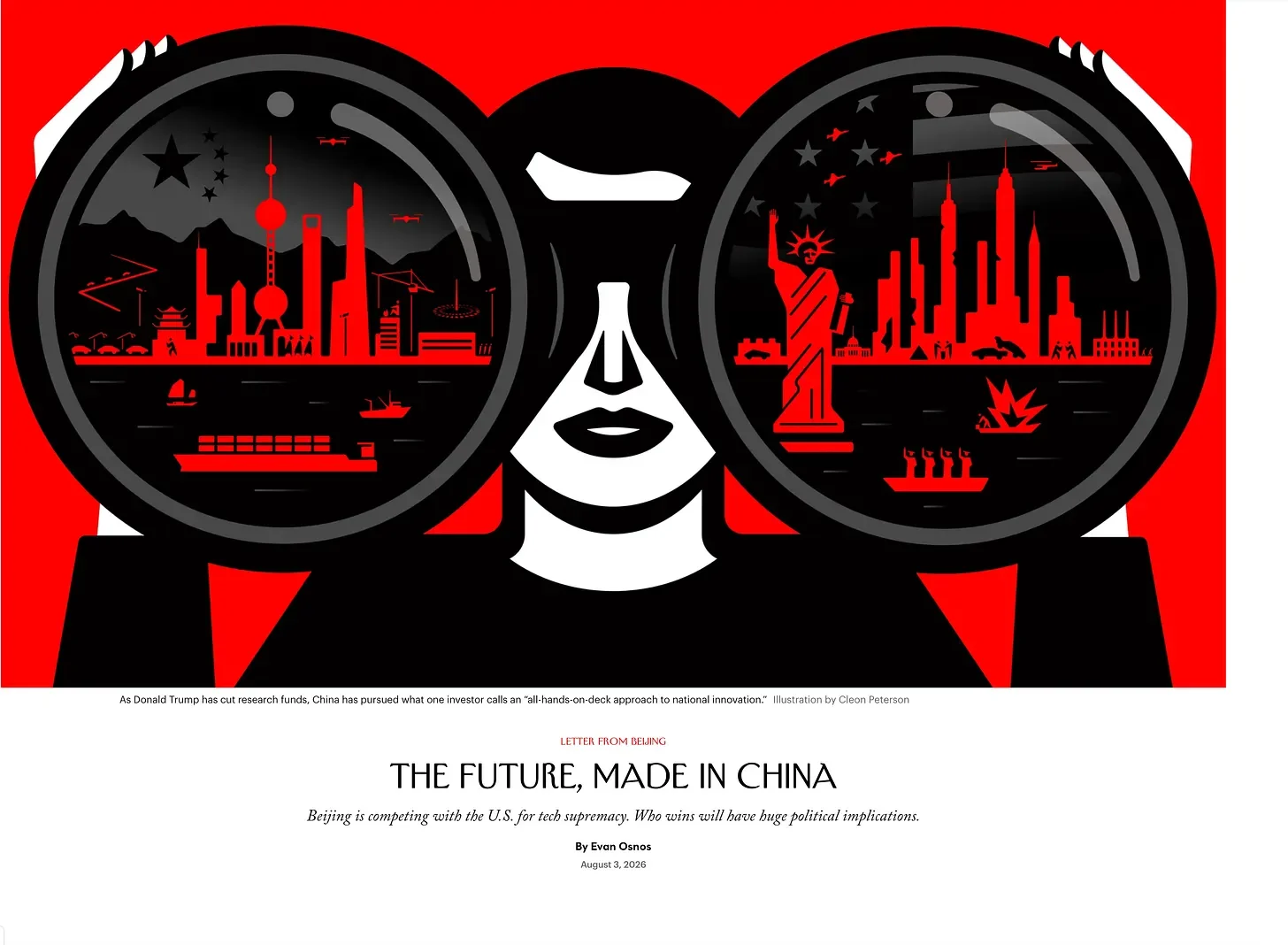
A 12 page article that is a must read if you wish to understand China and how it went from being a caterpillar to a butterfly.
https://www.newyorker.com/magazine/2026/08/10/the-future-made-in-china
Gifting.
Six years ago in August of 2020, I wrote:
The idea behind this newsletter is that of a gift.
Like a gift it is free (no subscription fee, no up-charges to access special content, no advertising, no affiliate links, your email will not be shared or sold, and no algorithm is running in the background mining your behavior.)
I hope it will be of some value in helping you see, feel and think differently about how to grow yourself, your team or your company in the future.
Like a gift, I hope it will generate goodwill for the giver. Your attention and time which is so valuable. Good karma. Stronger relationships.
This newsletter will be bohemian and eclectic in that it will mix art and science, it will have a certain wanderlust and will roam into different areas.
I have published “The Future Does Not Fit in the Containers of the Past” every Sunday morning for the past 312 weeks. It has remained completely free and the writing has covered multiple subjects from poetry to strategy, from photography to organizational structure, from culture to marketing and much more. In order to remain evergreen I have not written about news or politics.
The newsletter is now read by 32,000+ leaders. It is a body of work spanning almost half a million words.
To make the writing more accessible, I had curated the best of the writing on a single page organized in 12 subject area which you can find here: https://rishadtobaccowala.com/100
Generosity as an approach to Life.
A CEO shared a story about how a poor family of immigrants stopped to help someone who had a flat tire in bad weather. After the tire was changed, the individual offered money to the family. They turned it down saying “Today it was you. Tomorrow it might be us.”
Sooner or later, everybody finds themselves needing help and depending on acts of generosity. It might be some form of aid, guidance, a person to talk to who will listen, a leg-up or sometimes gently delivered difficult to hear advice.
By being there and helping when someone is in need ensures good “Karma.”
If what goes around comes around it may make sense to send good stuff people’s way.
Generosity makes for a better life for not just the recipient but also to the giver.
Generosity as a differentiator and moat.
If strategy is future competitive advantage, generosity is smart for individual or company strategies.
Generosity builds good will which is both an asset and a moat.
It is an asset in that it can be tapped in the future.
It is a moat because when an individual or a company has been generous in times of trouble their employee or customer are less likely to switch to a different firm for a lower price or higher pay.
Generosity is also a key differentiator in that usually when a person or firm needs help there are few people willing to help someone out of power or in trouble. Those individuals and brands who do help stand out and their showing up and helping when others are not burns into the emotional and mental memory of the recipient.
Emotional connections are harder to sever or replace than financial connections.
Gifts beget gifts. Generosity begets generosity.
Three days ago, at the request of the legendary Jon Bond, I took a call with Sean Clayton who runs a company called Myosin which is about to morph into a new company called Singulariti which is a marketing intelligence system that organizes the fragments of how organizations learn, decide, and act into a coherent operating system, built around three instruments that map agents, prove performance, and return knowledge to behavior.
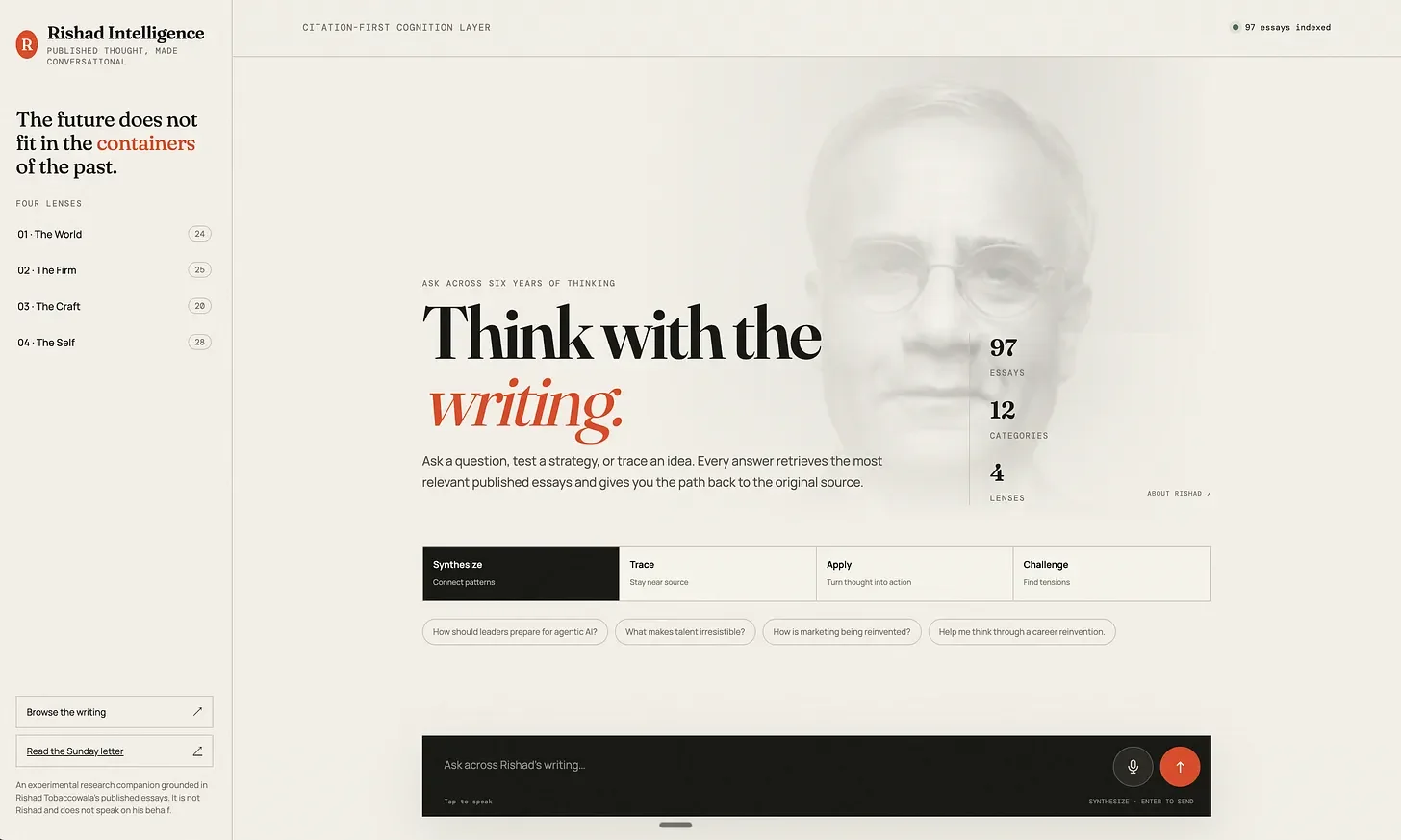
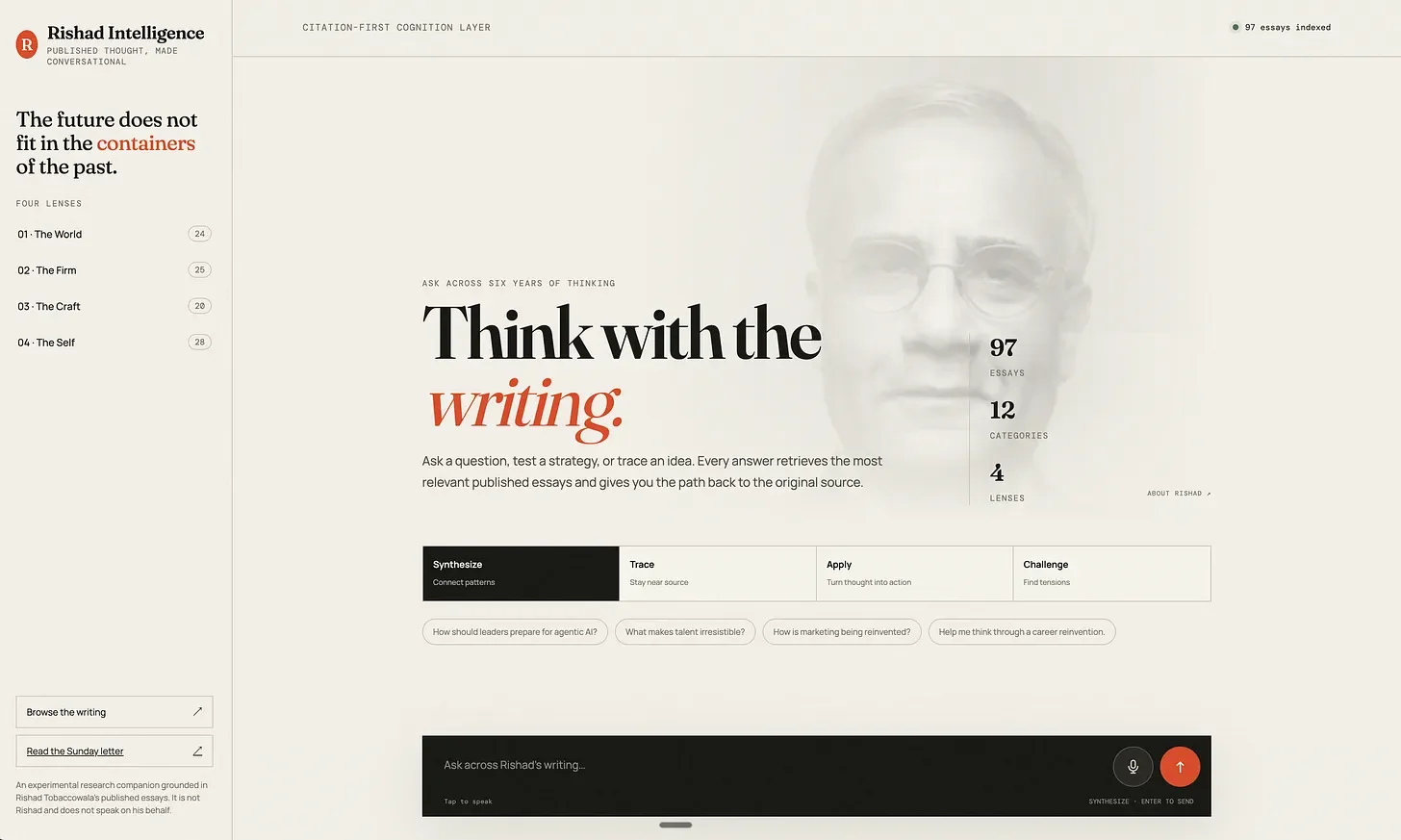
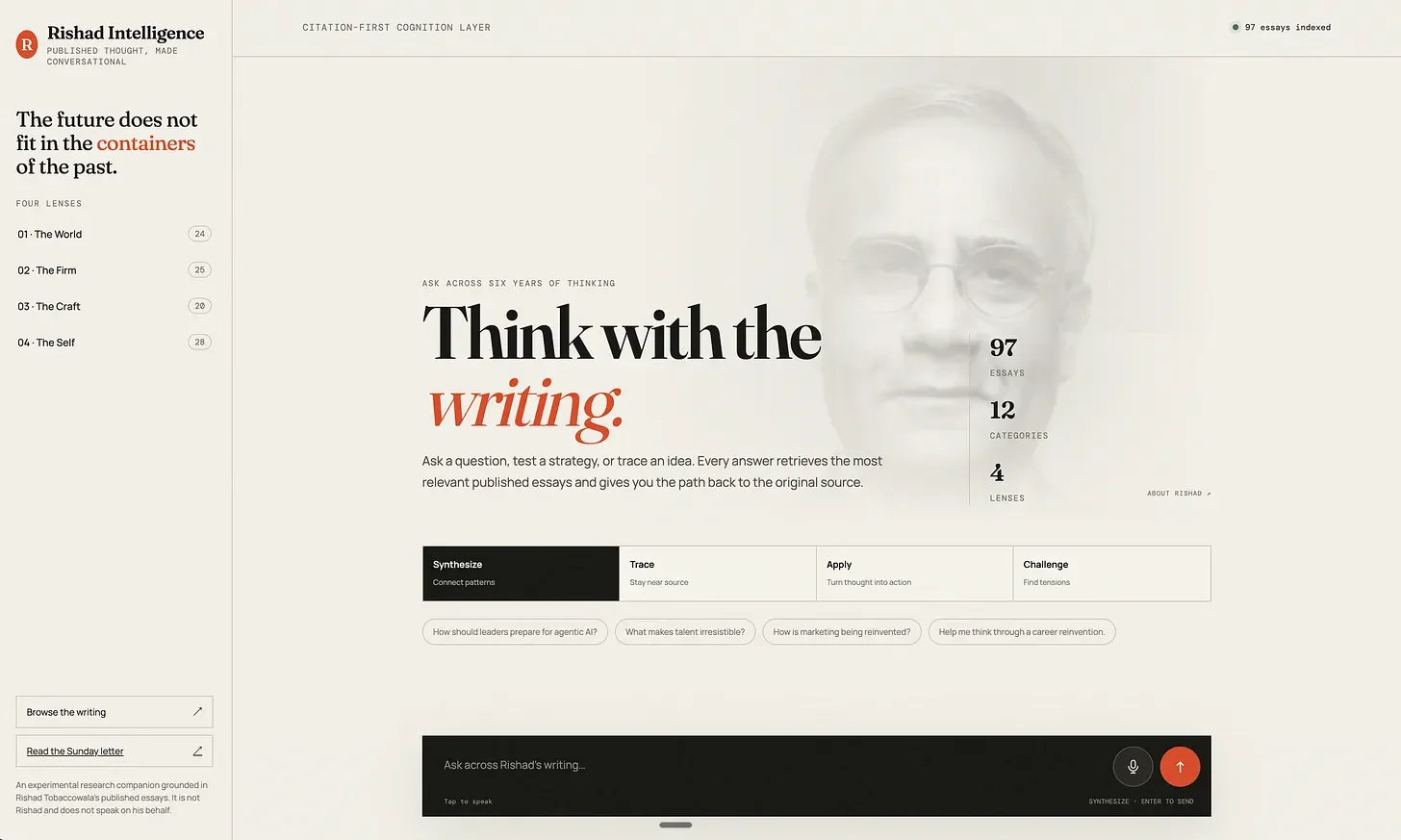
During our call, I shared the page containing the best of my writing with Sean who 24 hours later spun up rishad.ai as a gift in return. It is a way to navigate, learn and interrogate the best of my writing.
Check out rishad. ai which allows one to filter the best of 6 years (from a subset of 100 posts selected from all 312 by me) of The Future Does Not Fit in the Containers of the Past. One can navigate by 4 lenses, or by 12 subject areas , or by interrogation and much more. Each question provides an answer with links to six key articles and additional areas of investigation.
rishad.ai turns four decades of knowledge and six years of writing into a usable tool and resource to help everyone build their own thinking, interrogate the material or share all the writing as a gift in one single link for anybody :
One Single Thing.
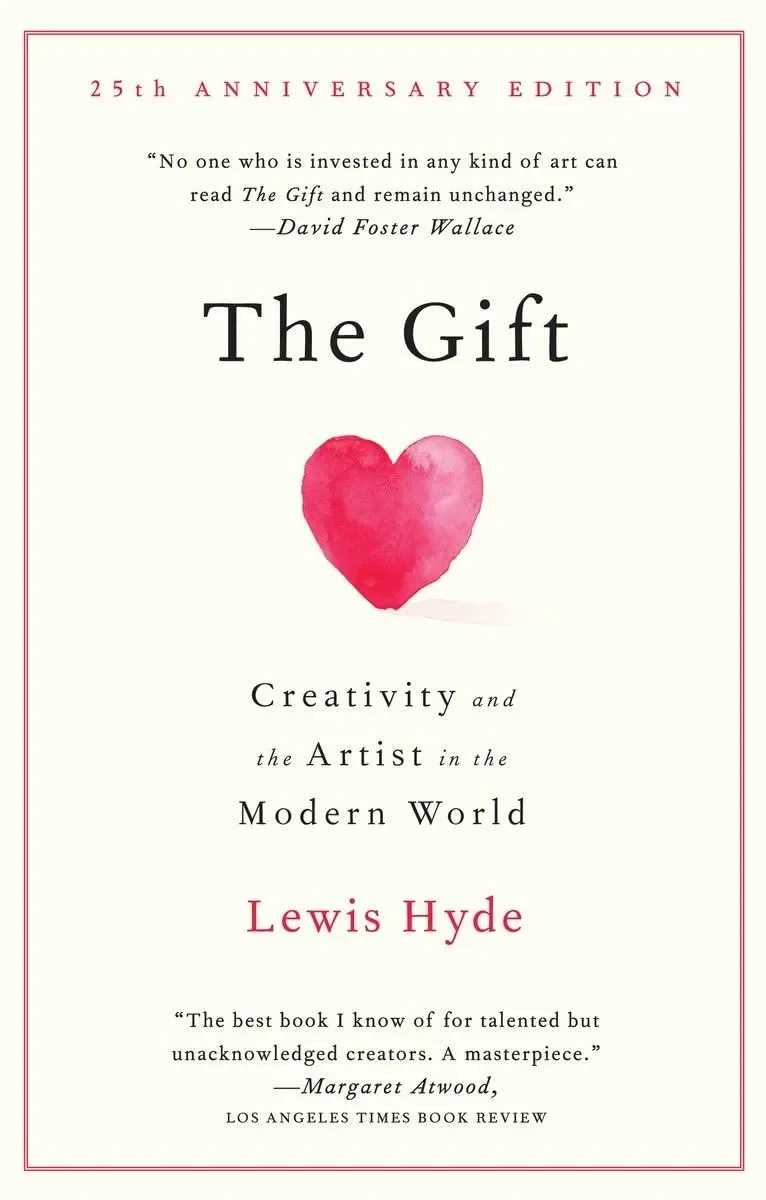
A book that is transformative on the concept of gifting is the classic called “The Gift” by Lewis Hyde
Here is Margaret Atwood’s opening in an article on the book from The Paris Review
“Gifts pass from hand to hand: they endure through such transmission, as every time a gift is given it is enlivened and regenerated through the new spiritual life it engenders both in the giver and in the receiver.
And so it is with Lewis Hyde’s classic study of gift giving and its relationship to art. The Gift has never been out of print; it moves like an underground current among artists of all kinds, through word of mouth and bestowal. It is the one book I recommend without fail to aspiring writers and painters and musicians, for it is not a how-to book—there are many of these—but a book about the core nature of what it is that artists do, and also about the relation of these activities to our overwhelmingly commercial society. If you want to write, paint, sing, compose, act, or make films, read The Gift. It will help to keep you sane.”
“Perfection is a Disease.”
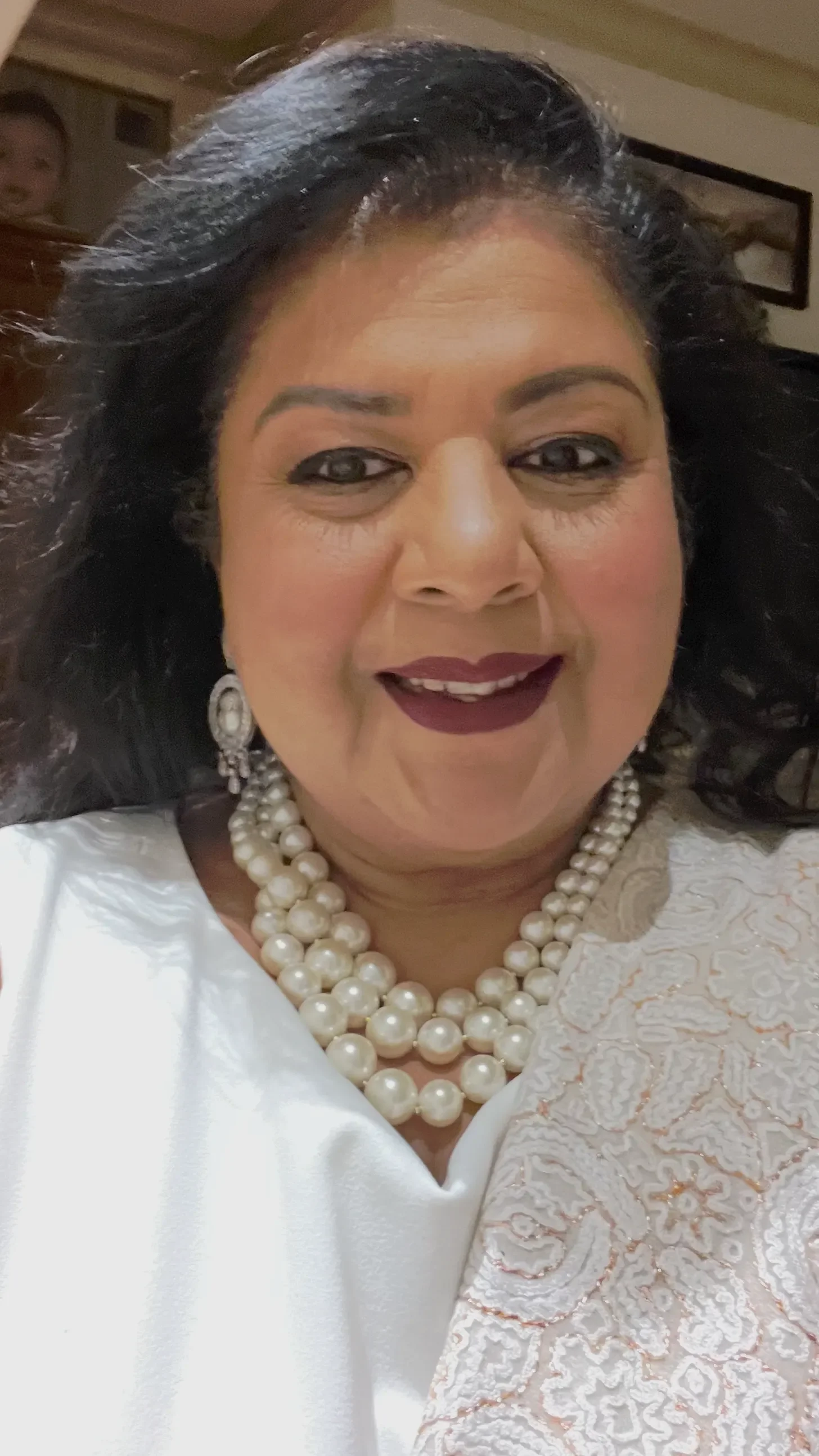
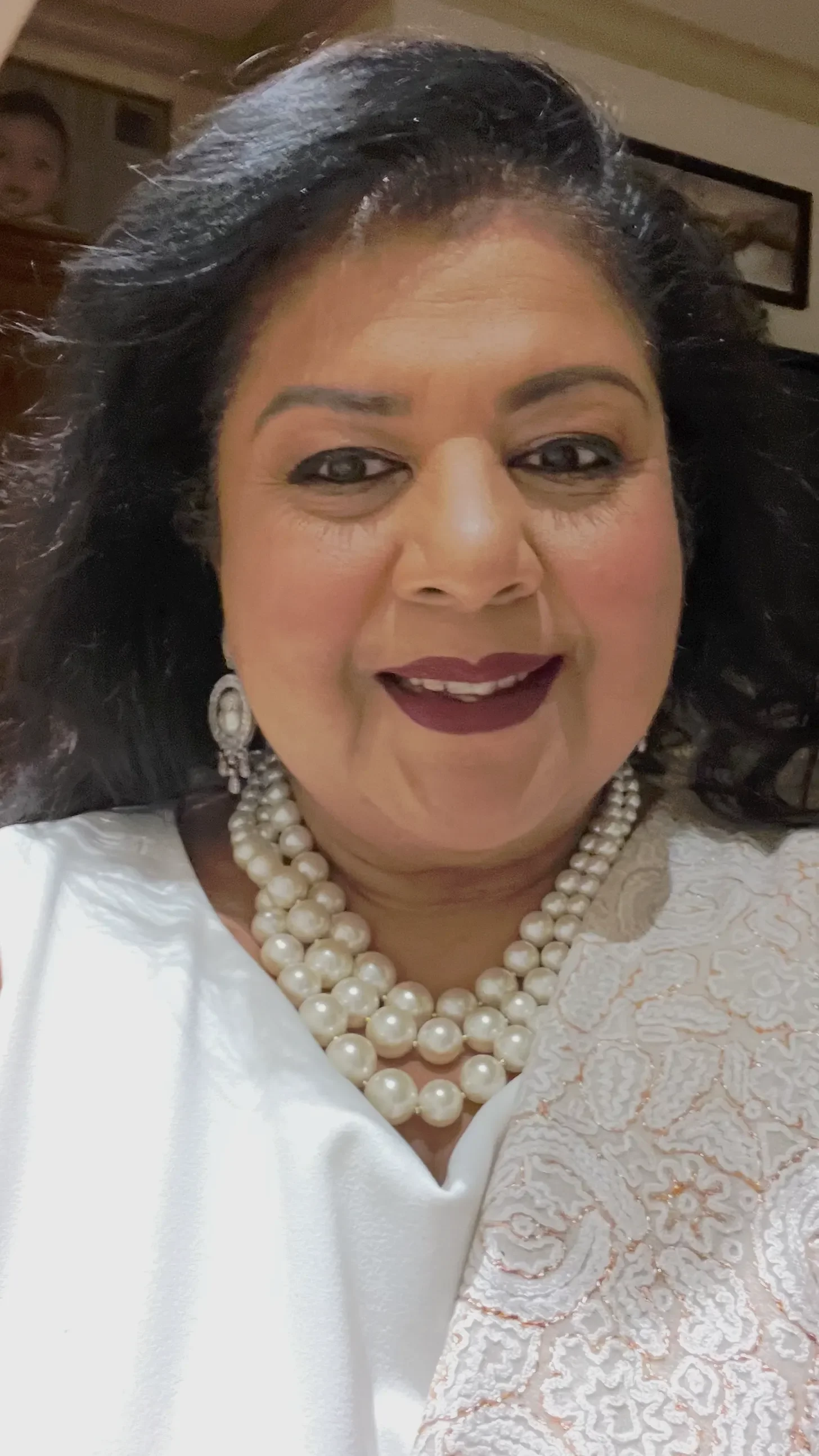
Ann Mukherjee is a seasoned C-Suite executive specializing in transforming global companies by leveraging demand driven growth to drive competitive advantage. Most recently, Ann served as Chairman and CEO, Pernod Ricard NA, the second largest spirits company in the world. Prior to Pernod Ricard, Ann was Global Chief Commercial and Marketing Officer of the largest privately held CPG company, SC Johnson, overseeing businesses in over 90 countries. Ann has also served as President, PepsiCo Global Snacks and served as CMO for Frito-Lay NA.
Ann has also served on the boards of Mondelēz, Hertz and Sabra. In 2020, President Trump appointed her to the Economic Recovery Committee during COVID and she has also worked with President Clinton as part of the Clinton Climate Change Initiative. Ann currently is program director for the Booth School of Business at the University of Chicago developing a new executive curriculum for next generation CEOs.
Ann is also a friend and a big supporter of The Athena Project on Modern Leadership that Drew Ianni and I co-founded and was our guest on Unbossing. Unbossing is a podcast with leaders on how to lead and not to boss, how to manage through a zone of influence and not just a zone of control and why the future is a fusion of learning and unlearning.
The 40 minute episode with Ann is a masterclass on four different subjects:
1) On Growing Ourselves : Why perfection is a disease and the way forward is to embrace our weaknesses. Strengths and weaknesses are flip sides of the same coin. The key is to understand one’s strengths and weaknesses. Then build on areas of strength and learn how to compensate for the weaknesses.
Failure comes from not paying attention to our threats. In understanding our threats we can forge our opportunities and Ann teaches us how to do this with a SWOT analysis.
We are moving from an era of the “all-knowing” leader to the “all-learning” leader. Today it is key to “AI the shit out of ourselves” since we now have a confidant and mentor who can spar and train us.
2) On Growing Business: The secret to the companies that deliver total shareholder growth is one simple thing. Organic Growth. Not financial re-engineering. Not Mergers and Acquisitions. A ten year study by the University of Chicago builds the case for marketing and growth with data no Board can refute.
Businesses are about getting humans to work together with other humans to make and sell things to humans. It is as simple and complex as that. Forgetting the human part is losing the plot on how to run a business.
Great leaders recognize that each company and era has its own system. While Kraft and Frito-Lay were both food companies their systems of manufacturing and distribution were so different that it was only through unlearning and starting with a fresh sheet of paper did Ann thrive.
On the other hand, the differences between private and public companies may not be as great as one thinks. Operators still have to report to the owners whose name, focus and entire financial worth may be in the company the operator is running.
Beware those who run the same playbook when the rules of the game have changed.
3) On the importance of Creativity: Creativity is the oxygen to growth. Creativity unleashes potential. Creativity is understanding core human truths.
Ann aligned organization and drove SC Johnson growth with one line that united all the teams and the brands around the globe:
“SC Johnson helps women get off their knees”
This clarion call recognized that SC Johnson made cleaning products and around the world it was mostly women who cleaned.
Similarly Ann team won a Cannes Lion and scored the highest rated ad in the Super Bowl by understanding the core truth at the heart of Doritos which was:
“Break the Rules”
In 2006 decades ago just when User Generation Content was being born the Frito-Lay team outsourced creative to users. This not only broke the rules but also enabled Frito-Lay to have hundreds of creators to offset the hundreds of millions of dollars that Anheuser-Busch had to make and test ads for the Super Bowl.
4) On Life: It is a harsh world and it is tough. One can have work and family but often it is hard to have everything at the same time. Ann left her CEO job to focus on helping her husband recover his health knowing she could not focus and do a great job on each highly important and urgent task of running a company and helping her husband in his hour of need.
A key is to understand what gives you joy. Ann on a flight made a list of what gave her joy and then used AI to suggest how to rethink her life to ensure more joy.
Sometimes to pursue what you want you need to “break the rules” of ones own.
Ann decided after her husband recovered not to return to corporate life but to become a teacher and film maker focusing on a CEO program at Booth and launching her own film company.
Her film company and the U of C role allowed her to reconfigure her love of creativity from growing brands to growing people by give “voice to the voiceless” in her film company and guidance and advice to the next generation of CEO’s.
Ann reminds us that we should embrace our entire selves. The good and the bad.
Listen to podcast. It will rock you. You will learn. You will be inspired. You will be moved. All in 40 minutes.
On YouTube:
On Spotify (also available on every podcast platform):
One Single Thing.
The Daily Spark
Torsten Slock is the Chief Economist of Apollo and his daily spark newsletter contains a single chart and an analysis. One can access every chart and subscribe here (free): https://www.apollo.com/insights-news/insights/daily-spark#page-1
Here is his latest:
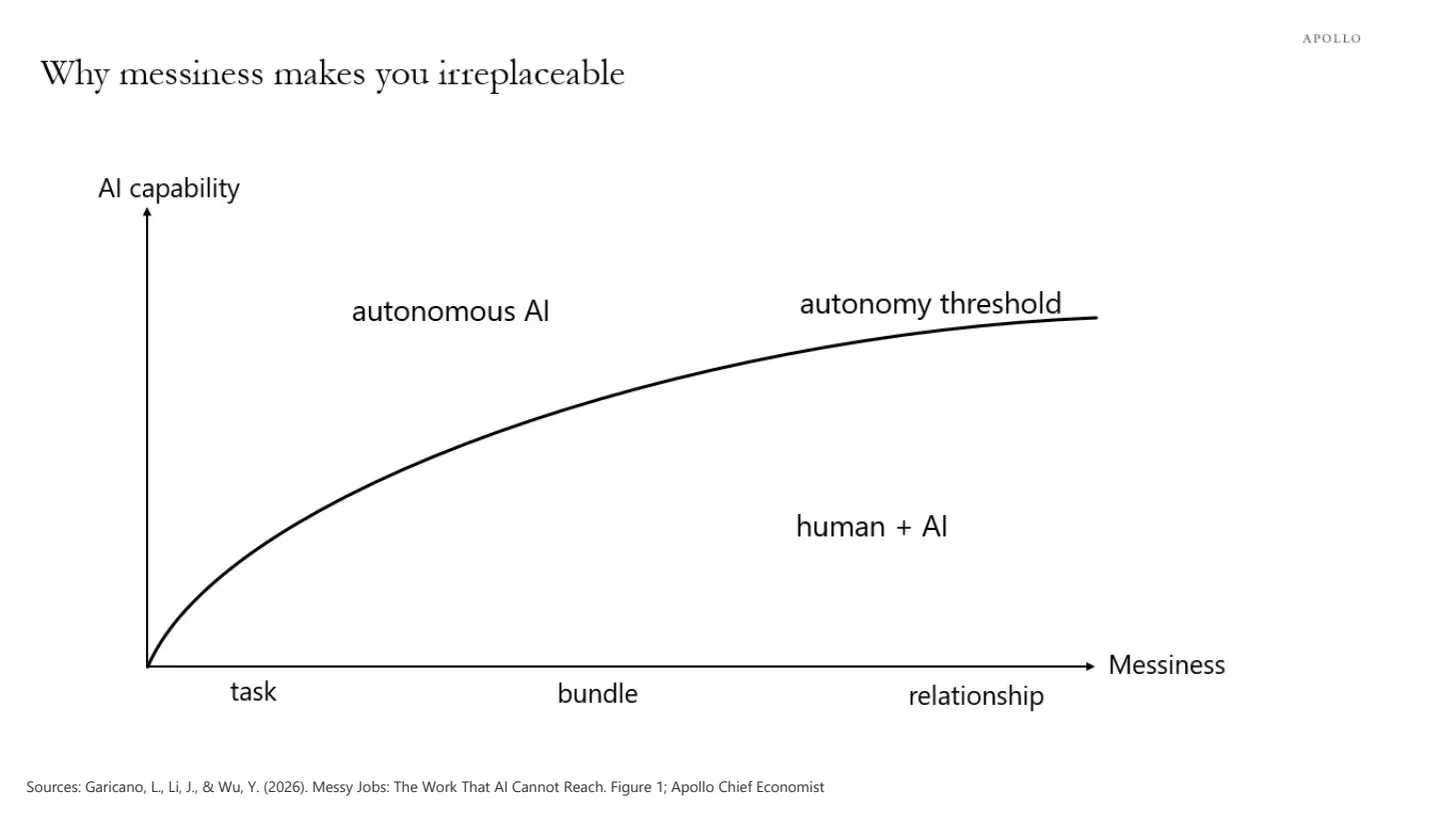
The Messiness Is Your Moat.
Luis Gariçano’s insight that AI autonomy declines with job messiness reveals an important truth about which work faces displacement. It’s routine, transactional roles that are vulnerable, not the complex relationship-driven work we assume is most at risk.
As tasks grow messier, AI capability stalls while human judgment becomes indispensable, drawing an autonomy threshold that protects messy work from replacement, see chart below and video here.

A Guide to Thriving.

Photograph by Rekha Tobaccowala | Provence. France. July 2026.
1. Success is the freedom to spend time in ways that gives one joy.
Success is sought by all but what is being sought?
For some it is making a mark in their field or leaving some enduring work.
For others it is seeking financial wealth or creating and nurturing a family. For some it is helping others.
For most people success also means a measure of happiness.
In the end if time is all we have then success probably has to do with how one uses time.
Ann Dillard wrote that “the way we spend our days is the way we spend our lives”
When one is financially constrained one’s mind and time are colonized by making ends meet.
When one is physically in pain or suffering from ill health it is often hard to be happy.
So, if happiness is the ability to limit the time we spend about our financial or physical situation and for most of us a certain amount of financial and physical well-being is key to being happy.
Sooner or later once these basics of not having to worry about the next rent check or waking up the next day in pain are mostly under control, the words and emotions that link the happy and successful are those of purpose, meaning, connection, flow, recognition and growth.
And these can change over time and are different for different people.
But it all comes down to having the freedom to allocate one’s time in the the way gives us joy.
How do we want to spend our time, and can we increasingly get to a place where we spend more of it in ways that give us joy?

Photograph by Rekha Tobaccowala | Provence. France. July 2026.
2. “Do not price yourself out of your dreams.”
It is often said that “it is never too late to become what we are” but for many people by following the wrong star home we lose our way. We spend most of their lives not being us. We find ourselves not “fitting” in our lives, our jobs, or our relationships.
The ability to control one’s time and find fit is inversely related to how much time one must do things to pay the bills.
Diminishing expenses can lead to expanding options.
One of the hardest decisions is to decide when one has “enough”.
Increasing one’s options by limiting one’s possessions and way of living tends to lead to more success than maximizing one’s possessions.
Pursuing “more” might force one to do work that one does not particularly enjoy or work with people who bring us down in order to pursue what the world says matters but not our heart.
Doing things that we resonate with and gets us into a flow is not only great for being happy today, but it is often a key to becoming an expert, to master and be a leader in what one does.

Photograph by Rekha Tobaccowala | Provence. France. July 2026.
3. “Do not live in other people’s minds”.
“Comparison is the thief of joy” but so is living one’s life to run up points on somebody’s else’s scoreboard of what success is.
The rise in mental anguish among many is in part how social media has accentuated the need to look good in other people’s eyes.
Caring what other people think is human and often learning and getting feedback on how one can improve is a key to success so not living in other people’s minds does not mean not listening to or not caring what other people say or think.
It means stopping using their metrics and their rulers of success to determine the way we live our lives.
We should not give somebody else a remote control to determine our lives.
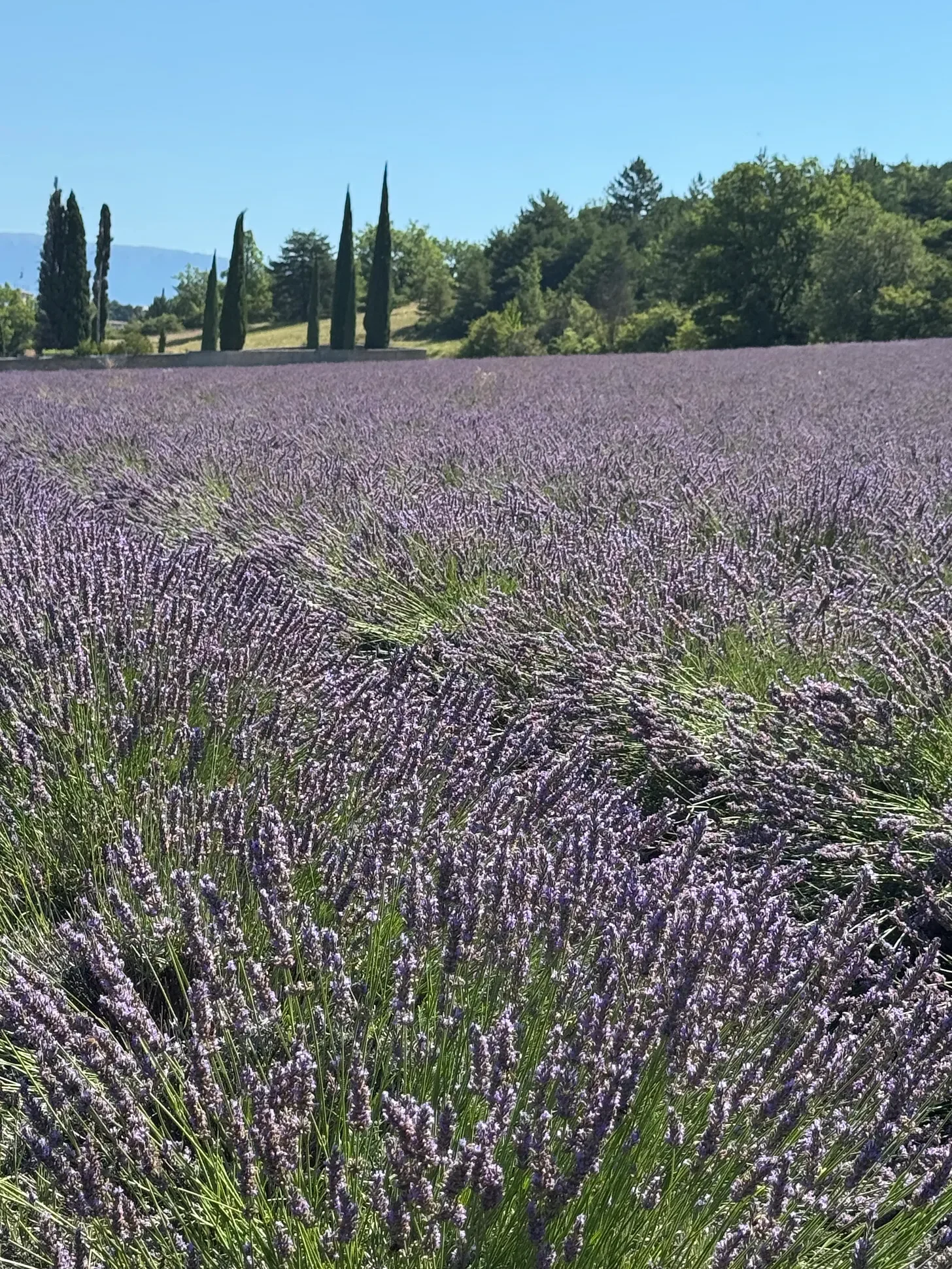
Photograph by Rekha Tobaccowala | Provence. France. July 2026.
4. “There is nothing good or bad but thinking makes it so”
While one may not agree with Hamlets’ statement that “there is nothing good or bad but thinking makes it so”, our mindsets matter a great deal in how we perceive life, how we are perceived and the degree of success we may have in our varied endeavors.
In rapidly changing and chaotic times an agile mindset can be critical to success.
While there are many personal trainers to help sculpt our bodies into somewhat supple forms, there is a scarcity in those who can show us how to exercise our minds to be as flexible as they need to be.
Mindsets matter.
Growth mindsets. Learning mindsets. Generous mindsets. Realistic mindsets.
Optimism matters.
In the novel “Gravity’s Rainbow” by Thomas Pynchon a character is described as one whose “mood collapsed the room”.
While misery may love company, nobody likes being in the company of miserable people.
Optimism is not just an essential component of innovators but a trait that we must have if we wish to inspire folks to follow us.
“Woe is me, doomed are us” works for a few drinks in a bar, but at the workplace it saps energy, hurts culture and is just a plain downer. Pessimism is something we all wallow in, but it fails to show the way out.
We should avoid practicing self-oppression or self-defeat.
To upgrade one’s mood we need to change our environment by finding people who provide clarity, self-belief and energy while leaving behind those who traffic in insecurity, control and weakness.
Remember mean people are just leaking and oozing out their own self-loathing and internal bile. Do not get angry with them but take pity on them. ( This really pisses them off and we need to be judicious in baiting these pathetic bullies!)
Another way to be optimistic is to forget all the legacy nonsense one may have to grapple with and ask that if we had a fresh sheet of paper, our talent and our assets what would we do?
Every day is a new career beginning.
Tomorrow is where we will spend the rest of our lives.

Photograph by Rekha Tobaccowala | Provence. France. July 2026.
5. “Practice Compound Improvement”.
The single most powerful concept in finance is that of compounding.
Along with the need and pursuit of love and gravity it is one of the three most powerful forces in the world.
Compounding interest and compounding returns can over time create wealth or lead one to bankruptcy depending on whether one owes or owns capital.
In a world of change we all may want to consider another way compounding can help us grow in changing times and drive mental, emotional, and even financial wealth which is compounding improvement.
There is so much we cannot control in a world driven by global, demographic, social and technological change but instead of being buffeted about helplessly in a sea of chaos maybe we can try to control and build our ourselves to be better.
Let us build habits, rituals and behaviors that we control and not others.
Three learnings about compound improvement.
a) Discipline equals Freedom: This is the title of a book by Jocko Willink, a Navy Seal.
Basically, if we want to get a grip on the world we need to get a grip on ourselves.
Things are more up to us than we think if we are willing to work at it.
b) Never graduate from school: The world is changing so fast that many of our skills and expertise and mindsets need continuous upgrading. While many of us set aside time to exercise to maintain our physical operating system we need to also feed and exercise our minds an hour a day.
The power of this habit is that at the end of a year one will have spent 365 hours learning new things. The day we start dying is the day we stop learning.
c) Deliberate Practice: Anders Ericsson wrote a book called “Peak” which is the best study of deliberate practice. Deliberate practice involves three components
1) Immediate feedback, 2) Clear goals and 3) Focus on technique.
According to his research, the lack of deliberate practice explained why so many people reach only basic proficiency at something, whether it be a sport, pastime, or profession, without ever attaining elite status.
Getting better is about behavior, iteration and resurrecting oneself from setbacks.
Photograph by Rekha Tobaccowala | Provence. France. July 2026.
One Single Thing
Last month at Oxford Yuval Noah Harari gave a talk on AI and Human Civilization. It is really worth a listen…